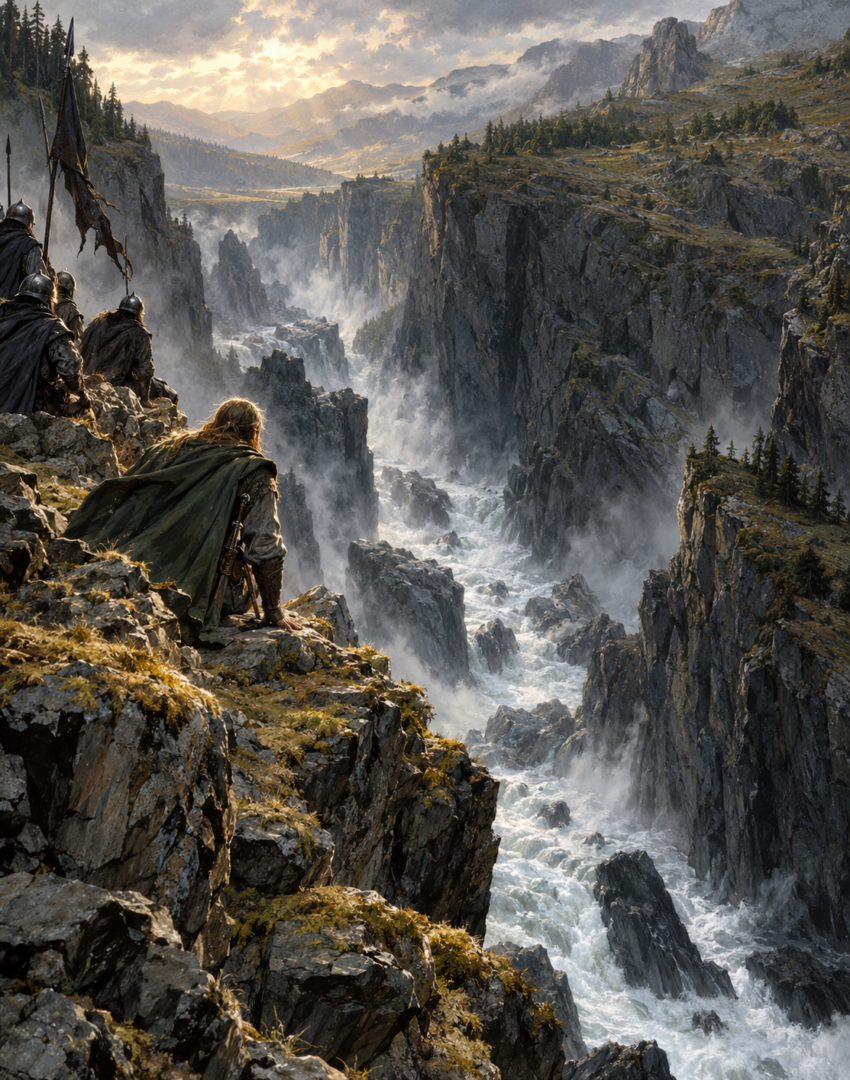
The Shire was never supposed to need a prison.
That is what makes the Lockholes at Michel Delving so unsettling. They were not Barad-dûr. They had no vast dungeons, no armies stationed beneath black towers, no supernatural terror hanging over their doors. By the standards of Middle-earth, they were almost absurdly small.
Yet when Frodo, Sam, Merry, and Pippin returned home in 3019 of the Third Age, the existence of the Lockholes revealed something far larger than the building itself. Hobbits were being imprisoned by other authorities within the Shire. Familiar neighbors could disappear behind locked doors for resisting orders. Rules that had once been little more than ordinary customs of communal life had multiplied into instruments of control.
The Lockholes matter precisely because they are so modest.
They show how oppression can arrive without looking like Mordor.
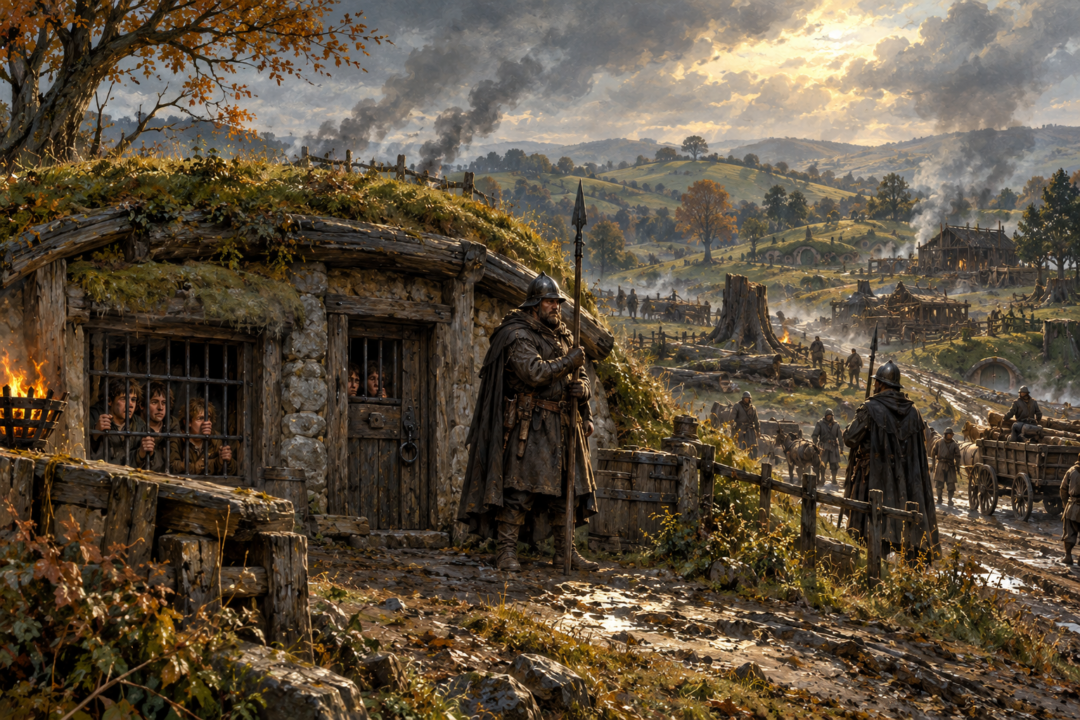
The Shire Had Almost No Tradition of Coercive Government
Before the War of the Ring, the Shire possessed institutions, but remarkably little centralized authority.
The Thainship survived from older political arrangements, while the Mayor of Michel Delving was elected every seven years. The Mayor's principal duties included presiding at banquets, and the office also carried the positions of Postmaster and First Shirriff. The Shirriffs themselves were few: twelve for the Shire's four Farthings, with additional Bounders concerned with the borders.
This was government on an extraordinarily small scale.
The Prologue to The Lord of the Rings makes the reason clear. Hobbits generally managed their affairs without needing rulers to command them. Families and local customs carried enormous importance, and the laws they observed were ancient laws that they attributed to the kings of old.
Even the Shirriffs were hardly a conventional police force. They spent much of their time dealing with stray animals rather than criminals.
That background changes the meaning of the Lockholes.
A dungeon beneath a Dark Lord's fortress is terrible but unsurprising. A prison becoming an ordinary tool of administration in the Shire represents a fundamental change in the character of public life.
The horror is not architectural.
It is institutional.
Sharkey's Regime Turned Rules Into Weapons
By the time the four travelers returned, Lotho Sackville-Baggins had become known as the Chief, although the power behind the final stage of the Shire's misery was Saruman—"Sharkey" to his Men.
The transformation had not happened all at once.
Lotho had acquired property and influence, including through dealings involving pipe-weed. After Frodo sold Bag End to the Sackville-Bagginses and departed, Lotho's position continued to expand. Eventually the Shire filled with new Rules, gathering and confiscation, ugly buildings, destruction, and armed Men.
When Frodo and his companions encountered Shirriffs after returning across the Brandywine, the absurdity of the system was immediately visible. The Shirriffs were still hobbits. They were not Orcs. Many were not enthusiastic servants of tyranny.
But they had become participants in it.
They carried out orders because orders were now there to be carried out.
That distinction is essential to understanding the Lockholes. Saruman did not need to turn every hobbit into a villain. He needed enough people to accept a system in which rules multiplied, authority became harder to question, and punishment waited for those who resisted.
The prison gave those rules consequences.
Without the Lockholes, an order might merely be irritating.
With the Lockholes, refusal could cost a hobbit his freedom.
Fredegar Bolger Shows What the Lockholes Were For
One of the clearest examples is Fredegar Bolger.
Fatty Bolger is easy to underestimate because he does not accompany Frodo beyond the Old Forest. Earlier, however, he plays an important part in Frodo's departure. He remains behind at Crickhollow as part of the attempt to conceal Frodo's movements, and survives the terrifying attack on the house by the Black Riders.
During the occupation of the Shire, Fredegar again refuses simply to submit.
He becomes associated with a band of rebels hiding in the hills around Scary. Eventually the group is captured, and Fredegar is taken to the Lockholes.
When the prisoners are released after the uprising, his condition is striking. The hobbit once known as "Fatty" has become so thin that Frodo initially has difficulty recognizing him.
The moment is not merely comic reversal.
His physical condition demonstrates that imprisonment under the Chief's regime was real suffering. The Lockholes were not some quaint Shire version of temporary detention. Prisoners could be badly treated and poorly fed.
Fredegar's presence also tells us whom the system feared.
Not invading armies.
Not mighty warriors.
A hobbit who said no.
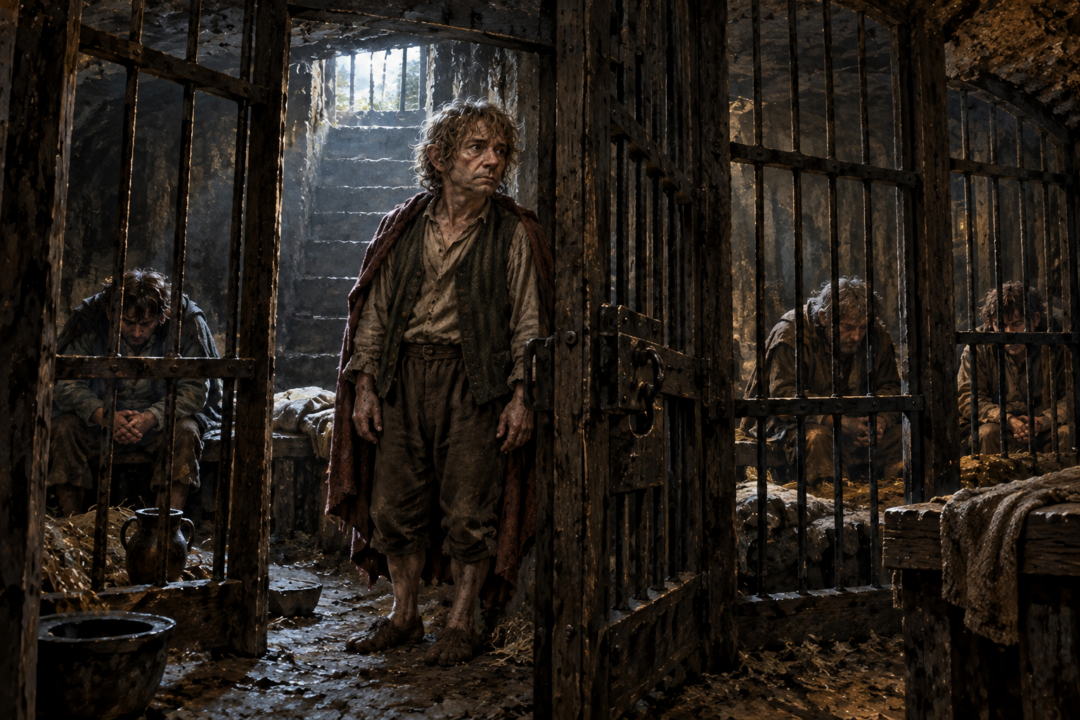
Lobelia's Imprisonment Exposes the Regime's Logic
Even more revealing is the fate of Lobelia Sackville-Baggins.
For much of the story, Lobelia is hardly presented as heroic. She is abrasive, acquisitive, and famously associated with the disappearance of Bilbo's spoons after his farewell party.
Yet the occupation produces one of the Shire's sharpest reversals.
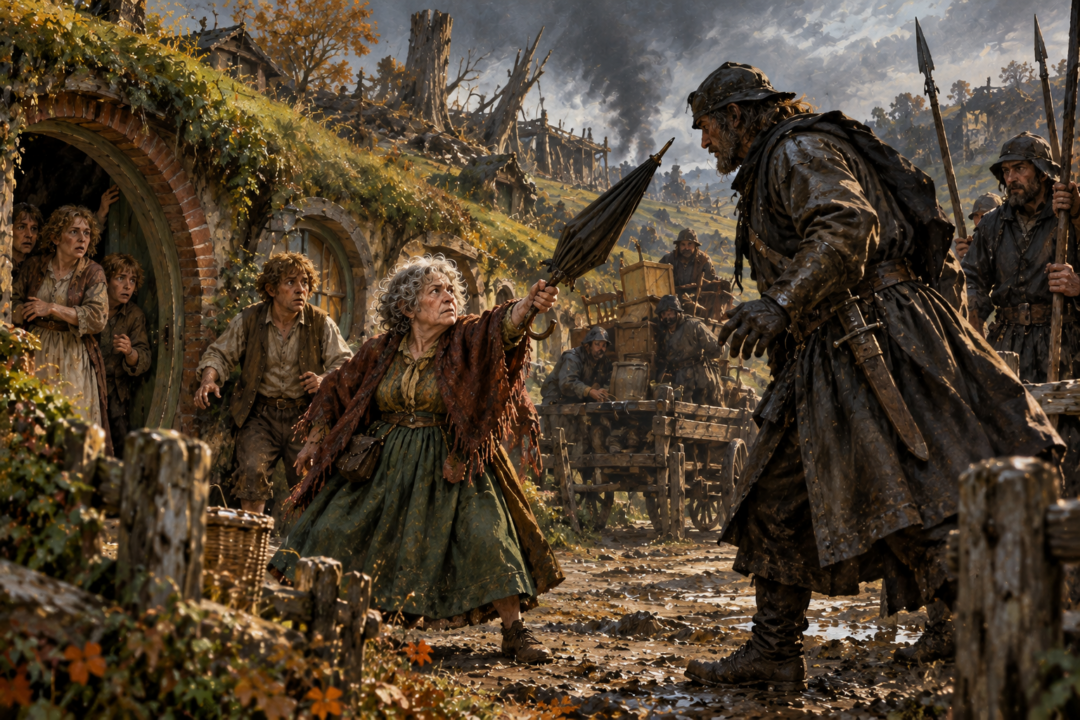
When Saruman's Men begin their destructive behavior, Lobelia confronts them. She attacks one of them with her umbrella and is arrested and taken to the Lockholes.
The episode is both funny and serious in the characteristic manner of the Shire chapters.
Her weapon is an umbrella.
Her opponents are armed Men.
But the underlying principle is not ridiculous at all. Lobelia resists people who have imposed themselves upon her community, and the regime answers resistance with imprisonment.
Her neighbors' reaction matters too. Her defiance earns her considerable respect.
That is part of what makes the Lockholes so important to the ending of The Lord of the Rings. Characters do not divide neatly into lifelong heroes and lifelong cowards. Under pressure, an unpleasant neighbor can display courage, while otherwise ordinary and respectable people can cooperate with a degrading system.
The Lockholes reveal character because they force choices.
A Small Prison Can Cast a Large Shadow
The number of cells is almost beside the point.
A prison used politically does not need to contain everyone it controls. It only needs to establish what can happen to someone who refuses obedience.
That broader interpretation fits what we see throughout "The Scouring of the Shire." Hobbits complain about endless Rules. Goods are gathered supposedly "for fair distribution," yet much disappears. Inns are closed. Trees are felled. Houses and mills are damaged or replaced with uglier structures. Shirriffs are expected to enforce restrictions that many of them clearly dislike.
The Lockholes stand behind this system as its final sanction.
Most hobbits do not have to be imprisoned for imprisonment to influence behavior.
Once Fredegar Bolger can be locked away, every potential rebel understands the risk. Once Lobelia can be arrested for standing up to the Chief's Men, social position offers little protection. Once Shirriffs can be ordered to take neighbors into custody, old relationships have been subordinated to the machinery of the new regime.
This is why measuring the Lockholes physically misses their significance.
Their real boundaries extend far beyond Michel Delving.
Saruman's Final Kingdom Is Deliberately Pathetic
There is a bitter irony in Saruman ending here.
Earlier in the story he commands Isengard. Orthanc rises as an extraordinary fortress. He has Orcs, Men, industry, machinery, and military ambitions. He attempts to rival powers far greater than himself.
By the time he reaches the Shire, almost all of that is gone.
Yet the impulse behind his rule has not disappeared.
He can no longer command Isengard, so he dominates hobbits. He cannot build a great empire, so he turns a small peaceful country into an uglier, meaner imitation of authoritarian power.
That diminished scale does not make the result harmless.
In some ways, it makes Saruman's moral collapse easier to see.
There is no strategic necessity for what he does to the Shire. His actions are bound up with malice, revenge, and the desire to injure what others love. He tells Frodo that the damage to the Shire is, in part, payment for injuries done to him.
The Lockholes therefore become a miniature monument to Saruman's decline.
The former head of the White Council ends by presiding over a system that locks hobbits underground.
His power has shrunk.
His desire to dominate has not.
The Returning Hobbits Understand What Has Changed
The four travelers recognize the new Shire differently because they themselves have changed.
Merry and Pippin have served among great peoples and witnessed war directly. Sam has crossed Mordor. Frodo has carried the Ring to the heart of Sauron's realm and endured wounds that will never fully leave him.
The Chief's Shirriffs cannot intimidate them in the way they might once have done.
This contrast is sometimes played for humor, but it has serious consequences. The travelers know that authority and power are not the same thing. A written Rule does not become just merely because someone has declared it.
Merry quickly organizes resistance. Pippin brings support from Tookland. Sam throws himself into defending and later restoring the Shire.
Frodo's role is different.
He repeatedly tries to prevent unnecessary killing.
That restraint matters because the liberation of the Shire could easily reproduce the logic it is overthrowing: enemies identified, violence normalized, punishment treated as its own justification.
Frodo refuses that path as far as he can.
The Lockholes must be opened, but the Shire does not need to become another place built around vengeance.
Opening the Doors Is More Important Than Destroying the Building
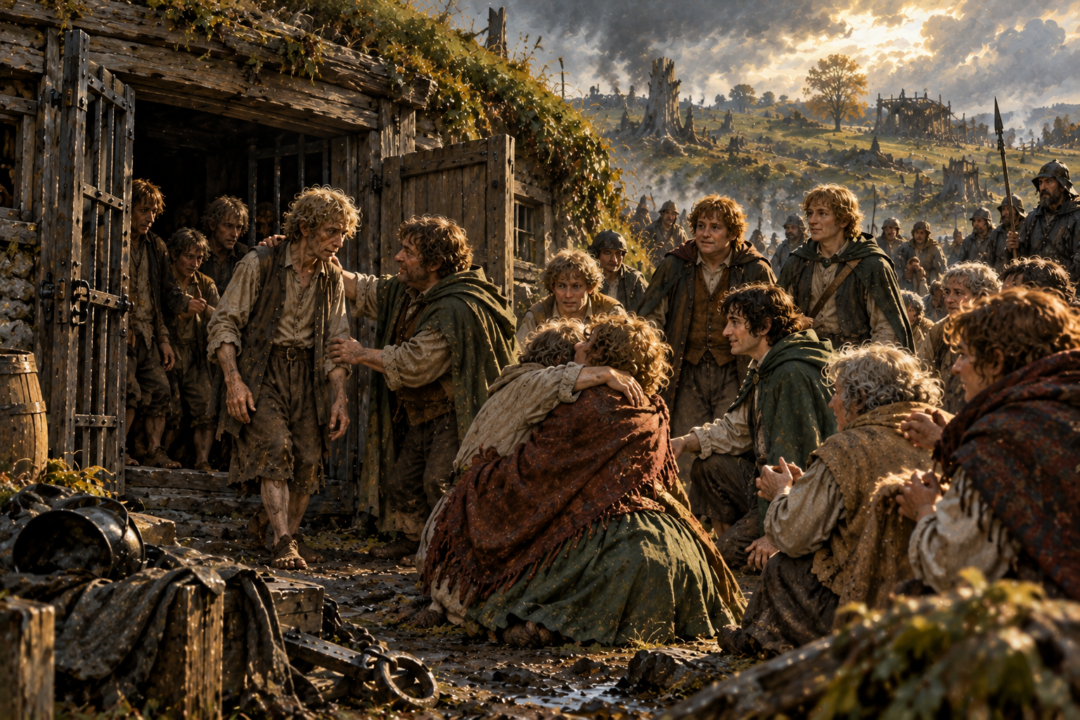
After the Battle of Bywater and the collapse of the Chief's system, the prisoners are released.
That action carries more symbolic weight than the physical scale of the prison could suggest.
The restoration of the Shire requires more than defeating armed Men. The institutions and practices that made their domination possible must cease to function as instruments of fear.
The prisoners must come out.
Neighbors must cease treating one another as subjects to be ordered about.
The multiplying Rules must lose their coercive authority.
The Shire's recovery then becomes strikingly practical. Damage is repaired. Unwanted structures are removed. Sam uses the gift of earth from Galadriel's garden to aid the restoration of the land, and the following year becomes extraordinarily fruitful.
But some losses cannot simply be reversed.
Trees have been destroyed. People have suffered. Frodo himself cannot recover merely because home has been saved.
The Scouring therefore avoids an easy restoration in which everything returns exactly to what it was.
The Shire survives, but innocence has been tested.
Why the Lockholes Matter
Middle-earth contains prisons and fortresses incomparably greater than the Lockholes.
Angband held captives beneath the power of Morgoth. Sauron's strongholds were places of terror. Isengard itself became a fortified industrial domain under Saruman.
Michel Delving cannot compete with any of them in scale.
It does not need to.
The Lockholes belong to a different kind of warning.
They show the machinery of domination reduced to a size that can fit inside ordinary life: a new rule, a confiscated possession, an obedient official, a threatening stranger, a neighbor taken away.
That is why their smallness makes them more meaningful rather than less.
The great fortresses of Middle-earth announce themselves as places of power. The Lockholes appear inside a community that had barely needed policing at all.
Their existence means that something once almost unimaginable has become administrative routine.
And when their doors are finally opened, the victory is not simply that a few small cells have been emptied.
It is that the Shire has remembered that it does not have to live by fear.
Sources & Notes
This article is based on close reading and interpretation of Tolkien's published works and related source material where relevant.