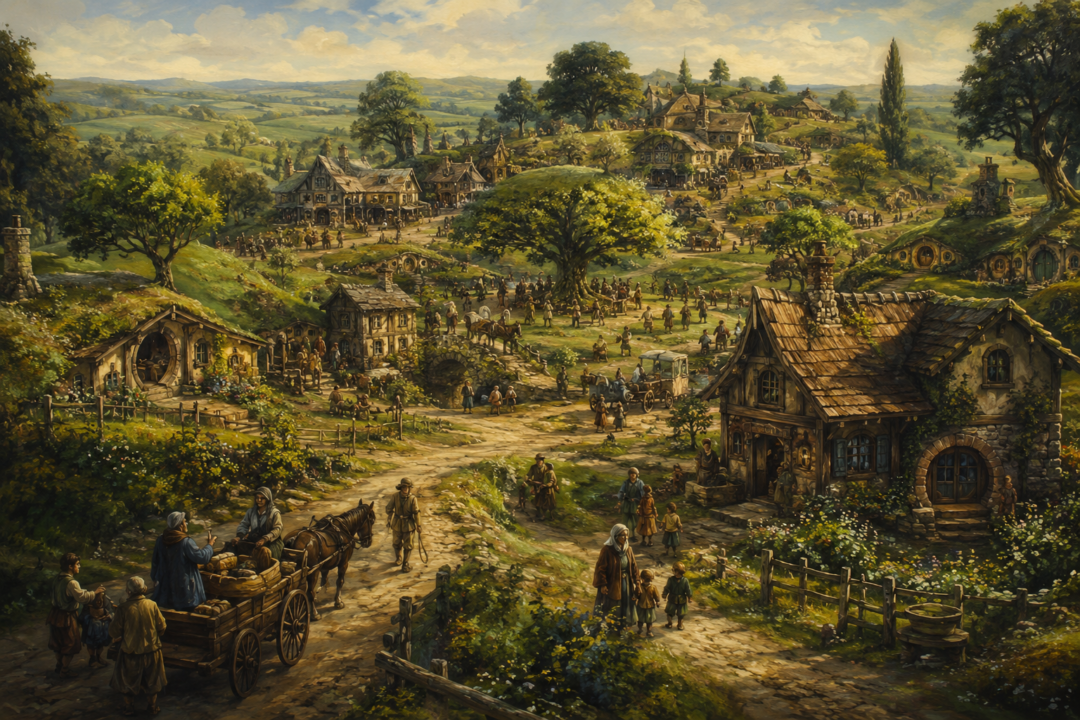
Michel Delving had several things that look suspiciously like the beginnings of a capital. It was the chief township of the Shire. It had the Mathom-house, the office of the Mayor, and public facilities important enough to serve hobbits beyond the immediate neighborhood. The Mayor attached to the town was eventually regarded as the Mayor of the whole Shire.
Yet Michel Delving never became anything resembling Minas Tirith.
There was no palace overlooking the White Downs, no royal court, no permanent ruling bureaucracy, and no Hobbit king. That was not because the Shire lacked political traditions. It was because its institutions had developed in an almost opposite direction: authority was scattered among offices, families, customs, and local communities, while kingship survived largely as a remembered source of legitimate law.
Michel Delving therefore occupied a peculiar position. It was a center without becoming a seat of sovereignty.
A Chief Town, but Not a Royal City
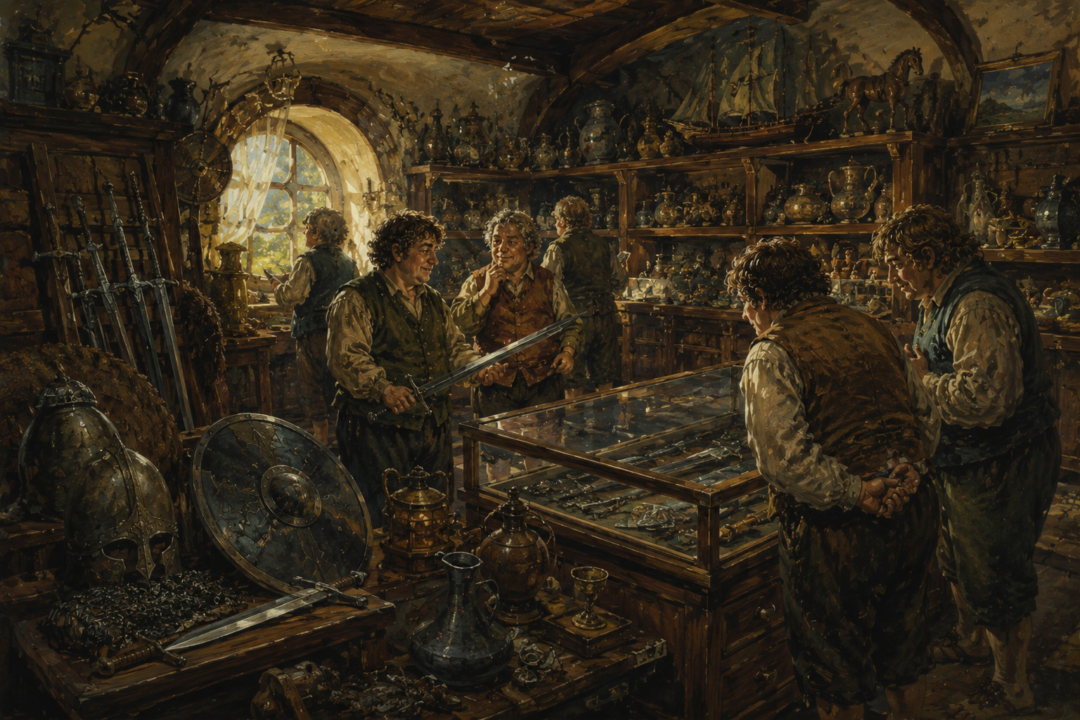
The Prologue to The Lord of the Rings describes Michel Delving on the White Downs as the Shire’s chief township. It was associated with the Mathom-house, where hobbits kept objects they had no immediate use for but did not wish to discard.
This already distinguishes Michel Delving from the great capitals elsewhere in Middle-earth.
Minas Tirith was inseparable from the government of Gondor. Edoras contained Meduseld and was explicitly the seat of the Kings of the Mark. Michel Delving’s defining institutions were considerably less regal. Its most famous public building was essentially a museum, while its most important officer was a mayor whose ordinary ceremonial responsibility largely involved presiding over banquets.
That contrast is revealing.
Michel Delving mattered because the Shire needed certain shared institutions. Nothing in the texts suggests that hobbits therefore concluded that their chief town ought to dominate the rest of the country.
Its importance was practical rather than royal.
The Shire Still Remembered a King
The apparent contradiction becomes more interesting because the Shire was not originally conceived as completely independent of royal authority.
In T.A. 1601, the brothers Marcho and Blanco crossed the Baranduin with many hobbits and settled the lands beyond it with permission from King Argeleb II of Arthedain. According to the Prologue, their obligations included recognizing the King’s lordship, maintaining roads and bridges, and assisting his messengers.
The northern kingdom eventually collapsed, but the political memory survived.
The Shire continued to reckon years from its settlement. More importantly, hobbits preserved the idea that legitimate laws ultimately belonged to the old kings. By the end of the Third Age, the King had been absent for roughly a thousand years, yet the Shire had not responded by creating a replacement monarchy of its own.
That may be one of the strangest features of Hobbit government.
The absence of a king did not create a vacant throne that someone in Michel Delving was expected to occupy. Instead, everyday life continued through custom and modest local offices.
The kings were gone.
The law remained.
The Thain Was Not a Hobbit King
If Michel Delving was not a royal capital, perhaps the obvious candidate for Hobbit sovereignty was the Thain.
The office had genuinely royal origins. After the disappearance of the North-kingdom, the hobbits chose a Thain to hold the King’s authority in the Shire. The Thain was captain of the Shire-muster and of the Hobbitry-in-arms.
But this impressive language can be misleading if separated from the peaceful conditions of the late Third Age.
The Shire had little need for military government. The Thainship became hereditary among the Tooks, and the head of that family remained socially important, but the office did not develop into a Hobbit monarchy ruling from Michel Delving.
Indeed, the Took family’s great center was elsewhere: the Great Smials at Tuckborough.
That geographical separation mattered. The Shire’s chief township and its hereditary Thain were not concentrated into one royal institution.
There was also the Master of Buckland, another powerful hereditary figure whose authority was rooted in the eastern part of Hobbit society.
Instead of one political center absorbing everything, the Shire contained several overlapping forms of prestige and authority.
Why the Mayor Mattered
Michel Delving’s real political importance came from the Mayor.
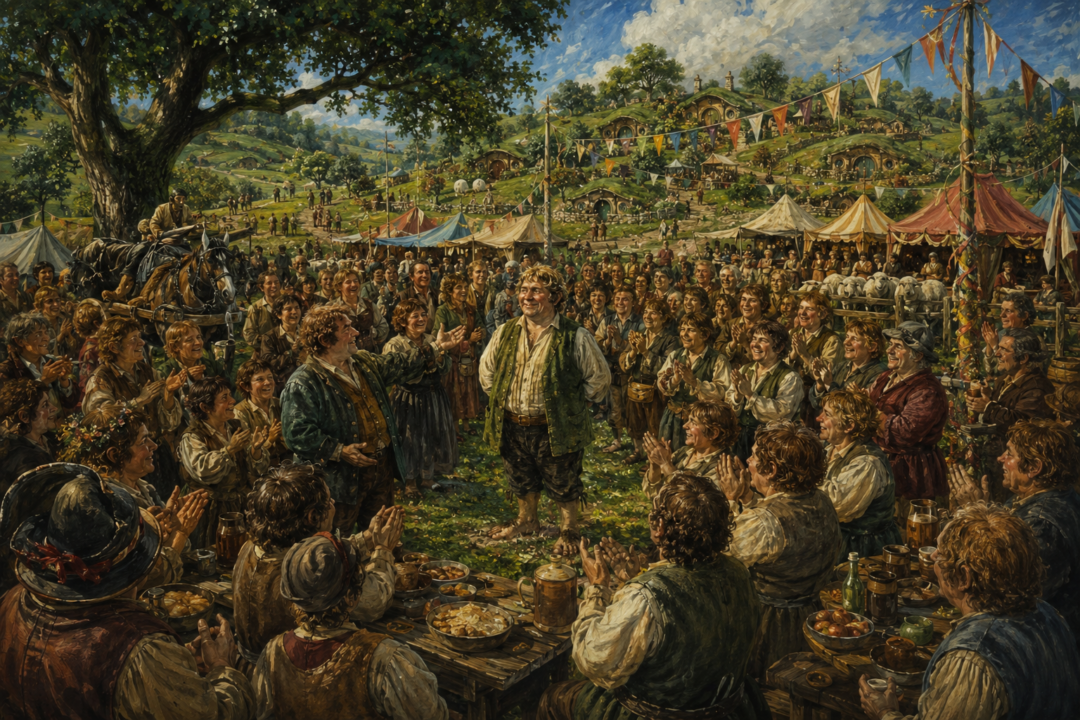
The Mayor of Michel Delving was elected every seven years at the Free Fair on the White Downs. The Prologue describes him as the only real official of the Shire at that period, though the phrase should not be stretched into the idea of a modern head of government.
His formal duties were remarkably modest.
The Mayor presided at Shire banquets. Attached to the office, however, were the responsibilities of Postmaster and First Shirriff.
Those responsibilities help explain why Michel Delving could function as an administrative center without becoming a royal capital.
The Messenger Service connected Hobbit communities. The Shirriffs represented the Shire’s tiny apparatus of public order. Neither required a royal court. They required coordination.
Even the Shirriffs underline how lightly governed the Shire normally was. There were only twelve within the Four Farthings, three for each Farthing, with additional Bounders concerned with the borders when circumstances required them.
Michel Delving therefore sat near the center of a network rather than at the summit of a state.
Its Mayor coordinated useful services.
He did not command subjects.
The Free Fair Reveals the System
Even the method of choosing the Mayor prevented Michel Delving from taking on a royal character.
The Mayor was not crowned in a palace. He was elected at the Free Fair on the White Downs during the Lithe days.
The setting matters.
Political legitimacy was embedded in a communal gathering rather than separated from ordinary Hobbit society behind ceremonial walls and guards. The same office that carried Shire-wide responsibilities remained associated with fairs and feasting.
Will Whitfoot demonstrates the nature of that position particularly well.
Before Saruman’s domination of the Shire, Whitfoot could be treated as an almost comic public figure. His nickname, Flourdumpling, hardly suggests the terrifying majesty of sovereign power.
Yet his office still mattered enough that the new regime could not simply ignore him.
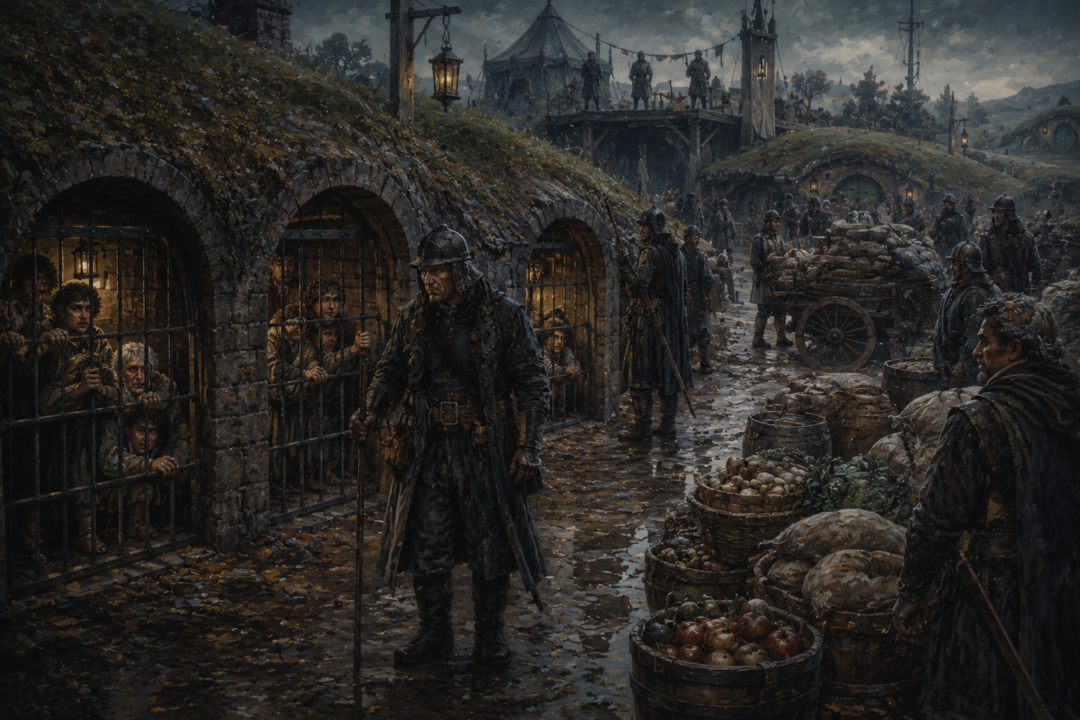
When Lotho Sackville-Baggins and eventually Saruman’s Men imposed their system on the Shire, Whitfoot objected and was imprisoned in the Lockholes at Michel Delving.
The harmless Mayor became politically significant precisely when ordinary Hobbit government was being destroyed.
The Lockholes Exposed What Michel Delving Was Not
Saruman’s occupation provides the clearest test of the Shire’s political structure because it transformed familiar institutions into instruments of coercion.
The contrast is deliberate and severe.
Storage tunnels at Michel Delving became the Lockholes. Shirriffs were drawn into enforcing intrusive rules. Goods were gathered and carried away or hoarded while hobbits faced restrictions utterly unlike their traditional way of life.
Michel Delving suddenly acquired some characteristics of an authoritarian administrative center.
But those characteristics belonged to the occupation, not to normal Hobbit government.
That distinction helps answer the larger question.
Michel Delving had possessed infrastructure before Saruman’s regime: officials, storage spaces, public institutions and communications. What it normally lacked was the desire to concentrate those things into coercive centralized power.
The machinery was small because the political expectations were small.
Saruman’s system demonstrated how different the same country became once rules, enforcement, confiscation, and imprisonment were deliberately centralized.
The Mathom-House Was an Appropriate Monument
There is something fitting about the fact that Michel Delving’s famous institution was the Mathom-house rather than a palace.
Hobbits called objects they had no immediate use for but were unwilling to throw away “mathoms.” Many weapons had become mathoms because warfare had grown remote from ordinary Shire life. Bilbo’s extraordinary mithril coat was itself lent to the Mathom-house before he reclaimed it prior to leaving the Shire.
A royal capital typically displays the symbols of active power: thrones, weapons, banners, fortifications and dynastic monuments.
Michel Delving stored relics.
Weapons could become museum pieces because the society around them generally did not organize itself around war.
That peace was not entirely the hobbits’ own achievement. The Rangers secretly guarded the Shire’s borders, something most hobbits did not understand. Their apparently self-contained political world therefore depended partly upon protection beyond their knowledge.
But internally, the Mathom-house still captures something important about the Shire. Objects associated with wealth, antiquity and violence could be preserved without becoming foundations of political authority.
Then the King Actually Returned
The ultimate test came after the War of the Ring.
Aragorn’s restoration did not require the abolition of Michel Delving’s institutions. Nor did he turn the town into a provincial royal capital.
Instead, the renewed monarchy recognized Hobbit self-government.
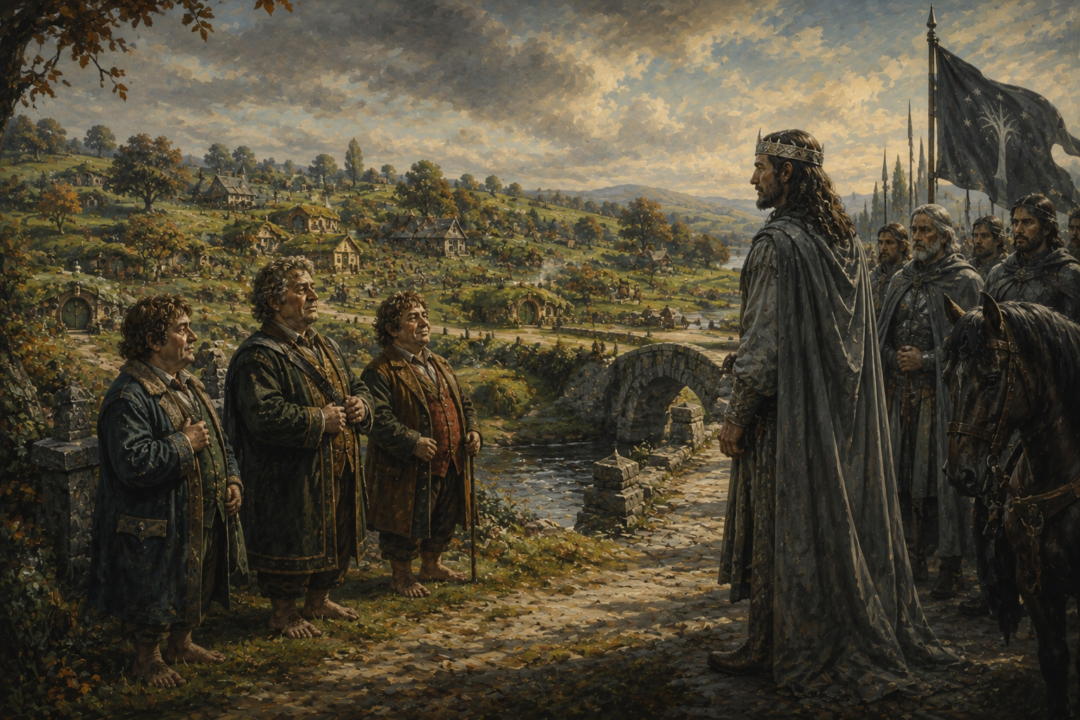
King Elessar issued an order forbidding Men from entering the Shire, and he respected that prohibition himself. When he later wished to meet his friends there, he stopped at the Brandywine Bridge rather than entering.
In S.R. 1434, the Thain, the Master of Buckland, and the Mayor of Michel Delving were made Counsellors of the North-kingdom.
The arrangement is striking.
The restored King did not erase the Shire’s distributed offices. He incorporated their leading figures into the renewed kingdom while leaving the Shire’s internal character substantially intact.
Michel Delving remained important, but it did not need a throne.
A Capital That Worked Because It Was Barely a Capital
Calling Michel Delving the Shire’s “capital” is useful only if the word is handled carefully. The texts support seeing it as the chief township and administrative center, but not as a royal capital in the sense represented by Minas Tirith or Edoras.
Its significance came from what happened there: the election of the Mayor nearby at the Free Fair, the Mayor’s Shire-wide functions, the Mathom-house, and other shared institutions.
Power itself remained dispersed.
The Thain represented an inherited connection to the vanished kings. The Master of Buckland possessed regional authority. The Mayor handled limited common functions. Families and local communities governed much of ordinary life through established custom.
Above all of them lingered the memory of a King who, for centuries, existed more as a principle of legitimate order than as a ruler anyone expected to see.
That arrangement survived because Hobbit society normally asked very little of government.
And when a King finally returned, the irony was complete: the Shire did not have to become more royal.
Its old political memory had become real again, while Michel Delving remained exactly the kind of center the hobbits needed—a place important enough to hold the Shire together, but never powerful enough to become its throne.
Sources & Notes
- https://www.glyphweb.com/arda/m/micheldelving.php — Encyclopedia of Arda: Michel Delving as the Shire’s chief township, museum site, and administrative centre
- https://www.glyphweb.com/arda/m/mayorofmicheldelving.php — Encyclopedia of Arda: the Mayor’s Shire-wide civic functions and limited authority
- https://www.glyphweb.com/arda/s/shire.php — Encyclopedia of Arda: the Shire’s geography, settlement pattern, government, and royal relationship
- https://www.glyphweb.com/arda/w/westfarthing.php — Encyclopedia of Arda: Michel Delving’s regional setting in the Westfarthing
Sources document Michel Delving’s civic offices and its place within the decentralized Shire.