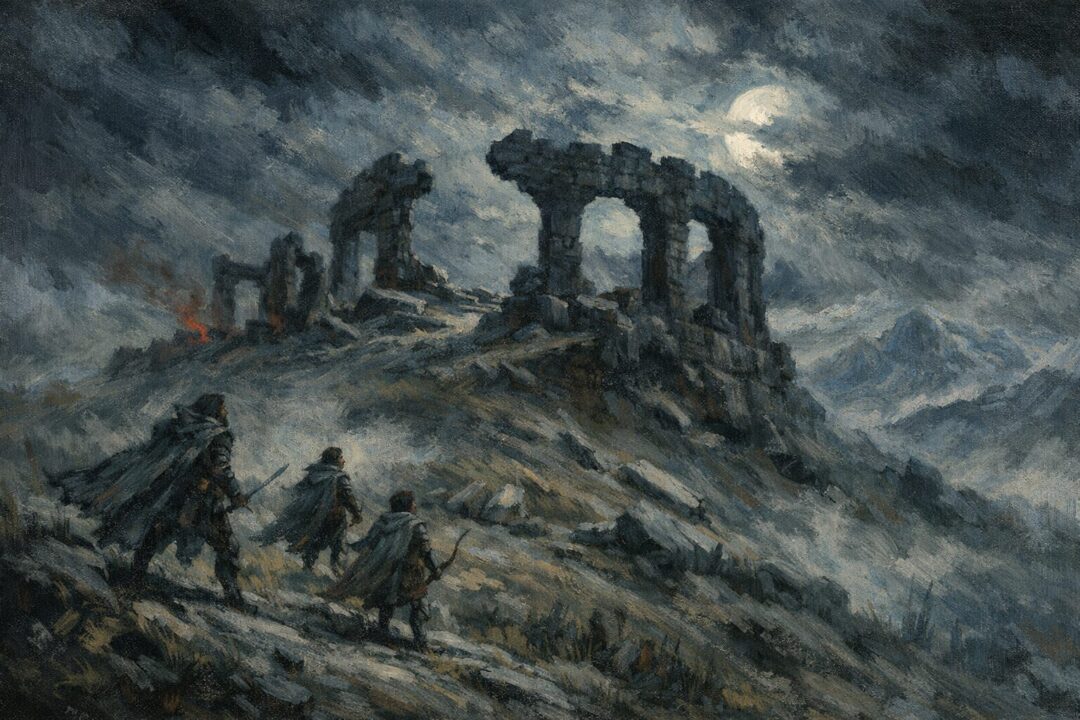
The journey of the Fellowship is often described as a race against time. A mission undertaken in desperation, meant to end the power of the Ring before Sauron can rise again in full strength. When people recount the tale, they focus on urgency: the pursuit, the danger, the narrow escapes.
But if you trace the Fellowship’s path on a map, something else becomes impossible to ignore.
They are not traveling through a living world.
They are walking through what remains of one.
From the moment they leave Rivendell, the Fellowship passes through lands that were once powerful and ordered — and are now quiet. These places were not destroyed in recent wars. They were not burned to ash in living memory. Many of them fell centuries or even millennia before Frodo ever set foot beyond the Shire.
This is not accidental worldbuilding. It is the point.
Middle-earth, as the Fellowship encounters it, is a landscape shaped less by sudden catastrophe than by slow loss. Kingdoms thin. Peoples diminish. Strongholds empty. Roads remain, but no longer lead anywhere important.
The Fellowship’s journey is not just toward Mount Doom. It is through the long aftermath of history.
Hollin (Eregion): A Realm That Simply Stopped
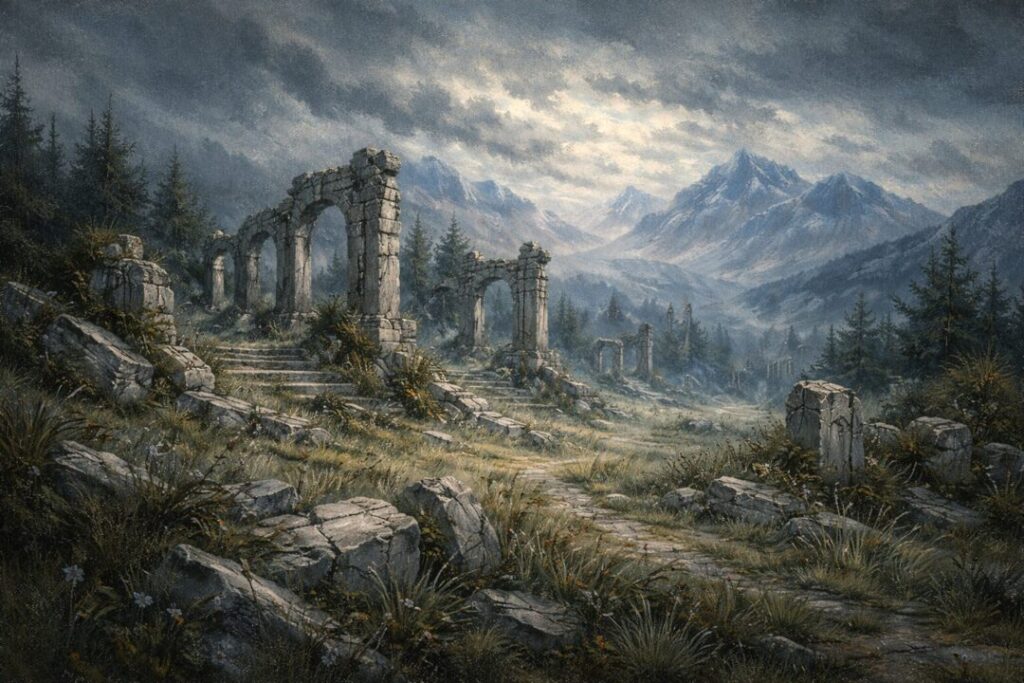
Before reaching the Misty Mountains, the Fellowship travels through Hollin — once known as Eregion.
This was not a minor settlement or a forgotten outpost. Eregion was one of the great Elven realms of the Second Age, founded by the Noldor and ruled by Celebrimbor, the greatest craftsman of his people after Fëanor. Here, the Rings of Power were forged. Here, lore, skill, and ambition flourished together.
Stone roads were laid with care. Walls were raised to endure. Trade passed freely between Eregion and Khazad-dûm, binding Elves and Dwarves in a rare and fruitful alliance. This was a land built with intention, confidence, and hope.
And then it ends.
Not with a last stand remembered in song, but with absence. By the time the Fellowship arrives, there are no cities left. No towers. No living Elves. Only stones half-buried in grass and the memories carried by Elrond, who remembers the land as it was.
Hollin did not fall because it was weak. It fell because evil does not need to conquer everything outright. Sometimes it only needs to corrupt, divide, and wait.
The land remains fair, but empty. Beauty survives without purpose. It is one of the earliest signs that the world the Fellowship walks through is already slipping away.
Weathertop: A Watchtower That Watches Nothing
Amon Sûl was once the greatest watchtower of the North-kingdom of Arnor. From this hill, the Dúnedain could see across vast distances. Signals were passed from tower to tower, warning of danger long before it arrived. It was a place of vigilance, coordination, and authority.
When the Fellowship reaches it, it is already broken.
The tower lies in ruins. The watchfires are cold. No guards stand ready. No banners fly. There is only a ring of stone where kings once watched over their realm.
The Nazgûl attack here not because the place is strong, but because it is weak. A former seat of oversight has become an exposed hilltop, offering no protection to those who linger upon it.
This is a pattern repeated throughout Middle-earth: ruins do not retain their sanctity. They retain only their vulnerability.
Amon Sûl is not honored as a relic of greatness. It is exploited as a failure of vigilance — a symbol of what happens when watchfulness fades before danger does.
Moria: Power That Dug Too Deep
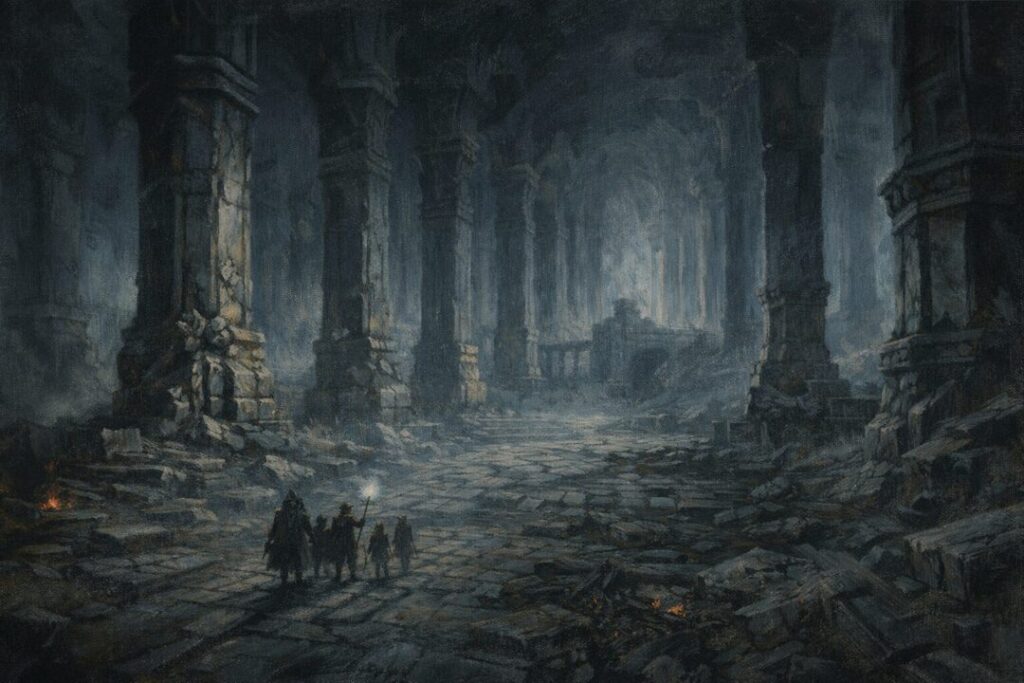
Khazad-dûm, later called Moria, is the most famous ruin the Fellowship enters — and the only one that is still inhabited, in a twisted sense.
Unlike Hollin or Weathertop, Moria did not fade quietly. It collapsed inward.
For ages, Khazad-dûm was the greatest Dwarven kingdom in Middle-earth. Its halls were vast beyond imagining, its craftsmanship unmatched. Wealth flowed from its mines, and its people thrived in strength and pride.
The Dwarves were not driven out by an army. They did not lose a decisive battle. They awakened something ancient and terrible beneath the mountains, a being of the Elder Days that should have remained undisturbed.
Their greatness became their undoing.
When the Fellowship walks through Moria, they are walking through success turned into catastrophe. Every archway and pillar speaks of mastery, of skill honed over generations — and of the cost of reaching too far, too deep, for too long.
Moria is not a warning against weakness. It is a warning against unchecked ambition.
Argonath: Kings Who Still Guard a Border That No Longer Exists
Perhaps no ruin encountered by the Fellowship is as haunting as the Argonath.
Two colossal stone kings stand on either side of the Anduin, hands raised in warning, marking what was once the northern border of Gondor at the height of its power. They are intact. Unbroken. Still imposing beyond measure.
And utterly useless.
No kingdom remains behind them to defend. No power answers their challenge. Their warning is addressed to a world that no longer exists.
The Argonath embodies one of Tolkien’s cruelest truths: symbols outlive the authority they represent. Greatness can be preserved in stone long after it has vanished from the world.
These kings still stand, but they can no longer act. They are guardians without a realm.
Amon Hen and Osgiliath: Seeing Too Much, Holding Too Little
Amon Hen offers vision, but no control. From its Seat of Seeing, Boromir perceives the danger clearly — and still fails. Knowledge alone does not grant strength. Understanding does not prevent corruption.
Osgiliath, once the capital of Gondor, stands as a larger version of the same lesson. By the time the War of the Ring begins in earnest, it is already in ruins. It is not reclaimed. It is not restored. It is fought over like a corpse, changing hands without truly belonging to anyone.
Its fall was not sudden. It was the result of long decline, neglect, and the slow retreat of power.
Together, Amon Hen and Osgiliath underline the same truth: heritage and foresight are not enough. They cannot stop decay on their own. Without renewal, they become burdens instead of strengths.

Why the Ruins Remain Silent
The Fellowship does not rebuild these places. Aragorn does not reclaim Amon Sûl. Legolas does not resettle Hollin. Even after victory, many ruins remain ruins.
This is intentional.
Middle-earth is not a story about restoring the past to its former glory. It is about surviving long enough to let something new grow — something smaller, humbler, and more fragile than what came before.
The world the Fellowship saves is not the world of great empires and towering cities. That age is already gone. What remains is worth protecting precisely because it is modest: the Shire, Rivendell, small realms holding on against time.
The road the Fellowship walks is a warning — not only about evil, but about time.
And time, in Middle-earth, always wins.
What matters is what endures quietly after it passes.