*disclaimer: This article is totally made up. It’s an idea of a Middle Earth / Star Wars mashup. It is not lore accurate.
There is a familiar moment in many legends where a fallen figure “returns changed.” The story often treats it as a pivot point: armor replaces flesh, shadow replaces voice, and the narrative moves on as though transformation itself is the end of the tragedy.
Middle-earth rarely allows such mercy.
In the songs sung in bright halls and the tales told beside warm fires, the return of a dark figure is usually described in a single breath. He rose again. He was clad in black. His presence chilled the air. But those accounts are not written by witnesses. They are written by survivors, by historians, by those who did not have to stand close enough to hear the breathing.
The oldest accounts—those copied in brittle ink, smudged by ash, hidden in half-burned archives—tell a different story. They do not describe a transformation. They describe a reforging.
And reforging, as every smith knows, is never gentle.
What Remained After the Fire
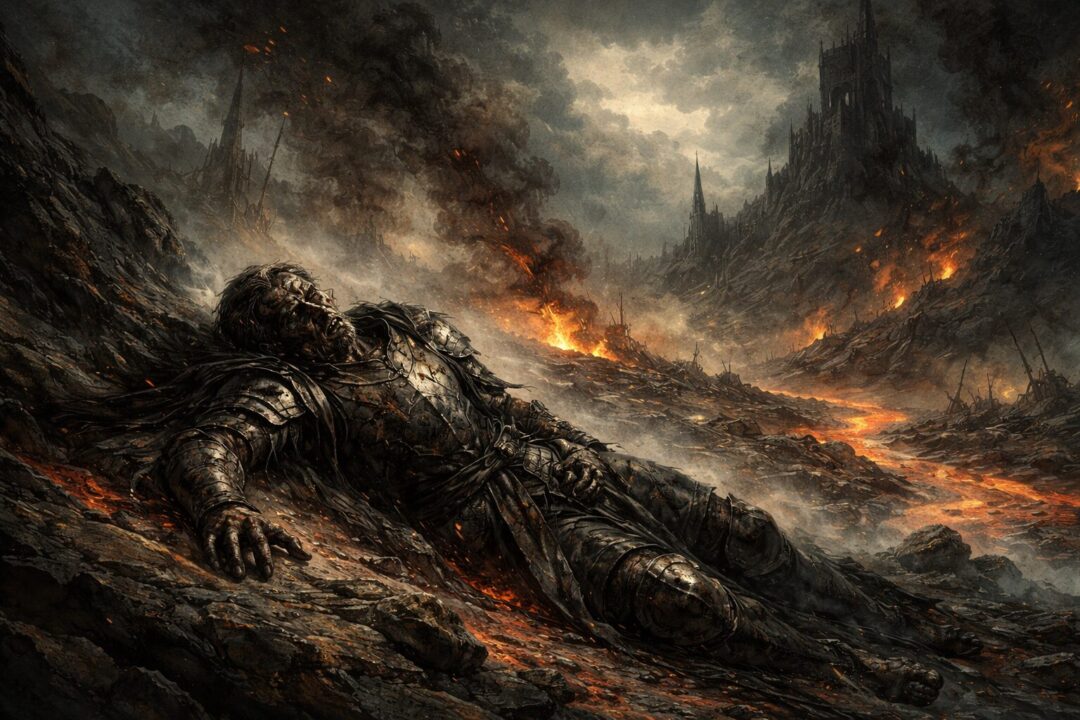
When the Dark Lord’s servants finally reached him, there was barely a man left to find.
He had been a king once. Or a prince. Or a champion raised too high by his own victories. The surviving texts cannot agree on his title, but they agree on what mattered: he had been powerful, proud, and dangerous. That was why the Dark Lord did not permit him to die.
The fire had done its work thoroughly.
Both legs were gone, taken earlier in battle and left behind on blackened stone. One arm had been severed at the shoulder, the wound cauterized only by heat. What remained of his body had been dragged too close to flame and ash. His garments had burned away. His skin blistered, split, and sloughed from muscle beneath. Every breath pulled scorched air into lungs already collapsing from smoke and heat, searing what little tissue still functioned.
Any healer of the West would have named the condition without hesitation: beyond hope.
Yet he lived.
Not because life clung stubbornly to him, but because will did.
The Dark Lord’s sorcery anchored the man’s spirit to his ruined flesh long after the body had lost the right to continue. The spell was not subtle. It was not kind. It bound awareness to agony, keeping the mind awake even as the flesh failed.
This was not rescue.
It was containment.
A Spirit Held Against Its Nature
Most beings of Middle-earth understand death as a release. Even those who fear it know, at some deep level, that it is part of the world’s design. What was done here violated that design entirely.
The man drifted repeatedly toward darkness, toward whatever lay beyond breath and pain—but each time, he was dragged back. Not gently. Not gradually. He was wrenched into awareness with the same violence that had destroyed his body.
Later writings suggest that this moment, more than any other, broke what remained of him. Pain can be endured. Loss can be mourned. But the denial of release twists the spirit inward, teaching it that mercy no longer exists.
By the time the Dark Lord’s servants lifted what remained of him from the battlefield, the man no longer begged. He did not curse. He only breathed, because breathing was forced upon him.
Transporting a Dying Man
He did not walk into the fortress.
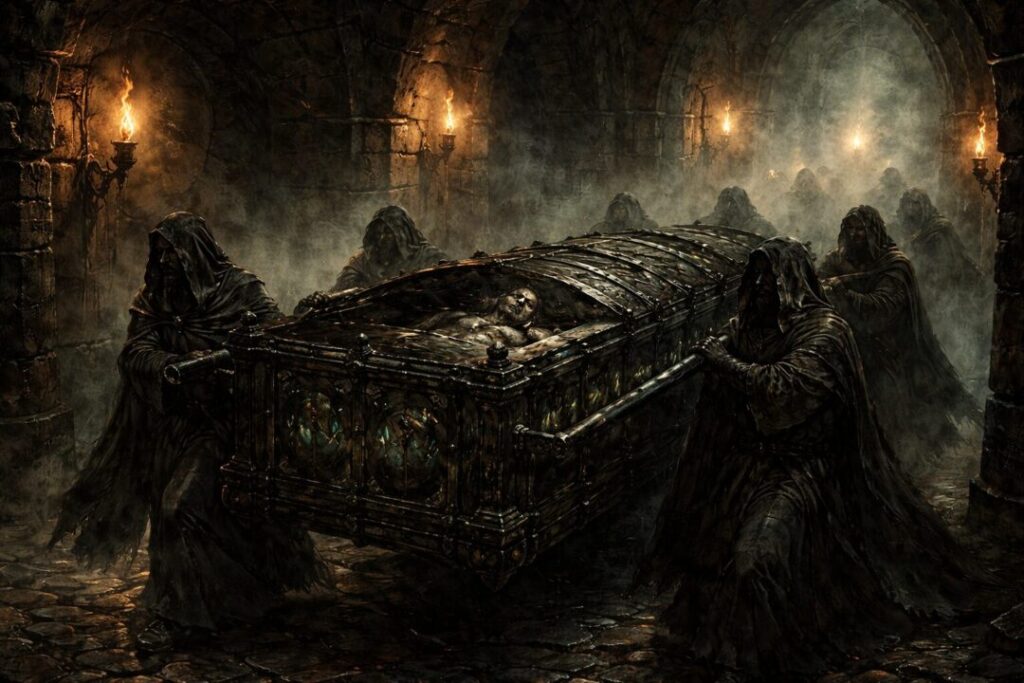
He was sealed into an iron cradle etched with runes of binding and preservation, its interior lined with hooks, restraints, and channels for air and sorcery alike. Bellows forced breath into lungs that could no longer draw it on their own. Spells stitched together failing moments, delaying collapse by sheer force of will imposed from without.
Dark priests debated quietly as the cradle was carried through smoke and shadow. Some argued that the body would not last the journey. Others argued that the spirit might slip free despite their efforts.
The Dark Lord ended the debate himself.
He reached into the man’s mind and forced him awake.
Awareness mattered.
Pain mattered.
The Dark Lord believed—correctly—that suffering sharpened obedience. A mind dulled by unconsciousness might wander. A mind held in pain had nowhere to go.
By the time the procession reached the forge-halls beneath the tower, there was no longer any question of recovery. That possibility had been abandoned miles ago. The only question that remained was whether the body could be made useful.
The Reforging Begins
The operation—if such a word can be used—did not begin with mercy.
No draughts of sleep were prepared. No herbs of easing burned in the air. The Dark Lord demanded that the man’s inner fire remain undimmed, convinced that dulling the pain would weaken the power he intended to harness.
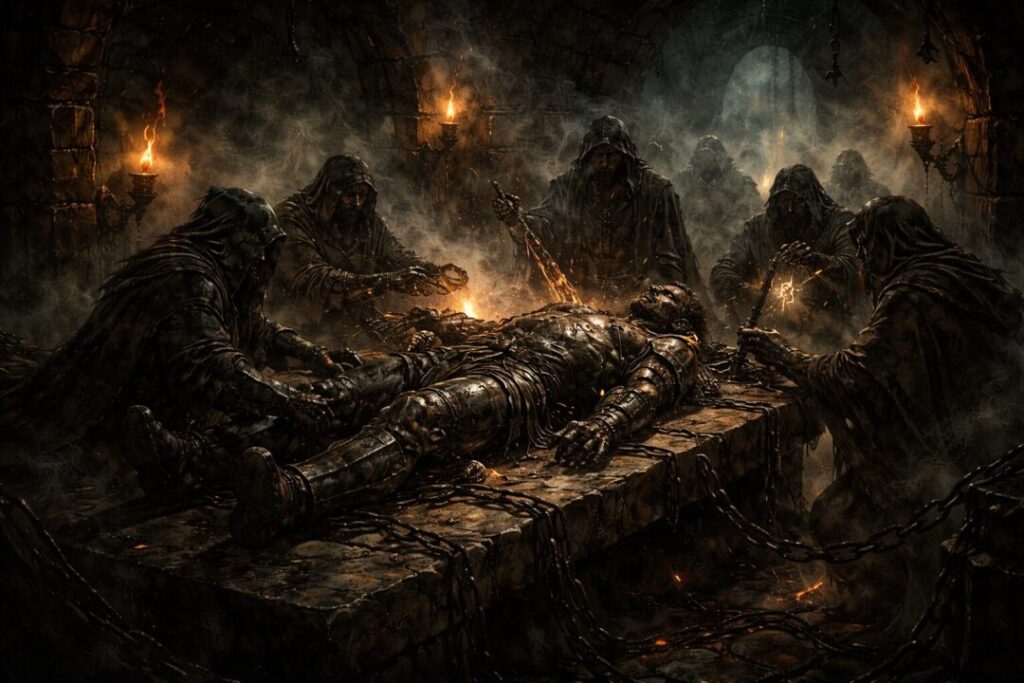
Iron limbs were forged while the man still breathed.
Smiths worked in silence, shaping metal not to replace what was lost, but to dominate it. The limbs were heavier than flesh, reinforced to bear unnatural strain. Each piece was etched with binding runes designed not to heal, but to command.
Blades cut away what rot and ruin remained of the man’s flesh. Bone shattered under pressure and was removed in fragments, replaced with blackened metal frames bolted directly into what remained of his torso. Organs that failed were excised entirely, substituted with mechanisms driven by gears, bellows, and dark enchantments.
He felt it all.
The texts are unflinching. They describe screaming that lasted until the throat could no longer shape sound. After that, there was only breath—ragged, mechanical, forced by devices that did not care whether the man wished to continue.
There was no single moment of horror.
It was a sequence.
And it did not end in one night.
Days of Conscious Suffering
The reforging stretched across multiple days.
Hours were devoted to fitting the iron frame that would bear his weight, locking it into place around what remained of his spine and ribs. More time was spent wiring the breathing apparatus that would replace lungs too damaged to function on their own. Spells were layered carefully, each one designed to prevent death without granting relief.
Between procedures, the man was not allowed to sleep.
Sleep risked release.
The Dark Lord could not allow that.
Instead, the man drifted in a state between agony and clarity, aware enough to understand what was being done to him, too weak to resist it. Memories surfaced unbidden—faces, victories, oaths spoken in better days—only to be crushed beneath the present reality of iron and pain.
By the final day, what remained of the man’s original body served only as an anchor. A core. A justification. Everything else was structure, reinforcement, imprisonment.
The Armor as a Prison
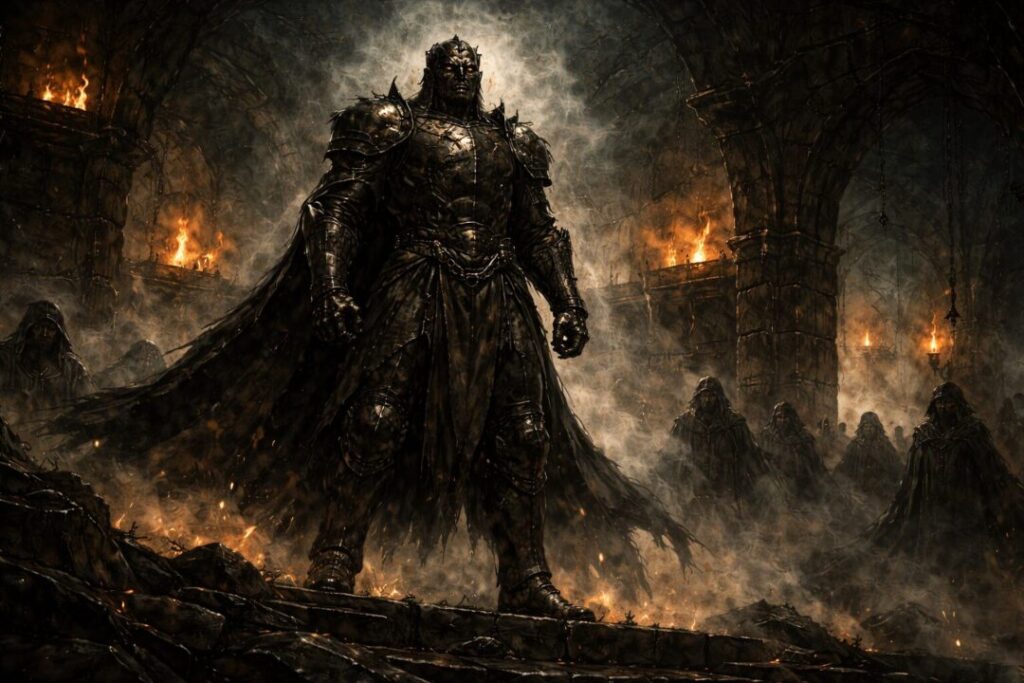
When the black armor was finally sealed around him, it was not a gift.
It was a cage.
The plates locked together with finality, enclosing him in a shell that sustained life while denying comfort. Every movement dragged metal against flesh. Every breath passed through chambers that rasped and hissed, announcing his presence long before he spoke.
The suit did more than protect him.
It ensured that pain would never fully leave.
The Dark Lord wanted it that way.
Pain reminded him who he served. Pain kept his thoughts from wandering inward toward memory, regret, or the faint remnants of who he had once been. The armor did not merely house the man—it disciplined him.
When he stood for the first time, supported by iron rather than muscle, there was no sense of rebirth.
There was only function.
He had not returned.
He had been completed.
The True Cost of Survival
Legends often celebrate survival at any cost. They speak of endurance as virtue and persistence as triumph.
Middle-earth offers a warning instead.
This man did not escape death. He was denied it. His punishment was not the loss of his former life, but the preservation of it—twisted, constrained, and bound eternally to darkness.
His body became a tool. His pain became a leash. His continued existence served not as proof of strength, but as a monument to cruelty.
And that may be the cruelest magic of all.