Thrór’s Moon-Letters Were More Than a Secret Message — They Required Both Craft and Calendar Knowledge
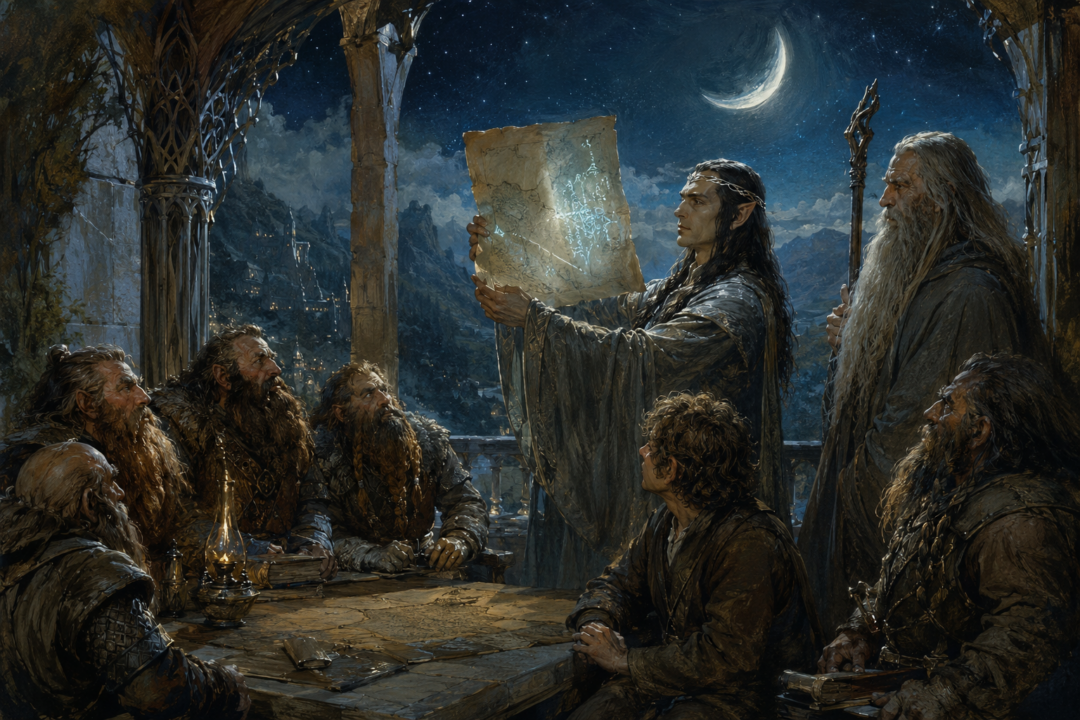
When Elrond holds Thrór’s map up to the moonlight in Rivendell, something appears that Thorin and his companions have been carrying without knowing it was there.
The map already shows the Lonely Mountain and marks a hidden entrance. But under the right moon, another layer becomes visible: moon-letters, concealed runes containing the crucial instruction for finding the keyhole of the secret door.
That discovery is easy to remember simply as another piece of Middle-earth magic. Yet the actual mechanism described in The Hobbit is more interesting. Moon-letters are not merely invisible writing. The more sophisticated kind depends upon astronomical conditions linked to the moment when the letters were made.
And the message on Thrór’s map creates a second problem. Even after it has been revealed, understanding how to use it requires knowledge of the Dwarves’ own calendar.
The result is a remarkably compact example of Dwarven secrecy. The map preserves information not through one lock, but several: craftsmanship, observation of the heavens, inherited custom, memory, and finally the ability to recognize the correct moment before it disappears.
Moon-Letters Are Ordinary Runes Made Extraordinary
Elrond explains moon-letters in “A Short Rest” after examining Thrór’s map on the eve of Midsummer.
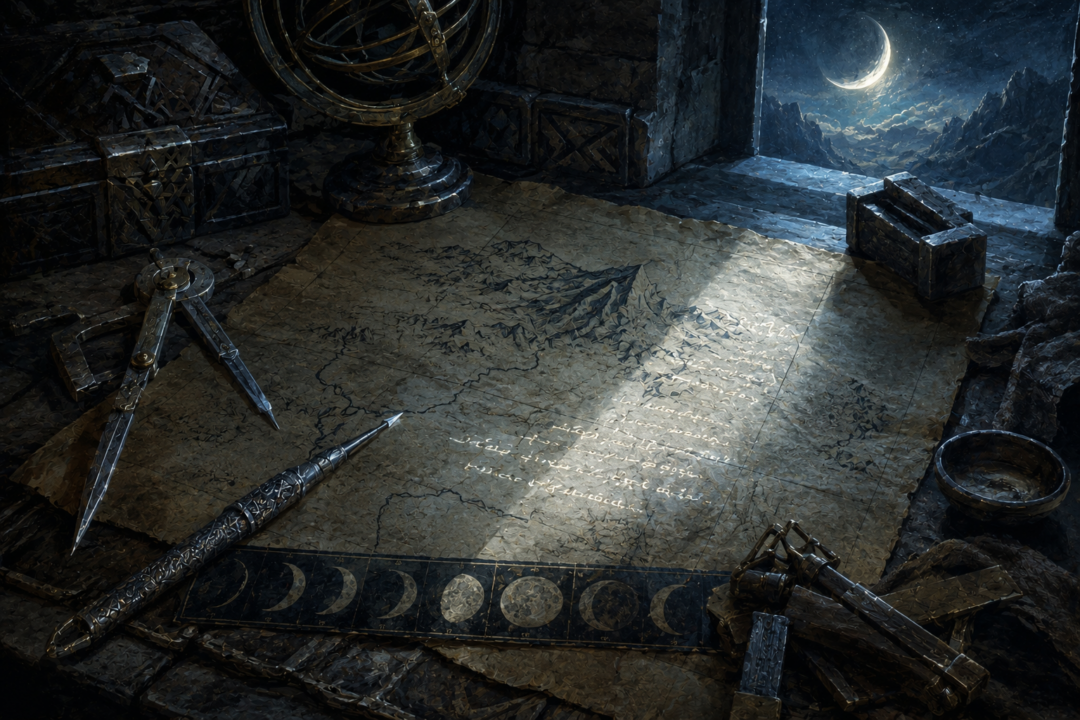
They are rune-letters, but cannot normally be seen by simply looking at them. They become visible when moonlight shines through or behind the writing.
The most important distinction is that not all moon-letters work in precisely the same way.
Elrond says that with the more cunning variety, the moon must correspond to the conditions under which the letters were written: the same shape of moon and the same season.
That means concealment is built into time itself.
Someone might possess the correct document for years and still fail to discover its hidden message because the appropriate astronomical conditions have not occurred while the map was being examined.
Elrond identifies Thrór’s inscription as belonging to this more difficult kind. From the conditions in which it becomes visible, he concludes that the letters must have been written on a Midsummer’s Eve beneath a moon of the same shape.
The text also gives one wonderfully practical detail about the process: moon-letters were written using silver pens.
Exactly how the complete technique worked is not explained. It is therefore safer not to turn moon-letters into a fully defined magical technology. What the story establishes is enough: they are a Dwarven method of writing, they require specialized craft, and their most secret form is tied deliberately to the heavens.
The Map Has More Than One Layer of Information
Thrór’s map already matters before Elrond discovers anything hidden upon it.
Gandalf produces it at Bag End together with the key associated with the secret entrance. The visible map identifies the Lonely Mountain and indicates a concealed door on its western side.
But the visible information is incomplete.
Knowing that a door exists does not mean knowing how to open it.
The moon-letters provide the missing operational instruction: the company must stand by a grey stone when a thrush knocks, and the last light of Durin’s Day will reveal the keyhole.
This creates a clever division of knowledge.
The map supplies location. The hidden inscription supplies timing. The key supplies the physical means of opening the door.
None of the three is sufficient by itself.
A thief who stole only the map could potentially find the mountainside yet remain unable to enter. Someone possessing the key without understanding where or when the lock would appear would face essentially the same problem.
Thrór’s safeguard therefore does not depend upon an impossibly strong barrier. It depends upon separating the knowledge needed to use an otherwise ordinary key.
The First Calendar Problem Is Needed to Read the Message
The first temporal lock appears in Rivendell.
Thrór’s moon-letters cannot simply be revealed whenever their owner chooses. Their visibility depends upon the correct moon and season.
This is where craft and calendar knowledge begin to overlap.
The maker must know how to produce moon-letters capable of responding to particular conditions. But a later reader must either know or recognize when those conditions have returned.
Elrond succeeds because the company happens to be in Rivendell under the necessary midsummer moon and because he knows what he is seeing.
This is an important limitation on the idea that the Dwarves simply carried a secret instruction with them. They carried it physically, but they did not possess it consciously.
Until Rivendell, part of Thrór’s knowledge remained inaccessible even to his own descendant.
The map therefore functions almost like inherited memory whose meaning can survive its makers but not automatically remain available to their heirs.
That distinction becomes even more important when Elrond reads what the hidden letters actually say.
Durin’s Day Creates a Second Temporal Lock
The moon-letters reveal one date-related secret only to point toward another.
The keyhole will appear in the last light of Durin’s Day.
When Elrond asks what that means, Thorin explains the Dwarven reckoning. Their New Year begins with the first day of the last moon of autumn, on the threshold of winter. They call it Durin’s Day when the sun and that moon can be seen in the sky together.
So opening the secret door depends on a second piece of specialized knowledge.
A reader must understand a cultural calendar that is not expressed as a simple fixed date.
And here The Hobbit introduces an especially revealing detail: Thorin knows what Durin’s Day is, but says that predicting when the required conjunction will occur has passed beyond their skill.
That should not be exaggerated into a claim that Dwarves had forgotten their calendar entirely. Thorin plainly remembers its definition and significance.
What has weakened is their ability to calculate the necessary occurrence reliably.
The distinction matters.
The tradition survives. The practical mastery needed to use it has become uncertain.
Thrór’s Security System Depends on Living Knowledge
Seen this way, the secret door is protected by far more than stone.
Its design assumes a chain of knowledge.
Someone must preserve the map. Someone must possess the key. Someone must reveal the moon-letters under the correct midsummer conditions. Someone must understand Durin’s Day. Someone must reach the right place. Someone must notice the grey stone and the thrush. And someone must act during the very brief interval when the setting sun exposes the keyhole.
The text never calls this a deliberate multi-stage “security system,” so that description is an interpretation rather than a stated Dwarven principle.
But functionally, that is what Thrór’s instructions create.
The door cannot be defeated merely through strength.
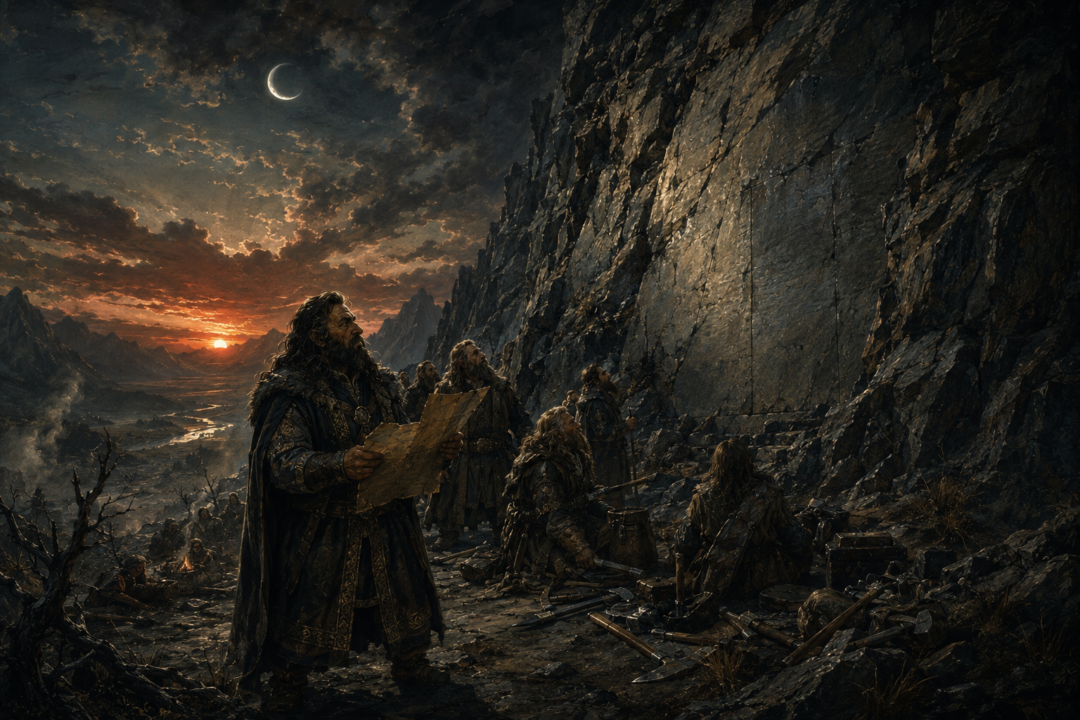
This becomes painfully obvious at the Lonely Mountain. Once the company finds the smooth rock face they believe to be the hidden entrance, the Dwarves try tools upon it. Their efforts accomplish nothing.
The secret is not greater force.
It is correct knowledge applied at the correct time.
The Dwarves Nearly Miss the Moment Their Ancestor Prepared
The most striking irony comes when the company finally stands on the doorstep of Erebor.
They have the map.
They have the key.
Elrond has already read the hidden instruction aloud.
And still they nearly fail.
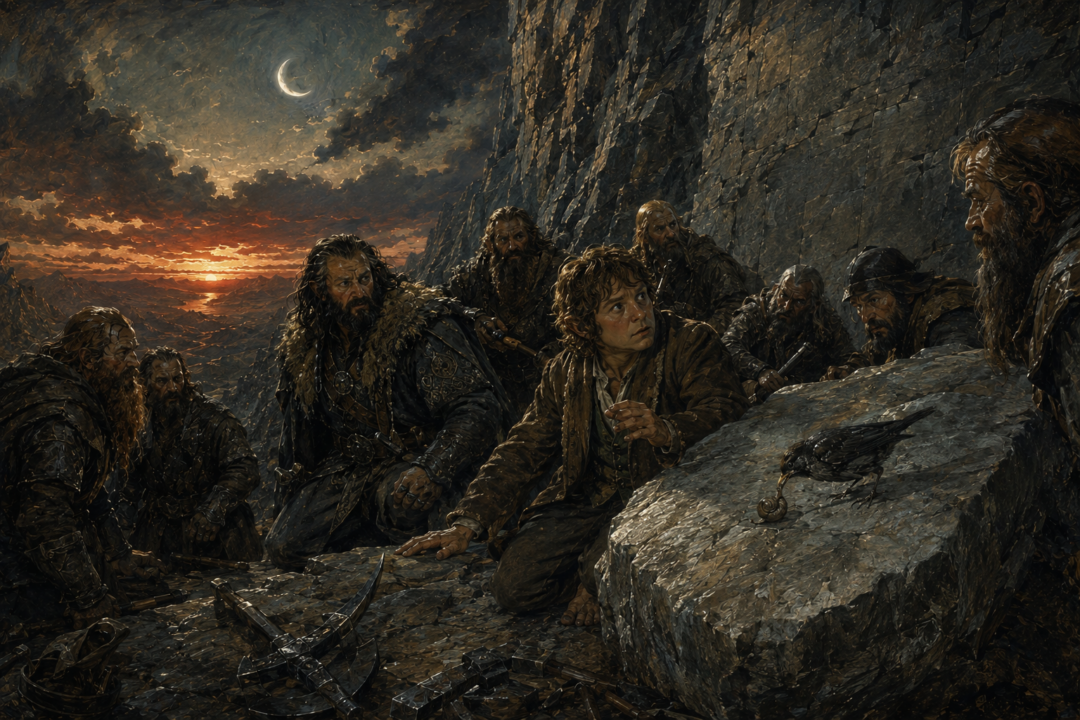
For days the company cannot open the door. As autumn reaches its end, Bilbo sits near the entrance while the others have become discouraged.
Then several signs come together.
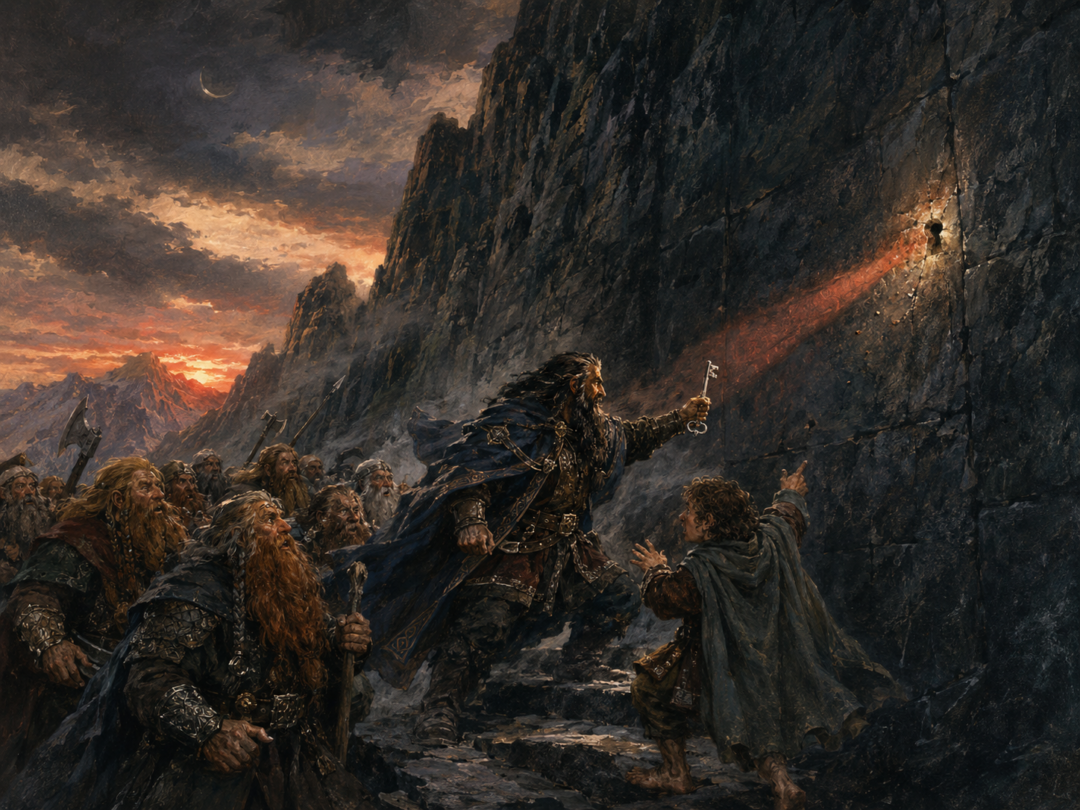
Bilbo sees a thin moon. A thrush begins knocking a snail against the grey stone. He remembers the moon-letter message and urgently summons the Dwarves.
They wait for sunset.
At first it seems even this recognition has come to nothing. The sun sinks behind cloud, and hope collapses with it.
Then at the final moment, a red ray reaches the smooth stone. The keyhole is exposed. Bilbo immediately calls for the key, Thorin uses it, and the concealed door finally opens.
The episode demonstrates why Thrór’s instructions required more than possession.
The company needed observation and memory at precisely the right instant.
Had Bilbo ignored the bird or failed to connect its behavior with Elrond’s reading, the necessary moment could have passed unnoticed.
Bilbo Completes Knowledge the Dwarves Already Possessed
There is another quiet reversal here.
The hidden writing belongs to Dwarven tradition. The calendar is Dwarven. The map comes from Thrór. The key belongs to Thorin’s inheritance.
Yet Bilbo is the person who recognizes the final pattern.
This does not make him a greater scholar of Dwarven lore than Thorin. He is not. Nor does he calculate Durin’s Day in advance.
Instead, Bilbo succeeds because he watches what is actually happening around him and remembers the clue when its signs appear.
That difference is central to the scene.
The Dwarves possess inherited knowledge. Bilbo supplies attention.
Neither would have been enough without the other.
Elrond’s scholarship reveals the hidden instruction; Thorin’s tradition explains Durin’s Day; Thrór’s craftsmanship preserves the message; the map guides them to the entrance; the key opens it; and Bilbo recognizes when all of those pieces have finally converged.
The opening of the door is therefore not the achievement of a single kind of intelligence.
It requires several.
Moon-Letters Preserve a Culture — But Also Reveal Its Fragility
Thrór’s map is valuable partly because it survives catastrophe.
Smaug destroyed the Kingdom under the Mountain, scattered its people, and severed Thorin’s generation from Erebor. Yet information about the secret entrance remained encoded in an object small enough to travel through exile.
That is an extraordinary strength.
But the story also reveals the weakness of such preservation.
An artifact can survive while the knowledge required to interpret it fades.
Thorin inherits the map without knowing that hidden writing lies upon it. He understands Durin’s Day but cannot confidently calculate its arrival. The company eventually reaches the door but cannot force it open. Even after receiving the necessary clue, they depend upon Bilbo recognizing its fulfillment.
The texts do not state that this episode represents a general decline of all Dwarven learning. That would go beyond the evidence.
But within Thorin’s company, at least, there is a clear gap between ancestral knowledge and present mastery.
The old craft still works perfectly.
Its heirs are the uncertain part.
The True Lock on Thrór’s Door Is Time
That is what makes the moon-letters more sophisticated than simple invisible ink.
Thrór’s secret depends upon two different calendars embedded in one chain of information.
The hidden writing is revealed under lunar and seasonal conditions corresponding to those under which it was made.
Then the writing itself directs the reader toward Durin’s Day, a Dwarven calendrical event determined through another relationship between moon, season, and sun.
Craft hides the instruction.
Calendar knowledge reveals when it matters.
Memory carries it from Rivendell to Erebor.
Observation identifies the final signs.
And sunlight exposes a keyhole that brute force could not find.
The secret door beneath the Lonely Mountain is made of stone, but its most effective barrier is not stone at all.
It is the requirement to know not merely where to look, but when.
Sources & Notes
- https://www.glyphweb.com/arda/m/moonletters.php — Encyclopedia of Arda: moon-letters, their Dwarven manufacture, and the lunar timing required for reading
- https://www.glyphweb.com/arda/t/throrsmap.php — Encyclopedia of Arda: Thrór’s Map, its hidden inscription, and Elrond’s reading of it
- https://www.glyphweb.com/arda/d/dwarves.php — Encyclopedia of Arda: Dwarven craft, lore, language, and calendar traditions
Sources document Thrór’s Map, moon-letters, Dwarven craft, and the lunar conditions needed to read them.