
Sauron is often described as the ultimate symbol of domination in Middle-earth—a being whose will stretches across vast distances, whose influence corrupts lands and peoples alike. By the Third Age, his presence is so pervasive that even speaking his name feels dangerous. Kingdoms fall under his shadow without ever seeing him. Minds bend long before armies arrive. The world itself seems to wither where his attention lingers.
And yet, for all his power, there is one place where his shadow does not fall.
The Blessed Realm—often called the Undying Lands—stands completely outside Sauron’s reach. Not hidden. Not defended by armies. Not protected by secrecy or distance alone. It is simply inaccessible to him in every meaningful sense.
This is not a matter of strength.
It is a matter of being.
The Blessed Realm Is Not Just a Location
The Undying Lands are often misunderstood as a paradise reserved for Elves and immortals—a distant heaven beyond the sea. But in Tolkien’s world, they are something far more specific and far more demanding.
They are a realm shaped by the authority of the Valar and aligned with the original moral order established at the world’s beginning. They are not merely beautiful; they are ordered. Not politically ordered, but ontologically ordered—structured according to harmony, restraint, and rightful authority.
Access to this realm is not determined by power, cleverness, or even immortality.
It is determined by alignment.
This is why not all beings may enter freely. It is why Men are invited only under rare and exceptional circumstances. And it is why Sauron, despite his immense strength, is permanently excluded.
He does not fail because he is weak.
He fails because he is misaligned.

Sauron’s Refusal of Mercy
To understand why Sauron can never return to the West, we must look not at the end of the Third Age, but at the end of the First.
After the defeat of Morgoth, Sauron stood at a crossroads. His master was overthrown. The world was broken and remade. And for a brief moment, Sauron was offered a choice that would define the rest of his existence.
He could submit to judgment.
He could accept correction.
He could be healed—however painful that process might have been.
He refused.
This refusal is not a footnote in Tolkien’s history. It is the keystone of Sauron’s character.
Unlike Morgoth, whose rebellion was driven by nihilism and a desire to destroy creation itself, Sauron desired order. He believed the world should be structured, regulated, perfected—but always according to his design.
Repentance would have required acknowledging a higher authority.
Healing would have required surrendering control.
Submission would have required humility.
And humility is the one virtue Sauron is incapable of practicing.
By rejecting mercy, Sauron did not simply choose evil. He severed his relationship with the moral structure of the world itself. In doing so, he cut himself off from the West forever.
Why He Cannot Return
The Blessed Realm is not defended against Sauron by force. No host stands ready to repel him. No wall bars his path. There is no battle to be fought, because there is no battlefield on which he could stand.
The barrier is metaphysical.
To enter the Undying Lands would require humility.
To remain would require repentance.
To exist there would require the surrender of domination.
Sauron cannot do any of these things.
His power is real—but it is narrow. It functions only where fear, coercion, and corruption can take root. His strength is parasitic. It feeds on resistance, ambition, envy, and despair.
The Blessed Realm offers no such soil.
There is nothing there to conquer.
Nothing to bend.
Nothing to improve through force.
And so his power simply has nothing to attach itself to.
This is why his influence ends at the Sea. Not because the Sea blocks him, but because beyond it lies a world in which his philosophy cannot function.
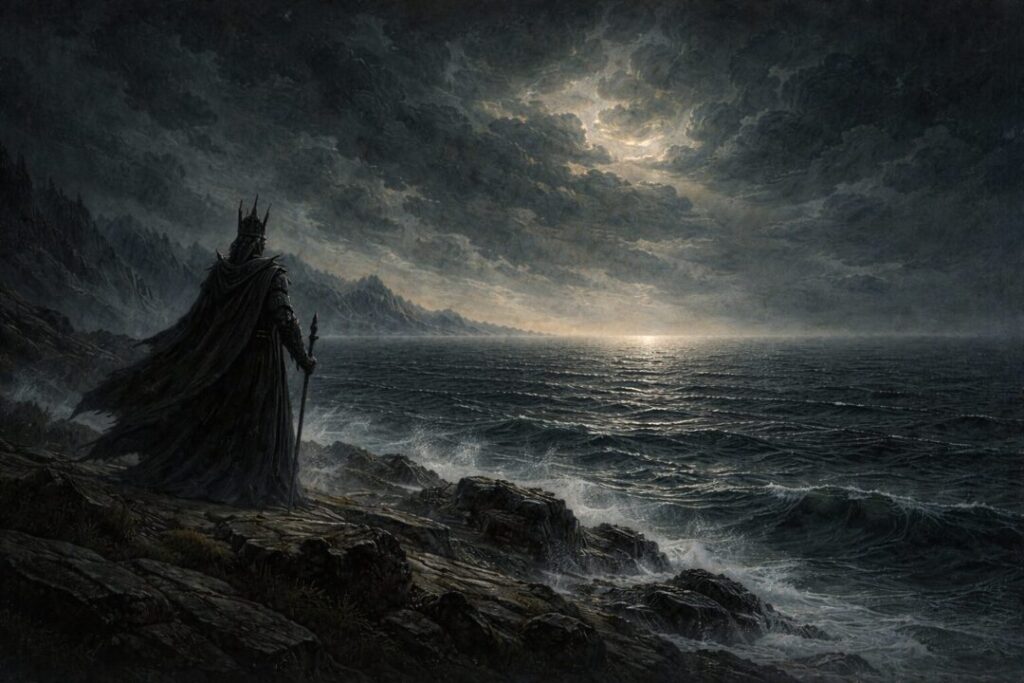
The Straight Road and the Closing of the World
After the reshaping of the world, the Undying Lands are removed from the circles of ordinary geography. The Straight Road remains for those permitted to travel it, but the world itself becomes bent and closed.
This is not an act of fear by the Valar. It is an act of containment.
Sauron is not imprisoned beyond the Sea. He is excluded from it.
The Straight Road is open only to those who move in harmony with the purpose of that realm. Sauron could no more walk it than he could willingly unmake himself.
His exile is not enforced by guards. It is enforced by his own nature.
Why the Valar Do Not Intervene
One of the most misunderstood aspects of The Lord of the Rings is the apparent absence of divine intervention. If Sauron cannot enter the West, why does the West not come to Middle-earth? Why do the Valar not simply end the conflict themselves?
The answer lies in responsibility.
Middle-earth is not abandoned.
It is entrusted.
The task of resisting Sauron is deliberately placed in the hands of the Free Peoples—not because they are strong, but because they are capable of moral choice. To intervene directly would be to remove that choice and repeat the mistakes of earlier ages.
The Valar have learned that overwhelming power does not heal the world. It reshapes it violently, often at terrible cost.
Sauron’s exile is not meant to spare Middle-earth from struggle. It is meant to ensure that struggle has meaning.
Victory gained without choice is not victory at all.

A Victory Sauron Could Never Achieve
Sauron seeks domination. But domination is not the highest form of victory in Tolkien’s world.
True victory is restoration.
The Blessed Realm represents everything Sauron cannot comprehend: healing without conquest, authority without tyranny, power without possession. It exists as living proof that his worldview is incomplete—and ultimately false.
Even if Sauron had conquered all of Middle-earth, his triumph would have been hollow. The West would remain beyond him, untouched and unchanged. A silent testament to the limits of his philosophy.
He could rule the world and still never possess what he desires most: legitimacy.
Why This Matters
The War of the Ring is not simply about destroying a Dark Lord. It is about exposing the weakness at the heart of his vision.
Sauron believes all wills can be bent.
The Blessed Realm proves otherwise.
There exists a place where domination has no meaning, where power cannot compel obedience, and where control is replaced by harmony. Sauron cannot enter that place—not because he is barred, but because he does not belong.
And that is why, in the end, he loses.
Not because he is overpowered.
Not because he is outmatched.
But because he is fundamentally incapable of the kind of victory that truly matters.