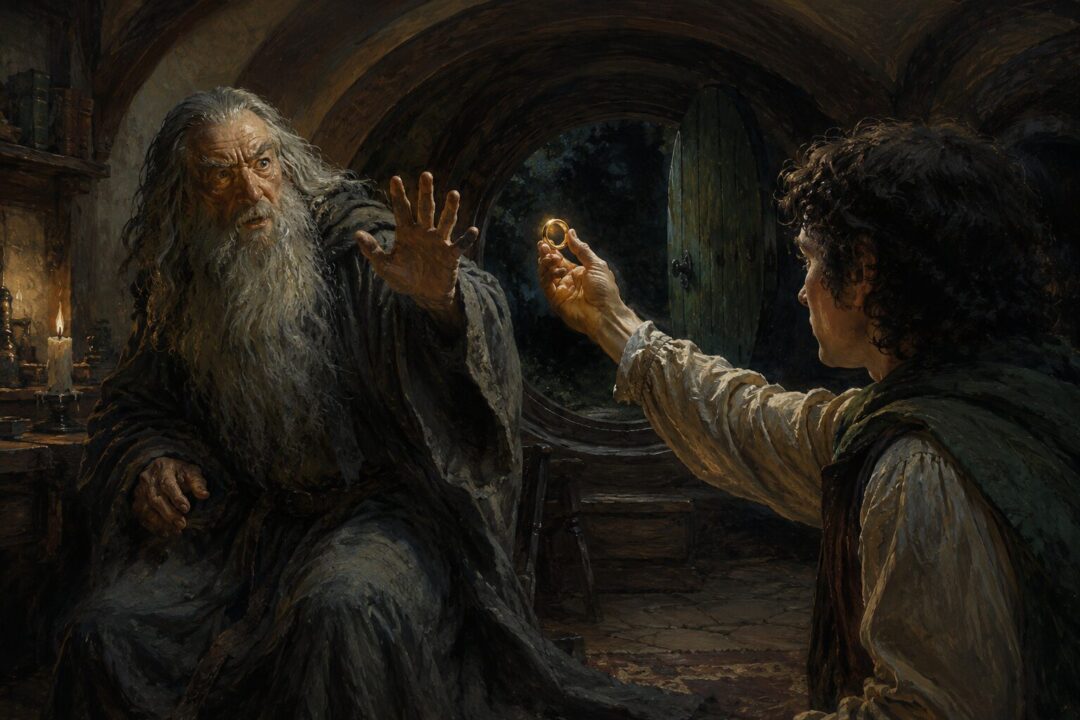
The One Ring sat on a chain around Frodo’s neck, but one of the people most afraid of it was the wizard who had spent centuries opposing Sauron.
Gandalf feared the Ring in a way that often surprises readers. Aragorn handled it briefly. Sam carried it. Even Boromir desired it. Yet Gandalf refused to touch it unnecessarily and flatly rejected the idea of taking it for himself. His refusal was not simple humility. It came from something darker and more dangerous: he understood exactly what the Ring would do to someone like him.
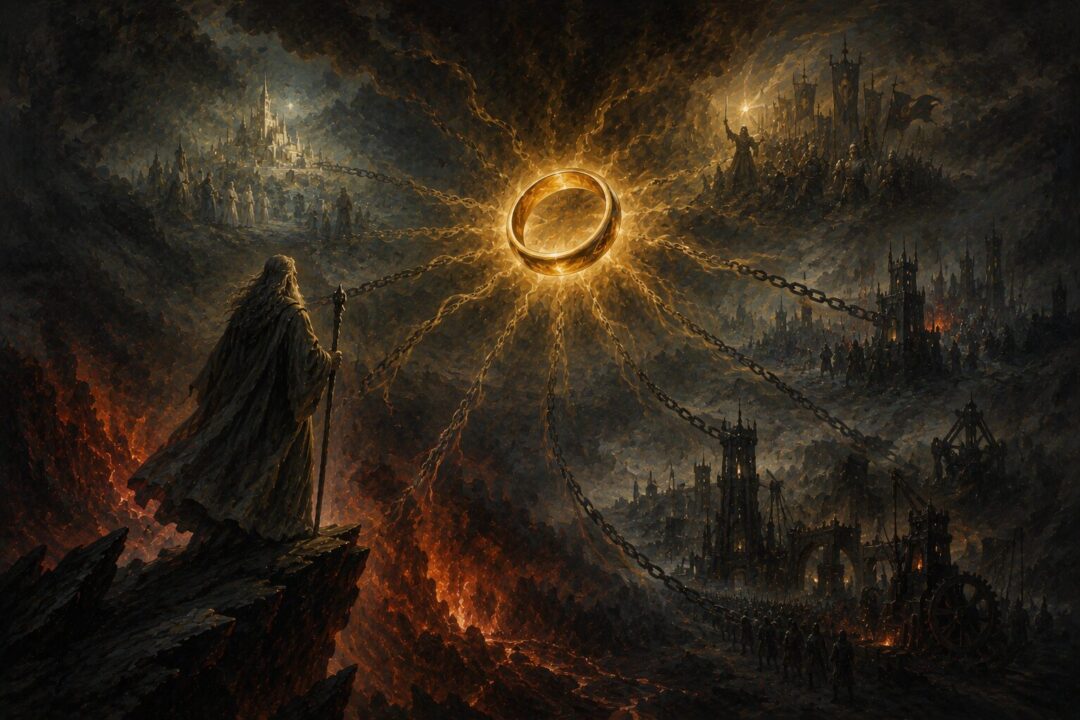
The deeper tragedy is that Gandalf may have been among the beings in Middle-earth most capable of using the One Ring successfully — which is precisely why he feared it.
Gandalf Knew the Ring Was Built for the Powerful
The One Ring was not merely a cursed object that tempted weak wills. It was a tool of domination.
Forged by Sauron in Orodruin, the Ring contained much of the Dark Lord’s native power and was designed to govern the other Rings of Power. Its nature was deeply connected to control, mastery, and the bending of other minds to a single purpose.
This matters enormously for understanding Gandalf’s fear.
Many beings in Middle-earth could be corrupted by greed, pride, or desperation. But not everyone could use the Ring effectively. The texts strongly imply differences in what various bearers might achieve with it.
Gandalf was not an ordinary mortal. He was one of the Istari — emissaries sent from the West to aid resistance against Sauron. Though clothed in the limitations of an old man, he was in origin a Maia: a spiritual being of the same broad order as Sauron himself.
That does not mean Gandalf and Sauron were equals in strength or purpose. But it means Gandalf possessed something many others did not: a nature potentially capable of wielding great power.
This helps explain one of Gandalf’s most chilling statements in The Fellowship of the Ring. When Frodo offers him the Ring, Gandalf recoils:
“Do not tempt me! For I do not wish to become like the Dark Lord himself.”
That is not rhetorical exaggeration.
Gandalf is not saying the Ring might make him selfish or ambitious. He fears becoming a new tyrant.
The Wise Feared Success, Not Failure
A common misunderstanding about the One Ring is that corruption meant simple moral collapse.
But the danger for the wise was subtler.
Galadriel’s famous refusal reveals this clearly. When offered the Ring, she does not imagine herself becoming a cackling villain. She imagines becoming beautiful, terrible, adored, and absolute — a ruler who believes her domination is justified.
Gandalf’s danger follows the same logic.
The Ring preyed upon virtues as easily as flaws. Compassion, wisdom, courage, and a genuine desire to save the world could become pathways into domination.
Gandalf desperately wanted Sauron defeated. He cared deeply for the peoples of Middle-earth. He understood the stakes better than almost anyone alive.
Those qualities did not protect him.
They endangered him.
Because the Ring would likely not tempt Gandalf with crude promises of wealth or vengeance. It would offer him something infinitely more persuasive: the power to accomplish good.
To end war. To overthrow Sauron quickly. To impose peace. To protect the weak permanently.
And that is exactly where the trap lay.
Gandalf Feared Becoming a Savior Who Could Not Let Go
When Gandalf explains why he cannot take the Ring, he gives a remarkably precise description of the mechanism of corruption.
He says that through him, the Ring would wield “a power too great and terrible to imagine.”
Then comes the key insight: his desire to do good would become the path to evil.
This distinction matters.
Gandalf did not fear sudden moral inversion. He feared gradual transformation.
One plausible reading of the text is that Gandalf understood he would not begin by serving darkness knowingly. He would begin by using power for necessary ends.
Defeat Sauron.
Secure peace.
Prevent future catastrophes.
Eliminate threats before they grow.
The problem is not difficult to recognize within Tolkien’s wider moral world. Again and again, attempts to force goodness through domination become destructive.
Saruman begins as a servant against Sauron and gradually comes to imitate the enemy’s methods. Denethor’s desperate need to save Gondor drives him toward despair and harshness. Númenor’s pursuit of security and permanence ends in catastrophe.
The Ring intensifies precisely these impulses.
A Gandalf empowered by the Ring might genuinely believe every act of control was justified by the danger facing Middle-earth.
And perhaps, at first, he would even be correct.
That is part of the horror.
Gandalf Understood Power Better Than Almost Anyone
Gandalf’s fear also came from experience.
Unlike many characters, he had spent immense stretches of time watching how power corrupts.
He knew Sauron before the War of the Ring. He knew Saruman intimately. He understood the long histories of pride, domination, rebellion, and decline that stretched back into the Elder Days.
He had seen what happens when mighty beings decide they alone can shape the world correctly.
The history of Arda contains recurring versions of this tragedy.
Melkor sought to remake reality according to his own will.
Sauron pursued order through domination.
Saruman embraced machinery, control, and strategic manipulation.
Even noble figures sometimes crossed dangerous lines when they trusted their own judgment too completely.
Gandalf knew these stories from the inside.
That perspective made him unusually difficult to deceive — but also unusually aware of what the Ring would exploit in him.
Ignorance can produce recklessness.
Understanding can produce terror.
The Istari Were Sent Specifically Not to Dominate
One often-overlooked reason for Gandalf’s fear lies in the mission of the Wizards themselves.
The Istari were not sent to conquer Sauron through overwhelming displays of divine force.
Their task was deliberately constrained.
They came to encourage, advise, awaken courage, and unite resistance among Elves, Men, and others. They were forbidden, in effect, from meeting domination with domination.
This context makes Gandalf’s refusal even more significant.
The One Ring offered exactly the opposite approach.
Why struggle to persuade free peoples? Why endure losses, uncertainty, and fragile alliances?
With the Ring, one could compel victory.
The temptation was not only personal power. It was abandoning the entire moral framework of the mission.
Saruman had already drifted toward this mindset before openly betraying the West. He sought power, technology, intelligence networks, armies, and eventually the Ring itself.
Gandalf saw where that road led.
The difference between the two wizards was not immunity versus weakness. Both understood the Ring’s significance.
But Gandalf feared himself enough to reject the shortcut.
Why Gandalf May Have Feared the Ring More Than Most Characters
Many characters fear the Ring because they desire it.
Boromir fears losing the war.
Gollum fears separation from his “precious.”
Even Frodo increasingly fears what the Ring is doing to him.
Gandalf’s fear has a different texture.
He fears capability.
He suspects he could use it.
That possibility is arguably more alarming than simple temptation.
The Ring had limited appeal to some beings because they lacked the stature, power, or nature to employ it on a grand scale. Gandalf was not in that category.
The texts never provide a detailed alternate history of Ring-bearing Gandalf. Any reconstruction remains interpretation rather than explicit canon.
But the available evidence points in a consistent direction: Gandalf believed taking the Ring could result not merely in personal corruption but in the rise of another Dark Lord — one perhaps beginning from mercy and good intentions rather than naked malice.
That distinction does not make the outcome safer.
It may make it worse.
A tyrant convinced of his own righteousness can be extraordinarily difficult to resist.
The Final Irony: Gandalf’s Fear Was Part of His Wisdom
The paradox at the center of Gandalf’s character is easy to miss.
His fear of the Ring was not evidence of weakness.
It was evidence that he understood power correctly.
Throughout The Lord of the Rings, some of the most dangerous figures are those who believe they can safely wield overwhelming authority for necessary ends.
The wiser characters tend toward renunciation.
Aragorn does not seize the Ring.
Faramir refuses it.
Galadriel passes her test.
And Gandalf, perhaps more consciously than any of them, refuses before the temptation can root itself.
He does so not because he doubts the urgency of defeating Sauron, but because he recognizes a hidden law running through Middle-earth:
evil cannot truly be defeated by becoming its improved version.
The Ring offered Gandalf what every exhausted defender secretly longs for — certainty, speed, control, decisive victory.
He feared it because he knew how persuasive that offer would be.
And because he knew that if he accepted it, Middle-earth might indeed be saved from Sauron.
Only to awaken under a different master.
Sources & Notes
- J.R.R. Tolkien, The Lord of the Rings, Book I, Chapter 2, “The Shadow of the Past” — Gandalf refuses Frodo’s offer of the Ring because through him it would gain “a power too great and terrible,” and he fears becoming like the Dark Lord.
- J.R.R. Tolkien, The Silmarillion, “Of the Rings of Power and the Third Age” — Sauron forges the One Ring to rule the other Rings and pours much of his own power into it, grounding the article’s point that the Ring is a tool of mastery.
- J.R.R. Tolkien, Unfinished Tales, “The Istari” — the Wizards are sent to aid and encourage resistance to Sauron, not to dominate Elves or Men by force, making the Ring a direct temptation against Gandalf’s mission.
- J.R.R. Tolkien, The Lord of the Rings, Book II, Chapter 7, “The Mirror of Galadriel” — Galadriel’s imagined transformation into a beautiful and terrible queen shows how the Ring can corrupt even noble desire into righteous domination.
- J.R.R. Tolkien, The Letters of J.R.R. Tolkien, Letter 131 — Tolkien describes Sauron’s central motive as ordering and controlling the world through domination, clarifying the moral danger Gandalf rejects rather than serving as a separate in-world event.