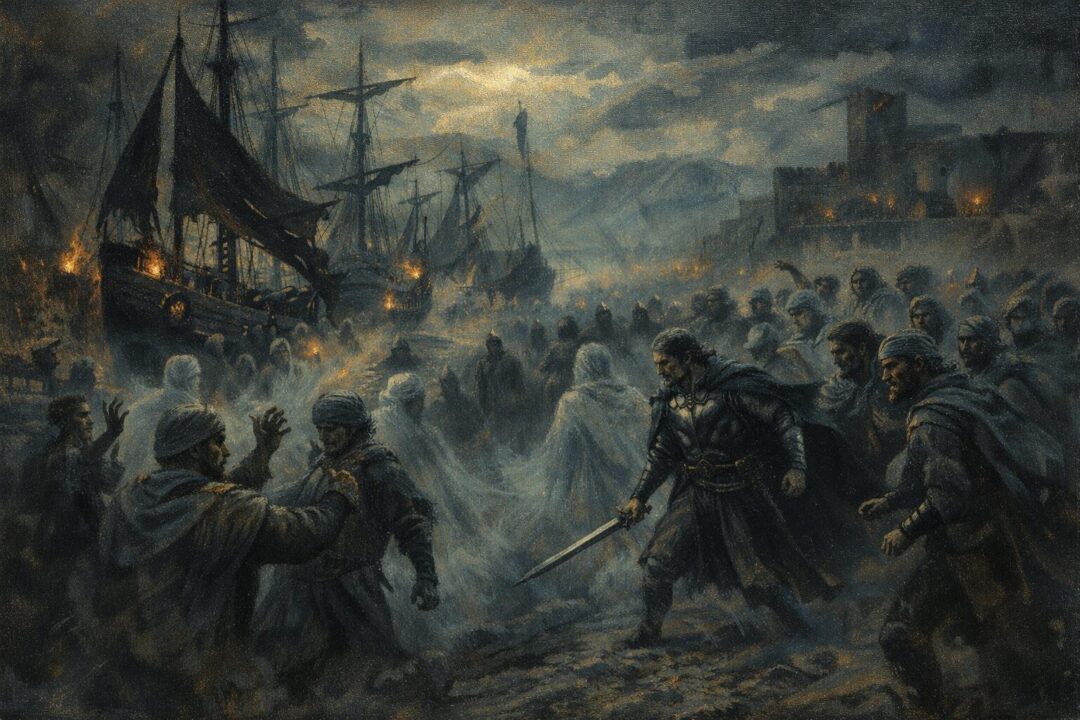
One of the most misunderstood moments in The Lord of the Rings happens in darkness, under a black stone, among men who are no longer truly alive.
Aragorn’s meeting with the Dead is often remembered as a display of power.
He goes into the Paths of the Dead.
He summons the oathbreakers.
They follow him.
They help defeat the Corsairs.
Then they vanish.
That is the outline most people carry away.
But the text gives something more exact than that.
What happens at Erech is not merely command. It is not raw magic. And it is not a random act of mercy. Aragorn is stepping into an old legal and moral relationship — one created by oath, broken by treachery, and preserved across generations until the heir of the wronged king returns to settle it.
That is why the scene feels so severe.
The Men of the Mountains had sworn allegiance to Isildur at the Stone of Erech in the early days of Gondor. Later, when Sauron rose again and Isildur called on them to fulfill that oath, they refused, for they had once worshipped Sauron in the Dark Years. Isildur then declared that they would have no rest until their oath was fulfilled. The result is not described as a temporary haunting or a local legend. It lasts through the long centuries, until the War of the Ring itself.
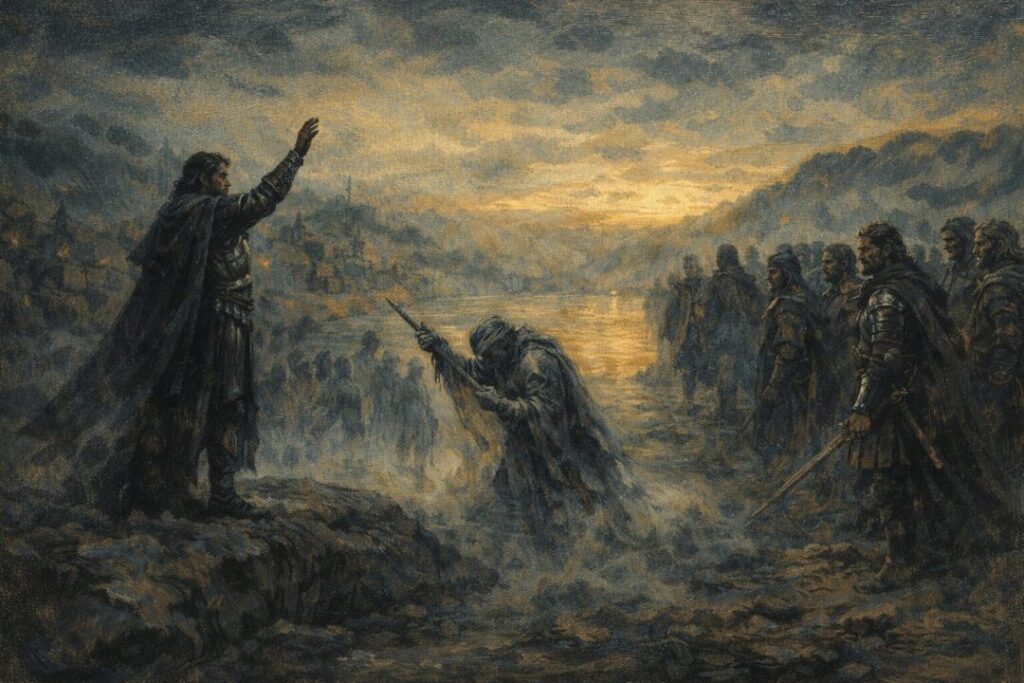
The important thing here is that the original bond is not vague.
This is not a general promise to be “good allies someday.”
It is sworn allegiance, tied to a king and to war against Sauron.
Aragorn says as much when he explains the matter before ever reaching Erech: the oath they broke was to fight against Sauron, and therefore fight they must if they are to fulfill it. That line matters because it tells you the obligation is specific. Their release cannot come from apology, pity, or mere presence. It can only come from performance. They must finally do what they once refused to do.
Then comes the second crucial point: Aragorn is not acting as an unrelated hero who happens to discover them.
The prophecy recalled in The Return of the King says the oathbreakers will answer “the heir of him to whom the oath they swore.” That wording narrows the field. The Dead are not waiting for any brave captain, or even any king in the abstract. They are waiting for the heir of the man against whom they broke faith.
This is why Aragorn identifies himself so explicitly at Erech.
He does not simply say “follow me.”
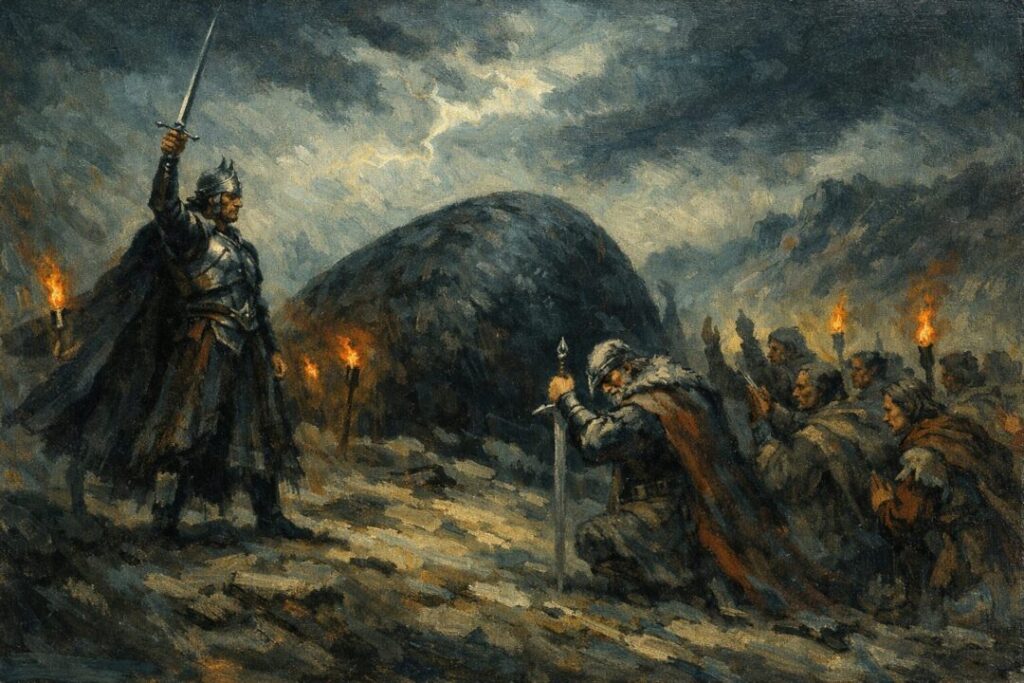
He says, in substance, that the hour has come, that they are to come after him to Pelargir, and that when the land is cleared of the servants of Sauron, he will hold the oath fulfilled — “for I am Elessar, Isildur’s heir of Gondor.” In other words, Aragorn is not claiming authority by force alone. He is claiming standing. He is the lawful successor in the exact line that the oath concerned.
That is where the “legally binding” idea becomes useful — so long as it is used carefully.
Middle-earth does not run on modern contract law. There is no courtroom at Erech, no written charter produced, no procedural hearing. So if “legal” is taken in a narrowly modern sense, the phrase would be misleading.
But if by “legal” we mean formally binding under the recognized structures of oath, lordship, inheritance, and public authority, then the scene absolutely works that way.
The Men of the Mountains swore allegiance to Isildur at a public monument of overlordship. Aragorn comes not merely as a descendant by blood, but as the acknowledged heir of Isildur. He states the terms under which the old obligation will now be considered discharged. Then, after those terms are satisfied, he publicly declares the oath fulfilled and orders them to trouble the valleys no more. That is not improvisation. It is judgment.
And Middle-earth gives strong evidence elsewhere that oaths are treated with extraordinary seriousness.
Elendil is said to have bound the Last Alliance with an oath and invoked Eru as witness, an act described as exceptionally solemn among the Númenóreans. Much later, the Oath of Cirion and Eorl is likewise framed in sacred and constitutional terms, with Eru’s name invoked again in a setting bound up with kingship and legitimate authority. These examples matter because they show that in Tolkien’s world, oath and public rule are not separate categories. Political bonds are often also sacred bonds.
That does not prove that Isildur invoked Eru in the oath at Erech; the text does not say that, and it would go too far to claim it.
But it does show the world Aragorn inhabits.
In that world, an oath is not just a promise between two private persons. It can attach to office, lineage, memory, and fate. It can survive the death of the original parties. And when the rightful heir returns, the obligation does not disappear as ancient history. It becomes present again.
This also explains why Aragorn’s promise to the Dead is so narrowly framed.
He does not promise them unlimited use in every battle of the war.
He does not drag them all the way to Minas Tirith for one last overwhelming victory.
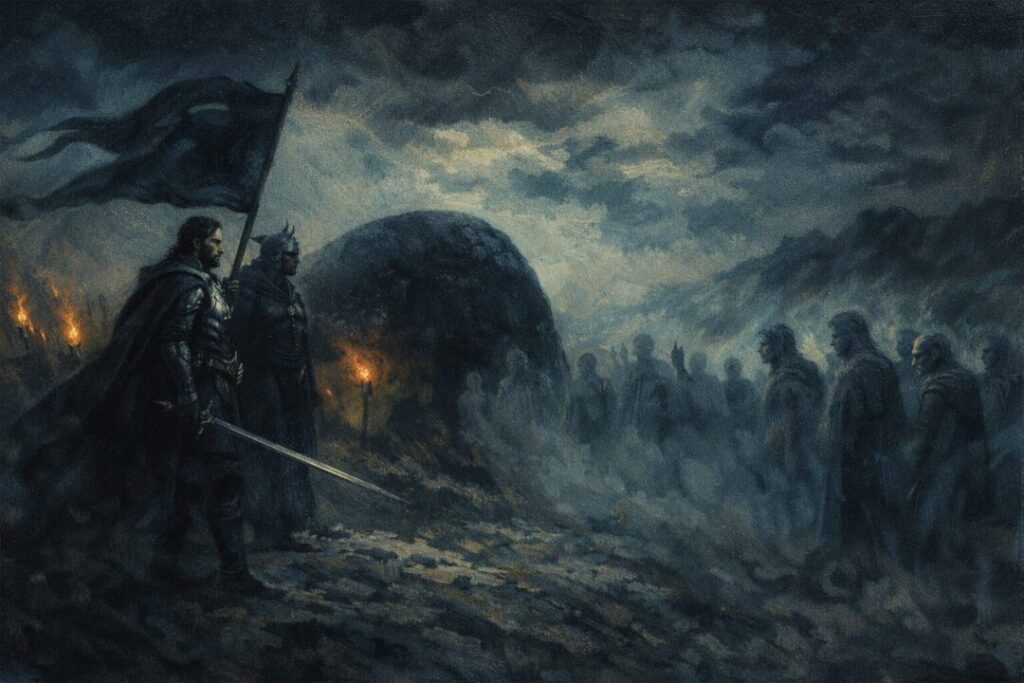
In the book, he names Pelargir and ties their release to clearing the land of Sauron’s servants there and along the way. After they help drive out the enemy at Linhir and Pelargir, Aragorn declares the oath fulfilled and releases them.
That detail is easy to miss if you are thinking only in terms of military convenience.
Why release such a terrifying force so quickly?
Because Aragorn is not free to redefine the bond however he likes. The text suggests the opposite: he comes to settle a specific inherited obligation, not to exploit cursed men indefinitely. Once the condition he named has been met, he keeps his word. In fact, keeping his word is part of what proves him worthy of kingship.
And that gives the whole episode a different emotional shape.
Aragorn is not simply master of the Dead.
He is the man who can finally end their long punishment.
When he calls them, he is not beginning the story. He is entering it at the last possible moment. The oath was broken long ago. The curse was already in force. The prophecy had already marked that one day the heir would come. Aragorn’s role is to bring the old matter to completion — first by demanding performance, then by recognizing it as complete.
That is why his words matter so much.
He promises them peace, but not immediately.
He promises departure, but only after service.
He promises release, but only once he himself “will hold the oath fulfilled.”
That final phrase is the heart of the matter.
The Dead do not free themselves by deciding they have done enough. The fulfillment must be acknowledged by the heir of Isildur — the same line through which the original claim still stands. Aragorn is therefore acting almost like a final judge in an inherited case, except that in Middle-earth judgment is not separate from kingship. It belongs to it.
So what did Aragorn actually promise the Dead?
Not pardon without cost.
Not automatic salvation.
Not a vague “help me and you’ll be free.”
He promised them this: follow me to Pelargir, help clear the land of Sauron’s servants, and then I — as Isildur’s heir — will hold your ancient oath fulfilled, and you shall have peace and depart forever. That is why the promise carries such weight. It answers the exact terms of the old failure with the exact authority needed to end it.
And once you see that, the Paths of the Dead stops being just one of the most eerie passages in the book.
It becomes one of the clearest windows into how Middle-earth thinks about rule itself.
A king is not merely someone who wins battles.
A king is someone who inherits obligations, speaks with rightful authority, and knows when a debt — even a centuries-old one — has truly been paid.