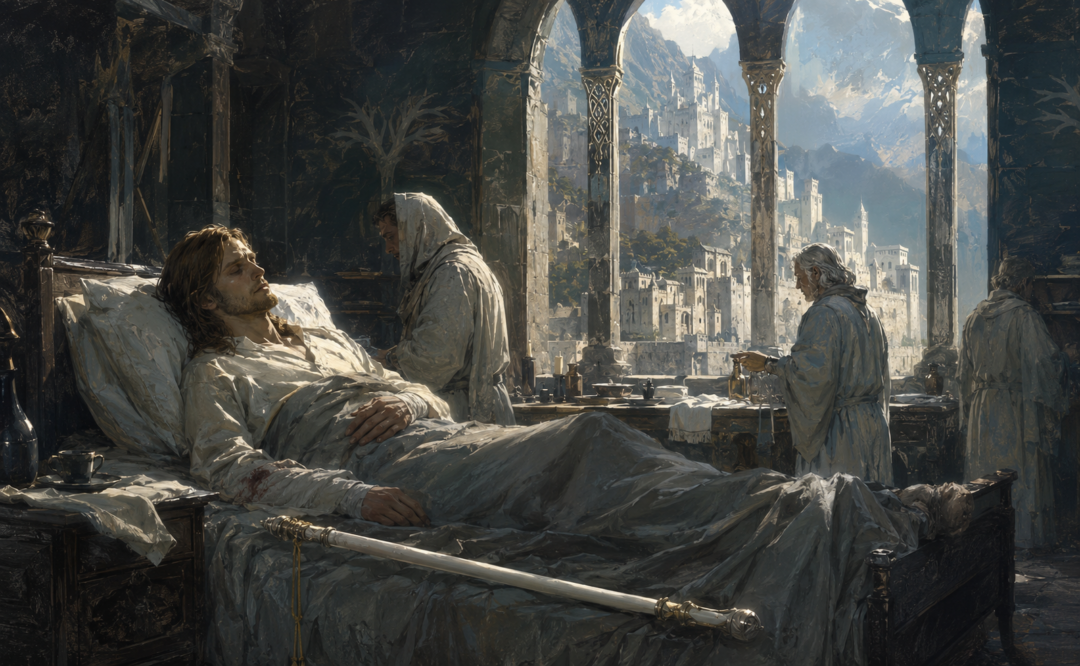
When Denethor dies in the fire of Rath Dínen, Gondor does not suddenly become a realm without lawful government.
The White Tower still stands. The royal throne is still empty. Aragorn has not yet been crowned. And Denethor’s surviving son lies wounded in the Houses of Healing.
Yet the succession is already clear.
When Imrahil asks after the Steward following the Battle of the Pelennor Fields, Gandalf answers that Faramir “is now the Steward,” because Denethor has departed. The transition does not require an election, a coronation, or even Faramir’s conscious participation. The Stewardship has long been hereditary.
That creates an unusual constitutional moment. For several weeks, Faramir possesses the authority that his father exercised over Gondor — but he inherits an office whose entire legal purpose is to surrender that authority if the King truly returns.
So how much power does Faramir actually have?
The answer is surprisingly broad.
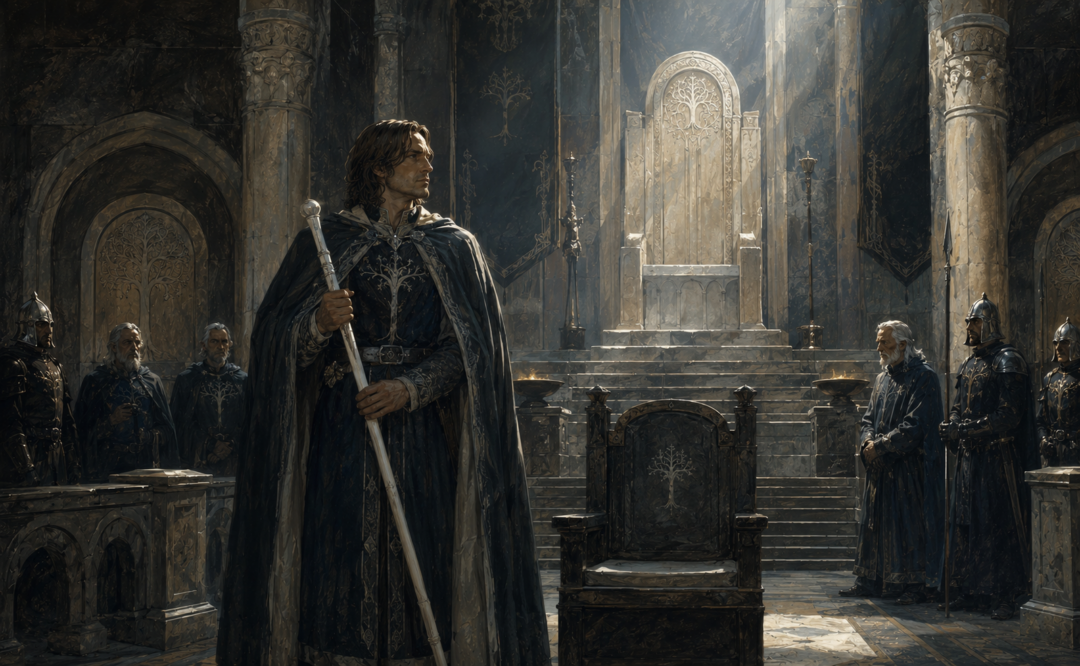
Faramir Inherits the Stewardship Automatically
By the late Third Age, the Stewardship of Gondor is not merely an appointment that must be renewed by some council.
Appendix A explains that after the time of Pelendur the office became hereditary “as a kingship,” passing from father to son or to the nearest kin.
That distinction matters.
Denethor does not have to nominate Faramir before his death. Nor does Prince Imrahil become Steward merely because Faramir is incapacitated. Faramir succeeds because he is Denethor’s surviving heir in the hereditary House of the Stewards.
This is why Gandalf can state immediately that Faramir is now Steward even while Faramir is gravely wounded.
Actual command during the crisis is another matter. While Faramir cannot govern personally, Imrahil assumes an enormously important practical role in Minas Tirith and in the military leadership of Gondor.
But Imrahil is not thereby replacing Faramir in the hereditary office.
Faramir is Steward.
And that office carries far more authority than the modern word “steward” might suggest.
The Ruling Steward Possesses Almost Royal Power
Gondor’s Stewards originally served its Kings as high officers and counsellors. Their role changed after King Eärnur disappeared in Third Age 2050 without an accepted heir succeeding him.
Mardil Voronwë began governing in the King’s name, and his descendants continued doing so for nearly a thousand years.
Appendix A gives the crucial constitutional principle: the Stewards eventually “exercised all the power of the kings.”
That means Faramir does not inherit some narrowly administrative caretaker position.
Until a lawful King assumes the throne, he possesses the governing authority of Gondor.
In practical terms, the precedent of earlier Stewards indicates extremely wide powers. They directed armies, organized Gondor’s defenses, governed provinces, maintained foreign relations, and made decisions affecting the realm as a whole.
One of the strongest examples comes from the Steward Cirion.
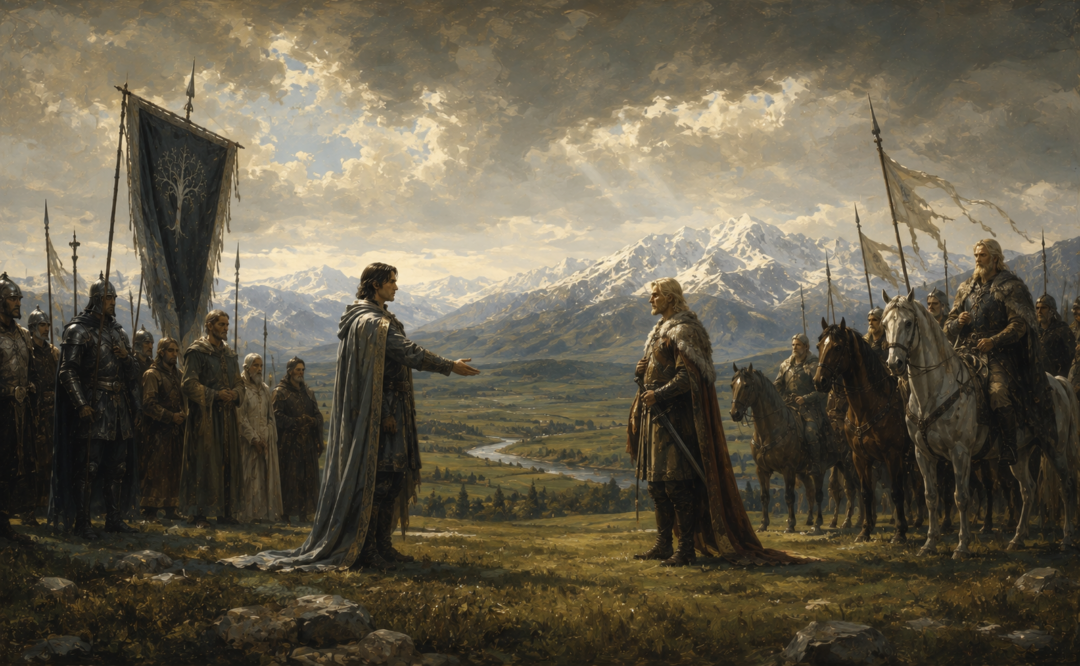
During the crisis that led to the alliance between Gondor and the Éothéod, Cirion exercised authority on an extraordinary scale. After Eorl came to Gondor’s aid, Cirion granted Calenardhon to Eorl and his people, creating the political arrangement from which Rohan emerged. The detailed account in Unfinished Tales presents this as a solemn and binding act of the Ruling Steward.
If Cirion could make a territorial settlement of that magnitude, Faramir’s theoretical governing authority after Denethor’s death is clearly not trivial.
He is capable of ruling the realm.
Faramir Can Command Gondor’s Forces
Military authority is among the clearest powers available to him.
Denethor had exercised supreme direction over Gondor’s defense. Earlier Ruling Stewards had likewise commanded wars, deployed forces, fortified borders, and appointed captains.
Faramir therefore inherits the legal authority to issue military orders once he succeeds his father.
There is an important difference between possessing authority and personally exercising it, however.
Faramir spends the decisive days after the Pelennor unconscious or recovering. Command therefore falls practically to men who can act: Gandalf during the defense of Minas Tirith, Imrahil as the leading Gondorian prince, and Aragorn in the coalition that marches against the Black Gate.
This does not demonstrate that Faramir lacks military authority.
It demonstrates that Gondor is operating during an emergency in which its lawful Steward is temporarily incapable of command.
Had Faramir been healthy immediately after Denethor’s death, the constitutional situation would have been very different. As Steward, he would have had an exceptionally strong claim to direct Gondor’s military decisions.
He Can Govern Without Becoming King
Here lies the great limitation on his power.
The Stewards may exercise the powers of kings, but they are not kings.
Each Ruling Steward traditionally takes office under an oath to hold “rod and rule” in the King’s name until the King returns.
The distinction remains visible even after centuries without a monarch.
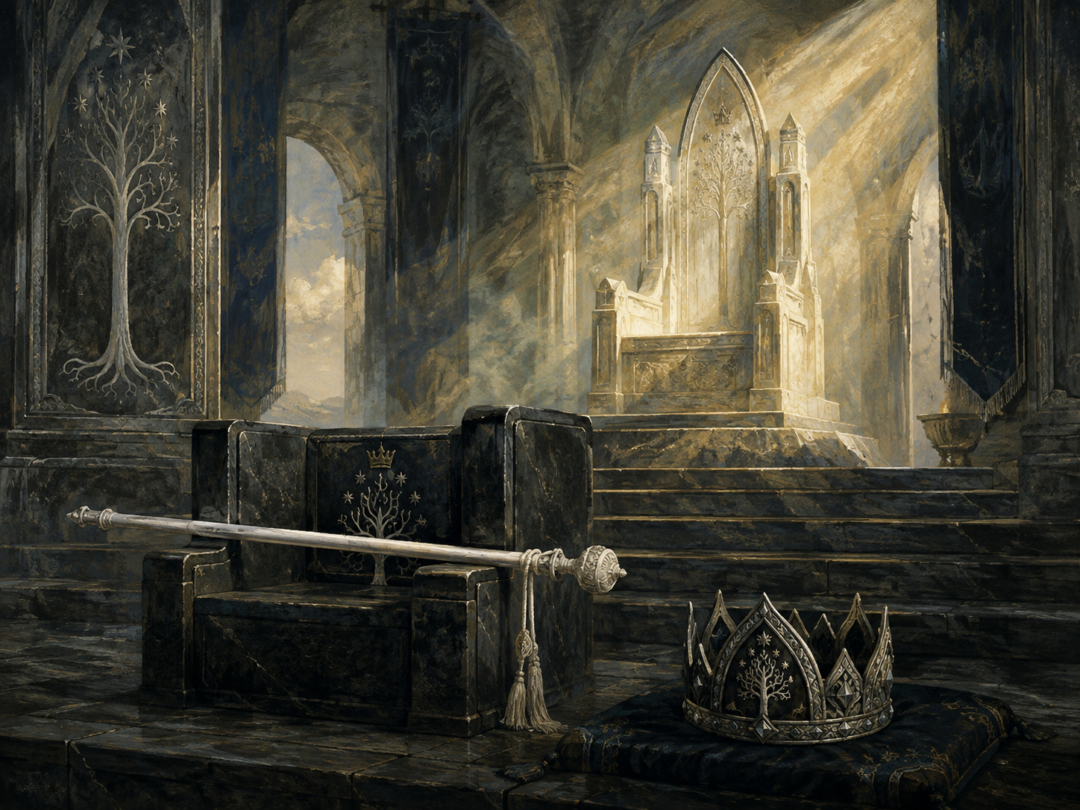
The Stewards do not wear Gondor’s crown. They do not wield a royal sceptre. They do not sit upon the ancient throne. Instead, the Steward bears a white rod and sits in a lesser seat below the King’s throne.
These are not merely decorative customs.
They express the theory upon which Stewardly government rests: the Steward governs because the royal office is vacant, not because the Steward has replaced it.
Faramir therefore cannot simply announce that nearly a thousand years without a crowned king have transformed his family into a royal dynasty.
The text addresses almost exactly that idea earlier in the story.
Faramir recalls Boromir once asking their father how many years must pass before a Steward becomes a King. Denethor’s answer is essentially that in Gondor, no passage of time would be sufficient.
The Stewardship can become hereditary.
Its powers can become practically royal.
Its holder still does not become King.
Could Faramir Refuse Aragorn?
This is the most interesting legal problem.
Aragorn’s arrival does not mean that any stranger claiming Númenórean descent could simply walk into Minas Tirith and order the Steward aside.
Gondor had rejected disputed royal claims before.
After King Ondoher and his sons were killed, Arvedui of Arthedain claimed Gondor’s crown through both descent from Isildur and marriage to Ondoher’s daughter Fíriel. Gondor did not accept that claim. Eärnil was ultimately chosen instead.
That history shows that identifying the rightful King could involve political and genealogical judgment rather than automatic obedience to anyone proclaiming himself heir.
So Faramir would presumably have been entitled to determine whether Aragorn’s claim was genuine.
What he could not legitimately do, according to the foundational principle of his office, was reject an acknowledged rightful King merely because he preferred to retain power.
Once the returning claimant is accepted as the lawful King, the Steward’s mandate reaches its endpoint.
That is precisely what happens.
Faramir does not behave as a defeated ruler surrendering to a conqueror. He performs the duty for which the Stewardship has existed for generations.
Aragorn Deliberately Waits Outside the City
Aragorn himself handles the situation with remarkable caution.
After the Battle of the Pelennor Fields, he does not immediately march into the Citadel and occupy the throne.
Instead, he initially enters Minas Tirith secretly to heal Faramir, Éowyn, and Merry, and afterward returns outside the walls.
His restraint matters politically.
The city has not yet formally received him as King, even though his deeds, lineage, the royal banner, the Sword Reforged, and especially his healing of the wounded increasingly identify him with Gondor’s returning kingship.
Only after Sauron has fallen does the formal transfer occur.
This avoids turning restoration into seizure.
Faramir remains the lawful Steward until the moment when Gondor publicly receives its King.
The White Rod Explains the Entire Constitution
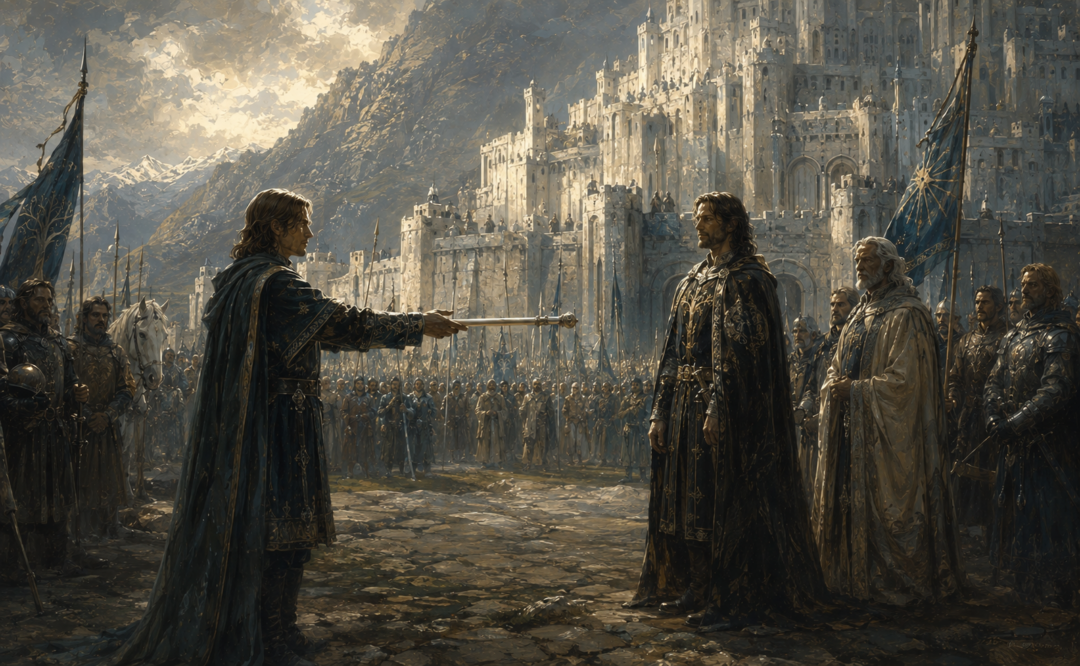
At Aragorn’s coronation outside Minas Tirith, Faramir comes forward carrying the white rod of Stewardship.
He surrenders it.
This act is enormously significant.
Faramir is effectively acknowledging that the authority he inherited from Denethor was never personal sovereignty. It was authority held conditionally in the name of a kingship that had remained vacant for centuries.
Aragorn then gives the rod back.
But its meaning has changed.
Faramir no longer rules because there is no King.
He serves because there is one.
Aragorn confirms Faramir and his heirs in the Stewardship and also makes him Prince of Ithilien. Under the restored monarchy, Faramir becomes one of the greatest lords of Gondor rather than its substitute sovereign.
The same man holds the same white rod.
The constitutional world around him has transformed.
Could Faramir Pardon Beregond?
Beregond provides a useful glimpse of where the transition becomes complicated.
He abandons his assigned post and kills men of the Guard in the hallowed precinct of Rath Dínen while preventing Denethor from burning Faramir alive.
His actions save the future Steward.
Yet Faramir does not simply erase the offense after recovering.
Instead, judgment eventually comes before Aragorn after his coronation.
The text does not explicitly tell us that Faramir legally lacked the power to judge or pardon Beregond beforehand. It would therefore be unsafe to invent such a restriction.
The episode does show something subtler.
Once the King’s return is imminent, major questions of royal justice can be left to the restored monarch. Aragorn acknowledges that Beregond has technically incurred the penalty of death, but he refuses to punish loyalty as though it were ordinary treason. Beregond is removed from the Guard of the Citadel yet appointed to command Faramir’s new White Company in Ithilien.
Law survives.
Mercy interprets it.
Faramir’s Greatest Power Is the Power He Gives Up
For the short interval between Denethor’s death and Aragorn’s coronation, Faramir stands at the summit of Gondor’s lawful government.
He can, in principle, exercise the enormous civil and military authority accumulated by the Ruling Stewards. Centuries of precedent show that Stewards can command armies, conduct diplomacy, administer territory, and make decisions with consequences far beyond Minas Tirith.
But there are symbols he cannot rightfully take.
The crown.
The sceptre.
The throne.
Those belong to the King.
That boundary is what makes Faramir’s brief rule so revealing. The Stewardship is powerful precisely because generations of Stewards accepted the fiction — or hope — that their authority remained borrowed.
Denethor comes to resent that limit. Faced with Aragorn’s possible return, he would rather see the old order preserved than become subordinate to another ruler.
Faramir responds differently.
When the King actually comes, he does the one thing every Steward has theoretically promised to do for nearly a thousand years.
He gives Gondor back.
And because he willingly relinquishes almost royal authority, he becomes not the last casualty of the House of the Stewards, but the founder of its place in the restored kingdom.
Sources & Notes
- https://www.glyphweb.com/arda/f/faramir.html
- https://www.glyphweb.com/arda/h/houseofstewards.html
- https://www.glyphweb.com/arda/c/cirion.html
Sources on Faramir’s succession, the hereditary House of the Stewards, and Cirion’s precedent for the wide authority exercised by a Ruling Steward.