When Gandalf stands on the Bridge of Khazad-dûm and confronts the Balrog, the moment lands with unusual force not just because of danger, but because of language.
He does not speak like a traveller cornered underground.
He does not even speak like a wizard using a spell.
Instead, he names realities that reach far beyond Moria.
The Secret Fire.
The Flame of Anor.
The Flame of Udûn.
For many readers, these phrases feel powerful before they feel understandable. That is part of why the scene endures. Even without fully grasping the words, we can feel that Gandalf is speaking from a depth the Balrog itself recognizes.
And the texts support that feeling.
Because this is not just a clash between two dangerous beings.
It is a confrontation between two servants of very different loyalties, drawing on two very different orders of fire.
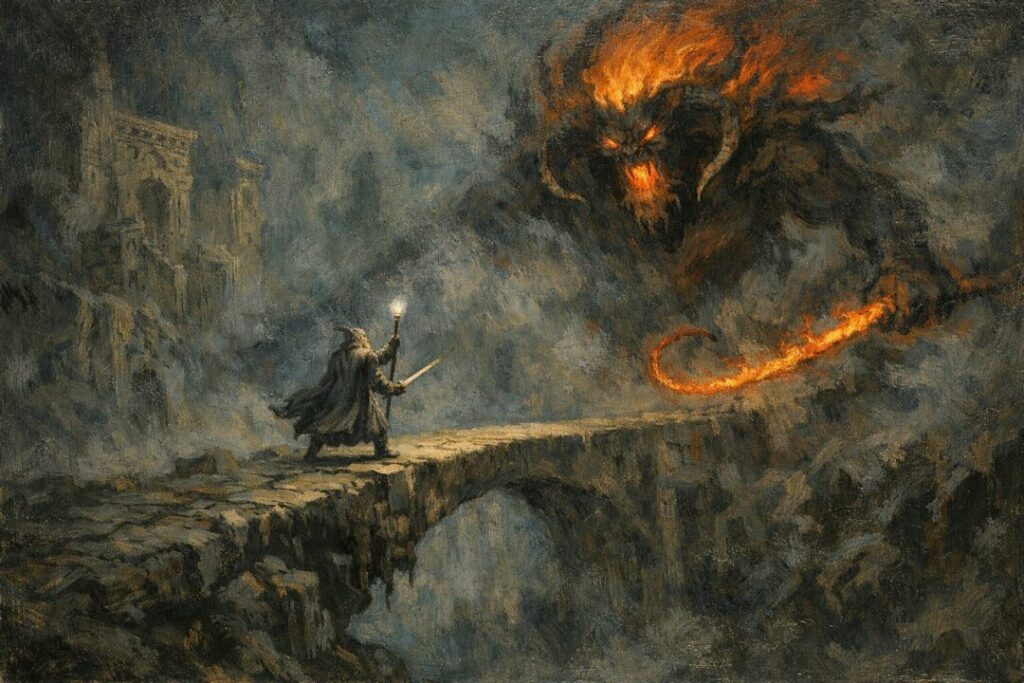
The Moment on the Bridge Is Bigger Than It First Appears
The Balrog of Moria is not merely a monster that wandered into the dark.
It is one of the Balrogs, the corrupted fire-spirits who served Morgoth in the Elder Days. In other words, Gandalf is not facing an ordinary evil thing. He is facing another Maia: an ancient spiritual being of the same broad order of existence as himself, though wholly fallen into the service of darkness.
That matters immediately.
When Gandalf speaks to the Balrog, he is not trying to frighten an animal or rebuke a brute.
He is identifying himself before an equal order of being.
That helps explain the solemnity of the exchange. Gandalf’s words are not ornamental. They are almost judicial in tone, as though he is stating under whose authority he stands and under whose darkness the Balrog has long remained.
What the Secret Fire Is
Of the three phrases, this one is the most important.
In the mythology of Arda, the Secret Fire is associated with the power by which true being and life come into the world. In the creation account, the Flame Imperishable is with Ilúvatar alone, and the Secret Fire is sent to burn at the heart of the World when creation is given being. Secondary lore references generally treat “Secret Fire” and “Flame Imperishable” as the same reality or as names for the same divine creative power.
That means Gandalf is not claiming to possess the Secret Fire as his own.
He says he is a servant of it.
That distinction is crucial.
Gandalf is placing himself under the authority of the true order of creation, not presenting himself as an independent source of power. The phrase suggests fidelity, rightful service, and alignment with the power that gives being rather than corrupts it.
This is one reason the line feels so absolute.
The Balrog is ancient, terrible, and fiery.
But Gandalf’s answer reaches beyond fire in the ordinary sense.
He invokes the fire that belongs to the world’s rightful making.
Why Gandalf Calls Himself a Servant
This part is easy to miss because the scene moves quickly.
The force of the line is not simply in “Secret Fire.”
It is in “servant.”
Gandalf is one of the Istari, and behind that role stands his deeper nature: he is a Maia sent into Middle-earth to resist Sauron, not by tyranny or domination, but as a messenger and guide. He is powerful, but delegated. He acts within a charge.
So when he identifies himself as a servant of the Secret Fire, the wording fits everything else we know about him.
He is not a rival god.
He is not a wielder of private, self-made power.
He stands in obedience to something higher.
And that makes the contrast with Morgoth’s servants even sharper.
Again and again in the legendarium, evil desires to possess, dominate, and create on its own terms. But the deepest creative fire is not available to the rebels. Melkor seeks the Imperishable Flame and cannot find it, because it is not his to seize.
Gandalf’s words on the bridge quietly reflect that same pattern.
He serves.
The Balrog has fallen.
What “Flame of Anor” Most Likely Means
This is the most debated phrase of the three.
What is certain is the word itself: Anor is the Sindarin name for the Sun. That much is straightforward.
So Gandalf is claiming to wield the flame of Anor, the flame of the Sun.
But what exactly does that mean?
The text does not define the phrase directly anywhere else, which means caution is necessary. We can say with confidence that Gandalf is invoking a form of light or fire associated with Anor, and that this stands in deliberate contrast to the Balrog’s “dark fire.” Beyond that, readers enter the territory of interpretation.
The safest reading is that Gandalf is naming the fire of the Sun as a symbol or manifestation of lawful, unshadowed light set against the Balrog’s corrupted flame.
That fits the immediate context.
The Balrog is a being of shadow, smoke, terror, and consuming fire.
Gandalf counters not with darkness turned against darkness, but with a fire linked to the visible light of the world.
Some readers try to tie “Flame of Anor” directly to Gandalf’s Ring, Narya, which is associated with fire. That is possible as interpretation, but the text never explicitly says that this line refers to Narya, so it is better not to state that as fact. What the text does give us clearly is the connection to the Sun and the contrast with the Balrog’s dark fire.
What “Flame of Udûn” Says About the Balrog
This phrase is easier to anchor.
Udûn is associated with Utumno, Morgoth’s first great fortress in the far north, a name linked with the deep places of the ancient underworld and the earliest stronghold of the first Dark Lord. When Gandalf names the Balrog “flame of Udûn,” he is not merely saying “creature of fire.” He is placing it in the lineage of Morgoth’s primeval darkness.
That is a remarkable thing to do in one phrase.
The Balrog in Moria is often remembered as a terror of the Third Age because that is when the Fellowship meets it. But Gandalf’s title reminds us that this being belongs to a much older story. It is a survivor of the Elder Days, a remnant of the first wars, a fire from the deep past still burning under the mountains.
And that makes the bridge scene feel suddenly older and darker.
Moria is not just a Dwarven ruin anymore.
For a moment, the First Age breaks through.
“The Dark Fire Will Not Avail You”
This part clarifies the whole exchange.
Gandalf opposes the Balrog’s fire not by denying that it is real, but by denying that it will avail.
In other words, the Balrog’s power is genuine, but insufficient.
Its flame is dark fire: corrupted, rebellious, tied to shadow and domination. Gandalf’s side of the contrast is the Secret Fire and the Flame of Anor, both associated with rightful being, true light, and the order of the created world.
This is why the scene is so much more than elemental imagery.
It is not fire versus fire in a simple magical duel.
It is one kind of fire set against another.
A fire of corruption against a fire of right order.
A fire of ancient rebellion against a fire that serves what the rebels could never master.
Why This Line Matters So Much
Many famous lines in The Lord of the Rings become famous because they summarize a character.
This one does more than that.
It briefly opens the entire cosmology of Middle-earth inside a single confrontation.
The line tells us what Gandalf is, without fully explaining it.
It tells us what the Balrog is, without pausing for exposition.
And it reminds us that beneath the journey of the Fellowship lies a much older struggle, one that began long before hobbits, rings, or even the kingdoms of Men.
That is why the words linger.
“Secret Fire” points to the deepest source of created being.
“Flame of Anor” points, at minimum, to the fire of the Sun and the light opposed to shadow.
“Flame of Udûn” names the Balrog as a servant of Morgoth’s ancient dark.
And once you see that, Gandalf’s stand on the bridge stops being only a heroic moment.
It becomes a revelation.
For a few lines in the dark below the mountains, the story lets us hear Middle-earth at its deepest level: not just courage against terror, but rightful fire answering the oldest shadow.
Sources & Notes
- J.R.R. Tolkien, The Lord of the Rings, Book II, Chapter 5, “The Bridge of Khazad-dûm” — gives Gandalf’s full challenge to the Balrog: “servant of the Secret Fire,” wielder of the “flame of Anor,” and “the dark fire” that will not avail the “flame of Udûn.”
- J.R.R. Tolkien, The Silmarillion, “Ainulindalë” — identifies the Flame Imperishable / Secret Fire with Ilúvatar’s creative power, which Melkor seeks but cannot possess.
- J.R.R. Tolkien, The Silmarillion, “Valaquenta: Of the Enemies” — describes the Balrogs as Maiar corrupted to Melkor’s service, spirits of fire wrapped in shadow and terror.
- J.R.R. Tolkien, Unfinished Tales, “The Istari” — explains Gandalf’s nature and mission as one of the Maiar sent as a messenger and guide, supporting the article’s emphasis on delegated service rather than self-made power.
- J.R.R. Tolkien, The Silmarillion, “Of the Sun and Moon and the Hiding of Valinor” — gives Anor as the Sun and places its light within the blessed, lawful order opposed to Morgoth’s darkness.