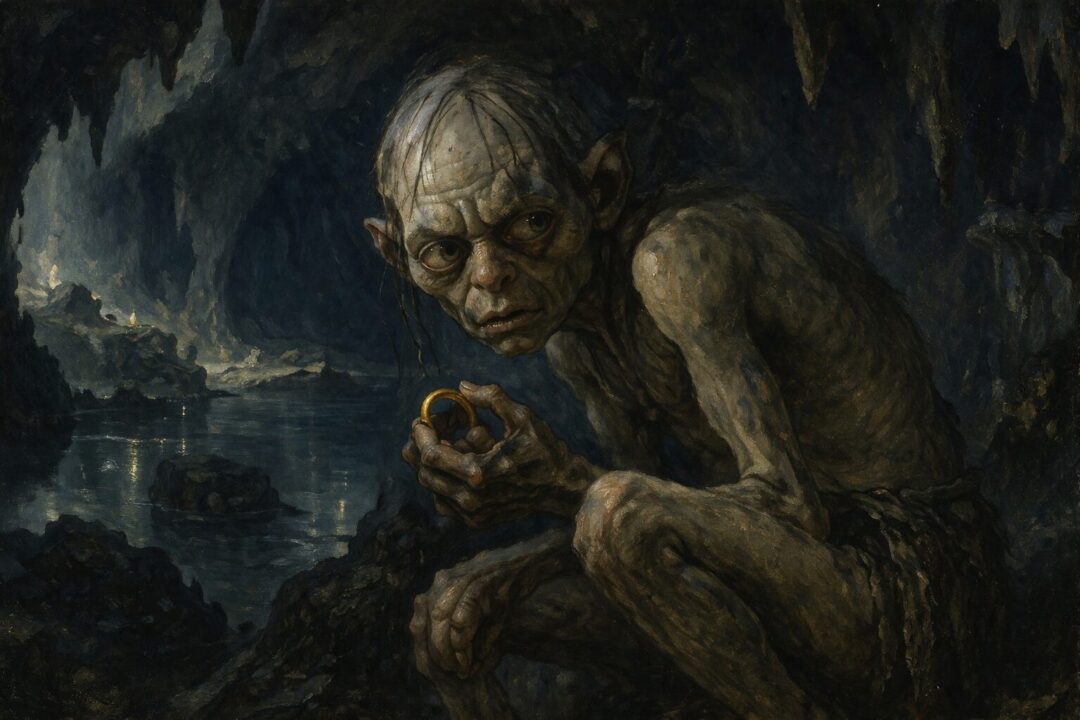
Most people assume Gollum should have become a Ringwraith.
At first glance, that seems almost unavoidable. He possessed the One Ring for centuries. It unnaturally prolonged his life. It hollowed out his mind, sharpened him for malice, and turned him into something far removed from the Stoor-hobbit Sméagol who once lived near the Gladden. Gandalf says plainly that the Ring “had given him power according to his stature,” and that he used it for “crooked and malicious uses.”
So why did he not become like the Nazgûl?
The answer is not that Gollum was unharmed. He plainly was not. Nor does the text say that hobbits are somehow immune to the Ring. Gollum, Bilbo, and Frodo all bear real scars from it. But the story also does not treat all Ring-corruption as identical. Once that distinction comes into view, the puzzle changes.
Gollum did not become a wraith because the books present wraithing as a more specific fate than simple corruption.
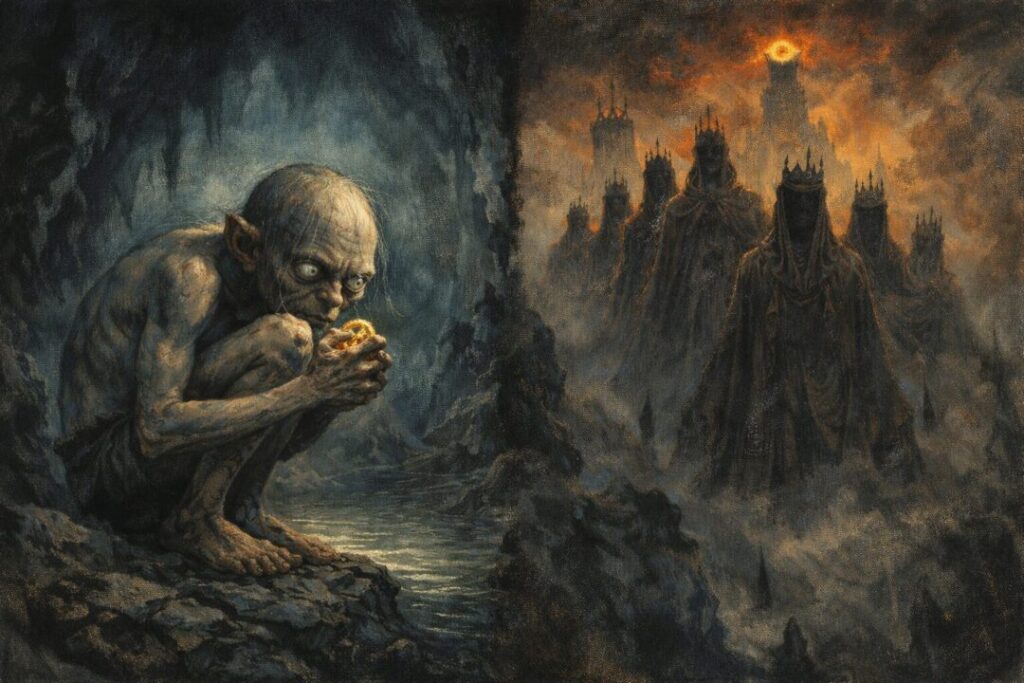
Corruption and wraithhood are not the same thing
This is the first distinction that matters.
The Ring corrupts. That is obvious in Gollum almost at once. After murdering Déagol, he uses the Ring to discover secrets, to avoid notice, and to feed the worst parts of his nature. What follows is spiritual and moral ruin. He becomes isolated, bent inward, suspicious, hungry, and increasingly cut off from ordinary life.
But corruption is not yet the same thing as becoming a wraith.
When Gandalf explains the danger of the Ring to Frodo, he does not describe an immediate transformation into a Nazgûl-like being. He says that a mortal who keeps one of the Great Rings does not truly gain more life, but “merely continues,” until existence itself becomes a weariness. He adds that if such a bearer often uses the Ring to become invisible, he “fades,” and in the end becomes permanently invisible, walking in the twilight under the eye of the Dark Power.
That matters because it shows two things at once.
First, fading is real. Gollum was on a path of deformation, not preservation. The Ring had already dragged him far from natural life. Second, the process is described as gradual, uneven, and bound up with usage, longevity, and the bearer’s condition. The text does not suggest that every bearer reaches the same final state at the same speed.
So the real question is not, “Why was Gollum unaffected?”
It is, “Why did his corruption stop short of the Nazgûl’s condition?”
The Nazgûl are a special case
The clearest answer begins with the Nine.
The Ringwraiths are not simply people who held a Ring for a long time. They are Men who received the Nine Rings of Power and through them became mighty in their age: kings, sorcerers, and warriors. They gained glory and wealth, their lives were unnaturally extended, they could move unseen, and in time they passed into the wraith-world and fell wholly under Sauron’s domination. The tradition about them is specific, repeated, and consistent.
That specific pattern should not be blurred.
The Nazgûl are what happened when Sauron ensnared Men through rings deliberately given for domination. Their wraithhood is not just an example of generic corruption. It is the end of a designed enslavement.
Gollum’s case is different in several ways.
He is not one of the Nine.
He is not a king, lord, or sorcerer raised up through one of Sauron’s distributed Rings.
And although the One Ring certainly corrupts him, he does not hold it in the same framework by which Sauron elevated and mastered the future Nazgûl.
That does not mean the One is gentler. In some ways it is more dangerous. But its effects are not presented as identical in every bearer.
The books distinguish between bearing the Ring, being stretched by it, fading under it, and becoming one of Sauron’s wraith-servants.
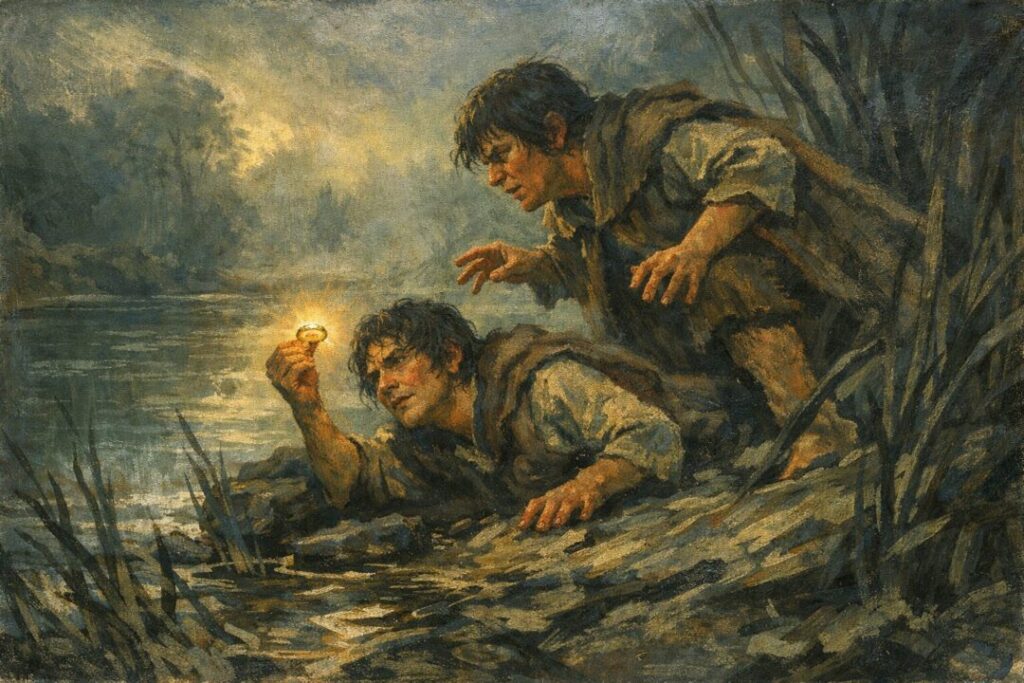
Gollum was horribly changed, but not wholly emptied
One of the most important lines about Gollum comes much later, when Gandalf says that “even Gollum was not wholly ruined.” He goes further: Gollum had proved tougher than the Wise would have guessed, “as a hobbit might,” and there remained “a little corner of his mind” still his own.
That is a remarkable statement.
It does not soften Gollum’s evil. He is still murderous, treacherous, and consumed by obsession. But the text refuses to describe him as spiritually erased. Something persists in him that can still respond, however faintly, to pity, memory, and kindness. That is very different from how the Nazgûl are usually presented in the late Third Age: they are Sauron’s most terrible servants, dominated, emptied of ordinary independent life, and bound to his will.
This is where hobbit-kind likely matters, though carefully.
The text does not say, “Hobbits cannot become wraiths.” It never gives such a rule. But Gandalf does explicitly connect Gollum’s surprising endurance to the fact that he is hobbit-like. That suggests hardiness, not immunity. It suggests resistance, not safety.
In other words, Gollum’s nature may have slowed or altered the Ring’s progress in him.
He is not preserved in health.
He is preserved in misery.
And that is not the same thing as passing fully into the condition of a Ringwraith.
The Ring gave him power only “according to his stature”
Another quiet clue lies in Gandalf’s wording about Sméagol’s early use of the Ring.
He says the Ring gave him power “according to his stature.”
That line is easy to pass over, but it helps explain why Gollum’s corruption takes the form it does.
Gollum does not become a mighty ruler. He does not rise into public greatness. He does not build a realm, gather followers, or exercise dominion like the Men who became Nazgûl. The Ring amplifies what he is capable of being. In his case, that means secrecy, spying, petty malice, survival, and obsession.
This does not make his condition smaller in moral seriousness.
It makes it narrower.
The Nine became terrible through power exercised outward into the world: wealth, rule, sorcery, renown, and eventually enslavement. Gollum collapses inward. He becomes furtive rather than imperial. He is consumed by possession, not enlarged by dominion. That distinction is partly interpretive, but it fits the textual pattern closely. The Ring works on him, yet not along the same visible line it worked on the Men of the Nine.
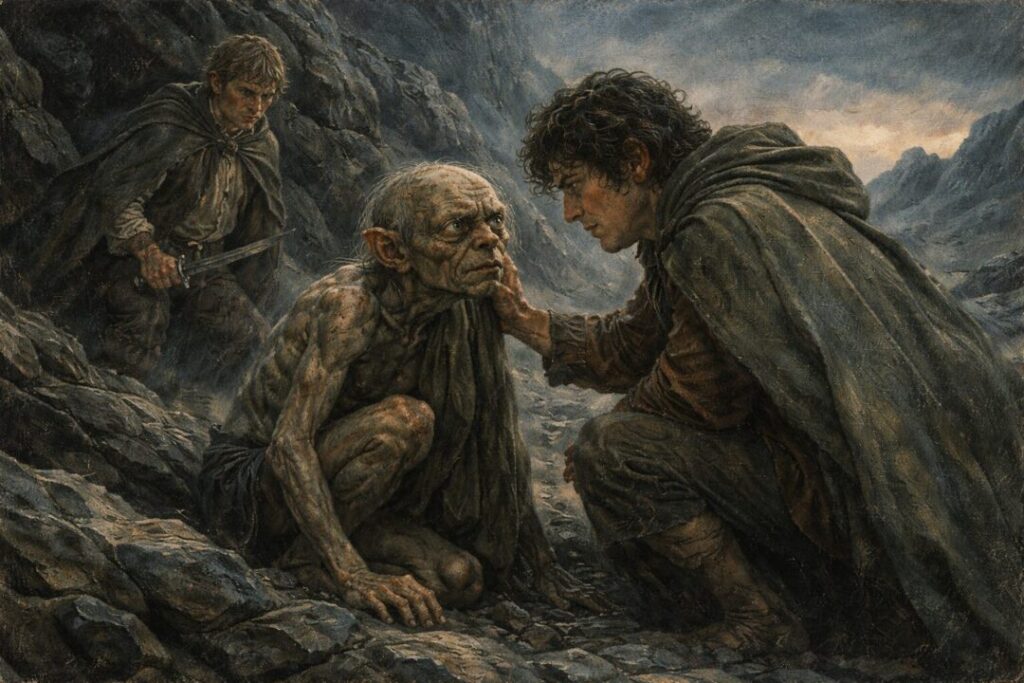
Losing the Ring matters too
Another part of the answer is often overlooked.
Gollum does not keep the Ring forever.
Gandalf tells Frodo that Gollum would never have willingly cast it away; the Ring itself left him. That ended one stage of its direct hold. Gollum remained enslaved to desire for it, and the damage done to him did not heal, but the centuries of constant possession stopped before the story’s end.
That is significant because Gandalf’s description of fading is tied to keeping and using a Great Ring over time. Gollum had already been deformed by long possession, but once the Ring slipped away, the process was no longer continuing in exactly the same way. He remained unnaturally sustained for a while, but what we see afterward is addiction, fixation, and spiritual ruin rather than a completed passage into full wraithhood.
This does not prove that he would never have become a wraith had he kept it longer. The text never states that. But it does mean the process was interrupted.
And in Tolkien’s world, interrupted corruption is still corruption.
It is just not always consummated in the same final form.
So why didn’t Gollum become a wraith?
Because the books do not treat “wraith” as the automatic result of bearing the Ring for a long time.
They treat it as the end-point of a more particular pattern: mortal fading, yes, but especially the Sauronic enslavement seen most clearly in the Men of the Nine. Gollum shares part of that road. He is stretched, diminished, secretive, half-detached from ordinary life, and profoundly corrupted. Yet he is also described as unusually tough, still partly retaining a self, and marked by hobbit resilience.
So the best conservative answer is this:
Gollum did not become a wraith because the Ring ruined him without yet reducing him to the Nazgûl’s fully dominated condition. His hobbit-kind seems to have made him more resistant than the Wise expected, the Ring worked on him according to his lesser stature, and the process of possession was interrupted when the Ring abandoned him.
That answer is less neat than people often want.
But it is also darker.
Because Gollum is not the story of someone who escaped the Ring’s worst power.
He is the story of someone who was destroyed by it in another way.
He did not become a crowned wraith riding out of Mordor.
He became something smaller, meaner, lonelier, and perhaps more tragic: a soul almost eaten away, but never emptied enough to lose the pain of remembering what he once was.
Sources & Notes
- J.R.R. Tolkien, The Lord of the Rings, Book I, Chapter 2, “The Shadow of the Past” — Gandalf explains how a mortal bearer who keeps and uses a Great Ring can fade, while also describing Gollum’s long possession and corruption.
- J.R.R. Tolkien, The Lord of the Rings, Book I, Chapter 2, “The Shadow of the Past” — the Ring gives Sméagol power “according to his stature,” shaping his corruption toward secrecy, malice, and obsession rather than lordship.
- J.R.R. Tolkien, The Lord of the Rings, Book I, Chapter 2, “The Shadow of the Past” — Gandalf says Gollum was not wholly ruined, had proved tough “as a hobbit might,” and still retained a small part of himself.
- J.R.R. Tolkien, The Silmarillion, “Of the Rings of Power and the Third Age” — describes how the Nine Rings extended mortal lives, made their bearers invisible, and finally brought them under Sauron as Ringwraiths.
- J.R.R. Tolkien, The Letters of J.R.R. Tolkien, Letter 131 — Tolkien’s summary of the Rings emphasizes power, domination, invisibility, and the enslavement of the Nine to Sauron.