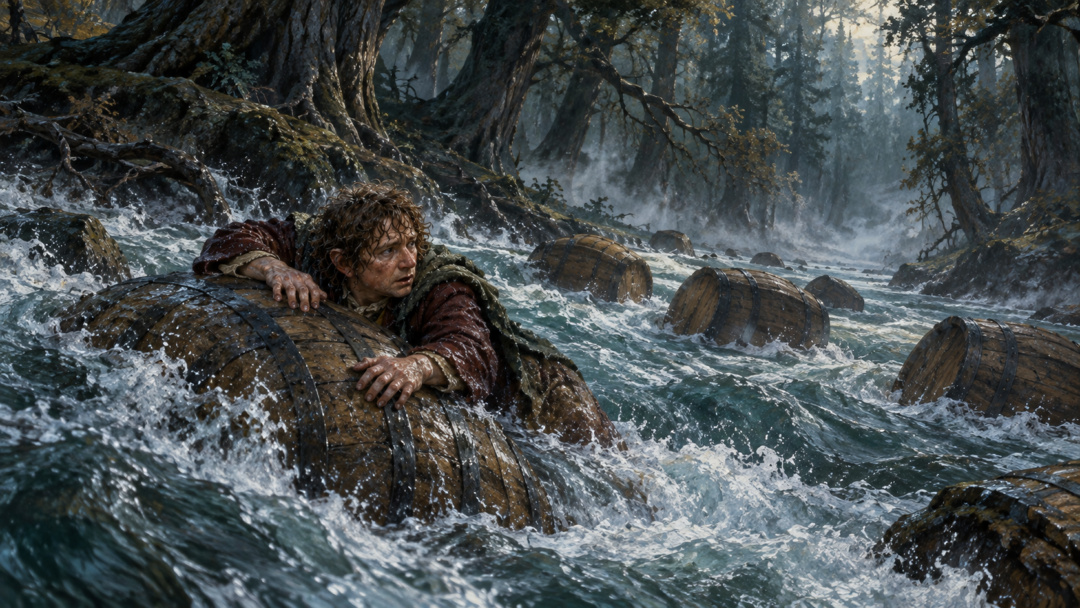
When Bilbo Baggins escapes the Elvenking’s halls in *The Hobbit*, he achieves something remarkable: he gets thirteen imprisoned Dwarves out of captivity without openly fighting their guards. Yet the escape contains a cruel little irony. The Dwarves are shut inside wooden barrels, unable to see where they are going or do anything to help themselves. Bilbo remains outside, awake and free to move.
And somehow, that freedom leaves him in a particularly miserable condition.
The difference is not simply that Bilbo gets wet while the Dwarves stay dry. Their barrels are uncomfortable, their confinement is frightening, and some emerge in a wretched state. But the wooden containers provide one advantage Bilbo does not possess: a barrier between their bodies and the cold river.
Bilbo must endure the journey without that protection. He is exposed to water, cold air, slippery surfaces, and the constant difficulty of remaining with the floating barrels.
The result is one of the most revealing physical contrasts in *The Hobbit*. The person who arranges everyone else’s escape must bear a hardship that his companions largely avoid.
The Escape Plan Has One Serious Weakness
Bilbo’s solution to the imprisonment of Thorin and his companions depends upon the empty barrels used in the Woodland Realm’s trade with the lands downstream.
The Dwarves can be concealed inside these containers and sent down the river toward the Long Lake. Once the barrels are closed, they can travel without revealing their presence to the Elves handling the cargo.
But Bilbo faces a problem that the others do not.
He must put the Dwarves inside their barrels and close them. Nobody is left outside to perform the same service for him.
His magic ring can make him invisible, but it cannot provide a second pair of hands to secure a barrel around him. Nor does invisibility protect him from water or cold.
This is the central weakness of the escape.
The Dwarves have a way to travel concealed within the cargo. Bilbo must somehow accompany that cargo from the outside.
His ingenuity solves the problem of imprisonment, but it does not solve the problem of his own physical safety.
The Dwarves Have Shelter, Not Comfort
It is important not to exaggerate the advantages of traveling inside a barrel.
The Dwarves are not passengers in comfortable boats. They are confined in dark wooden containers, with little room to move and no opportunity to observe the journey.
The account makes clear that the barrels are an unpleasant means of transportation. The Dwarves have to endure confinement, cramped positions, and the uncertainty of being carried downstream without control over their direction.
Some suffer badly from the experience.
Nevertheless, the barrels provide a form of protection that becomes increasingly important once the journey begins.
Their wooden sides separate the passengers from the surrounding river. Water can splash against the outside without striking the occupants directly in the same way it strikes Bilbo.
That distinction does not guarantee that every Dwarf remains perfectly dry. The story does not establish that all the barrels are completely watertight or that their passengers emerge unaffected by dampness.
What matters is the difference between being enclosed and being exposed.
The Dwarves must endure the discomfort of being shut inside their containers. Bilbo must endure the river itself.
Neither position is pleasant, but their hardships are fundamentally different.
Bilbo’s First Problem Is Staying Afloat
Bilbo’s journey is more complicated than simply sitting on a barrel and allowing the current to carry him away.
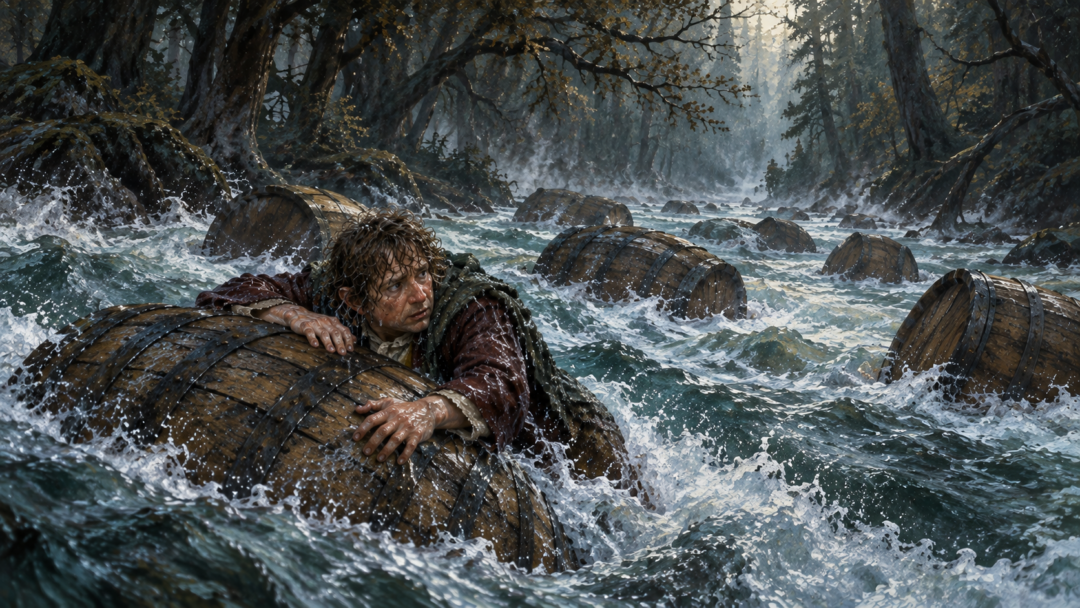
In Chapter 9, “Barrels Out of Bond,” he finds himself in the water and struggles to secure a place among the floating barrels.
This is a dangerous and uncomfortable situation for a small traveler already exhausted by the events inside the Elvenking’s halls.
The barrels are rounded, wet, and moving with the current. They are not designed to carry someone on their outer surfaces.
Bilbo cannot simply step aboard as he would a boat.
He has to cling to the floating cargo and find a position that allows him to remain above the water as much as possible.
The text describes his difficulty in getting onto a barrel and maintaining his position. Eventually, he manages to establish himself, but the achievement does not transform the journey into a comfortable ride.
His situation remains precarious.
A barrel offers no proper seat, railing, or stable deck. Its curved surface provides little security, especially when wet.
Even when Bilbo is no longer struggling directly in the river, he must remain alert to his position.
The Dwarves have no comparable need to grip the outside of their containers. Their barrels may move unpredictably, but the passengers are enclosed within them.
Bilbo’s freedom of movement comes with the burden of having to secure himself.
Cold Water Changes Everything
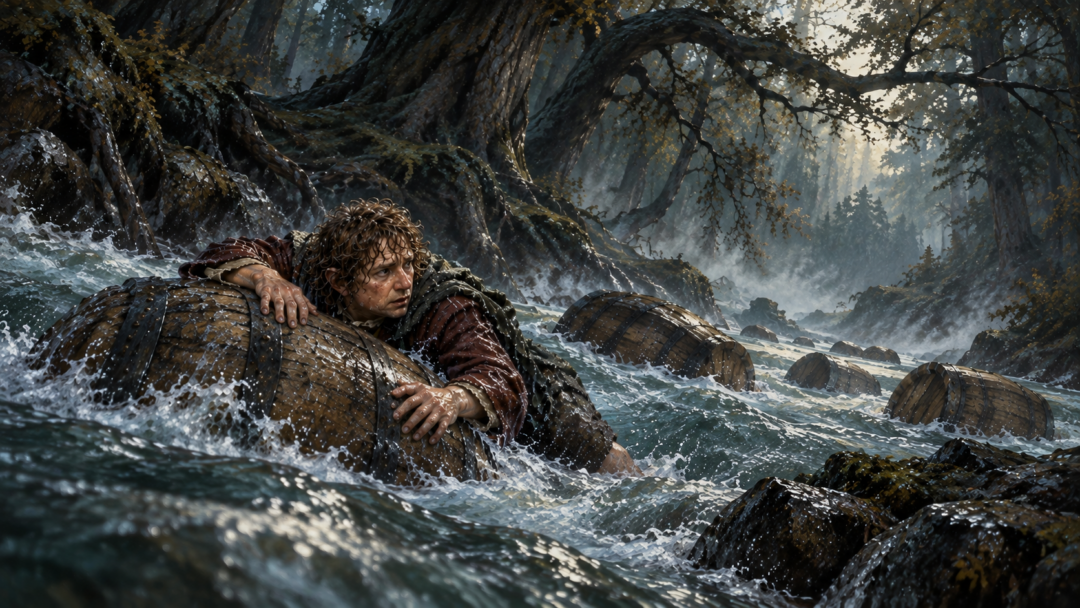
The most obvious physical cost of Bilbo’s exposed journey is his soaking.
The Dwarves are protected from direct contact with much of the river water by the walls of their barrels. Bilbo has no such protection.
His clothes become wet, and he is exposed to the cold conditions of the journey.
This matters because wet clothing makes an already uncomfortable situation considerably worse.
Water held against the skin can increase heat loss, particularly when combined with cold air and continued exposure. Bilbo has no convenient opportunity to dry his clothes, change into something warmer, or find proper shelter while traveling with the floating cargo.
The river journey therefore creates a hardship that continues even when he is not actively struggling to stay afloat.
He cannot escape the cold simply by getting more of his body above the surface.
His clothing remains soaked.
The narrative emphasizes how thoroughly miserable the experience becomes for him. His condition is not presented as a brief inconvenience that disappears once he has found a barrel to cling to.
The cold and wetness accompany him through the escape.
And unlike the Dwarves, he has no enclosing wooden walls to reduce his direct exposure.
Why Staying Awake Does Not Make Bilbo Safer
At first glance, Bilbo appears to have an important advantage over the Dwarves.
He remains conscious of his surroundings. He can see the river, recognize where the barrels are going, and attempt to adjust his position.
The Dwarves cannot do any of those things from inside their containers.
Yet awareness is not the same as control.
Bilbo does not command the river. He cannot steer the entire group of barrels or choose a comfortable route downstream.
He is carried by the same current as his companions.
His ability to see what is happening may help him respond to immediate difficulties, but it cannot remove the conditions that make the journey miserable.
Indeed, remaining outside requires more physical effort.
The Dwarves are confined, but they do not have to keep themselves attached to the outer surface of floating cargo. Bilbo must repeatedly contend with the practical consequences of his position.
This creates an important reversal.
The enclosed travelers surrender freedom of movement and awareness in exchange for a degree of physical shelter.
Bilbo retains awareness and some freedom to act, but must endure the weather and water directly.
His apparent advantage becomes a source of additional hardship.
The River Does Not Offer a Resting Place
Another important difference lies in the possibility of rest.
Inside a barrel, a Dwarf may be terribly cramped. There is no reason to imagine a comfortable sleeping position or an easy journey.
But the enclosed passenger does not need to maintain an external grip simply to remain with the cargo.
Bilbo’s position is different.
His security depends upon staying attached to the floating barrels and keeping himself in a position where he is not continually submerged.
This limits his opportunities to relax.
The text does not provide a precise measurement of how much energy Bilbo expends or how many times he must adjust his grip. It would be misleading to invent a continuous sequence of desperate struggles.
Nevertheless, the physical disadvantage is clear.
He has no secure passenger compartment.
He cannot rely upon the barrel to contain him in the same way it contains the Dwarves.
The journey demands attention from someone who is already cold, wet, and weary.
That combination helps explain why his condition deteriorates despite the fact that he remains outside the barrels and able to act.
The Journey Continues Beyond Mirkwood
The barrels carry the company away from the Woodland Realm and toward the settlements associated with the Long Lake.
For the Dwarves, the river journey is an ordeal endured largely without knowledge of their surroundings.
For Bilbo, it is a prolonged exposure to the world outside.
He experiences the passage of the river directly: its water, its movement, and the changing surroundings.
The contrast becomes especially meaningful as the barrels approach their destination.
The company is drawing nearer to freedom, but Bilbo has been paying for that freedom throughout the journey.
There is no moment when the mere fact of escape restores his comfort.
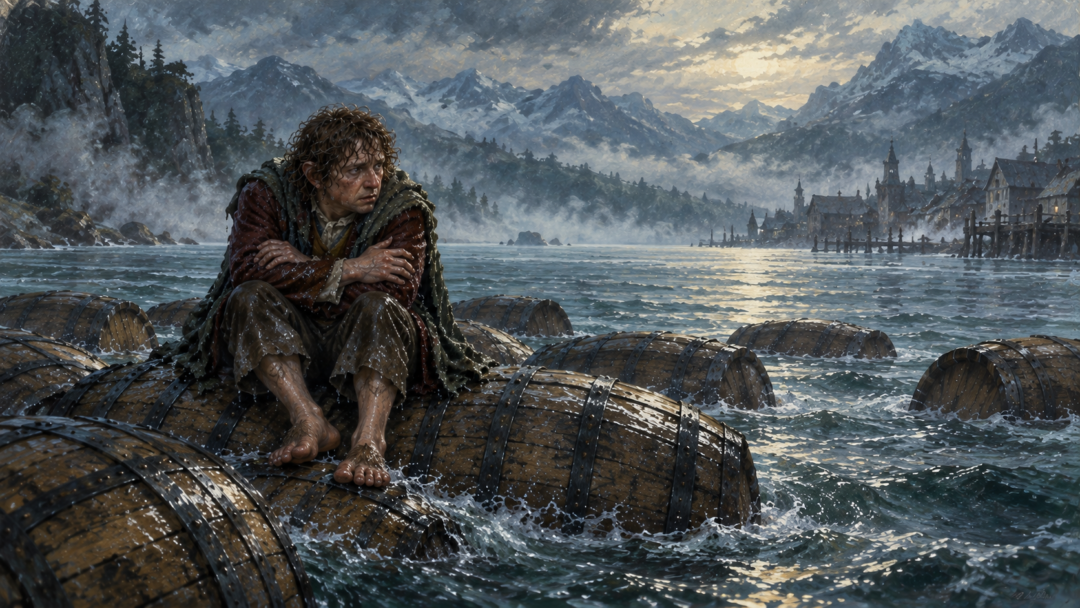
He remains a soaked and exhausted traveler who has had to accompany his companions in a manner never intended for passengers.
His experience demonstrates that reaching safety and recovering from hardship are not the same thing.
The escape can succeed while leaving its organizer in miserable physical condition.
What Happens When the Barrels Are Opened?
Chapter 10, “A Warm Welcome,” shows that the Dwarves have not escaped their own suffering.
When Bilbo begins releasing them from their barrels, their condition is far from admirable.
They are cramped, battered by their confinement, and in varying states of distress. Their journey has been sufficiently unpleasant that being enclosed cannot reasonably be described as a comfortable alternative.
This is where the comparison becomes more precise.
Bilbo’s ordeal is not necessarily worse than every individual Dwarf’s in every respect.
The story gives particular attention to the difficulties suffered by the enclosed passengers, and their conditions differ.
But Bilbo has endured a kind of hardship that the others have largely avoided: prolonged direct exposure to the cold river while trying to remain with the floating cargo.
The Dwarves’ suffering is primarily associated with confinement and the consequences of being transported inside barrels.
Bilbo’s suffering comes from having no such enclosure.
The two forms of discomfort are not interchangeable.
The Dwarves must recover from being shut inside their containers. Bilbo must recover from a journey that has left him soaked, chilled, and exhausted.
The Hidden Cost of Being the Burglar
The barrel escape also reveals something important about Bilbo’s changing role in the company.
At the beginning of the adventure, he is often treated as an unlikely companion whose usefulness remains uncertain.
By the time the company reaches the Woodland Realm, that situation has changed.
The Dwarves depend upon him to accomplish what they cannot accomplish from their prison cells.
His small size, invisibility, patience, and resourcefulness allow him to move through the Elvenking’s halls and arrange their escape.
Yet success places an unusual burden upon him.
Because he is the person outside the barrels, he cannot share the limited shelter his plan provides to everyone else.
The very circumstances that allow him to rescue the Dwarves prevent him from traveling as they do.
There is a quiet irony in this arrangement.
Bilbo’s companions are physically helpless during much of the escape, but their helplessness comes with a wooden barrier against the river.
Bilbo is the one who can still act, yet he is also the one left exposed.
The narrative does not need to present this as a deliberate sacrifice planned in advance. It arises naturally from the practical problem of getting everyone out.
Bilbo accepts the only workable position available to him.
And that position is miserable.
Why This Small Detail Matters
The barrel escape is often remembered for its cleverness.
Bilbo uses an ordinary feature of the Elvenking’s household to accomplish something that force could scarcely achieve. The Dwarves escape imprisonment, and the company continues toward the Lonely Mountain.
But the physical details prevent the episode from becoming a simple triumph of ingenuity.
The plan works, yet it is imperfect.
It protects the prisoners from discovery without protecting their rescuer from the river.
It gives the Dwarves enclosed transport while leaving Bilbo to struggle outside.
And it shows that a successful escape can still demand an unpleasant price from the person who makes it possible.
This is part of what makes Bilbo’s development convincing.
His growing courage does not mean that he becomes immune to discomfort, fear, or exhaustion. He remains a hobbit who suffers from cold, wet clothing, physical strain, and the absence of ordinary comforts.
His achievement is not that these things cease to matter.
It is that he continues despite them.
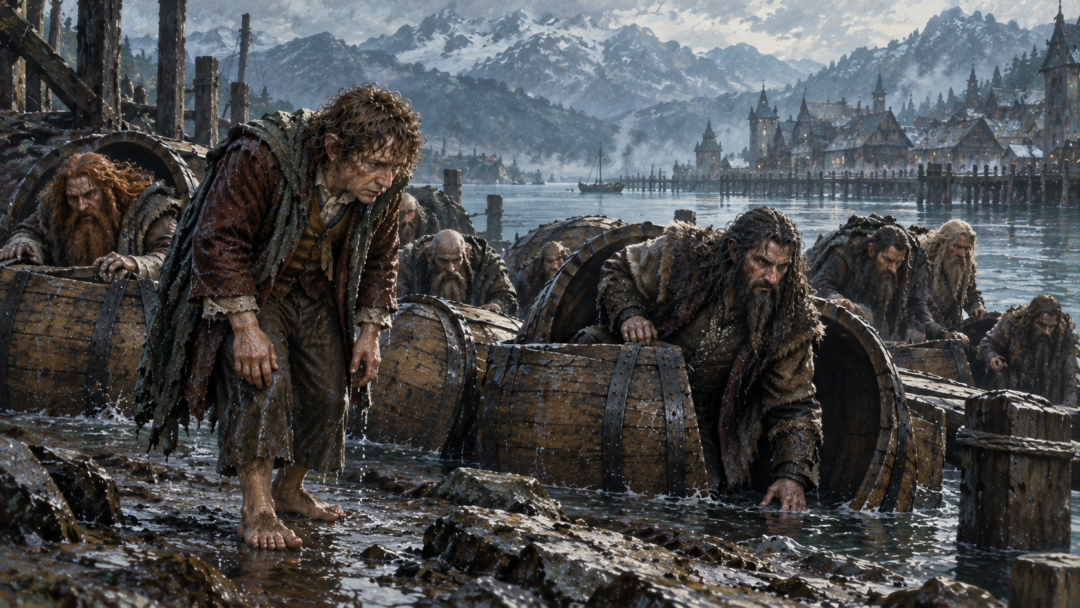
The Freedom That Leaves Bilbo Worse Off
The essential difference between Bilbo and the Dwarves is not courage, intelligence, or even the success of their escape.
It is shelter.
The Dwarves travel inside wooden barrels that restrict their movement and cause considerable discomfort, but largely separate them from the river.
Bilbo travels outside those barrels, exposed to cold water and air, struggling to find and maintain a secure position.
He can see where he is going, but he cannot control the current.
He can move, but he cannot rest securely.
He is free, but he has no protection from the journey itself.
That is why the escape leaves him so thoroughly miserable even though he remains conscious and capable of helping his companions.
The Dwarves pay for their passage through confinement. Bilbo pays through exposure.
And when the company finally reaches the lands around Lake-town, the contrast gives the episode its lasting significance: the hobbit who found a way to carry everyone else toward freedom is the one who had to face the river without a barrel around him.
Sources & Notes
- LitCharts — The Hobbit, Chapter 9: Barrels Out of Bond (Bilbo's escape plan and swimming alongside the barrels). https://www.litcharts.com/lit/the-hobbit/chapter-9-barrels-out-of-bond
- LitCharts — The Hobbit, Chapter 10: A Warm Welcome (Bilbo's cold and the exhausted Dwarves' release and recovery). https://www.litcharts.com/lit/the-hobbit/chapter-10-a-warm-welcome
- Penguin Random House — The Hobbit Teacher's Guide, Chapters 9–10 (Bilbo riding atop a barrel and the wet, bedraggled company's arrival and rest at Lake-town). https://www.penguinrandomhouse.com/books/179206/the-hobbit-by-jrr-tolkien/teachers-guide/
Primary reading: J. R. R. Tolkien, The Hobbit, Chapters 9 (Barrels Out of Bond) and 10 (A Warm Welcome). The linked chapter guides support the escape sequence, Bilbo's exposed river journey, and the company's recovery. The contrast between shelter and exposure is interpretation; the Dwarves' barrels are not claimed to be completely watertight or comfortable.