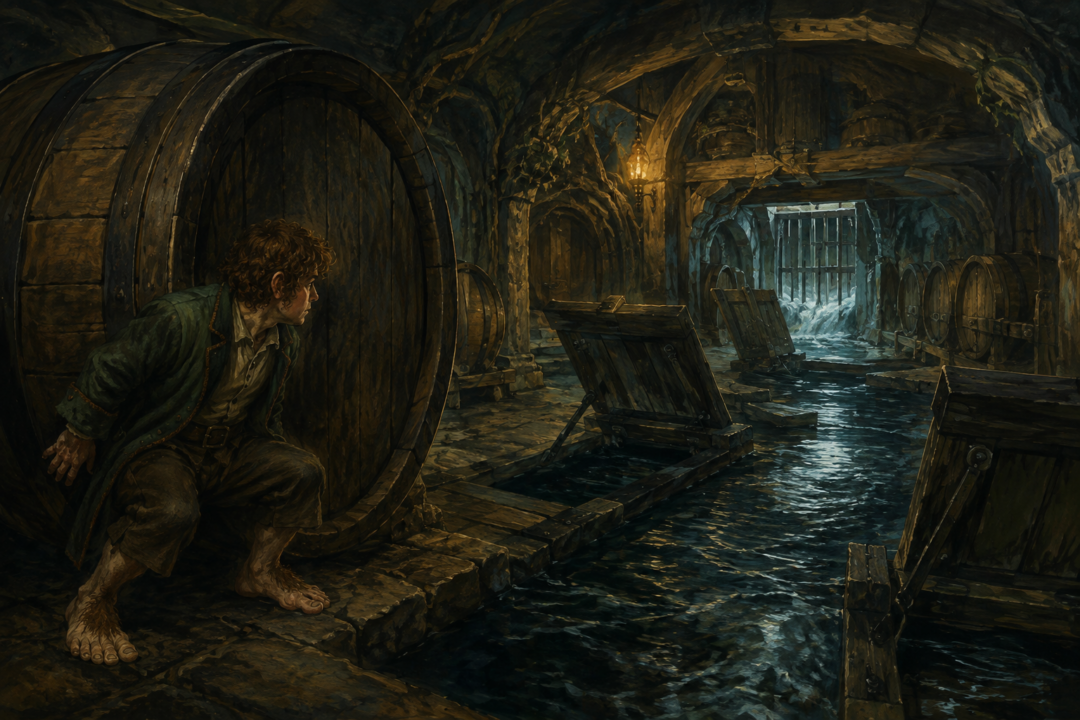
The most famous escape from the Elvenking’s halls begins with an absurdly simple object: an empty wine-barrel.
Bilbo Baggins has thirteen Dwarves locked in separate cells, an underground palace full of Elves around him, and no obvious route through the guarded main entrance. Then he discovers the water-gate beneath the cellars. Empty barrels are routinely dropped through trapdoors into the underground stream and eventually returned down the Forest River toward Lake-town.
That gives Bilbo a route.
It does not, by itself, give him an escape.
For the plan in “Barrels Out of Bond” to work, several independent safeguards have to fail almost simultaneously. The chief of the guards must become incapable of guarding his prisoners. His keys must become available. Bilbo must free thirteen captives without raising an alarm. The cellar workers must accept barrels that are suspiciously heavy. Later, Elves handling the barrel-raft must notice that something is wrong and still send it onward.
Read closely, the escape is not a demonstration that the Woodland Realm has no security. It is a demonstration of what can happen when a secure system becomes routine—and when Bilbo is patient enough to wait for several small failures to align.
The Elvenking’s Halls Are Not Easy to Escape
The first important point is that Bilbo does not simply walk into an incompetent prison.
The Elvenking’s halls are entered through great doors, and the underground waterway has its own defensive barrier. The stream passes beneath the caves and emerges through a water-gate protected by a portcullis. The text explains that this gate is frequently opened because considerable traffic passes through it.
That distinction matters.
The water-gate is not an accidental hole in the defenses. It is part of the Woodland Realm’s working infrastructure.
The Wood-elves trade beyond the forest. Wine and other goods arrive from distant places, passing through Lake-town and along the Forest River. Once barrels are empty, they are thrown through great oaken trapdoors into the stream beneath the cellars. The water-gate is opened, and the barrels float eastward to a collection point before eventually returning to Lake-town.
Bilbo does not invent a secret passage.
He discovers a supply chain.
And supply chains are difficult to secure precisely because they must keep moving.
Bilbo Has Time to Learn the Routine
Bilbo’s greatest advantage is not merely invisibility. It is observation.
After the Dwarves are imprisoned, he remains loose inside the Elvenking’s halls because the Ring keeps him unseen. He spends a considerable period sneaking about, locating the prisoners, finding Thorin, and learning the habits of the palace.
Eventually he discovers the cellar trapdoors and understands what happens to the empty barrels.
This is a crucial stage of the escape because Bilbo does not immediately gamble everything on the first possibility he sees. He watches.
The Elves have no reason to suspect that an invisible outsider is studying their procedures. From their perspective, every member of Thorin’s company whom they captured is locked away.
Bilbo therefore occupies a strange blind spot: the Elves are guarding the prisoners they know exist.
They do not know there is another member of the company inside their halls.
That is not straightforward carelessness. The Ring has created a situation they have little reason to anticipate. But once Bilbo has that advantage, every predictable routine becomes useful information.
He knows where the barrels go. He knows how they are handled. He knows when servants come and go.
Then chance gives him the opening he needs.
The Chief Guard Makes the Most Serious Mistake
The decisive failure begins with wine.
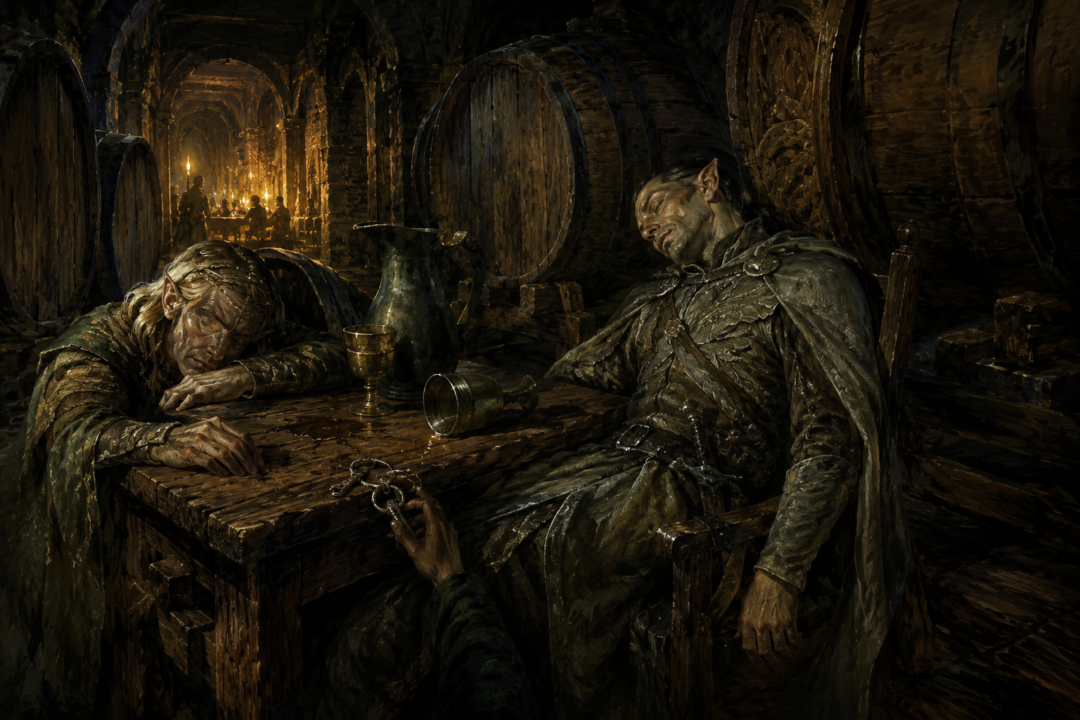
The king’s butler invites the chief of the guards to taste newly arrived wine before the evening’s work of clearing empty barrels. The chief agrees, partly under the excuse of determining whether it is suitable for the king’s table.
The wine proves exceptionally potent.
The narrative specifically indicates that this was a powerful vintage, unsuitable for being consumed carelessly in the fashion the two Elves attempt. Both eventually fall asleep.
For the butler, this is embarrassing.
For the chief guard, it is a security failure.
He is responsible for prisoners, and the keys to their cells are in his possession. By becoming drunk enough to sleep while those prisoners remain confined nearby, he unintentionally gives Bilbo exactly what he has been waiting for.
Bilbo takes the keys.
There is an important difference here between defeating a guard and exploiting one. Bilbo does not overpower anyone, pick a lock, or break a door. The security mechanism itself still works perfectly.
The person controlling it has stopped functioning.
That is the first major layer of carelessness.
Nobody Notices Thirteen Prisoners Moving Through the Halls
Bilbo then has another problem.
Opening one cell is not enough.
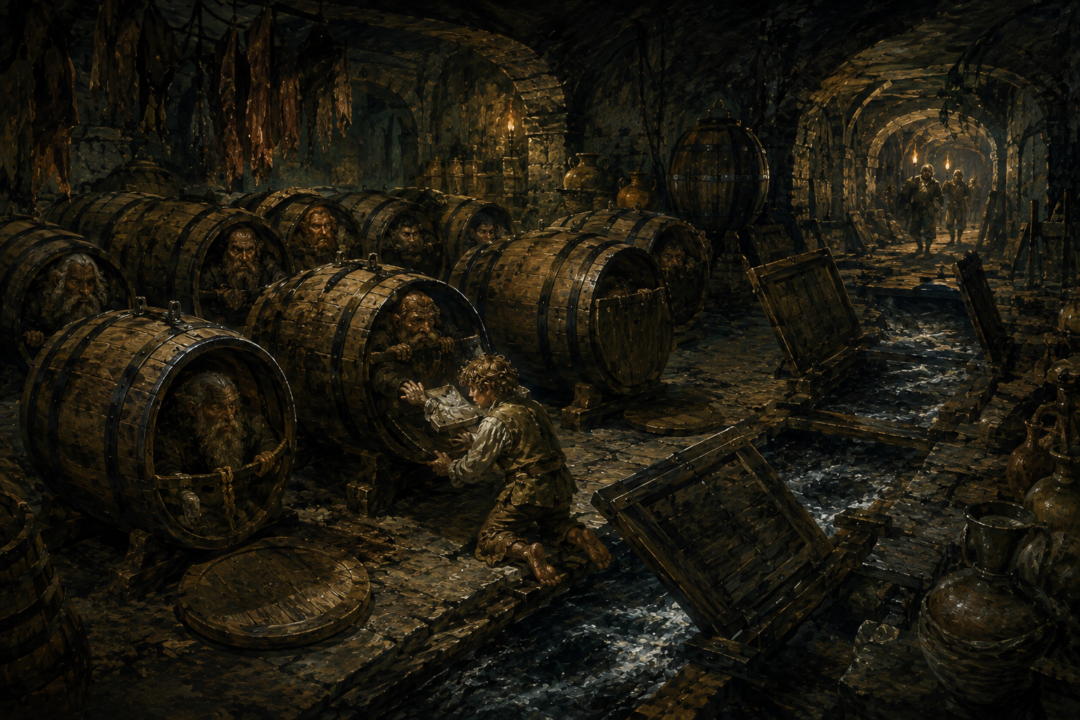
Thorin and his twelve companions have been separated. Bilbo must unlock them, assemble them, explain his desperate plan, and get all thirteen into the cellars.
The timing helps enormously. A feast is underway, and the normal movement of the palace has shifted accordingly. Bilbo also urges the Dwarves to move quietly.
The text does not provide evidence that every guard in the Woodland Realm is drunk or absent, so it would be an exaggeration to describe the entire palace as abandoned. Rather, Bilbo has found an unusually favorable moment in which attention is elsewhere.
The Ring helps Bilbo himself remain undetected, but it cannot make thirteen Dwarves invisible.
Their successful movement therefore depends on timing, silence, familiarity gained through Bilbo’s reconnaissance, and luck.
It is the least blatant of the Elves’ failures, but it matters. A prison can have strong doors and still fail if nobody realizes those doors have been opened.
The Heavy Barrels Should Have Exposed Everything
Then comes perhaps the clearest warning.
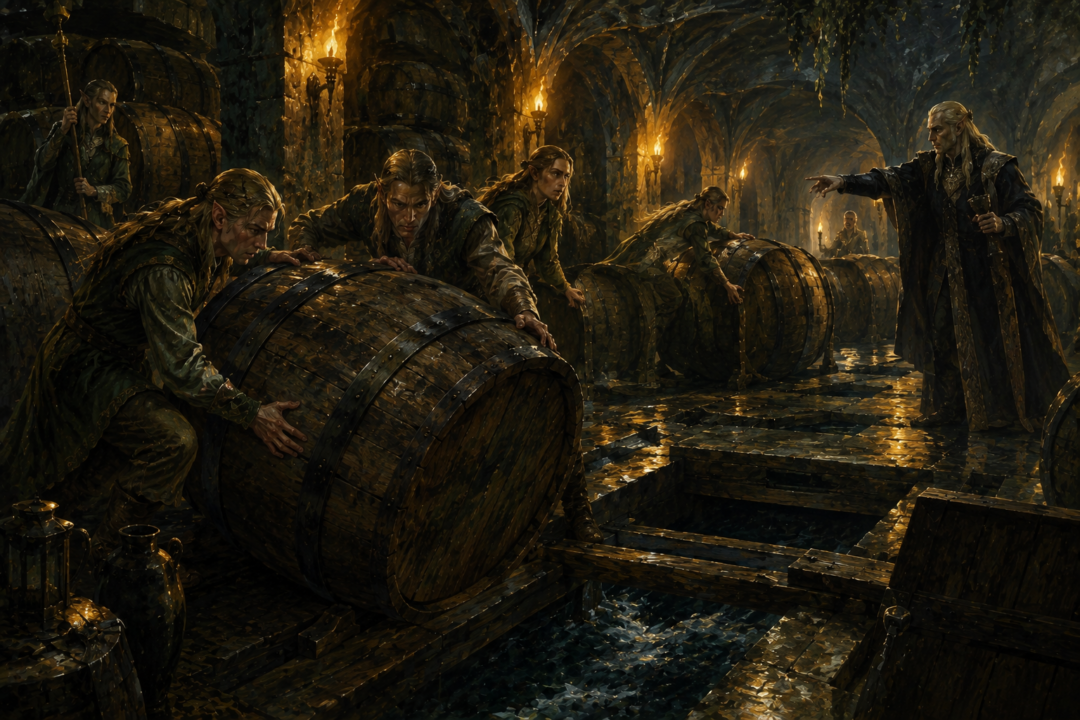
Bilbo places the Dwarves into empty barrels and closes them inside. He cannot join them in the same manner because there is nobody left to pack him into a barrel, a flaw he realizes only after arranging the others’ escape.
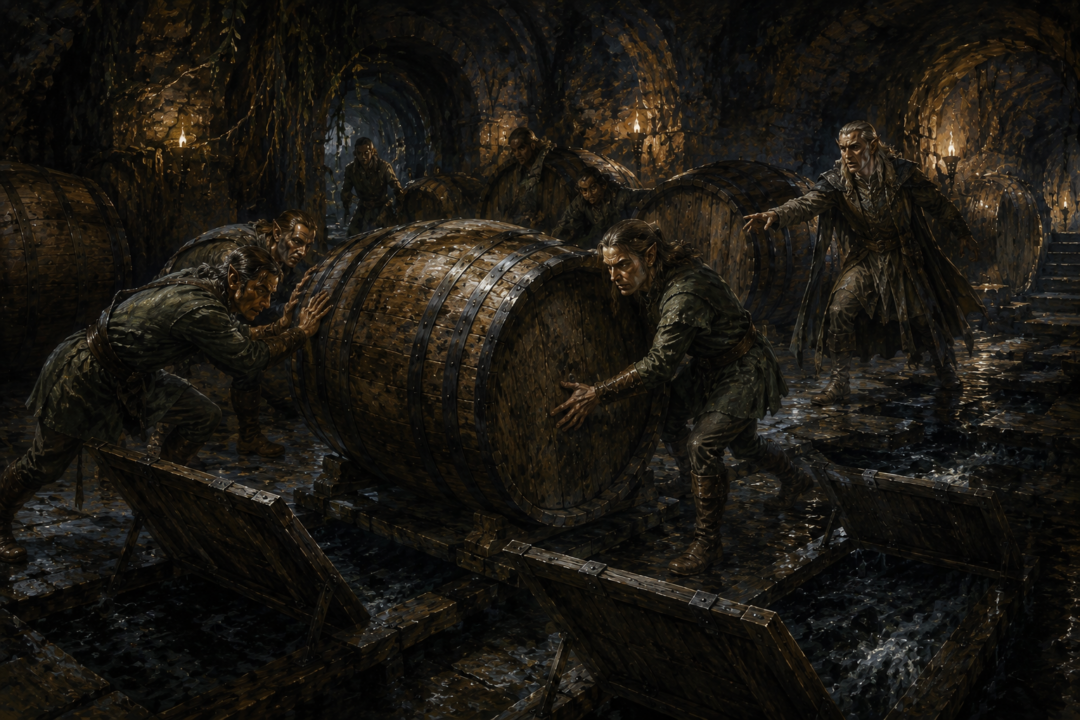
The cellar workers arrive to dispose of the supposedly empty casks.
And some of them notice that something is wrong.
The barrels are heavy.
This detail is essential because the escape does not succeed because every Elf is oblivious. The text does something more interesting: it allows the workers to detect the physical evidence of Bilbo’s deception.
Their suspicion is reasonable.
An empty barrel should not weigh like a barrel containing a Dwarf.
But the butler, only recently awakened from his drunken sleep, dismisses the objection and urges the work onward. His impaired judgment now produces a second failure. The problem has effectively been reported, yet the warning is not acted upon.
The barrels go through the trapdoors.
At that moment the Dwarves have passed the most dangerous inspection point without actually being inspected.
The Elves Get a Second Warning Downstream
Remarkably, the deception nearly fails again.
After the barrels travel downriver and reach the place where the Elves collect them, they are gathered and lashed together for the journey toward Lake-town. Bilbo, who has endured a miserable journey in the water and clinging to a barrel, eventually reaches the collection area as well.
When the raft is being prepared, the Elves handling it notice another problem.
The load is unusually heavy. The barrels float too deep in the water. Some clearly do not behave like empty casks.
This is no longer merely one drunken butler ignoring a complaint.
Different Elves, at another stage of the transport system, independently notice evidence that something is wrong.
They even recognize that an inspection would make sense.
But circumstances work in Bilbo’s favor again. It is not a convenient time to investigate, and the raft is sent onward.
The Dwarves survive because the same anomaly is noticed twice without producing the obvious response: open the suspicious barrels.
That is the final institutional failure on which the plan depends.
The Escape Works Because Every Mistake Is Small
This is what makes “Barrels Out of Bond” more interesting than a simple story about foolish guards.
No single mistake explains the escape.
The water-gate itself is legitimate infrastructure. Bilbo’s invisibility is something the Elves cannot reasonably account for. The feast does not magically empty the entire palace. The workers are not uniformly stupid; some of them correctly recognize that the barrels are too heavy.
Instead, the escape succeeds through a chain.
The chief guard drinks when he should remain responsible for prisoners. The keys become accessible. Bilbo gets the Dwarves out during a favorable period of distraction. The butler dismisses evidence that supposedly empty barrels are too heavy. Later workers notice that the raft sits suspiciously low but send it onward anyway.
Break almost any link and Bilbo has a serious problem.
That is why the plan feels both ingenious and desperate.
Bilbo has identified the only plausible route he can find, but he cannot control most of the variables that determine whether it succeeds.
Bilbo’s Real Skill Is Exploiting Luck
It would therefore be misleading to say Bilbo escapes purely through cleverness.
The chapter itself treats his plan as desperate, and its success plainly depends on fortunate circumstances.
Yet calling it pure luck would miss what Bilbo contributes.
Luck gives him sleeping Elves.
Bilbo takes the keys.
Luck gives him a commercial waterway.
Bilbo has already spent time learning where it leads and how the barrels use it.
Luck allows the suspicious barrels to pass inspection.
Bilbo is the one who understood that the barrels could conceal the Dwarves in the first place.
This combination—chance creating an opening and Bilbo having enough courage and intelligence to exploit it—is increasingly characteristic of his role in the company. Earlier in the journey he often needed rescue. In Mirkwood, he kills a giant spider, helps rescue the Dwarves from the spiders, remains free when the Wood-elves capture them, discovers their cells, maintains contact between the separated prisoners, and finally engineers their escape.
The barrel plan is ridiculous because the circumstances are ridiculous.
Bilbo’s achievement is recognizing that ridiculous circumstances can still be useful.
The Woodland Realm Is Defeated by Routine, Not Force
There is a final irony in the escape.
Thorin’s company could never have fought its way out. When the Wood-elves originally capture the Dwarves, resistance is effectively hopeless. The Elves are armed and dangerous, while the exhausted Dwarves are in poor condition and inadequately equipped.
The Elvenking’s defenses are not overcome by strength.
They are bypassed through the most ordinary machinery of his realm: keys, cellars, servants, barrels, trapdoors, river traffic, and scheduled work.
That is why the carelessness matters.
The escape requires the Elves to fail in several different ways, but those failures are believable precisely because most are mundane. Someone drinks too much. Someone assumes locked prisoners remain locked. Someone dismisses a worker’s concern. Someone notices an irregularity but decides there is no time to investigate it.
Bilbo never becomes more powerful than the Woodland Realm.
He simply becomes the one person inside it who understands that, for one extraordinary night, nobody is quite paying attention to the same thing at the same time.
And thirteen supposedly empty barrels float away.
Sources & Notes
- https://www.glyphweb.com/arda/e/elvenkingshalls.html — The Encyclopedia of Arda: the Elvenking’s Halls, their dungeons, the Forest River trade route beneath them, and Bilbo’s trapdoor-and-barrel escape
- https://www.glyphweb.com/arda/g/galion.html — The Encyclopedia of Arda: Galion, the Elvenking’s butler, whose strong wine and lapse with the chief guard create Bilbo’s opportunity
- https://www.glyphweb.com/arda/f/forestriver.html — The Encyclopedia of Arda: the Forest River’s course from northern Mirkwood past the Elvenking’s Halls toward the Long Lake
- https://www.glyphweb.com/arda/w/woodlandrealm.html — The Encyclopedia of Arda: the Woodland Realm, its people, location, trade, and settlement in the northeastern forest
Sources cover the halls and underground trade route, Galion’s lapse, the Forest River, and the Woodland Realm context.