A green shield seems like one of the simplest images in Rohan: wood, paint, a bright device, something carried by a rider or hung ready in a hall. Yet in The Lord of the Rings, shields do more than protect the body. They quietly reveal the difference between a kingdom, a royal household, and a king.
That distinction matters especially with Théoden.
The familiar colors of Rohan are unmistakable. Green appears repeatedly around the Rohirrim, and the running white horse upon green is explicitly identified as the emblem of the House of Eorl. But Théoden himself rides into his greatest battle with something different: a golden shield that flashes like the Sun.
So there is not, strictly speaking, one “green shield of Théoden” that simply becomes his personal badge. The texts give us something subtler. Green shields belong to the visual language of his people and household; the white horse upon green belongs to his dynasty; and Théoden’s own golden shield distinguishes the king at the climax of his reign.
Together they create a remarkably precise language of kingship.
The Green Shields at the Golden Hall
When Gandalf, Aragorn, Legolas, and Gimli climb the terraces of Edoras and approach Meduseld, they encounter the guards of Théoden’s hall.
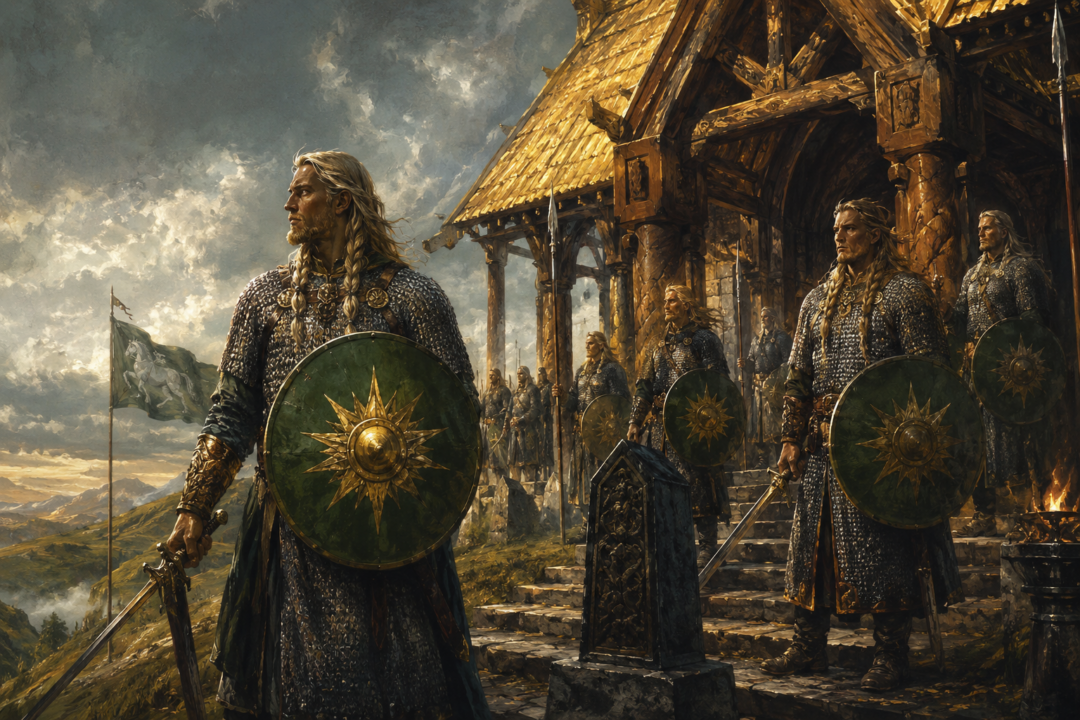
These men are immediately marked by splendor. Their golden hair is braided upon their shoulders, their long mail-coats shine, and the Sun is blazoned upon their green shields.
This is important because it establishes green before the narrative formally explains the royal horse emblem. Green is already part of the visual world surrounding Théoden’s kingship.
The Sun on these shields should not automatically be treated as the formal heraldic emblem of Rohan. The text does not call it that. Nor does it explicitly establish a separate system of heraldry in which the Sun is Théoden’s personal coat of arms.
What it does establish is an association.
The guards stand at Meduseld, the Golden Hall. They serve the king directly. Gold, sunlight, and green repeatedly gather around Théoden’s royal setting. Their shields therefore belong to the imagery of his household even though the text does not define the Sun as the official device of his dynasty.
That distinction becomes clearer once the armory of Edoras is opened.
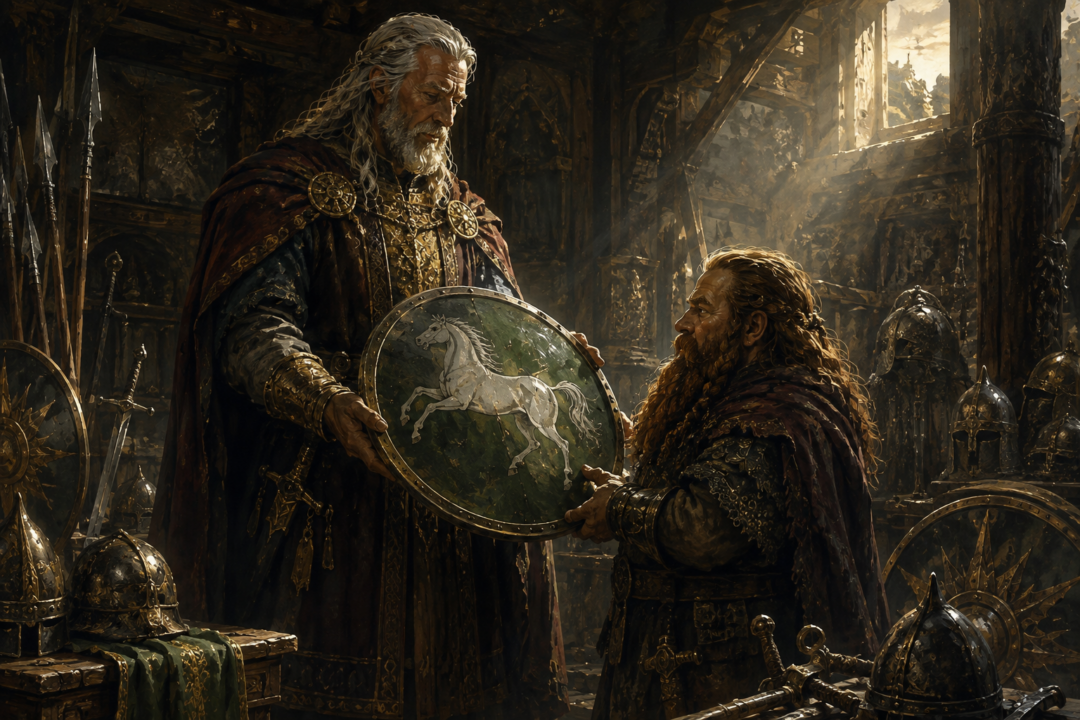
The Shield Made for Théoden as a Boy
Before riding to war, Théoden equips his guests from the stores of Edoras. Gimli chooses an iron-and-leather cap and a small shield suitable for him.
The shield bears a running horse, white upon green.
Here the narrative removes all ambiguity: this is “the emblem of the House of Eorl.”
Even more revealing is the shield’s history.
Théoden tells Gimli that it had been made for him during the reign of his father Thengel, when Théoden was still a boy.
That single detail transforms an ordinary piece of military equipment into a dynastic object.
The shield is not merely decorated in the colors of Rohan because Théoden happens to be its king. It predates his kingship. It belonged to him while he was still the heir of Thengel, and it carries the emblem not simply of the country but of the House of Eorl.
The distinction is crucial.
Eorl the Young founded the kingdom after receiving Calenardhon from Cirion, Steward of Gondor, following the victory at the Field of Celebrant. Théoden belongs to Eorl’s royal line through the Second Line of kings, founded by Fréaláf after the death of Helm Hammerhand and his sons.
Thus the running white horse upon green reaches beyond Théoden personally. It identifies the lineage from which his authority comes.
When Gimli accepts the shield, he tells Théoden that he is proud to bear his device. The wording is personal in conversation, but the narrative has already defined the device more precisely: it is the emblem of the House of Eorl.
Théoden possesses it because he belongs to—and ultimately heads—that house.
Why the White Horse Matters More Than the Green
It is easy to call the white horse upon green simply “the flag of Rohan.” By the War of the Ring, it certainly functions publicly as the sign beneath which the Rohirrim ride.
But the text gives it a specifically dynastic identity.
It is the emblem of the House of Eorl.
The horse itself is perfectly suited to that house, although the texts never explicitly explain the emblem’s origin or state that the pictured horse represents a particular animal.
That caution matters. It is tempting to identify the white horse with Felaróf, the great horse ridden by Eorl, or more broadly with the mearas from which Shadowfax came. Such a connection is thematically attractive, but it is not directly confirmed.
What can be said safely is that horses lie at the heart of the identity of Eorl’s people. Their ancestors were the Éothéod. Eorl’s legendary relationship with Felaróf stands near the beginning of the royal story, and the Rohirrim are repeatedly defined by their mastery of horses.
A running horse is therefore both cultural and dynastic.
The green field is equally appropriate to the Mark, a country of grasslands and rolling plains. Yet the text explicitly names the entire white-horse-upon-green design as the emblem of the royal house.
The symbol joins land, people, and dynasty without making them identical.
Théoden’s Banner Makes the Dynasty Public
The transformation becomes most visible when Théoden rides to the Pelennor Fields.
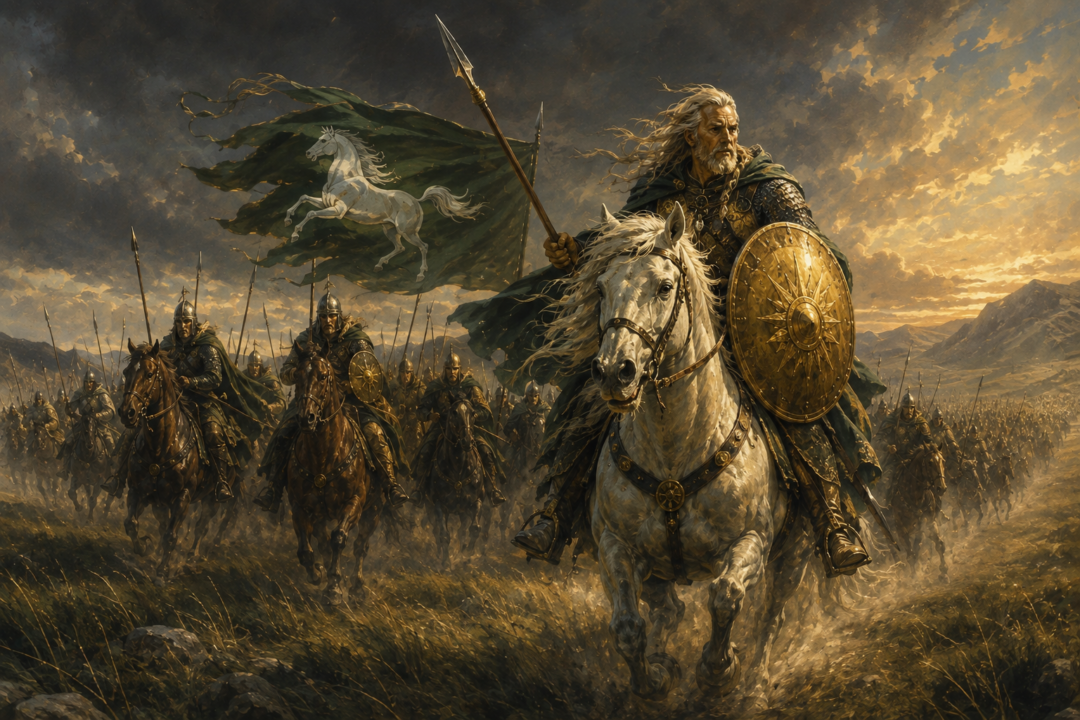
Behind him flies his banner: a white horse upon a field of green.
The same essential device once painted on the small shield made for Théoden as a boy is now raised above an army.
That is the real progression.
The private object from Théoden’s youth and the public standard of Théoden King carry the same dynastic identity. What belonged to the heir of Thengel now rides before the host of the Mark.
And Théoden does not merely follow that banner.
He outpaces it.
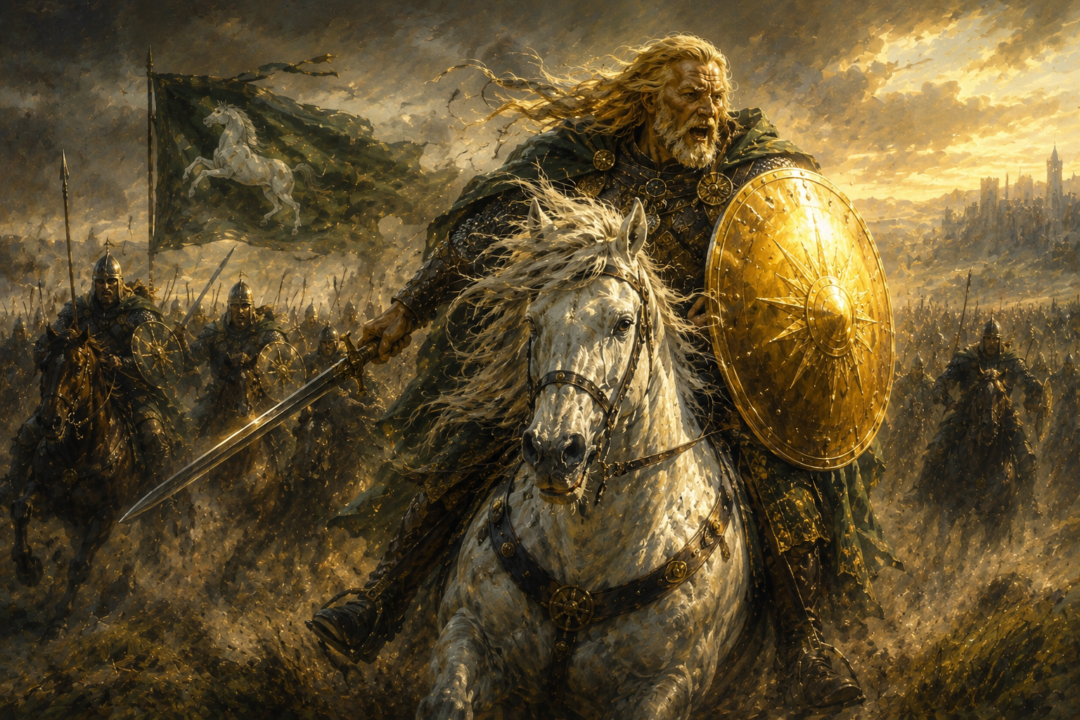
During the charge, Snowmane carries him ahead of his standard and even ahead of the knights of his house. The image is significant because the king temporarily becomes a living embodiment of everything the banner represents: the House of Eorl, the horse-lords, and their ancient courage.
Yet the narrative then gives Théoden another visual sign.
His shield is not described as green.
It is golden.
Théoden’s Golden Shield Changes the Meaning
At the height of the charge, Théoden uncovers his golden shield. It shines “like an image of the Sun,” while the grass seems to flame green around Snowmane’s white feet.
The color pattern is extraordinary.
Gold above.
Green below.
A white horse between them.
It echoes the visual vocabulary already established around Meduseld without reducing Théoden to a heraldic diagram.
This is also why it is misleading to describe the Sun simply as Théoden’s formal personal emblem. The text never gives us that heraldic rule. Instead, solar imagery follows his kingship poetically.
The guards at the Golden Hall have Suns upon green shields. Meduseld itself is golden. At the Pelennor, Théoden’s golden shield becomes sunlike as morning breaks through the darkness.
The association reaches its fulfillment precisely when the old king has escaped the diminished condition in which we first found him.
In Edoras, Théoden had been bent, suspicious, and isolated under the influence of Gríma’s counsel and Saruman’s pressure. By the Pelennor he is riding at the head of his people with such terrible energy that the narrative compares his appearance to a figure out of the world’s ancient days.
His shield does not need to carry the dynastic horse.
The banner behind him already does that.
The golden shield identifies the man at the center of the dynasty’s final great charge under his reign.
A Symbol Théoden Cannot Take With Him
Théoden dies on the Pelennor, but the white horse upon green does not.
That is exactly what a dynastic emblem should do.
Théoden is a king of the House of Eorl, not the source of the House of Eorl. After his death the kingship passes to Éomer, beginning the Third Line of the Kings of the Mark.
The emblem therefore exceeds the individual.
This gives the old childhood shield an unexpected emotional weight. Théoden can give it away to Gimli because his kingship does not depend upon possession of one physical object. The device exists on shields and banners because it represents the house itself.
The king may die.
The sign continues.
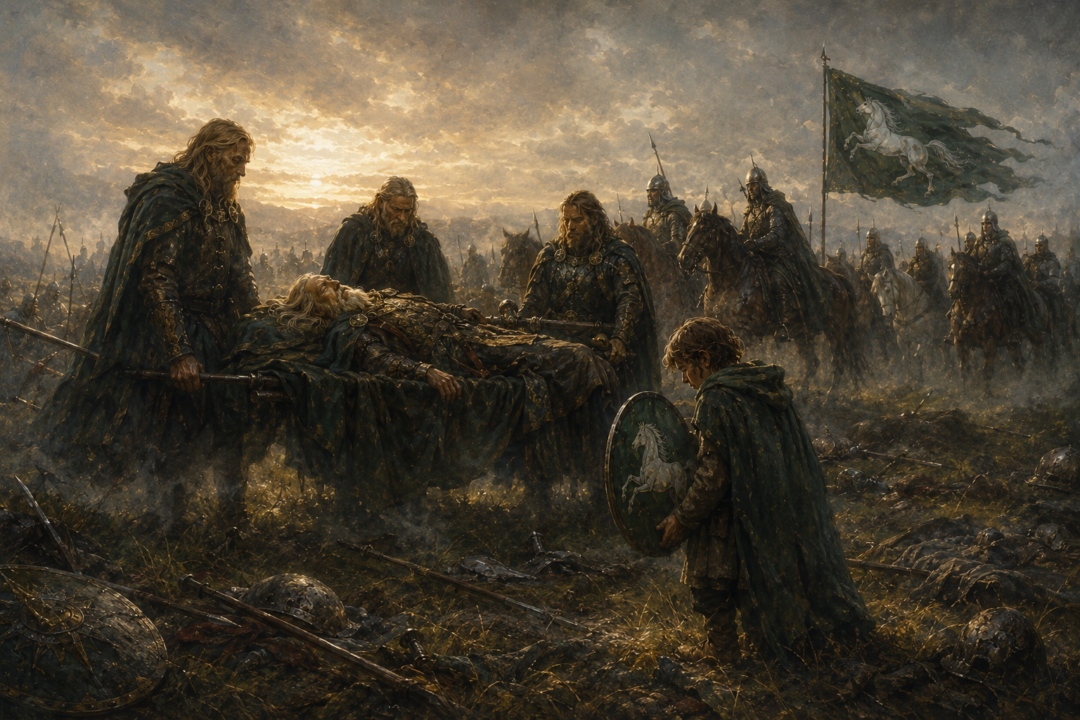
There is even a smaller echo of this process in Merry. When he enters Théoden’s service, he is equipped as a member of the king’s following, and Éowyn gives him a small green shield. After Théoden’s fall and the destruction of the Witch-king, Merry retrieves that shield from the battlefield.
Again, green has become more than scenery.
For Merry it is part of his adoption into Théoden’s world: the visual mark of the people and household to which he has pledged himself.
Rohan’s Heraldry Is More Subtle Than One Logo
The most lore-grounded way to understand Théoden’s shields is therefore to resist collapsing everything into a single modern-style national emblem.
The texts present overlapping layers of identity.
Green shields belong naturally within the visual culture of Rohan and appear among Théoden’s own guards. The Sun appears upon the shields at Meduseld and returns poetically when Théoden’s golden shield shines at the Pelennor. The running white horse upon green is explicitly the emblem of the House of Eorl and appears both on Théoden’s childhood shield and on the royal banner carried behind him in battle.
Théoden himself stands at the intersection of all three.
He inherits the horse.
He rules the green land.
And at the moment when his own story reaches its terrible fulfillment, he rides beneath the white-horse banner while carrying a shield that seems to become the rising Sun.
That is why the imagery works so powerfully. Théoden does not replace the symbol of his house with a personal one. Instead, his individual glory briefly burns inside a tradition older than himself.
The green field belongs to the Mark. The white horse identifies the House of Eorl. The golden shield singles out the king.
And when Théoden falls, the gold goes down with him—but the horse upon green rides on.
Sources & Notes
- https://www.glyphweb.com/arda/t/theoden.php — Encyclopedia of Arda: Théoden’s kingship, lineage, arms, and leadership of the Rohirrim
- https://www.glyphweb.com/arda/r/rohan.php — Encyclopedia of Arda: Rohan’s realm, people, royal house, colors, and heraldic identity
- https://www.glyphweb.com/arda/m/mark.php — Encyclopedia of Arda: the Riddermark as Rohan’s own name and political territory
- https://www.glyphweb.com/arda/h/houseofeorl.php — Encyclopedia of Arda: Théoden’s dynasty and descent from Eorl
Sources document Théoden’s heraldry and the green-and-white emblems of Rohan and the House of Eorl.