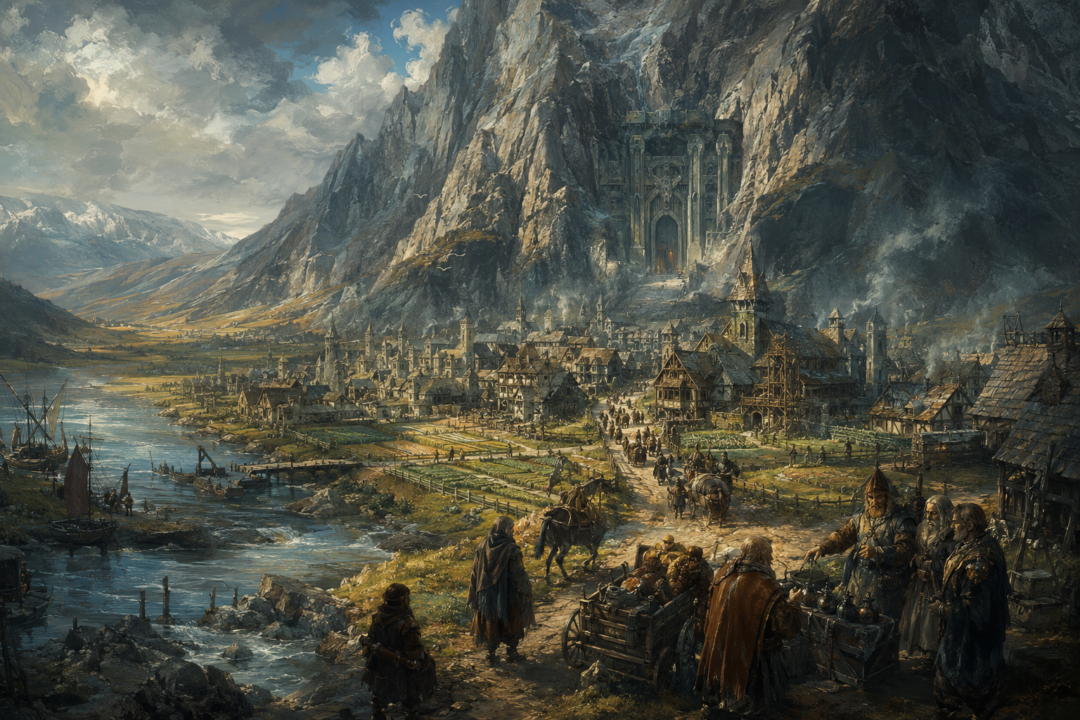
When Bard’s black arrow struck Smaug, the most obvious obstacle to the restoration of Dale vanished in a single night. The dragon that had destroyed the old town, occupied Erebor, and terrorized the surrounding country was dead.
But killing Smaug did not automatically bring Dale back.
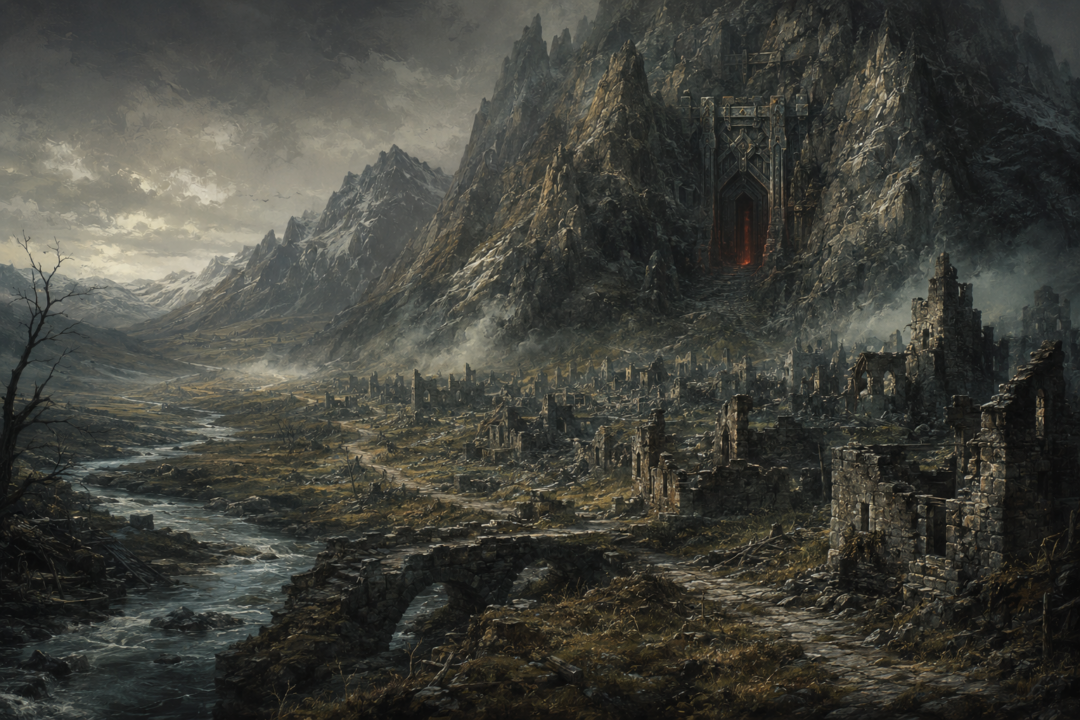
The old settlement beneath the Lonely Mountain had already lain ruined for generations. Its people had scattered, its former prosperity had disappeared, and the economic world that had sustained it had collapsed alongside the Kingdom under the Mountain.
That is the overlooked part of Dale’s recovery. Bard could restore his ancestral realm because the dragon was gone, but Dale’s deeper revival was tied to something larger: Erebor was alive again too.
The histories of the two kingdoms repeatedly move together. They prosper beside one another, fall in the same catastrophe, rise after the same turning point, and finally defend one another when war reaches the North.
Smaug’s death removes the destroyer. The restoration of Erebor helps restore the world that Dale once belonged to.
Dale Had Flourished Beside a Dwarven Kingdom
Dale was not simply a human town unfortunate enough to be located near a dragon’s lair.
Long before Smaug came, it stood beside one of the great Dwarven realms of the late Third Age. Appendix B of The Lord of the Rings records that Thrór returned to Erebor in T.A. 2590 and that his people became prosperous there. Men also lived along the River Running, and Dale grew beneath the Mountain.
The Hobbit gives the relationship more texture. Thorin remembers the days before the dragon as an age when the Dwarves of the Mountain were extraordinarily wealthy and their craftsmanship benefited their neighbours. He describes the Men of Dale as prosperous themselves and recalls how they rewarded the Dwarves for their work.
This matters because Dale and Erebor possessed complementary strengths.
The Dwarves were renowned as miners and makers. The surrounding Men inhabited the open lands and river country beyond the Mountain. Dale stood immediately below Erebor, while the River Running connected the region southward toward the Long Lake and lands beyond.
The texts do not provide a detailed economic ledger for this relationship, so it would be too strong to claim that Dale literally could not exist without Erebor. But they do present the prosperity of the two communities as closely connected.
Their golden age is a shared one.
That makes what Smaug does in T.A. 2770 more destructive than the loss of two separate settlements.
He breaks an entire regional order.
Smaug Destroyed Both Sides of the Relationship
Smaug first descended upon the Lonely Mountain and drove out the Dwarves. Dale was ruined in the same disaster.
The survivors of Dale fled, and generations passed.
By the time of The Hobbit, the old town is not a functioning kingdom waiting for its king to return. It is a ruin. The human centre of life in the region has shifted to Lake-town, whose people retain memories of the prosperity associated with the King under the Mountain.
That memory is revealing.
When Thorin and his companions arrive at Lake-town, their appearance awakens old songs and expectations. The return of the King under the Mountain is imagined not merely as good fortune for Dwarves. It is connected with renewed wealth flowing through the region.
Some of those hopes are plainly exaggerated. The Master of Lake-town is especially interested in the commercial possibilities. Yet the expectation itself has historical roots.
The earlier prosperity of the North had involved connections between the Mountain, Dale, the Long Lake, and the River Running.
Smaug had severed those connections.
His death therefore creates an opportunity, but opportunity is not the same thing as reconstruction.
Bard Has Gold, but Gold Alone Does Not Make a Kingdom
After Smaug destroys Lake-town and is killed by Bard, the survivors face immediate material needs. They have lost homes and supplies just as winter approaches.
Bard therefore has strong reasons for seeking a share of the treasure of Erebor.
His claim is not simply that the treasure would be useful. In his parley with Thorin, Bard invokes both the destruction suffered by the Lake-men and the older wealth of Dale that Smaug had taken.
Thorin initially refuses.
That confrontation shows how dangerous the relationship between the restored kingdoms could have become. Erebor possesses enormous treasure while the neighbouring Men have suffered catastrophic destruction. The death of Smaug has removed their common enemy without resolving competing claims created by his violence.
Only after the Battle of Five Armies and Thorin’s death does a more stable settlement emerge.
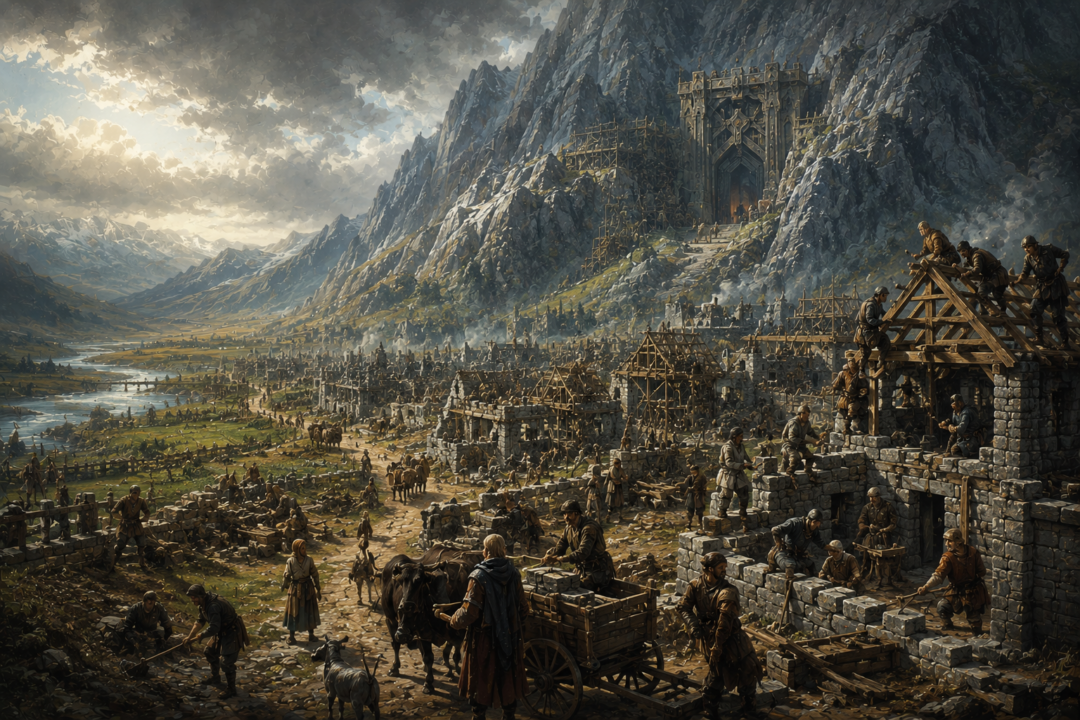
Dáin Ironfoot becomes King under the Mountain. Bard receives treasure, and the rebuilding of Dale begins.
Appendix B gives the crucial chronology: in T.A. 2944, three years after Smaug’s death, Bard rebuilds Dale and becomes its king.
The delay itself is instructive.
Smaug dies in 2941. Dale is rebuilt in 2944.
The dragon’s death made restoration possible. It did not accomplish restoration by itself.
The Rebirth of Erebor Restores More Than Treasure
Under Dáin, Erebor again becomes a living Dwarven kingdom.
When Glóin speaks with Frodo in Rivendell many decades later, he describes prosperity under the Mountain and new works made by the Dwarves. Meanwhile, Dale has also become powerful.
The parallel is difficult to miss.
Appendix B says that Bard’s son Bain and grandson Brand succeeded him. By Brand’s reign, the kingdom had grown considerably, extending south and east of the Long Lake.
This is no longer merely a rebuilt town.
Dale has become a substantial northern realm.
The texts do not explicitly state that every stage of this expansion was financed or caused by Erebor. That would go beyond the evidence. Dale had its own people, rulers, agriculture, trade connections, and political strength.
But Erebor clearly formed part of the environment in which that growth occurred.
The Mountain once again contained a wealthy and productive Dwarven population. Dale once again stood beneath it. The River Running still linked the northern settlements to the Long Lake and farther country.
The old geography of cooperation had returned.
And eventually that relationship would prove valuable in a way more important than commerce.
By the War of the Ring, Prosperity Has Become Alliance
The strongest evidence that Dale’s relationship with Erebor is structural rather than incidental comes near the end of the Third Age.
Sauron does not threaten only Gondor and Rohan.
War also comes to the North.
Before the main conflict reaches its climax, messengers from Mordor approach Dáin and attempt to obtain information about Bilbo and the Ring. Dáin refuses to give them what they want and sends Glóin and Gimli to Rivendell seeking counsel.
Later, Easterling forces attack the northern kingdoms.
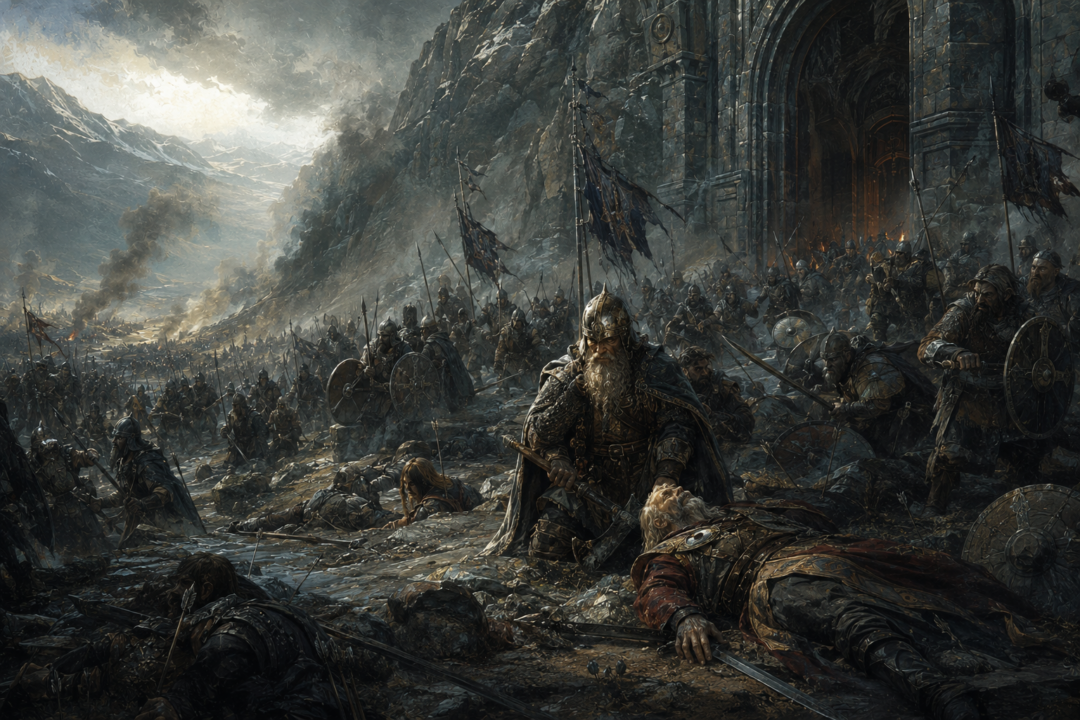
Appendix B records that on March 17, T.A. 3019, the Battle of Dale begins. King Brand of Dale and King Dáin fight against the invaders.
After three days they are driven back toward Erebor.
Brand falls.
Then Dáin falls beside him.
The image is one of the clearest expressions of the bond between the two realms: the King under the Mountain dies in the same battle as the King of Dale, defending the northern alliance at the very gate of Erebor.
Their fathers’ kingdoms had been restored together after Smaug.
Their descendants now face destruction together.
Erebor Becomes Dale’s Refuge
Here the relationship reaches its most literal form.
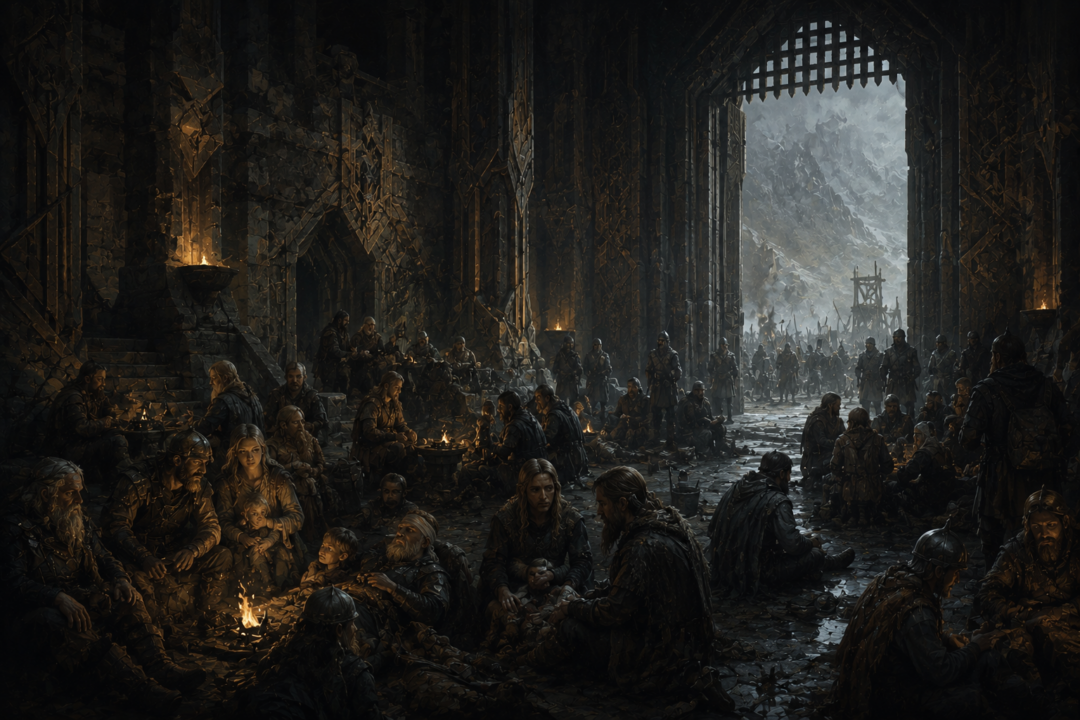
After the defeat at Dale, the surviving Men and Dwarves retreat into the Lonely Mountain.
Erebor, once the source of much of Dale’s prosperity, becomes its fortress.
The Easterlings cannot take the Mountain and instead besiege it.
This changes how we should understand Dale’s dependence on its neighbour. In peaceful years, the connection is partly commercial and geographic. In the War of the Ring, it becomes strategic.
Dale occupies open country beneath the Mountain. Erebor is a fortified underground realm whose great gate can be defended.
When the outer kingdom is overwhelmed, the Mountain preserves the surviving strength of both peoples.
Had Erebor remained an abandoned dragon-hoard after Smaug’s death, that refuge would not have existed in the same form.
It mattered that Dwarves had returned.
It mattered that the Kingdom under the Mountain had been restored.
And it mattered that generations of coexistence had produced allies capable of fighting and surviving together.
The Two Kingdoms Emerge Together Again
The siege does not end because the defenders suddenly become stronger than Sauron’s entire northern strategy.
The larger war changes.
After Sauron falls, his northern forces lose heart. Bard II, son of Brand, and Thorin III Stonehelm, son of Dáin, lead their peoples out and drive away their enemies.
The symmetry is remarkable.
Bard and Dáin’s fathers die together.
Their sons survive the siege together.
Then both inherit restored kingdoms.
Appendix B records that Dale was rebuilt again after the war, while Bard II became its king and Thorin III became King under the Mountain.
The pattern established after Smaug repeats itself on a smaller scale: destruction strikes the region, the two peoples endure it together, and recovery follows through the survival of both realms.
Dale’s Real Recovery Was the Restoration of a Neighbourhood
It would be misleading to reduce Dale to a dependent settlement living entirely on Dwarven wealth.
The Men of Dale created a genuine kingdom of their own. Under Bard’s descendants its territory expanded, and its rulers possessed their own military and political importance.
But independence does not mean isolation.
Dale’s history repeatedly shows that its location beneath Erebor shaped its fortunes.
When the Mountain prospered before Smaug, Dale prospered beside it.
When Smaug destroyed Erebor, Dale fell in the same catastrophe.
When the Dwarves returned, Bard could rebuild a human kingdom beside a restored Dwarven one.
And when Sauron’s northern war threatened to destroy Dale again, the survivors found safety inside Erebor.
That is why Smaug’s death is only the beginning of Dale’s recovery.
A dead dragon cannot rebuild roads, restore trade, repopulate abandoned lands, defend a frontier, or recreate trust between neighbouring peoples.
Those things require living communities.
The deeper victory beneath the Lonely Mountain was therefore not simply that Smaug died. It was that after nearly two centuries of desolation, Men and Dwarves returned to the same landscape and rebuilt two kingdoms capable of strengthening one another.
By the end of the Third Age, Erebor is no longer the terrible shadow hanging over Dale.
It is the reason that, when another shadow reaches the North, Dale does not have to face it alone.
Sources & Notes
- https://www.glyphweb.com/arda/d/dale.php — Encyclopedia of Arda: Dale’s destruction, rebuilding, kings, trade, and alliance with Erebor
- https://www.glyphweb.com/arda/e/erebor.php — Encyclopedia of Arda: the Lonely Mountain’s restoration, wealth, Dwarven kingdom, and neighboring Dale
- https://www.glyphweb.com/arda/b/bard.php — Encyclopedia of Arda: Bard’s slaying of Smaug and foundation of Dale’s restored royal line
- https://www.glyphweb.com/arda/d/dainii.php — Encyclopedia of Arda: Dáin II’s kingship under the Mountain and alliance with Dale
Sources document the linked restoration of Dale and Erebor under Bard and Dáin.