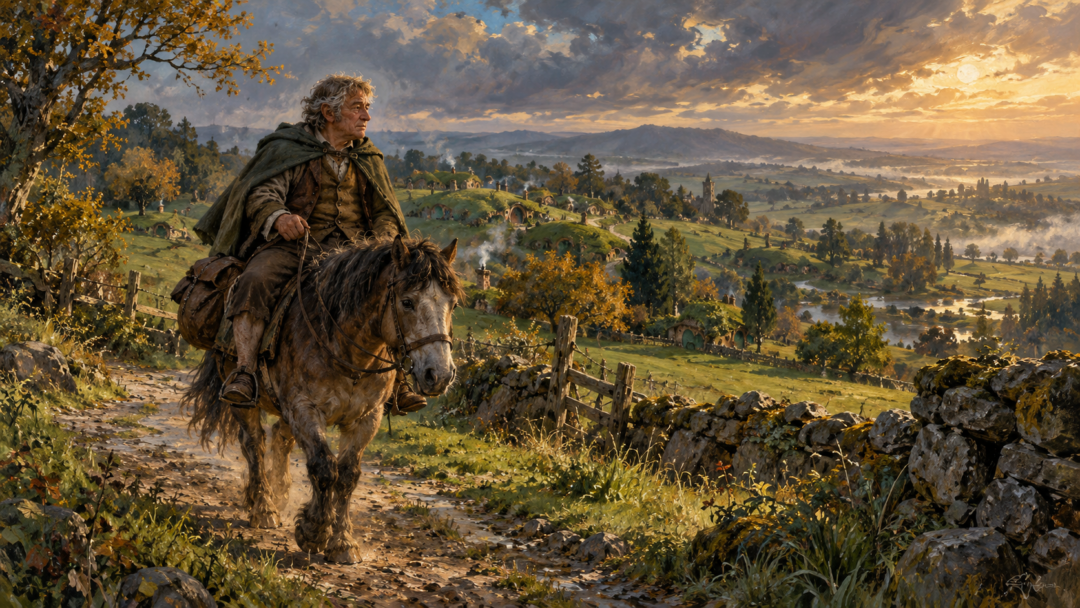
Samwise Gamgee’s last journey begins with something wonderfully ordinary: a hobbit leaving Bag End.
There is no recorded company of Elves waiting outside his door, no final council, and no description of a white ship prepared for him. In Shire Reckoning 1482, sixty-one years into the Fourth Age, the record becomes strikingly spare. Rose dies on Mid-year’s Day. Then, on September 22, Sam rides away from Bag End.
But before the surviving tradition carries him west toward the Grey Havens, Sam stops at the Tower Hills.
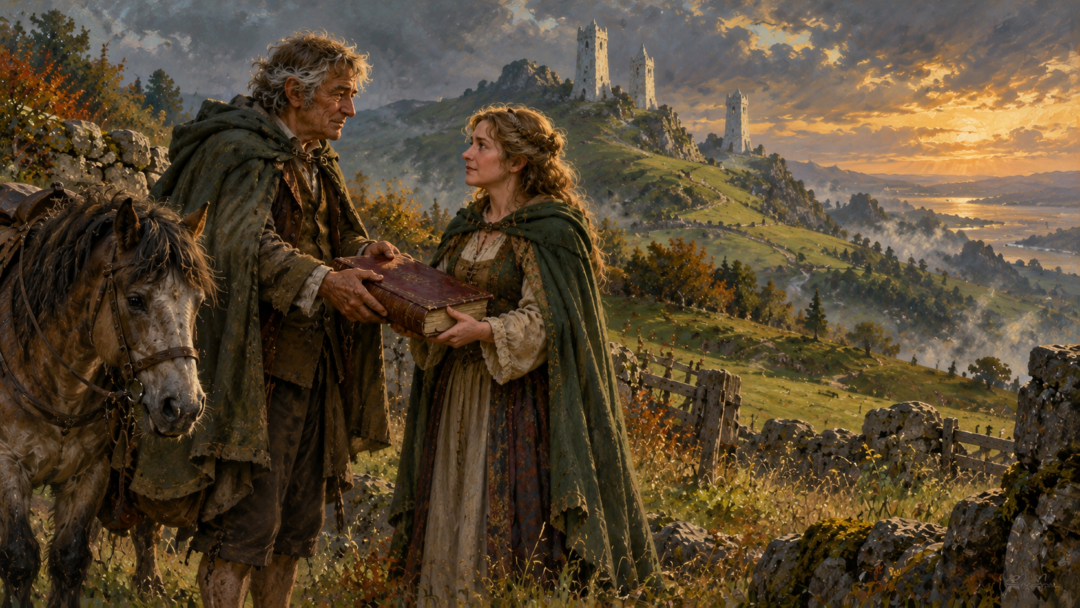
There Elanor, his eldest daughter, sees him for the last recorded time.
And Sam gives her the Red Book.
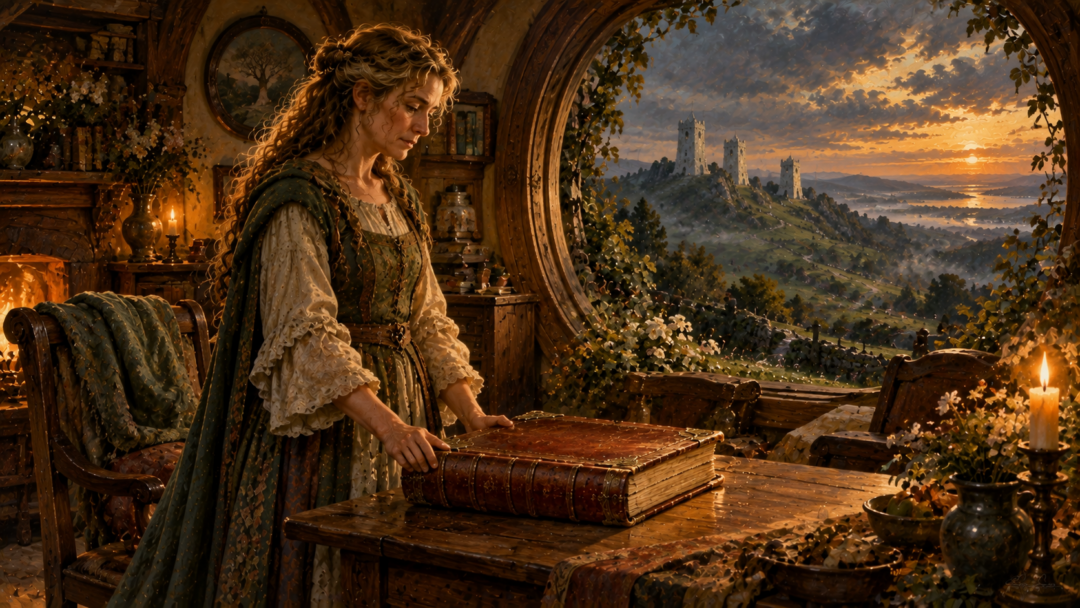
That small act is the concrete handoff at the end of his life in Middle-earth. Sam does not merely leave behind an old family possession. He entrusts Elanor with the written memory of the age through which he, Frodo, Bilbo, and their companions had lived.
Before Sam can disappear into legend, the story itself must remain behind.
The Last Thing Sam Is Explicitly Said to Give Away
Appendix B of The Lord of the Rings gives the essential sequence.
Rose Gamgee dies on Mid-year’s Day in S.R. 1482. On September 22, Sam rides out from Bag End. He reaches the Tower Hills and is last seen by Elanor. There he gives her the Red Book, which is afterwards preserved by the Fairbairns.
Everything about that wording matters.
The text does not provide a detailed inventory of Sam’s possessions. It does not describe him formally distributing Bag End, household goods, money, titles, or keepsakes before departing. Nor is he handing over the office of Mayor: Sam’s seventh and final term had already ended years earlier, in S.R. 1476.
The Red Book is the object specifically named.
That makes it difficult to treat the handoff as incidental. The book had already passed through several stages of authorship and guardianship. Bilbo had written material preserved within it. Frodo had continued the record. When Frodo departed from the Grey Havens decades earlier, he entrusted the book to Sam.
Now Sam repeats the pattern.
He becomes, like Frodo before him, a keeper who eventually must let the record go.
Why Elanor Is Waiting at the Tower Hills
The location makes the scene even more significant.
Elanor is not simply somewhere along the road by coincidence. Long before Sam’s departure, she had married Fastred of Greenholm. The Westmarch, stretching westward to the Tower Hills, had been added to the Shire by King Elessar. At Sam’s request, Fastred later became Warden of Westmarch, and Fastred and Elanor made their home at Undertowers.
Their descendants became the Fairbairns of the Towers.
So when the elderly Sam reaches the Tower Hills, he is entering the part of the enlarged Shire associated with Elanor and her family.
And it is this family that preserves the Red Book.
The geography therefore forms a remarkable threshold. Behind Sam lies the Shire where he was born, worked as a gardener, raised his children, served repeatedly as Mayor, and grew old beside Rose. Ahead lies the road westward.
At the threshold stands his daughter.
Sam passes the record backward into the keeping of his descendants while he himself continues forward.
The Book Frodo Once Left to Sam
The scene becomes more powerful when set beside Frodo’s earlier departure.
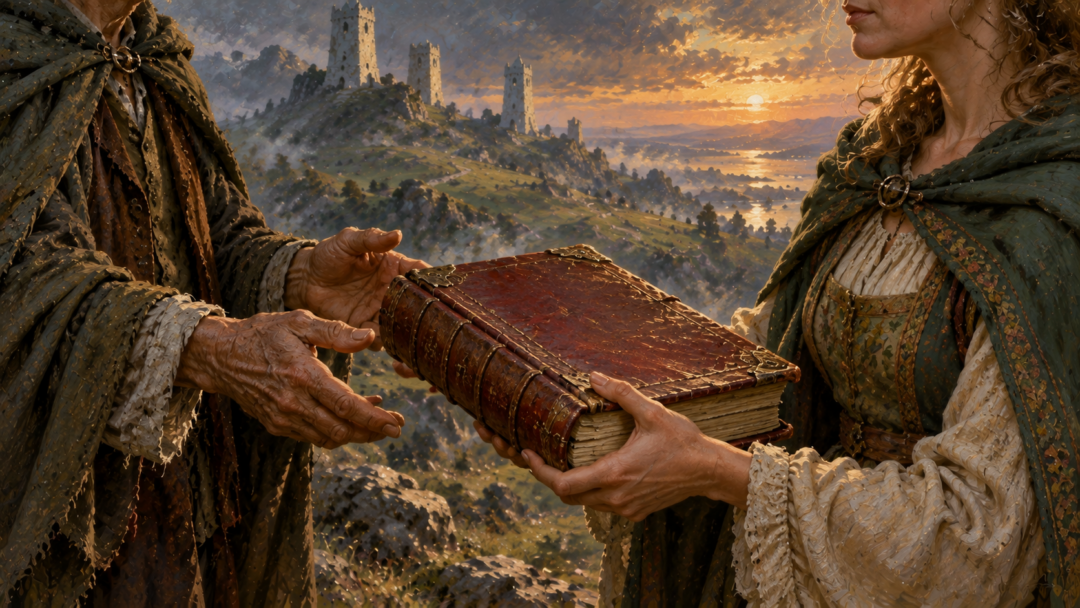
At the end of The Return of the King, Frodo reveals that he will not remain in the Shire. His wounds have not fully healed, and he is going away. Before doing so, he leaves his written work to Sam.
The book is unfinished.
Frodo tells Sam that the final pages are for him.
That moment establishes Sam as more than Frodo’s companion. He becomes a custodian of the story they survived together.
For most of his life, Sam’s greatness had expressed itself through service. He carried cooking gear. He worried about food. He watched Frodo while he slept. He literally carried Frodo when Frodo could go no farther.
The Red Book gives that old pattern another form.
Sam carries the story after Frodo can no longer remain to carry it himself.
Decades pass.
Eventually Sam reaches the same problem Frodo once faced: he too is going away, while the history must remain.
So he gives the book to Elanor.
Rose’s Death Changes the Shape of Sam’s Life
The chronology carefully places Rose’s death before Sam’s departure.
That does not mean the text explicitly explains every thought behind his decision. We should not invent a private conversation, a promise between Sam and Rose, or a precise psychological explanation that the book never supplies.
But the sequence is unmistakable.
Rose dies at Mid-year. Sam leaves Bag End less than three months later.
For decades after the War of the Ring, Sam had done what Frodo could not: he built a long domestic life in the restored Shire.
He married Rose. They had a large family. He became Mayor again and again. His life continued through gardening, family, public responsibility, and the ordinary rhythms that victory had made possible.
This is one of the deepest contrasts between Frodo and Sam.
Frodo helps save the Shire but cannot truly settle back into it. Sam returns from the Grey Havens after Frodo’s departure and resumes his life at Bag End.
His famous homecoming is therefore not the end of his story.
It lasts for decades.
Only after Rose’s death does the final westward movement begin.
Sam Does Not Hand Over the Mayoralty
It is tempting to imagine Sam’s departure as a grand retirement in which he transfers every responsibility to the next generation.
The chronology does not support that picture.
Sam had served seven terms as Mayor of the Shire. His seventh and final term ended in S.R. 1476, when he was ninety-six. His departure occurs in 1482.
His public office was therefore already behind him.
That distinction matters because it changes the emotional character of the Tower Hills scene.
This is not primarily a politician surrendering authority.
It is a father giving his daughter a book.
Sam’s formal responsibilities have already fallen away. What remains is memory.
The Red Book contains a history larger than the Gamgee family, but its preservation now becomes a family responsibility. Through Elanor and the Fairbairns, the account survives into later generations, with copies, notes, and additions associated with that tradition.
Sam relinquishes possession of the story precisely so that the story will not disappear with him.
Elanor Becomes the Last Witness
There is another crucial restraint in the account.
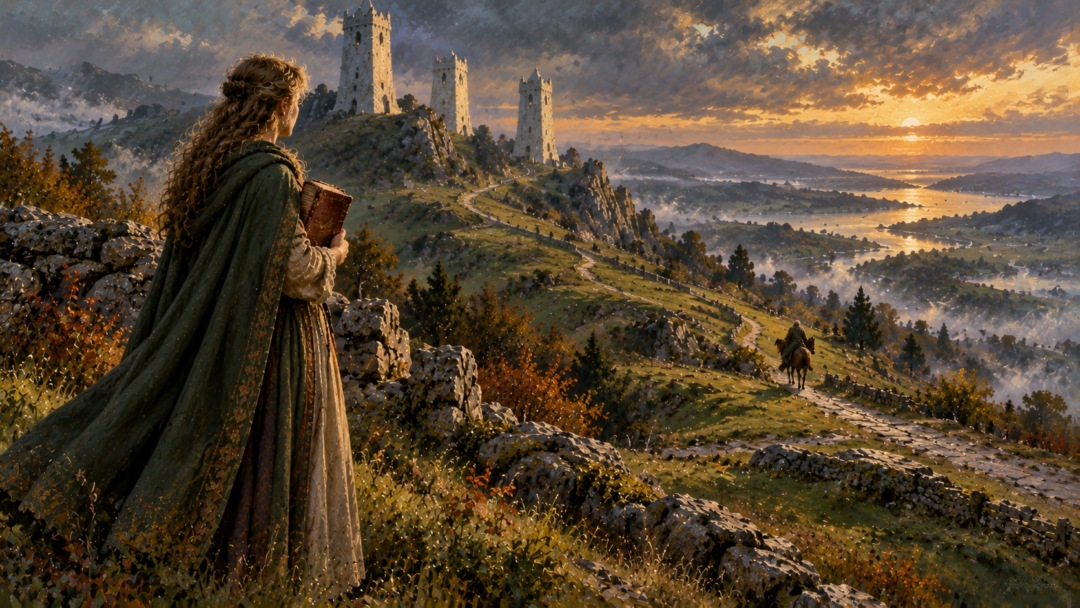
Elanor is the last person explicitly said to have seen Sam.
What happens afterward is presented as family tradition.
According to the tradition handed down from Elanor among the Fairbairns, Sam passed beyond the Towers, went to the Grey Havens, and crossed the Sea as the last of the Ring-bearers.
That is not the same thing as a narrated harbor scene.
We are not shown Sam arriving at Mithlond. We are not told who greets him. No shipboard conversation is recorded. The surviving account deliberately moves from chronicle into tradition.
That uncertainty gives the Tower Hills meeting unusual importance.
The last concrete scene is not Sam boarding a ship.
It is Sam giving Elanor the Red Book.
After that, Sam belongs increasingly to remembered history—the very thing contained in the object he has just surrendered.
Why Sam Could Go West
The tradition identifies Sam as the last of the Ring-bearers.
Although Frodo bore the One Ring for most of the Quest, Sam briefly became its bearer after Frodo was taken by the Orcs following the encounter with Shelob. Sam carried the Ring into Mordor before returning it to Frodo.
That episode had enormous moral significance. Sam experienced the Ring’s temptation but relinquished it voluntarily.
His later passage over Sea is associated with his status as a Ring-bearer. Yet this should not be confused with ordinary mortal immortality. Sailing West did not simply transform mortals into immortal beings.
Sam’s departure is better understood as an exceptional grace connected with the burden he once carried.
And it comes only after he has lived the mortal life that remained to him in Middle-earth.
He does not abandon Rose and his children immediately after the Quest.
He stays.
He plants.
He raises a family.
He serves the Shire.
He grows old.
Then, when that long chapter is finally closing, he turns west.
The Red Book Is Sam’s Final Burden to Set Down
There is a beautiful pattern running through Samwise Gamgee’s life.
He is repeatedly the person who carries what must not be lost.
He carries supplies through the wilderness.
He carries the Ring when Frodo appears dead.
On Mount Doom, when Frodo can scarcely move, Sam carries Frodo himself.
After the Quest, he carries the written record entrusted to him.
But Sam cannot carry everything forever.
At the Tower Hills, the old bearer finally hands one burden to someone else.
Elanor receives the Red Book, and through her descendants it survives.
Sam continues west.
That is perhaps the most fitting way his story could pass beyond the borders of the main narrative. The gardener who spent his life helping other things survive leaves his own story in the hands of the next generation.
What lies beyond the Tower Hills is preserved as tradition.
What remains behind is a book.
And because Sam gives it away before he goes, the memory of those who left Middle-earth can endure among those who stayed.
Sources & Notes
- Tolkien Gateway — Samwise Gamgee: Rose's death, the Tower Hills handoff to Elanor and the later voyage — https://tolkiengateway.net/wiki/Sam_Gamgee
- Encyclopedia of Arda — Elanor Gardner: her home at Undertowers and receipt of the Red Book — https://www.encyclopedia-of-arda.com/e/elanorgardner.php
- Tolkien Gateway — Red Book of Westmarch: Frodo entrusted the book to Sam, who later left it with Elanor and her Fairbairn descendants — https://tolkiengateway.net/wiki/Red_Book_of_Westmarch
Appendix B supplies the dated handoff; the Shire records and Westmarch chronology explain how Elanor's family preserved the book. Sam's sailing is recorded as tradition, not directly witnessed.