The Battle of the Pelennor Fields gives the War of the Ring its most famous battlefield: Théoden’s charge, the fall of the Witch-king, and the desperate defense of Minas Tirith. Yet while Gondor and Rohan are fighting for survival in the south, another kingdom is being broken hundreds of miles away.
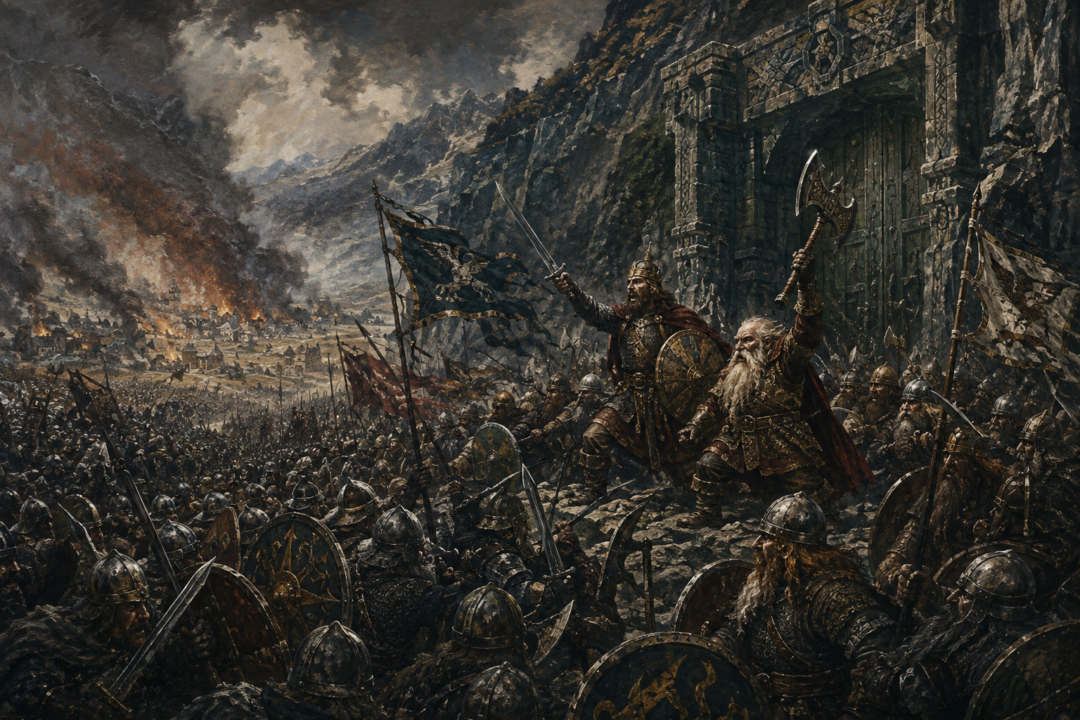
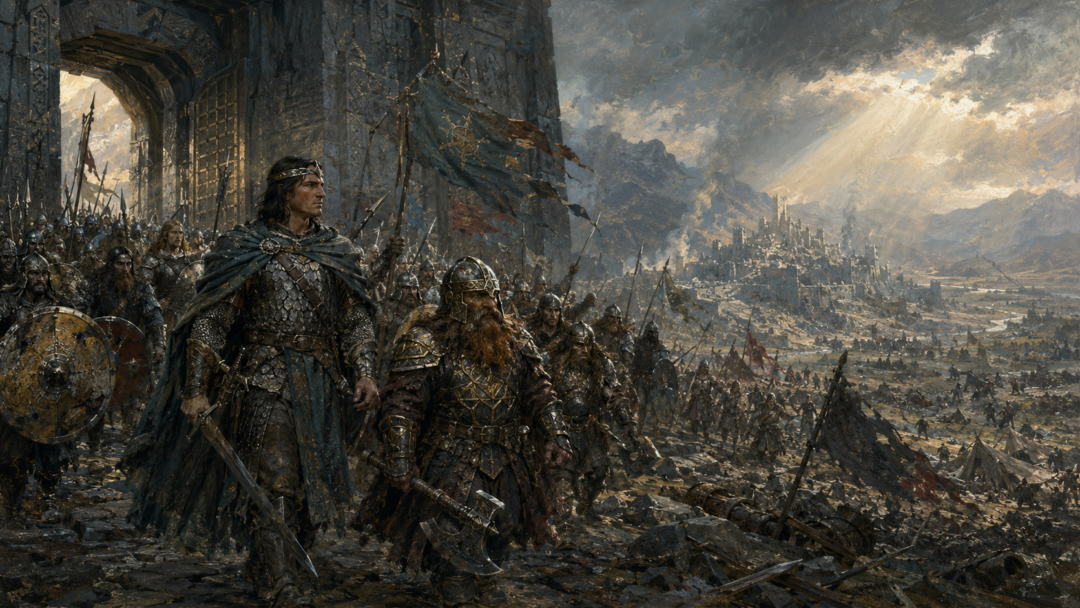
Dale falls back before an invading host from the East. The Dwarves of Erebor join its defense. King Brand is killed. Dáin Ironfoot dies beside him before the Gate of the Lonely Mountain. The surviving Men and Dwarves are driven inside Erebor and besieged.
None of this interrupts Frodo’s journey. No northern army arrives dramatically at Minas Tirith. The main narrative barely pauses to show what is happening.
But that absence hides one of the War of the Ring’s largest strategic costs.
The Battle of Dale consumes two kingdoms at precisely the moment when the Free Peoples need every possible ally. More importantly, those kingdoms pay that price by preventing Sauron’s northern war from spreading much farther west.
Sauron Was Fighting More Than One War
The assault on Gondor was the center of Sauron’s strategy, but it was not his only offensive.
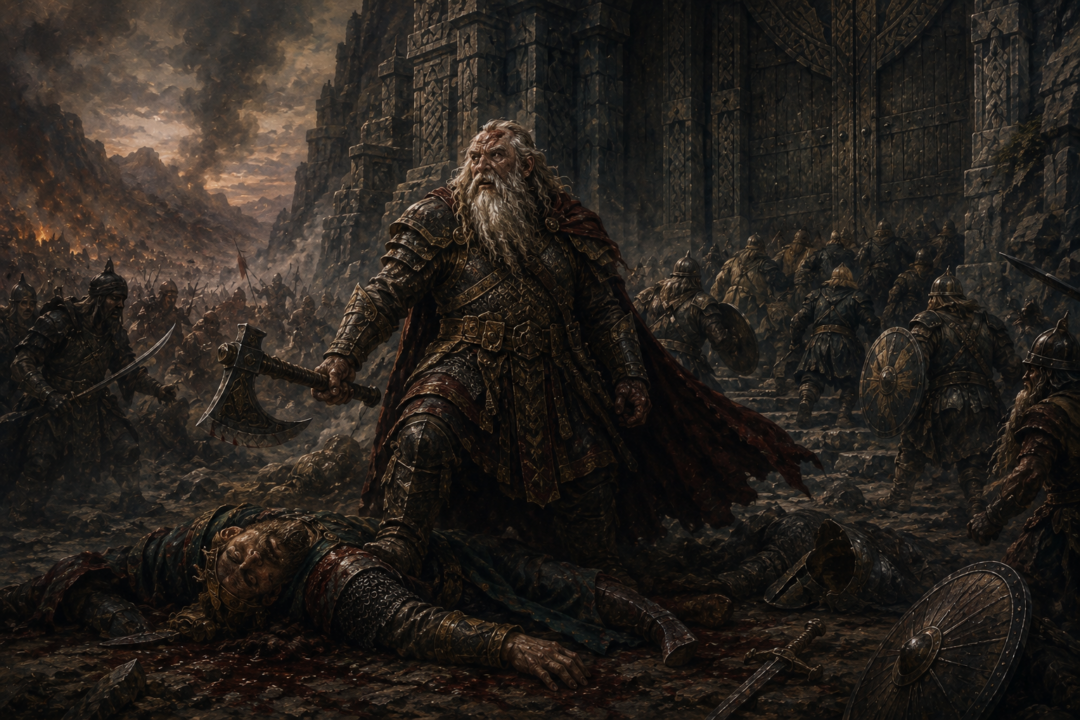
Appendix B of The Lord of the Rings records attacks across a vast front. While Mordor struck Gondor, forces from Dol Guldur attacked Lórien and Thranduil’s woodland realm. In the north-east, Sauron’s allies moved against Dale and Erebor.
This matters because the War of the Ring was never simply a contest between Mordor and Minas Tirith.
Sauron was attempting to overwhelm multiple centers of resistance at once.
Dale was particularly exposed. Its prosperity had grown considerably since the death of Smaug and the rebuilding that followed The Hobbit. Erebor had likewise become a restored Dwarven kingdom under Dáin Ironfoot.
Their success made them strategically important.
The appendices make clear that Sauron had already attempted to pressure the northern kingdoms before open war began. A messenger from Mordor came to Erebor seeking news of Bilbo and the Ring, offering rewards and making threats. Glóin also reports at the Council of Elrond that King Brand was troubled because forces were gathering along his eastern borders.
The attack on Dale was therefore not a random raid accompanying the larger war. The northern kingdoms were recognized obstacles.
Dale Absorbs an Army That Otherwise Has Somewhere Else to Go
Around the same time that Sauron’s great offensive reaches Gondor, his allies cross the River Carnen and drive Brand back toward Dale.
Dáin and the Dwarves come to the aid of the Men.
The fighting lasts for days.
Eventually the defenders are forced back to the Gate of Erebor. Brand falls there, and Dáin dies defending his fallen ally. The remaining forces retreat inside the Mountain, where the enemy cannot force the Gate and instead lays siege.
Militarily, this is a defeat for Dale and Erebor in the immediate sense.
The field is lost. Both kings are dead. Dale is effectively abandoned to the enemy while its surviving defenders take refuge inside Erebor.
Yet those defenders have accomplished something enormous simply by continuing to exist.
The invading host cannot move freely westward because a powerful fortified kingdom remains behind it.
Erebor has become an anchor.
The Men and Dwarves are trapped, but their enemies are also occupied.
That is the strange strategic exchange at the heart of the Battle of Dale: the northern kingdoms lose their battlefield and their kings, yet prevent Sauron’s northern offensive from becoming something much larger.
The Most Expensive Loss Is Dáin Ironfoot
Dáin’s death carries unusual weight because readers have already seen how long his history stretches.
He fought at Azanulbizar long before the Quest of Erebor. He came from the Iron Hills to aid Thorin during the crisis that ended in the Battle of Five Armies. After Thorin’s death he became King under the Mountain and ruled the restored Dwarven realm for decades.
By the War of the Ring, Dáin is extraordinarily old even by Dwarven standards.
And he still dies in battle.
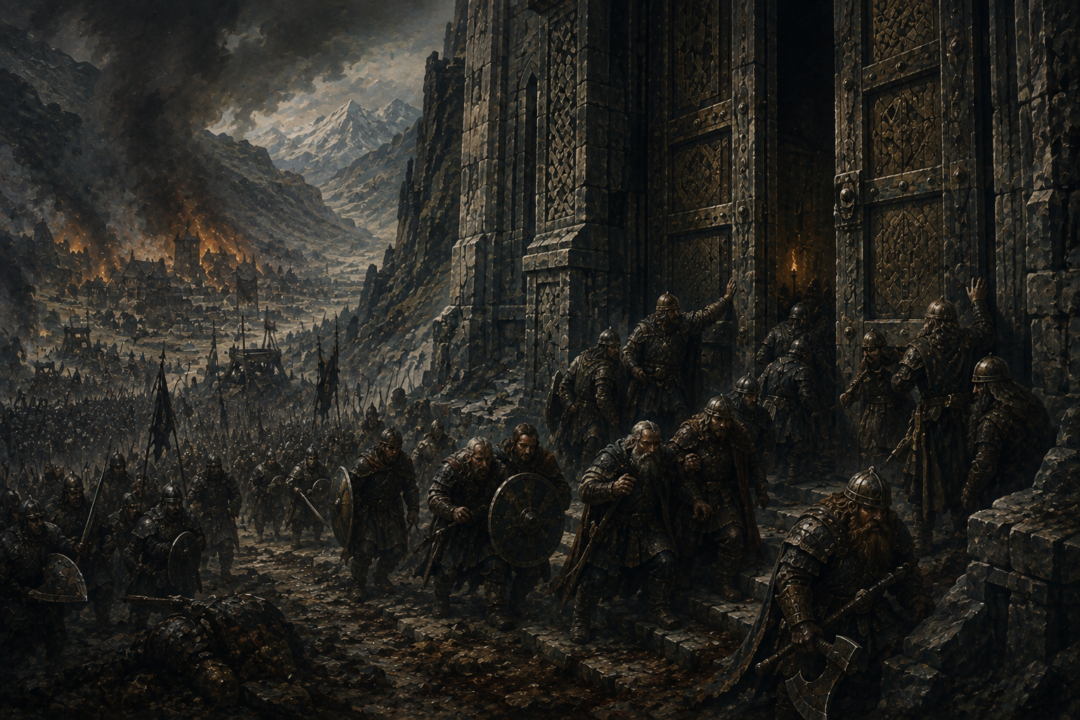
Appendix A presents his final stand with deliberate grandeur: Dáin remains near the body of Brand before the Gate of Erebor and fights until he too is slain.
The cost is therefore larger than one commander.
The Dwarves lose the ruler who rebuilt their political strength beneath the Mountain after Smaug’s death. Dale simultaneously loses Brand, grandson of Bard the Bowman.
Two allied kingdoms lose their kings on the same battlefield.
Their heirs, Thorin III Stonehelm and Bard II, inherit during a siege.
That is an extraordinary degree of instability to absorb during an existential war.
Dale Cannot Help Gondor Because Dale Is Fighting for Dale
One tempting question is why the great kingdoms of the north do not send armies toward Gondor.
The chronology itself provides much of the answer.
They cannot.
Dale and Erebor are fighting their own version of the War of the Ring.
This is one of the hidden effects of Sauron’s multi-front strategy. He does not need every allied army to march directly upon Minas Tirith. If forces in the East can keep Dale and Erebor occupied, those northern powers are effectively removed from the southern campaign.
The same principle appears elsewhere. Lórien must defend itself against repeated assaults from Dol Guldur. Thranduil fights a battle beneath the trees of northern Mirkwood.
The Free Peoples are fragmented geographically because each stronghold faces its own danger.
That does not mean a large army from Erebor would otherwise certainly have marched to Gondor; the text never establishes such a plan. But it does mean that during the decisive days of March 3019, Dale and Erebor have no strategic freedom at all.
Their armies are committed to survival.
Sauron has successfully tied them down.
The Siege Turns Defeat Into Strategic Resistance
Had the Gate of Erebor fallen, the northern war could have ended very differently.
It does not.
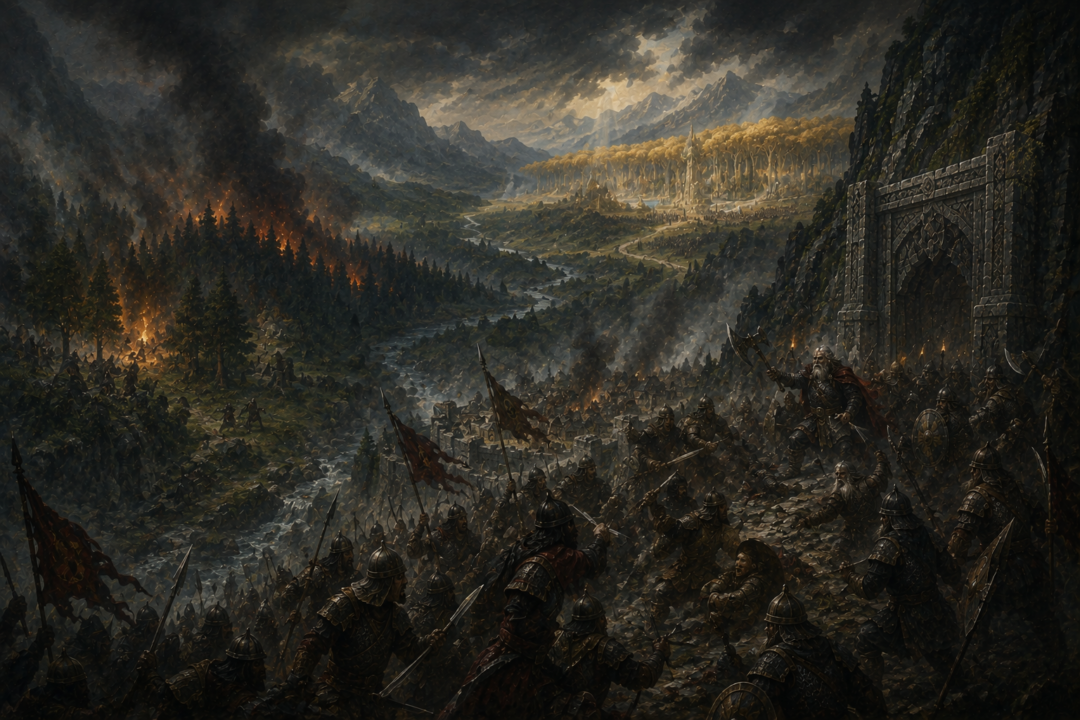
The surviving Dwarves and Men hold the Mountain after the battlefield defeat. This distinction is crucial.
The enemy wins Dale but does not destroy its defenders.
Erebor therefore becomes what a strong fortress should be in wartime: a position that forces an enemy either to capture it or remain threatened by it.
The besiegers cannot simply treat the northern kingdoms as finished.
And then the entire strategic situation changes.
On March 25, the Ring is destroyed and Sauron falls. The consequences spread far beyond Mordor. His servants and allies lose the central power that had driven the war.
The northern defenders eventually emerge from Erebor. Under Bard II and Thorin Stonehelm, they break the siege and drive their enemies away.
Dale and Erebor survive.
But they survive after having paid heavily for the privilege.
Gandalf Reveals What Their Sacrifice Prevented
The strongest explanation of the battle’s importance comes later in Appendix A.
Gandalf specifically warns against remembering the Pelennor while forgetting Dale and the courage of Durin’s Folk.
He then imagines the alternative.
His language points toward devastation spreading westward into Eriador and darkness reaching Rivendell. He even connects the northern war to the future Queen of Gondor — Arwen — who had long dwelt in Rivendell.
This is not presented as a detailed campaign plan showing exactly how Sauron’s armies would have advanced. It is a retrospective judgment about the scale of the danger.
If Dale and Erebor had not stood, the north would have been dangerously exposed.
And behind that defense lies an event from decades earlier: the Quest of Erebor.
Gandalf’s concern about Smaug was never merely about helping Thorin recover treasure. In the retrospective account preserved in Appendix A, he feared what might happen if Sauron could use the dragon against the Free Peoples.
Smaug’s death and the restoration of Dale and Erebor therefore created the very defenses that Sauron later had to overcome.
In 3019, those defenses finally paid their strategic dividend.
The Battle of Dale Is Victory Through Containment
The Battle of Dale is easy to overlook because nothing that happens there destroys the Ring.
No member of the Fellowship participates.
No messenger from Dale arrives in time to change the Battle of the Pelennor Fields.
Measured only by the central narrative, it seems peripheral.
Measured strategically, it is anything but.
Dale and Erebor absorb an eastern invasion. Their kings die. Their armies are driven from the battlefield. Their people endure a siege. They are prevented from helping anyone elsewhere because their own survival demands everything they possess.
Yet that sacrifice prevents a worse result.
Sauron’s northern forces do not pass triumphantly through a destroyed Erebor toward the lands beyond. They remain entangled with enemies they have defeated but not eliminated.
That distinction lasts just long enough.
When Sauron falls, the besieged become the counterattackers.
The strange truth is that the Battle of Dale costs the war effort precisely because it saves it. Two kingdoms have to spend their strength so that the northern front does not collapse. They lose rulers, territory, lives, and freedom of action so that Sauron gains nothing more valuable than a temporary battlefield victory.
The War of the Ring is won at Mount Doom.
But the world that survives that victory is larger because other people, far from Frodo and Sam, were holding doors that could not be allowed to open.
Sources & Notes
- https://www.encyclopedia-of-arda.com/b/battleofdale.php — The Encyclopedia of Arda: Battle of Dale (the Easterling invasion, deaths of Brand and Dáin, retreat into Erebor, and siege).
- https://www.encyclopedia-of-arda.com/d/dainironfoot.php — The Encyclopedia of Arda: Dáin Ironfoot (his long reign and death defending Brand before Erebor’s gate).
- https://www.encyclopedia-of-arda.com/k/kingbrand.php — The Encyclopedia of Arda: King Brand (Dale’s king, his alliance with Erebor, and his death in the northern campaign).
- https://en.wikipedia.org/wiki/D%C3%A1in_II_Ironfoot — Wikipedia: Dáin II Ironfoot (publication-based overview of Dáin’s role from Azanulbizar through the War of the Ring).
Sources checked for relevance and availability.