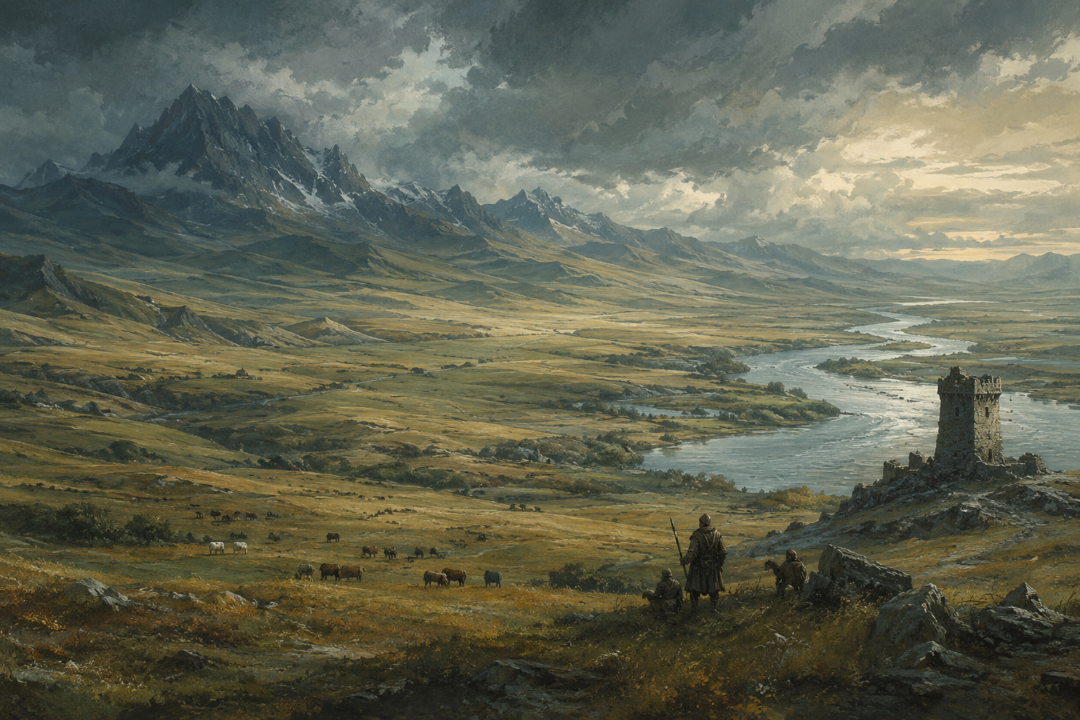
When most readers picture Rohan, they imagine a kingdom made for defence: horsemen racing across open grass, distant enemies visible beneath an enormous sky, and riders able to cross the country faster than almost any invading army.
Yet the northern edge of the Mark reveals the weakness hidden inside that strength.
The Wold was a broad upland region in northern Rohan, lying toward the Anduin and south of the Limlight. It was good country for grazing, but it was never presented as one of the great settled hearts of the Rohirrim. Long distances, open ground, scattered pastoral use, and vulnerable approaches toward the Great River made it very different from the more politically important lands nearer Edoras.
That mattered because the Wold stood beside one of Middle-earth’s dangerous strategic corridors.
Long before the War of the Ring, enemies from beyond Anduin had discovered that northern Calenardhon could be entered with terrifying speed. The history of the Wold shows a recurring problem: empty land can provide warning space, but it can also give an invader room to move before a kingdom can concentrate enough strength to stop him.
Before Rohan, the North Was Already Failing
The weakness of this frontier did not begin with the Rohirrim.
Before Calenardhon became Rohan, it was a province of Gondor. By the later Third Age its population had severely declined. Pestilence, war, and Gondor’s long demographic and military contraction had reduced its ability to hold territories that had once belonged securely to the South-kingdom.
The detailed account in Unfinished Tales, especially “Cirion and Eorl and the Friendship of Gondor and Rohan,” makes this decline essential to the crisis of 2510.
Gondor still claimed Calenardhon, but possession on a map was not the same thing as effective occupation. Cirion, the Steward, was sufficiently concerned about the northern approaches that he placed men in old forts along the Anduin, particularly around the Undeeps, and sent scouts into the lands east of the river.
The implication is important. Gondor was no longer defending a densely inhabited frontier whose population could itself obstruct enemy movement. It was watching a vast, weakened border with limited forces.
Meanwhile the threat beyond Anduin was increasing.
The Balchoth, an Easterling people, had gathered in great numbers in southern Rhovanion. Their growing strength contrasted sharply with the declining population west of the river.
The geography was becoming dangerously unbalanced.
The Wold Was Not a Wall
A mountain frontier can force armies through narrow passes. A heavily settled frontier can provide forts, roads, local levies, supplies, scouts, and communities capable of reporting enemy movements.
The Wold offered something different: space.
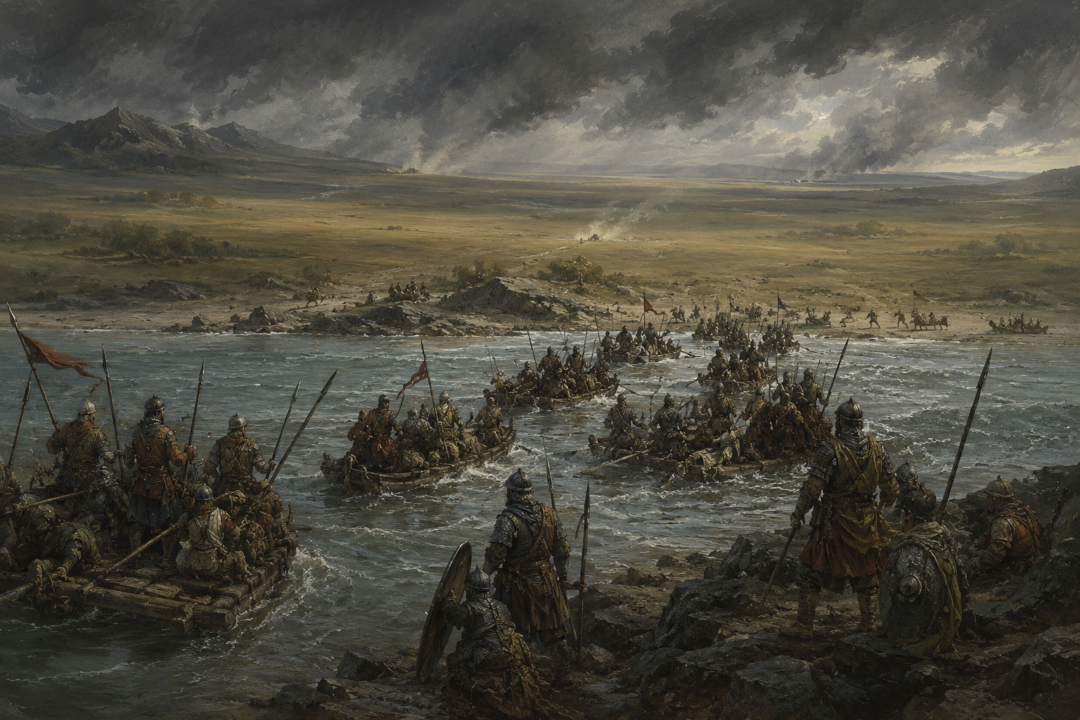
Its openness could favour mounted defenders once they were assembled, but open country did not automatically prevent an enemy from entering it. In 2510 the Balchoth prepared boats and rafts and crossed the Anduin in force.
Gondor’s river defence failed to contain them.
Once across, they entered northern Calenardhon and confronted Cirion’s northern army. The Gondorians were defeated and driven northward, eventually being forced across the Limlight into the Field of Celebrant.
This episode shows the real danger of a thinly held region.
The Balchoth did not need to capture a chain of major cities in the Wold before advancing. There were no great northern urban centres described in the texts whose possession determined control of the country. Once the river barrier was breached, the decisive contest became one between mobile armies across broad terrain.
That made the frontier capable of collapsing very quickly.
An Empty Frontier Gave the Enemy Room
It would go beyond the texts to claim that the Wold’s settlement pattern alone caused Gondor’s defeat. The surviving accounts do not provide that kind of explicit military analysis.
But the relationship is difficult to miss.
Calenardhon had become sparsely populated at precisely the moment when powerful enemies were gathering east of Anduin. Gondor therefore had to compensate with forts, scouts, and field armies.
Those measures could warn of invasion.
They could not replace population.
A settled frontier creates friction for an attacker. Every defended community, crossing, storehouse, and local concentration of manpower can complicate movement. A largely empty pastoral or abandoned region offers fewer such obstacles.
In 2510, once the Balchoth forced the Anduin, the defence depended heavily on Cirion’s army.
When that army was defeated, there was little strategic depth immediately available in northern Calenardhon to stop the enemy.
Worse still, another danger emerged from a different direction.
The Disaster Became a Two-Sided Trap
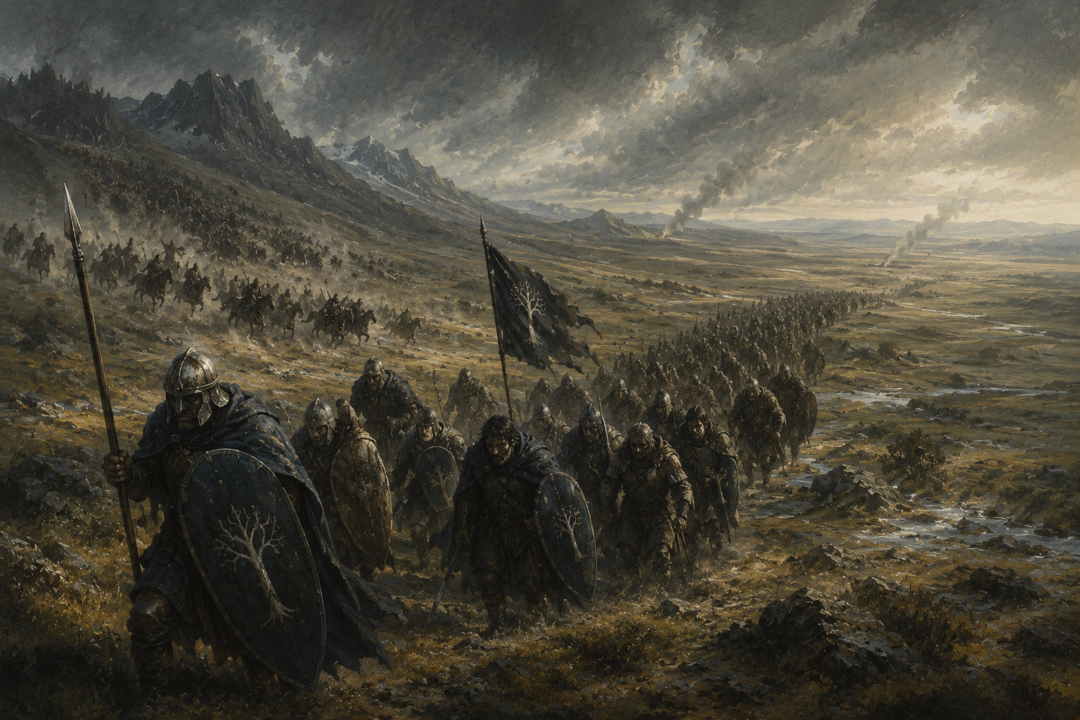
As Cirion’s forces were driven toward the Field of Celebrant, Orcs descended from the Misty Mountains.
Whether the cooperation between the various enemies was fully coordinated is not stated with certainty. The texts allow the possibility of hostile powers acting under a wider malign influence, but the precise operational relationship should not be overstated.
For Cirion’s soldiers, the distinction hardly mattered.
Balchoth pressure had already forced them north. Now Orcs attacked as well. The Gondorian army was trapped in an increasingly desperate position near the Anduin.
This reveals another weakness of the Wold’s geography.
Northern Calenardhon did not face danger from only one direction. Enemies could approach from beyond Anduin, while the Misty Mountains and their Orcs threatened from the west and northwest.
The open northern territory between these dangers could become a killing ground if the defenders lost freedom of movement.
In 2510, that nearly happened.
Only the arrival of Eorl changed the battle.
Eorl Used the Same Geography Differently
The Éothéod’s great ride is one of the striking reversals in the history of the Third Age.
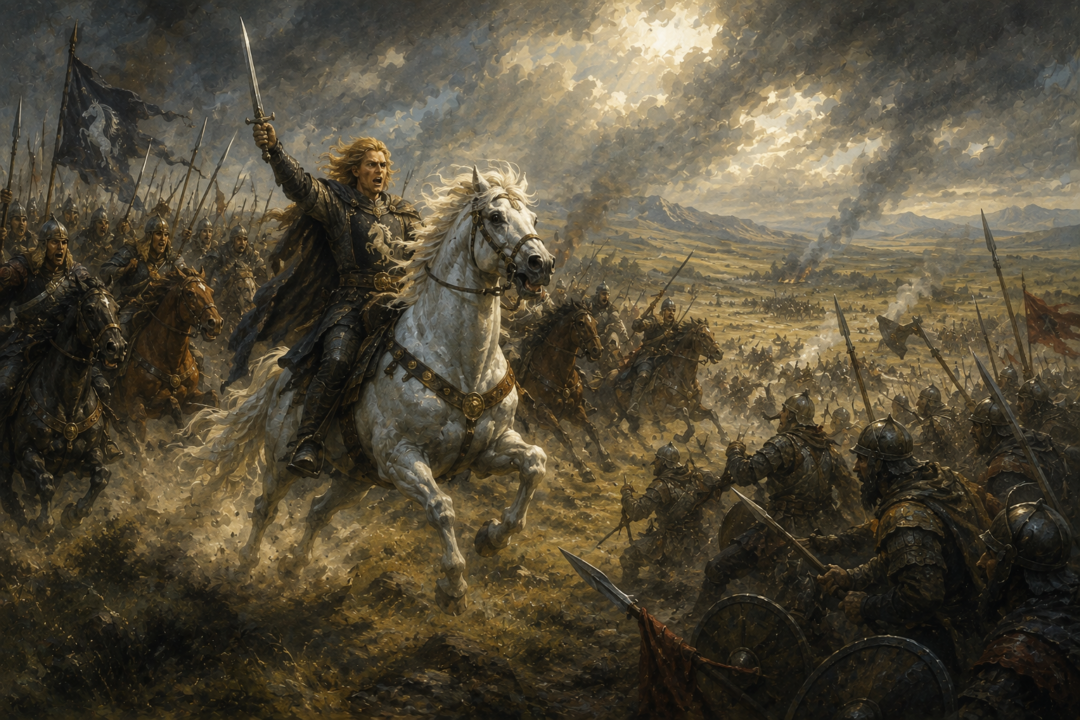
Eorl had answered Cirion’s desperate summons and brought his mounted host south from the distant lands of his people. At the Field of Celebrant, his riders unexpectedly struck the enemies of Gondor and transformed what had been approaching catastrophe into victory.
The contrast is revealing.
The same broad northern landscape that offered dangerous freedom of movement to invaders also rewarded an army built around speed.
The Rohirrim’s ancestors were precisely such a force.
Where Gondor had struggled to maintain permanent control over a depopulated province, the Éothéod possessed a military culture exceptionally suited to crossing large expanses of grassland. After the victory, Cirion granted Calenardhon to Eorl and his people, and the land became Rohan.
This did not make the northern frontier invulnerable.
It changed the kind of defence possible there.
Instead of relying primarily upon distant Gondorian garrisons to hold a fading province, the land would now be occupied by a people whose horses were central to both their society and their warfare.
Yet even that solution had limits.
The Wold Remained Exposed
Only thirty-five years after the founding of Rohan, Easterlings attacked again.
In 2545, Eorl himself fell fighting them in the Wold.
The surviving chronology gives few details about this campaign, so we should resist reconstructing a battle that the texts do not describe. We cannot confidently state the invaders’ exact route, numbers, tactical plan, or relationship to the Balchoth of the earlier war.
What we can say is significant enough: renewed Easterling attacks reached the Wold, and the first King of Rohan died fighting there. His son Brego succeeded him, and the invaders were ultimately driven out.
Rohan had therefore solved the problem of an almost abandoned Calenardhon without eliminating the strategic vulnerability of its northeastern border.
The Wold remained frontier country.
Its value to the Rohirrim was pastoral rather than urban. Its open spaces could support herds and mounted movement, but they did not become a continuous belt of fortifications and dense settlement.
The kingdom’s answer was mobility.
Sparse Settlement Was Both Weakness and Weapon
This is where the apparent contradiction of the Wold becomes clearest.
Sparse settlement could help an invader penetrate the frontier because there were fewer fixed obstacles and fewer concentrated communities standing in the way.
But the Rohirrim did not need to turn every mile of the Wold into fortified ground.
Their military system depended upon riders who could gather and move rapidly across the plains. Open country that was dangerous when undefended could become advantageous once an éored was in motion.
The texts do not give us enough information to calculate patrol systems or precise response times, and such details should not be invented. But the broader relationship between Rohan’s landscape and its mounted warfare is unmistakable.
Rohan was not a kingdom that made every frontier physically impenetrable.
It was a kingdom capable of responding across distance.
That distinction explains both its strength and its recurring danger.
If warning arrived early and riders assembled in time, open ground gave the Rohirrim room to exploit their horses.
If an enemy crossed the frontier before sufficient forces gathered, that same openness gave the enemy room.
By the War of the Ring, the Wold Was Emptier Still
The danger had not disappeared by Théoden’s time.
During the journey through Rohan in The Two Towers, the northern and eastern reaches of the kingdom are presented as increasingly troubled by war and Orc activity. The Wold’s pastoral population had been affected by raids, and parts of the region had become deserted.
This was not merely atmospheric emptiness.
It echoed an older pattern in the history of Calenardhon: insecurity reduced settlement, and reduced settlement made effective control more difficult.
Yet the Wold never became famous for a Minas Tirith, a Hornburg, or an Edoras.
That absence is part of its historical importance.
Its story is the story of territory that kingdoms could claim more easily than they could permanently fill.
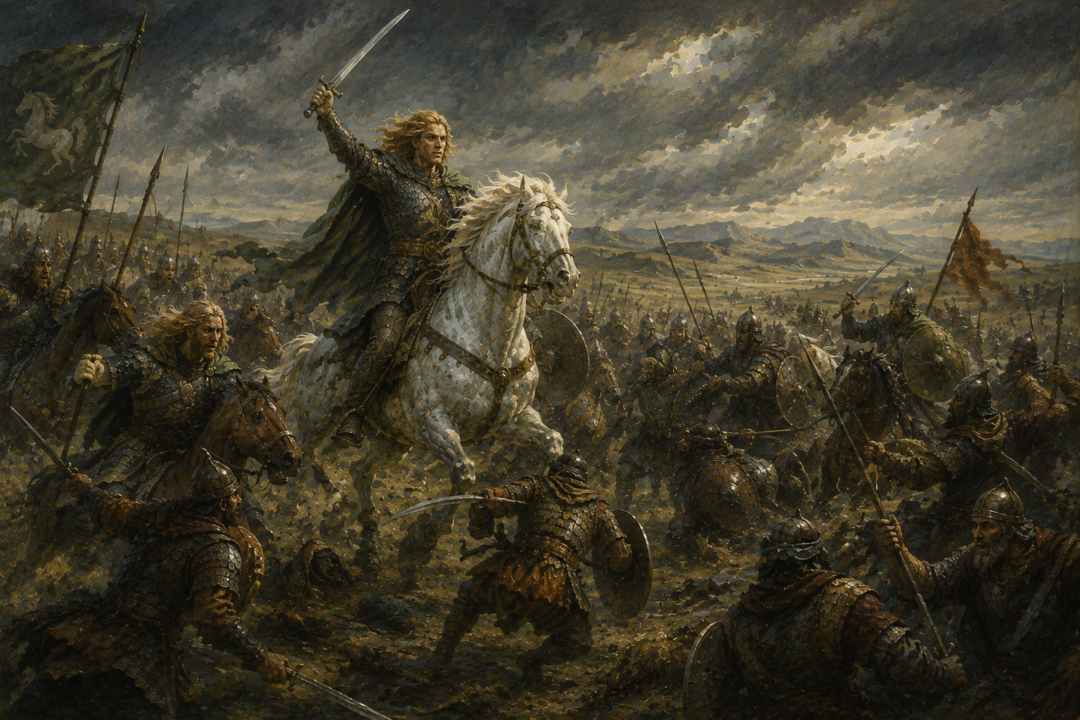
The Wold Reveals Rohan’s Hidden Strategic Problem
Rohan’s greatest weapon was movement, but movement was also what its enemies needed.
That is the deeper lesson of the Wold.
The Rohirrim inherited a land that Gondor had become too weak and too thinly spread to defend effectively. Their arrival transformed Calenardhon because a mounted people could use its enormous spaces far better than distant Gondorian administrators and scattered garrisons could.
But geography did not change allegiance when Cirion gave the land to Eorl.
The Anduin still lay to the east. The Limlight still marked the north. Hostile peoples could still gather beyond the river. Orcs could still descend from the mountains. And the Wold remained too broad to be treated like the gate of a fortress.
So Rohan lived with a permanent bargain.
Its open country gave its horsemen extraordinary freedom, but it could never guarantee that an enemy would be stopped at the border.
Sometimes the enemy would enter first.
The real defence of the Wold was not the emptiness of the land.
It was whether the Riders could reach that emptiness before the invaders turned it against them.
Sources & Notes
- The Encyclopedia of Arda — The Wold: geography of the treeless northern uplands of Rohan between Fangorn, Anduin, and the Limlight — https://www.glyphweb.com/arda/w/wold.html
- The Encyclopedia of Arda — Calenardhon: Gondor’s depopulated northern province and its transfer to Eorl’s people after the invasion of 2510 — https://www.glyphweb.com/arda/c/calenardhon.html
- The Encyclopedia of Arda — Balchoth: the Easterling confederation that crossed Anduin and overran northern Calenardhon — https://www.glyphweb.com/arda/b/balchoth.html
- The Encyclopedia of Arda — Battle of the Field of Celebrant: Cirion’s defeat, the arrival of Eorl, and the destruction of the invading force — https://www.glyphweb.com/arda/b/battleofthefieldofcelebrant.html
- The Encyclopedia of Arda — Éothéod: the northern horse-people summoned by Cirion who rode south to become the Rohirrim — https://www.glyphweb.com/arda/e/eotheod.html
Background references for the Wold’s geography, Calenardhon’s declining population, and the Balchoth invasion of 2510. Primary account: J.R.R. Tolkien, Unfinished Tales, ‘Cirion and Eorl and the Friendship of Gondor and Rohan’; see also The Lord of the Rings, Appendix A, ‘The House of Eorl’.