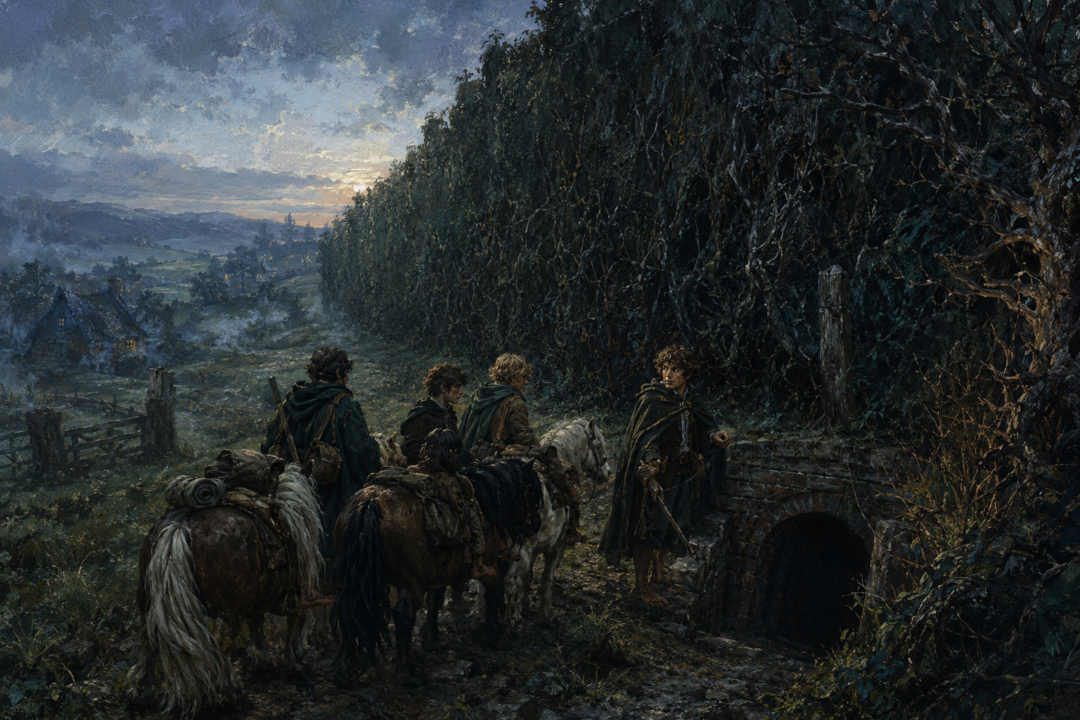
When Frodo Baggins reaches Crickhollow, the obvious road to safety seems almost embarrassingly simple. Bree lies eastward. The Great East Road leads toward Bree. Frodo has ponies, loyal companions, and at least some hope of finding Gandalf farther along the journey.
Instead, the hobbits deliberately ride into the Old Forest.
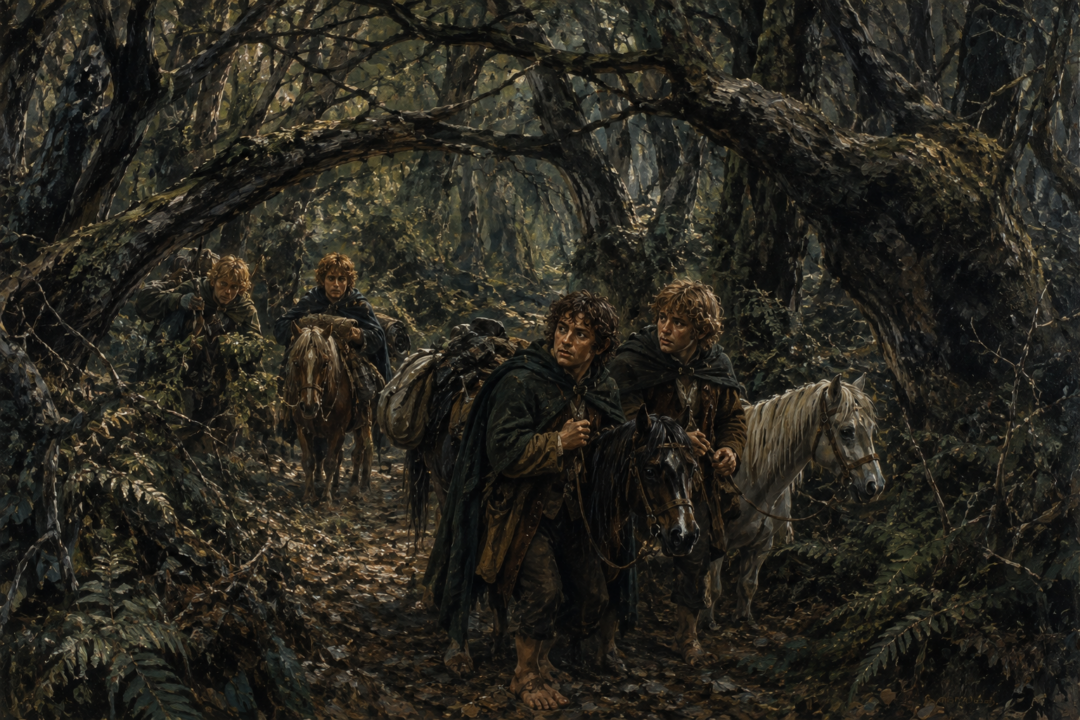
It looks like a terrible decision. The Bucklanders themselves fear the wood. Its trees have a long memory, its paths cannot be trusted, and somewhere beneath its branches waits a power capable of putting travellers into an enchanted sleep. Yet Frodo, Merry, Pippin, and Sam choose this route rather than simply leaving Buckland by the road.
The reason is not that they misunderstand the danger. They understand it surprisingly well.
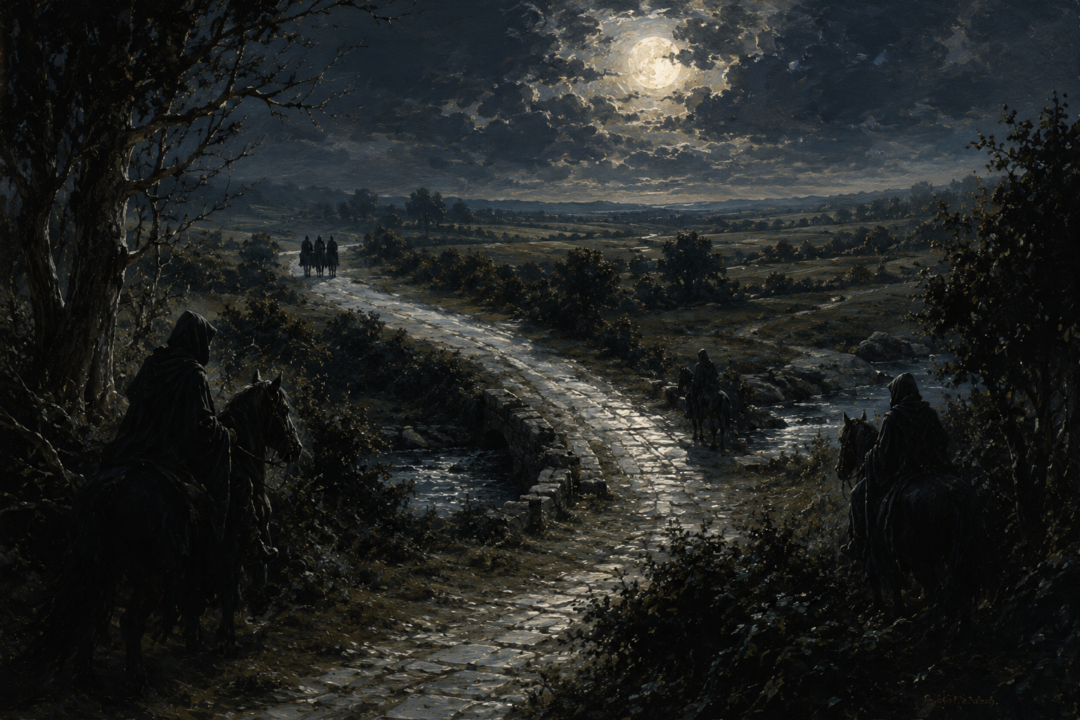
They enter the Old Forest because the Black Riders have transformed the safest road in the Shire into the most predictable place Frodo could possibly be.
The East Road Has Become a Trap
By the time Frodo arrives at Crickhollow, secrecy is already collapsing.
The Black Riders have been asking about Baggins. Frodo has personally encountered them on his journey across the Shire. One Rider has followed the hobbits as far as the Brandywine, and Merry reports that the Buckland gatekeepers might delay suspicious strangers but could not indefinitely prevent determined enemies from entering.
This changes Frodo's problem.
His original plan had depended heavily on disguise and delay. He had sold Bag End and created the appearance that he was simply moving to Crickhollow. Fatty Bolger would remain there after Frodo departed, helping preserve the illusion that Frodo was still living quietly in Buckland.
But if Frodo leaves by Buckland's North-gate, his departure will immediately become much less secret. More importantly, Frodo concludes that the Bridge and the East Road near the borders are likely to be watched.
That is the crucial calculation.
The East Road is geographically sensible, but strategically obvious.
And Frodo now knows that his pursuers are intelligent.
Why the Black Riders Change Everything
At this stage Frodo does not yet understand the Nazgûl as fully as he eventually will. He nevertheless knows enough to recognize that ordinary travel habits have become dangerous.
The Riders are searching rather than wandering randomly. They ask questions. They follow information. They investigate places associated with Baggins. Their pursuit has already reached the borders of Buckland.
Taking the main road would therefore mean moving through precisely the kind of route an enemy searching for eastbound travellers would naturally watch.
Frodo consequently decides to leave in an unexpected direction.
That choice reveals something important about his early development. He is frightened, but he is not merely fleeing blindly. He is beginning to think in terms of what the Enemy expects him to do.
The logic anticipates a much larger pattern in the story: survival sometimes depends not on choosing the safest terrain, but on choosing the course the enemy considers unlikely.
The Old Forest is dangerous.
That is partly why it can serve as an escape route.
Buckland Gives Them a Secret Exit
The geography of Buckland makes the plan possible.
Buckland lies east of the Brandywine, squeezed between the river and the Old Forest. Along its eastern boundary stands the High Hay, the enormous hedge maintained by the Bucklanders as protection from the wood. At the northern end, near the Brandywine Bridge, travellers can pass through the guarded North-gate and reach the East Road.
Encyclopedia of Arda
But the Brandybucks know another way.
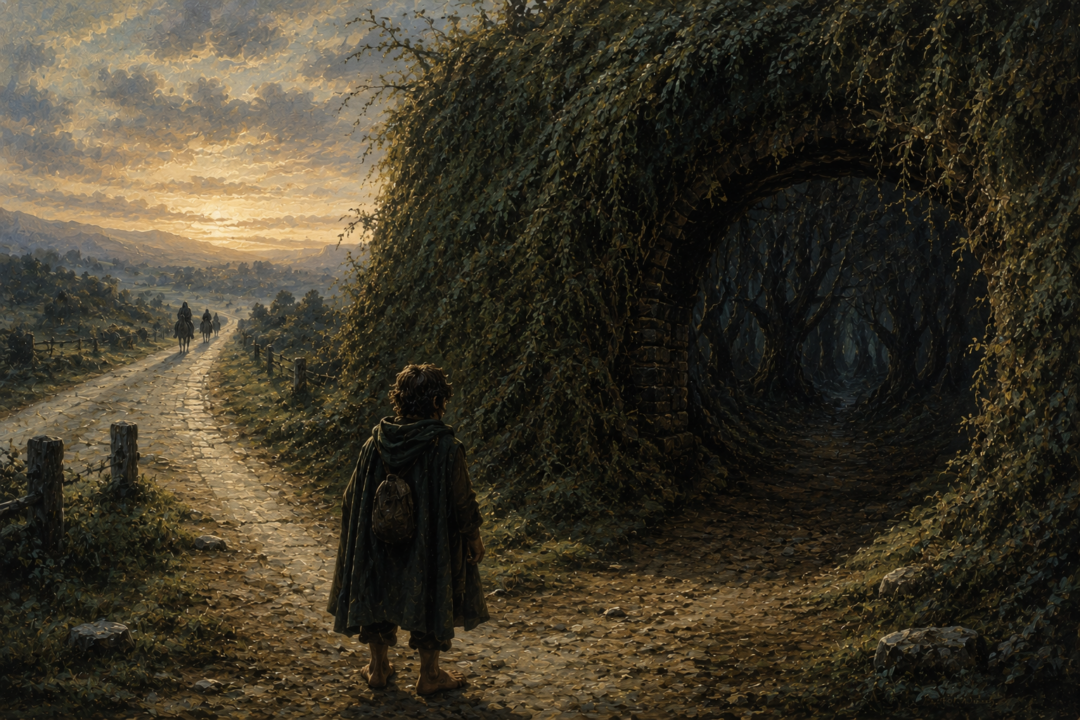
Near Crickhollow is a tunnel running beneath the Hedge. Merry leads the company there before dawn. At its far end is an iron gate opening directly onto the edge of the Old Forest.
This is almost the opposite of the North-gate.
The northern route is public, guarded, connected to the Road, and therefore observable. The tunnel is obscure, local knowledge possessed by people familiar with Buckland.
Using it allows Frodo's party to vanish without announcing their departure along the normal route.
Fatty Bolger remains behind at Crickhollow, strengthening the deception. The hope is not that the Riders will remain fooled forever, but that Frodo can gain time.
For someone being hunted, a few hours of uncertainty can matter enormously.
The Hobbits Know the Forest Is Dangerous
The decision becomes more striking because nobody pretends the Old Forest is harmless.
Fredegar Bolger is horrified by the proposal. Merry, who knows more about the Forest than the others, has entered it before and understands the hostility associated with it. Frodo himself had also been inside the Forest once in earlier days. lotrinklings.net
The Bucklanders have good reason to distrust the place.
Merry tells of trees pressing against the Hedge and of Bucklanders responding by cutting down trees and burning a strip of woodland, creating the place later known as the Bonfire Glade. The relationship between Buckland and the Forest is therefore not simply one of frightened hobbits inventing stories about dark woods. Within the narrative, the Forest really does possess an uncanny awareness and hostility.
The hobbits are choosing between two genuine dangers.
One danger is known to be hunting Frodo specifically.
The other is dangerous to anyone foolish enough to enter it.
That distinction makes the Old Forest the desperate but rational choice.
Their Real Plan Is to Reach the Road Later
Entering the Old Forest is not a decision to abandon the East Road permanently.
The hobbits hope to cross the Forest and eventually regain the Road farther east, after bypassing the area where Frodo expects the Riders to be watching.
This is easy to miss because their journey immediately begins going wrong.
Once inside, Merry attempts to navigate using what he knows of the country. The company reaches higher ground and tries to orient itself. The East Road should lie somewhere to the north, while the Barrow-downs are visible beyond the Forest to the east.
But the Forest refuses to behave like ordinary terrain.
Paths disappear. Trees seem to crowd them away from their intended direction. Whenever the hobbits attempt to work northward, the land and vegetation repeatedly force them south.
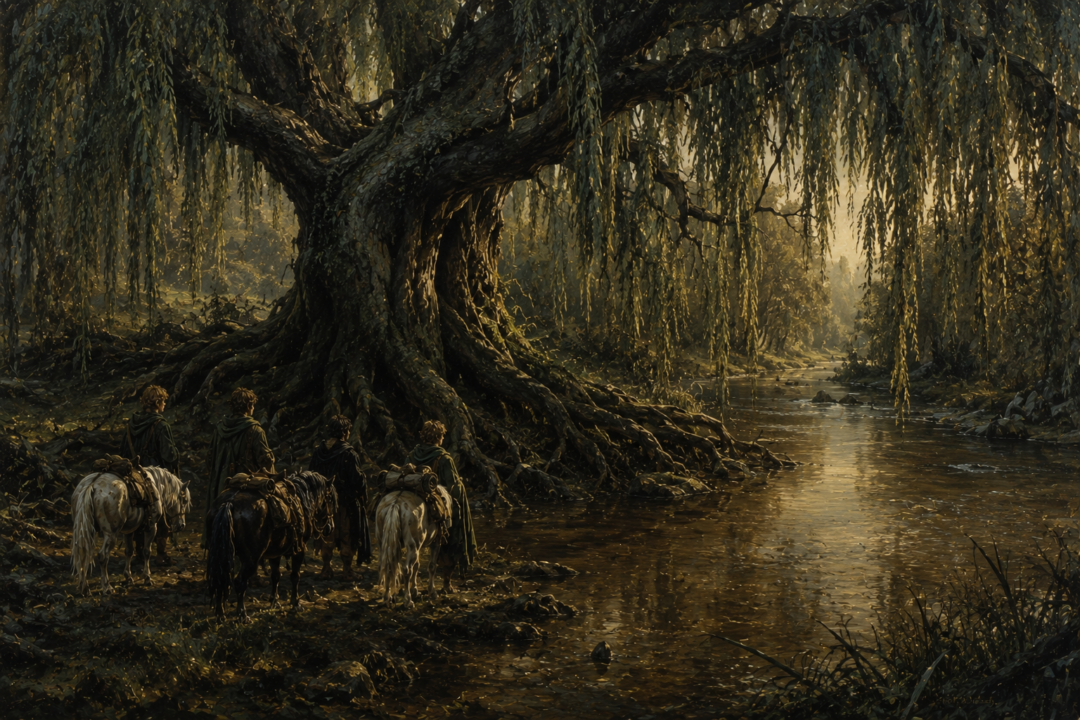
Instead of emerging toward the Road, they are drawn toward the valley of the Withywindle.
Their clever attempt to evade one enemy has carried them into the influence of another power entirely.
The Forest Is Not Just Difficult Terrain
This is where the episode becomes more than a wilderness detour.
The Old Forest is presented as possessing a kind of awareness. Merry believes the trees communicate and remember injuries. The hobbits increasingly feel that the Forest is deliberately directing them.
The text does not require every tree to be understood as an individually conscious creature acting according to one coordinated plan. But it leaves little doubt that something more than bad navigation is occurring.
At the centre of the danger is Old Man Willow.
Tom Bombadil later describes the great willow's influence as spreading through the Forest, with power reaching through root and branch. The hobbits, without understanding the full nature of what is happening, are steadily drawn toward the Withywindle and eventually into Old Man Willow's immediate reach.
Their shortcut has become a trap.
Yet it is a different kind of trap from the one Frodo feared on the Road. The Nazgûl represent deliberate pursuit by servants of Sauron. The Old Forest belongs to an older and stranger layer of Middle-earth, one that cannot simply be reduced to Sauron's power.
That distinction matters.
Middle-earth contains dangers that are not extensions of the central war.
Frodo Makes the Right Decision—and Nearly Dies Anyway
It is tempting to judge Frodo's choice by what happens next.
The hobbits are exhausted and enchanted into sleep. Merry and Pippin are trapped by Old Man Willow. Frodo is thrown into the water and nearly overwhelmed. Without Tom Bombadil's arrival, their attempt to cross the Forest could have ended disastrously.
But a dangerous outcome does not make the original reasoning foolish.
The East Road really is compromised. The Black Riders really are closing in. Frodo has good reason to believe that leaving openly through the North-gate would expose his movements. His companions agree that an unexpected route offers their best chance of slipping away.
What they underestimate is not the Nazgûl.
They underestimate the Old Forest.
And that is characteristic of the wider journey. Again and again, the hobbits discover that the world beyond their familiar borders contains powers for which Shire experience has not prepared them.
The First True Step Outside the Shire
There is also a deeper significance to the route.
Crossing the Brandywine feels like departure, but Buckland is still hobbit-country. Crickhollow is comfortable. There are beds, food, friends, ponies, familiar customs, and a carefully prepared house.
The tunnel beneath the Hedge marks a sharper boundary.
When Merry unlocks the gate on the far side, the company passes beyond the protected world maintained by hobbit society and into country that does not care about hobbit expectations.
The contrast is almost perfect.
Behind them stands the High Hay: cultivated, maintained, defensive, a barrier constructed by generations of Bucklanders.
Ahead stands the Old Forest: ancient, self-willed, tangled, and resistant to control.
Frodo's journey toward Mordor does not truly begin with a heroic march down a famous road. It begins with an attempt to disappear.
The Choice That Defines the Journey
The hobbits enter the Old Forest because the Road is exactly where their enemies expect them to be.
Frodo sacrifices the certainty of a known route for the possibility of secrecy. Merry's knowledge of Buckland provides a hidden way through the Hedge, while Fatty Bolger remains behind to maintain the appearance that Frodo has settled at Crickhollow.
It is a sensible plan built on incomplete knowledge.
That is what makes the episode so effective.
Frodo has correctly recognized the danger posed by the Black Riders, but he has not yet grasped how enormous and complicated the world outside the Shire really is. Escaping Sauron's servants does not mean escaping danger. Beyond the Hedge are ancient trees, strange powers, haunted downs, forgotten kingdoms, and forces that belong to histories far older than any hobbit adventure.
The East Road would have been easier.
That was precisely the problem.
For the first time, Frodo survives by asking not simply, “Which way should I go?”
He asks the question that will eventually become essential to the entire quest:
Which way will the Enemy expect me to go?
Sources & Notes
- The Encyclopedia of Arda — Old Forest: the perilous wood east of Buckland and the hobbits’ route through it — https://www.glyphweb.com/arda/o/oldforest.php
- The Encyclopedia of Arda — Buckland: geography between the Brandywine and the Old Forest — https://www.glyphweb.com/arda/b/buckland.php
- The Encyclopedia of Arda — High Hay: Buckland’s hedge, gates, and hidden access to the forest — https://www.glyphweb.com/arda/h/highhay.php
- The Encyclopedia of Arda — Crickhollow: Frodo’s decoy home and the company’s departure point — https://www.glyphweb.com/arda/c/crickhollow.php
- The Encyclopedia of Arda — Black Riders: the Ringwraiths’ pursuit of Frodo through the Shire — https://www.glyphweb.com/arda/b/blackriders.php
Background references for Buckland’s geography, the concealed forest route, and the Black Riders’ pursuit. Primary narrative: J.R.R. Tolkien, The Fellowship of the Ring, ‘A Conspiracy Unmasked’ and ‘The Old Forest.’