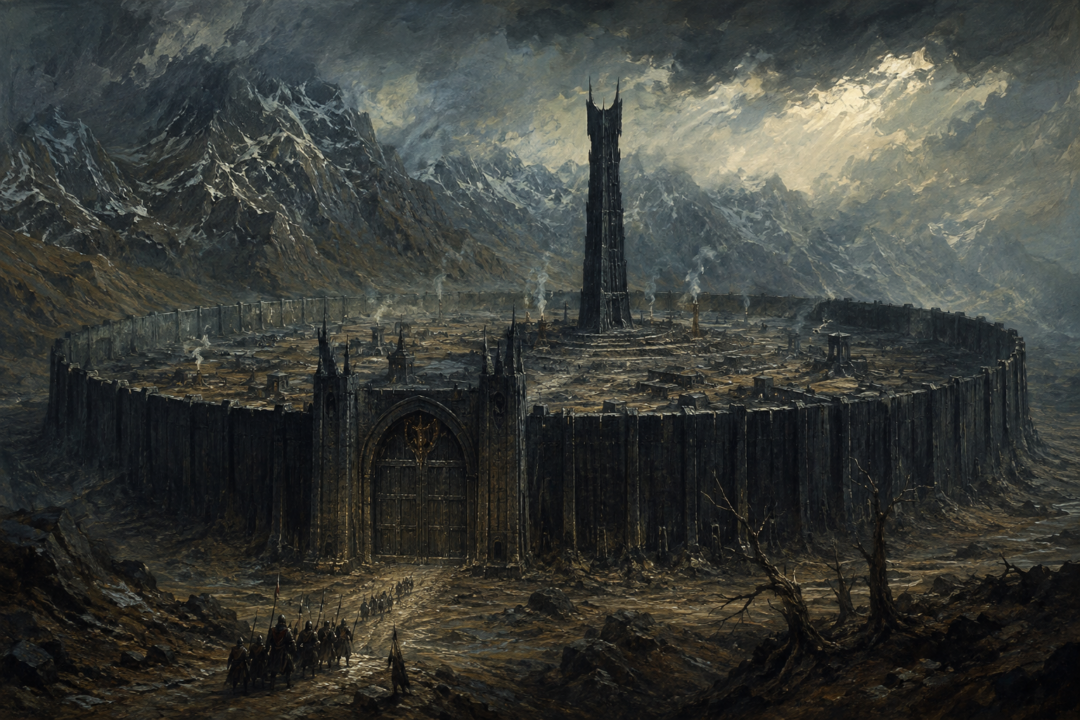
When Théoden’s riders approached Isengard after the Battle of the Hornburg, they were riding toward what should have been one of the hardest fortresses in western Middle-earth to enter by force. The Ring of Isengard was not merely a curtain wall surrounding Saruman’s tower. It was a vast enclosure of black stone, compared in The Two Towers to towering cliffs, with a single great entrance cut through its southern side. rsd2-alert-durden-reading-room.weebly.com
Yet when the riders arrived, the iron doors had been cast down, the gate was ruined, and great breaches had been torn through the Ring.
Orthanc, strangely, was still standing.
That contrast reveals something important about Isengard. Its defenses were formidable, but they were not all formidable in the same way. The Ring-wall could control armies, roads, and ordinary attackers. It could turn Isengard into an exceptionally difficult military position. But Saruman eventually faced an enemy for whom the assumptions behind those defenses no longer applied.
Understanding what the Ring could stop—and what it could not—helps explain why the fall of Isengard is not simply a story about stronger creatures breaking a weaker wall.
It is a story about a fortress designed for the wrong war.
The Ring Was a Fortress Before It Was Saruman’s
Isengard was an ancient stronghold long before Saruman transformed it into his military and industrial base.
At the southern end of the Misty Mountains, the enclosure occupied a naturally powerful position. The great Ring-wall ran outward from the mountainside and returned to it, enclosing a roughly circular plain. The works of the Men of Westernesse had shaped and strengthened the place, while Orthanc stood near its center.
The Ring had only one normal entrance: a great arch in its southern wall.
Anyone entering there had to pass through a long tunnel cut through the black rock. Mighty iron doors closed the passage at either end, their hinges and steel supports fixed into the stone itself.
Against conventional attackers, that arrangement was extremely valuable.
An approaching army could not simply advance across a broad front and pour into Isengard. The Ring concentrated normal access into a narrow, prepared approach. Attackers would have to overcome the gate or somehow breach the surrounding stone.
Saruman therefore inherited something more useful than a tall wall.
He inherited controlled access.
What the Walls Were Meant to Stop
The Ring-wall makes the most sense when imagined against the kinds of enemies a great fortress normally expects: Men, Orcs, cavalry, raiders, and organized armies.
Such enemies depend on movement.
Horsemen need openings. Infantry need gates, ladders, breaches, or some other practical means of crossing defenses. Supply trains need roads. Large forces become vulnerable when compressed into narrow approaches.
The Ring of Isengard exploited all of those problems.
Its wall was described as cliff-like, while its single southern entrance could be sealed by enormous iron doors. The interior side of the Ring also contained chambers, halls, passages, and dwellings. Under Saruman, thousands could live within Isengard, including workers and warriors, while weapons and supplies were stored throughout the complex. rsd2-alert-durden-reading-room.weebly.com
This was therefore not simply a perimeter surrounding Orthanc.
It was part wall, part settlement, part barracks, and part military infrastructure.
Against an army such as the Rohirrim, the Ring would have been a serious obstacle. Even victory in the open field would not automatically give an attacker possession of Isengard. A surviving enemy could withdraw behind stone and iron and force the attacker to confront the fortress itself.
That is one reason Saruman’s strategic position initially seemed so dangerous. Isengard could send forces south while remaining a defensible base behind them.
But walls solve specific problems.
They do not solve every problem.
The Ents Did Not Fight Like a Human Army
Saruman’s catastrophic mistake was that the enemy who came against Isengard was not an ordinary besieging host.
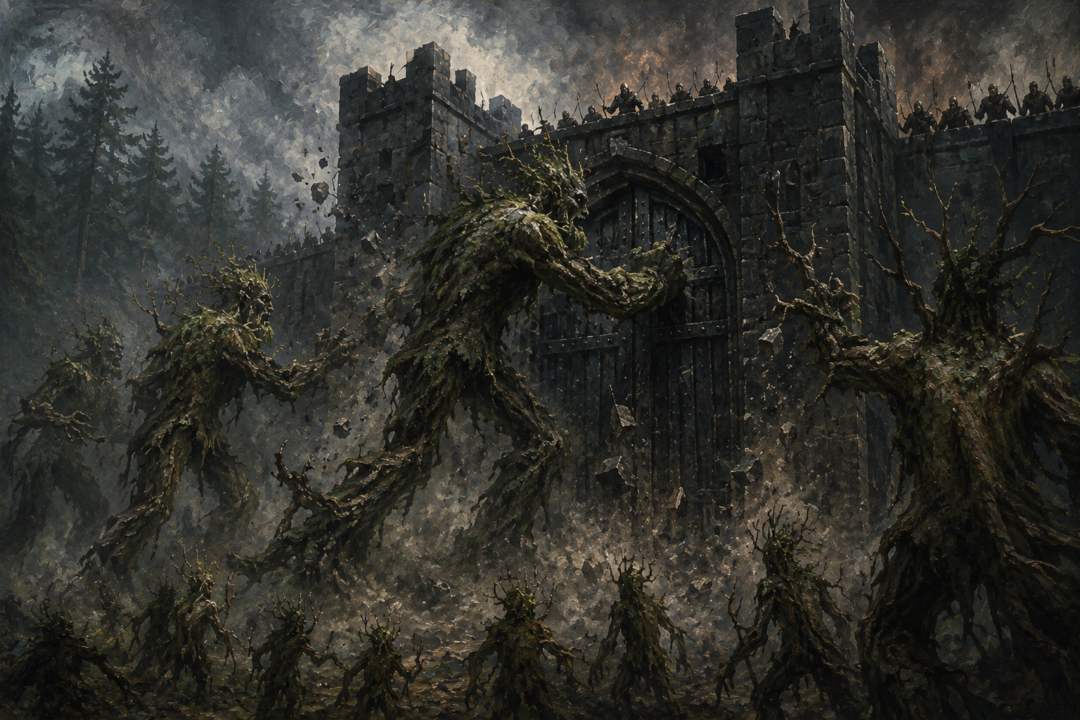
After the Entmoot, Treebeard and the Ents marched on Isengard. Merry and Pippin later describe the assault in “Flotsam and Jetsam.” The Ents surrounded the stronghold, and once Saruman’s army had departed, they attacked.
The gate did not withstand them.
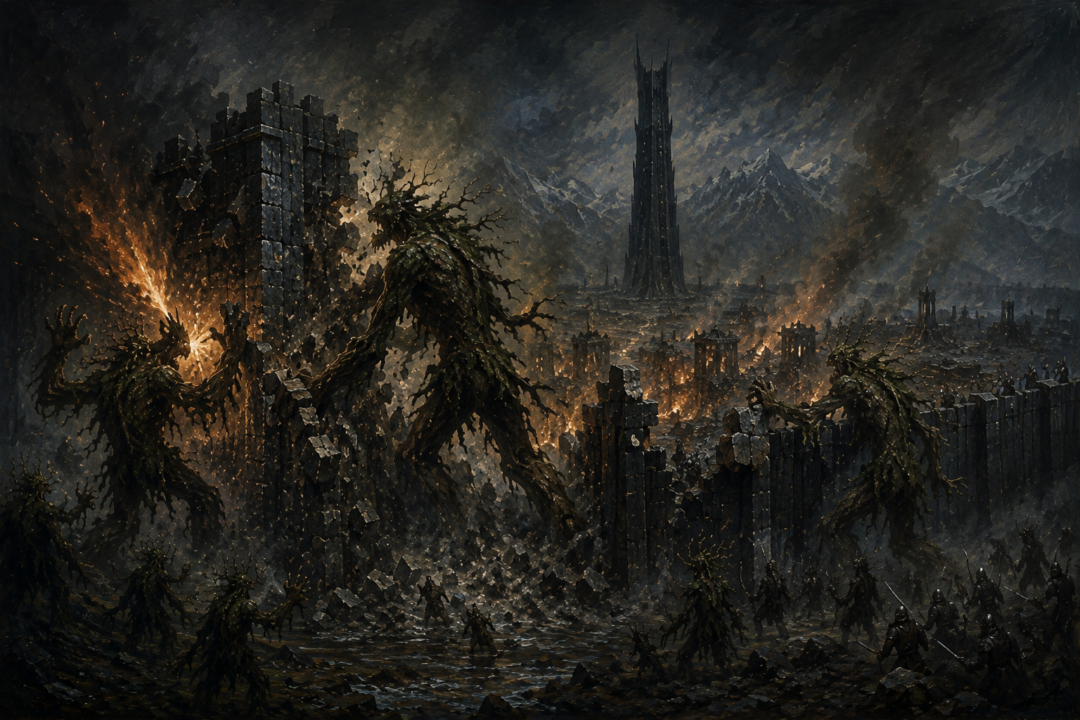
Pippin describes Treebeard and other Ents battering the doors until they were destroyed. The Ents then turned their strength against the surrounding structures and eventually the Ring-wall itself. By the time Théoden, Gandalf, Aragorn, Legolas, Gimli, and the Rohirrim arrived, the once-formidable entrance had become wreckage and breaches had been opened in the walls.
The narrative repeatedly emphasizes the extraordinary physical power of enraged Ents. Ordinary weapons were dangerous to them—one Ent was burned during the attack, and axes could wound them—but they were extraordinarily difficult opponents for defenders accustomed to fighting Men. edoc.ku.de
The distinction matters.
The Ring was not useless because stone walls are useless.
It failed because its attacker possessed capabilities outside the normal military scale for which such defenses were suited.
A gate designed to prevent companies of soldiers from entering is much less reassuring when ancient tree-like beings can tear and batter its works apart.
Saruman Could Still Hurt Them
The destruction of the Ring should not be exaggerated into the idea that the Ents were invulnerable.
They were not.
During the assault, Saruman attempted to resist from within Isengard. Fire was particularly dangerous. Pippin’s account makes clear that one of the Ents was caught by fire and badly harmed, provoking the others into even greater fury.
This is an important limit on what the fall of the Ring proves.
The Ents were powerful enough to overcome Isengard’s outer defenses, but they were living creatures, not unstoppable siege engines. Saruman’s machinery, fire, and defenders could injure them.
What he could not do was restore the normal logic of a siege.
Once the Ents were inside and tearing apart his works, the Ring could no longer perform its primary function of keeping an enemy outside.
And then Treebeard changed the nature of the attack completely.
The Walls Could Not Stop Water From Becoming a Weapon
After wrecking much of Isengard, the Ents did something more devastating than simply smashing buildings.
They turned the waters against Saruman.
Saruman had altered the old landscape of Isengard. The green avenues and groves had disappeared, while the ground had been excavated for shafts descending into underground chambers, smithies, furnaces, storehouses, and workshops. Smoke and steam had once risen from the industrialized plain. rsd2-alert-durden-reading-room.weebly.com
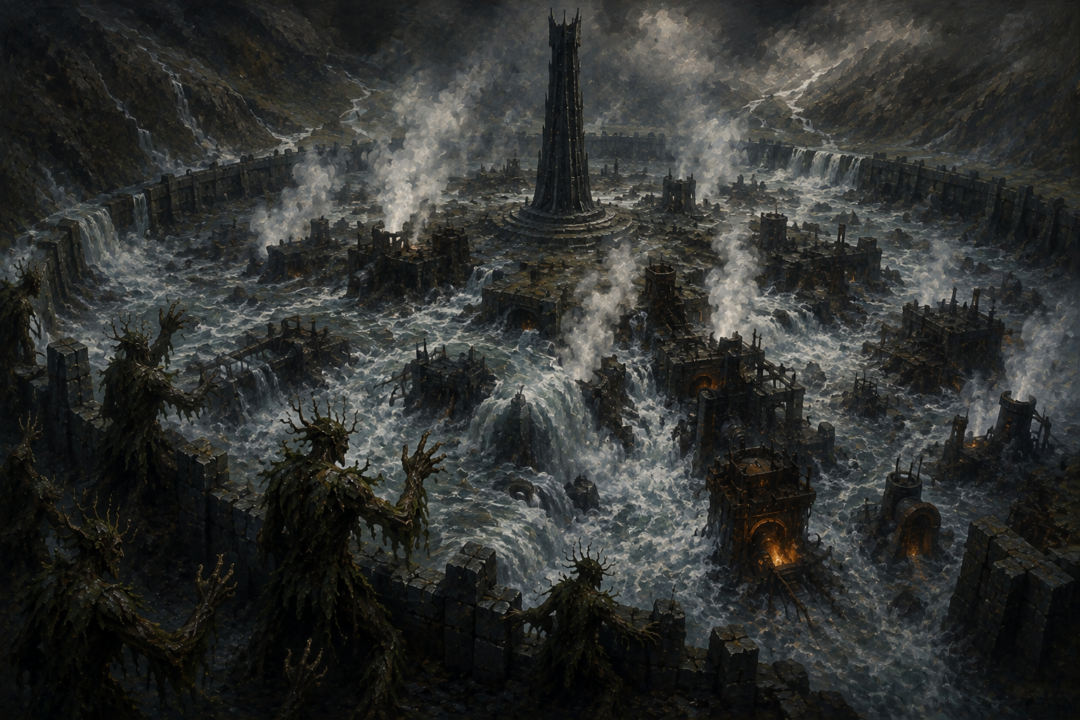
The Ents blocked and redirected the waters, then released them into Isengard.
Water poured across the enclosed plain and into Saruman’s underground works. His fires were drowned. Steam rose over the devastated fortress.
Here the Ring’s greatest defensive feature became, in effect, irrelevant.
A wall can prevent soldiers from walking through it. It cannot necessarily save everything inside when the landscape itself is manipulated.
Indeed, Isengard’s hollowed interior and extensive underground excavations gave the flooding many vulnerable places to reach. The text does not state that the Ring was deliberately designed as a basin for such an attack, so it would be too strong to say the wall itself caused Saruman’s defeat. But the Ents clearly transformed water into a means of neutralizing the subterranean machinery that physical destruction alone had not fully dealt with.
Saruman had fortified the boundary.
Treebeard attacked the environment.
Yet Orthanc Was Different
The clearest demonstration of the limits of Entish strength comes at the center of Isengard.
Orthanc survived.
The Ents tried to damage the tower, but their assault achieved essentially nothing against it. Treebeard recognized that Orthanc possessed a strength unlike the works Saruman had built around it.
This distinction is crucial because people often speak of “Isengard” as though the Ring and Orthanc were one defensive structure.
They were not.
The Ring-wall could be broken by the Ents.
Orthanc could not.
The tower was an ancient work of extraordinary strength, associated with the craftsmanship of the Númenórean exiles. After the destruction around it, Saruman remained trapped inside rather than being physically dragged from his refuge.
The Ents had conquered Isengard without conquering Orthanc.
That apparent contradiction is exactly what the battlefield looked like after their victory: shattered walls, drowned pits, ruined machinery—and a black tower still rising from the center.
Saruman’s outer fortress had ceased to protect him.
His final refuge had become his prison.
The Ring Could Stop Armies, but Not Saruman’s Real Enemy
There is a deeper irony in the destruction of Isengard.
Saruman had spent years making the place more useful for war. Trees disappeared. Stone covered the ground. Underground workshops multiplied. Furnaces burned. Orcs and other servants filled the stronghold. Isengard became a place capable of producing and supporting military power.
But those preparations were directed toward enemies Saruman understood.
Rohan could be attacked with armies.
Helm’s Deep could be assaulted with troops and machines.
Roads could carry soldiers.
Walls could stop soldiers.
Fangorn did not answer according to those rules.
Saruman’s destruction of trees helped provoke the very beings capable of making his fortifications inadequate. The Ents did not need to defeat him through a conventional siege. They attacked the gate with their own strength, tore at the walls, wrecked his surface works, and then used water to extinguish what remained below.
One reading of the episode is that Saruman’s failure is therefore strategic as much as physical. He had accumulated power while narrowing his understanding of what power meant.
He prepared Isengard to dominate the surrounding world.
He did not prepare for the surrounding world to rise against Isengard.
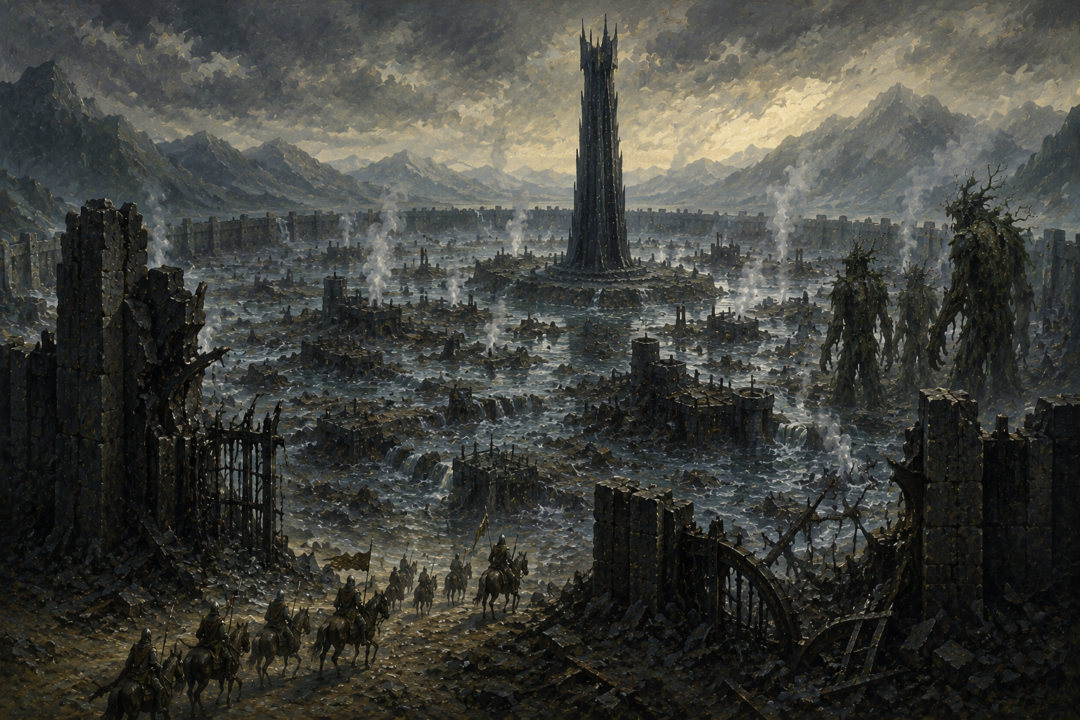
What the Ring of Isengard Can—and Cannot—Stop
The Ring of Isengard should not be dismissed as a weak fortification merely because the Ents destroyed it.
Against ordinary military threats, its advantages were immense: cliff-like stone defenses, one controlled entrance, iron doors, internal accommodation, stores, armaments, and a position anchored against the mountains.
It could restrict movement.
It could protect a garrison.
It could make a conventional assault extraordinarily difficult.
What it could not provide was absolute security.
It could not make its gate proof against the strength of enraged Ents. It could not prevent those attackers from creating breaches elsewhere. It could not protect Saruman’s underground industrial works once water was deliberately turned against them. And it could not make the Ring equal in durability to Orthanc itself.
That final difference may be the most revealing.
When Théoden’s company reached Isengard, the outer fortress that represented Saruman’s military power was wrecked. The tower he had inherited from an older and greater craftsmanship remained.
Saruman had filled the Ring with weapons, servants, engines, furnaces, and plans for conquest.
In the end, almost everything he had added could be destroyed.
The ancient tower endured.
And the great wall that was supposed to keep the world outside had been opened by the very world Saruman believed he could cut down, reshape, and command.
Sources & Notes
- https://www.glyphweb.com/arda/r/ringofisengard.php — The Encyclopedia of Arda, “Ring of Isengard”: describes the immense circular stone wall, its single tunnelled southern gate, iron doors, and the Ents’ breaching of the Ring.
- https://www.glyphweb.com/arda/i/isengard.php — The Encyclopedia of Arda, “Isengard”: historical and geographic background on the Númenórean stronghold, Saruman’s fortified base, and its capture and flooding by the Ents.
- https://www.glyphweb.com/arda/o/orthanc.php — The Encyclopedia of Arda, “Orthanc”: distinguishes the exceptionally durable central tower from the surrounding defenses and summarizes its survival after the Ent assault.
- https://www.glyphweb.com/arda/e/ents.php — The Encyclopedia of Arda, “Ents”: background on the tree-herds, their physical power, and their march against and destruction of Saruman’s Isengard.
Sources cover the Ring-wall and gate design, Isengard’s history and flooding, Orthanc’s contrasting durability, and the Ents’ unusual destructive power.