How Morgoth Turned Captured Elves Into Weapons Before the Battle Began
Before the Nirnaeth Arnoediad—the Battle of Unnumbered Tears—the armies of the Noldor possessed something they had lacked for years: a genuine chance to strike Morgoth with coordinated strength.
Fingon waited in the west. Maedhros and his allies were to advance from the east. Turgon had secretly brought a great host from Gondolin. The plan depended upon timing and discipline.
Morgoth therefore attacked something more vulnerable than their fortifications.
He attacked their emotions.
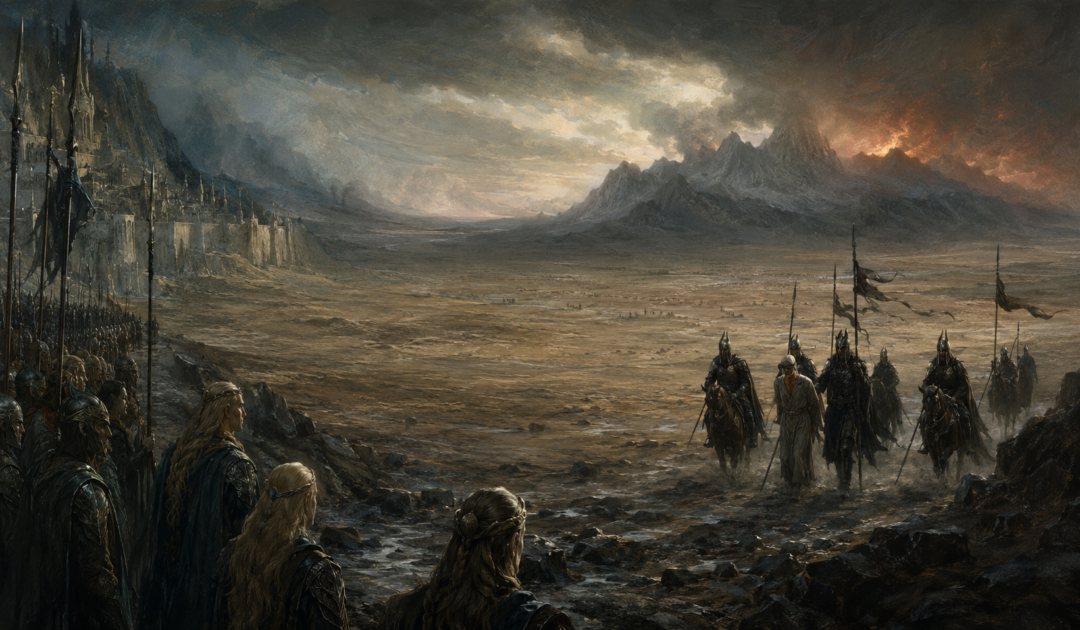
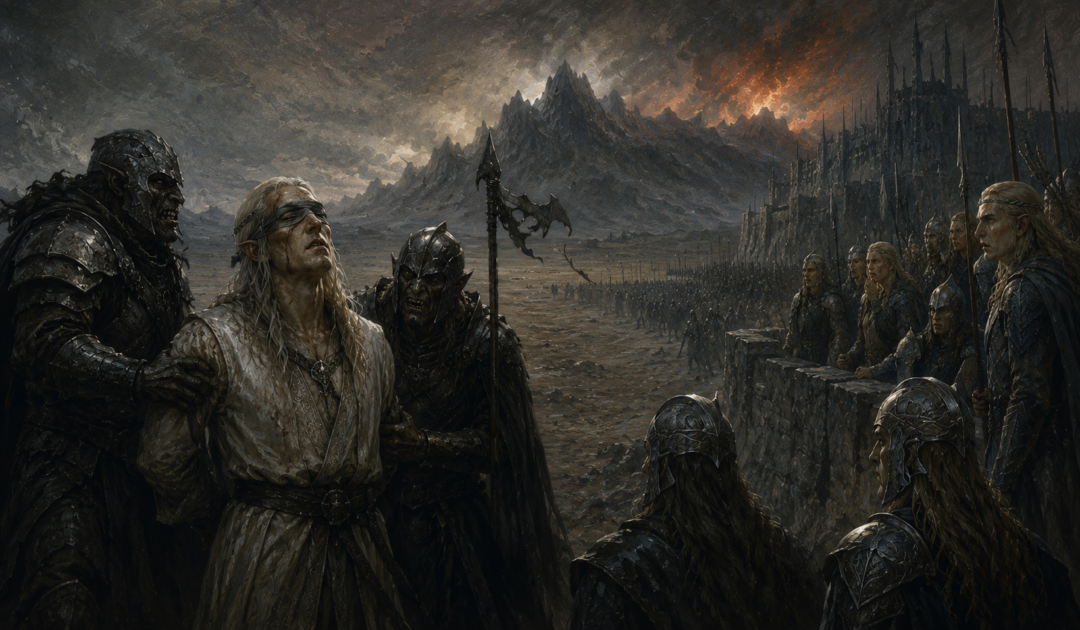
At the western front, his servants brought forward a captive Elf named Gelmir, a lord of Nargothrond who had disappeared during the Dagor Bragollach. He had been blinded in captivity. His brother Gwindor was among the Elves waiting with Fingon's forces.
Gelmir was not brought there for negotiation.
He was brought there to be seen.
What followed is one of the clearest examples in the First Age of Morgoth using a prisoner not merely as a victim, but as a psychological weapon. His enemies were being provoked into abandoning their battle plan—and the terrible irony is that the tactic succeeded precisely because the Elves cared about the captive before them.
Morgoth Needed Fingon to Attack Too Soon
The opening movements of the Nirnaeth were shaped by a problem for Morgoth.
The western army under Fingon was not supposed to rush blindly onto the plain. The larger strategy depended on cooperation between the western and eastern hosts. Fingon's force waited near Eithel Sirion while Maedhros was expected to advance from the other direction.
Morgoth wanted to break that coordination.
The account explicitly says that the captain commanding Morgoth's western forces had orders to draw Fingon out swiftly by whatever means he could. The enemy advanced until Fingon's outposts could see them, while Orcs attempted to provoke the defenders with taunts.
The Elves did not move.
That restraint mattered. Morgoth's servants were confronting an army that understood the danger of abandoning its position before the intended moment.
So the provocation escalated.
Riders approached under tokens of parley.
And with them came Gelmir.
Gelmir Had Been Preserved in Captivity
Gelmir son of Guilin was a lord of Nargothrond and the brother of Gwindor. He had been captured years earlier during the Dagor Bragollach, the Battle of Sudden Flame.
By the time he appeared before Fingon's lines, he had been blinded.
His survival was not unique in itself. Elsewhere, the histories of the First Age make clear that Morgoth did not simply kill every captured Noldo. Gwindor himself would later be captured during the Nirnaeth and forced into labour in the mines of the North. When Beleg eventually encountered him after his escape, Gwindor had been physically and psychologically diminished by his years of enslavement.
Captivity therefore served several purposes in Angband. Prisoners could be exploited for labour, especially where their skills were valuable. They could be interrogated, tormented, or held in bondage.
Gelmir reveals another possibility.
A captive could be saved for the moment when his suffering would inflict damage on people who were still free.
There is no statement that Morgoth had preserved Gelmir for years specifically in anticipation of this exact battlefield use, so that should not be assumed. What the text does establish is that, once Gelmir was in Morgoth's power, his captain deliberately used him to provoke Fingon's army.
At that moment Gelmir ceased to be merely a prisoner.
He became part of the enemy's battlefield strategy.
The Threat Was Bigger Than One Captive
The heralds of Angband displayed Gelmir before the Elves and claimed that they possessed many more captives who would receive the same treatment if the army did not hurry.
That threat is crucial.
The psychological weapon was not only Gelmir's suffering. It was what Gelmir was made to represent.
The Elves were being shown the possible fate of every missing friend, kinsman, lord, or warrior who had vanished into the North.
The heralds then mutilated and killed Gelmir within sight of Fingon's forces.
This was calculated public cruelty. It transformed an abstract military objective—defeating Morgoth—into an immediate personal horror.
And by terrible chance, Gelmir's brother was watching.
Gwindor Was Exactly the Man Who Could Not Ignore It
Gwindor had not come north without emotional baggage.
He had gone to the war against the will of Orodreth, King of Nargothrond, because he grieved for Gelmir, whom he had lost in the Bragollach. Nargothrond itself had not committed its full strength to the Union of Maedhros; Gwindor led only a small company.
Then the brother he had mourned appeared alive before him.
Only to be murdered.
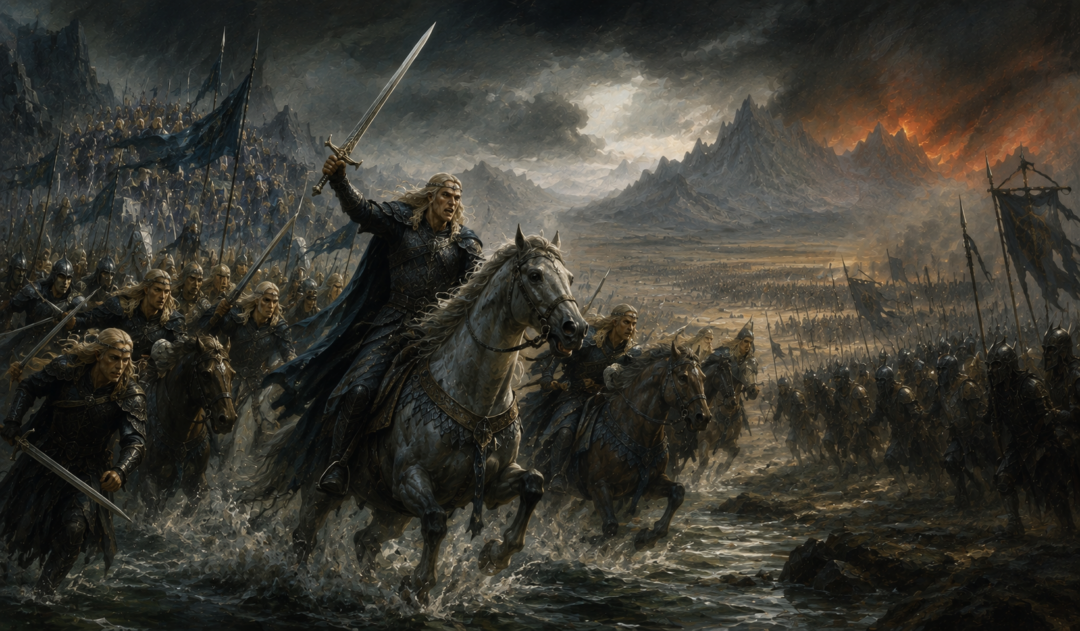
Gwindor's wrath became uncontrollable. He mounted and charged the heralds of Angband. Other riders followed him. They killed the messengers and drove directly into Morgoth's forward host.
Then the emotional shock spread.
The wider host of the Noldor surged into battle. Fingon sounded his trumpets, and the western army came down from the hills in a sudden assault.
The planned battle had become something different.
Morgoth had successfully forced his enemies to react.
The Trap Almost Backfired
Yet the episode contains one of the great ironies of the Nirnaeth Arnoediad.
The Elves' premature attack was devastatingly effective.
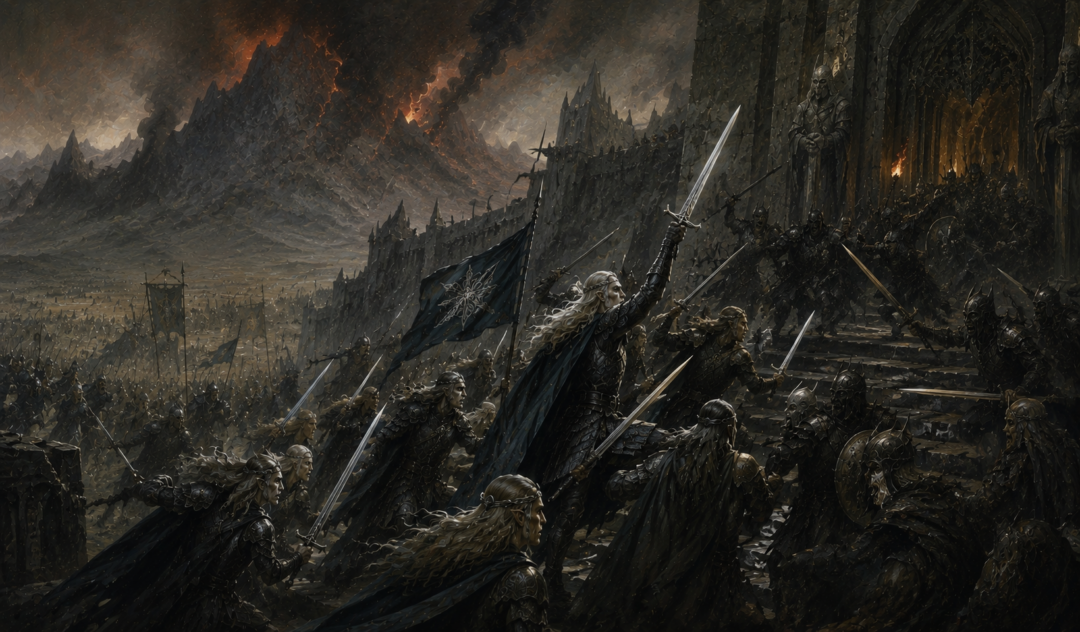
Their charge was so fierce that Morgoth's designs nearly failed. His western forces were swept back before they could be reinforced, and Fingon's banners crossed Anfauglith toward Angband.
Gwindor and the Elves of Nargothrond were at the forefront.
Their fury carried them farther still. They penetrated the Gate of Angband, killed guards within its defenses, and reached so deep that Morgoth himself trembled as he heard them striking at his doors.
For a moment, emotional fury achieved what careful strategy might scarcely have seemed capable of accomplishing.
But fury could not sustain the advance.
Gwindor's company had outrun support. Fingon could not reach them. Morgoth released forces that had been held back through secret ways, and the attackers were trapped.
Almost all of Gwindor's company were killed.
Gwindor was taken alive.
The brother who had charged because he witnessed Gelmir die in captivity now became a captive of Angband himself.
Morgoth's Weapon Was Loss of Self-Control
It would be too simple to say that Gelmir's death caused the defeat at the Nirnaeth.
The battle was much larger than that single event.
Maedhros's eastern host was delayed. Morgoth possessed reserves. Glaurung and other terrible servants entered the fighting. Most decisively, the treachery of Ulfang's sons helped destroy the eastern alliance at the critical moment. The text itself emphasizes the importance of that betrayal.
But Gelmir's murder damaged the original coordination before the main struggle had fully unfolded.
That is what makes the incident strategically revealing.
Morgoth did not need to convince the Elves that surrender was wise. He needed them to stop acting according to their own plan.
Fear could accomplish that.
So could grief.
So could love.
The very bonds that made resistance to Morgoth meaningful could be manipulated when subjected to sufficient cruelty.
Gwindor Shows What Captivity Could Do Even After Escape
Gwindor's later story deepens the theme.
He was not executed after being captured at Angband. He was forced to labour in the mines of the North. Eventually he escaped, but the Elf who emerged was profoundly changed from the prince who had ridden furiously into battle.
When Beleg encountered him, Gwindor was a diminished figure compared with what he had once been.
That distinction matters because Morgoth's power over captives was not limited to chains.
A prisoner might eventually leave Angband while still carrying Angband with him.
Gwindor later returned to Nargothrond and became entangled in the tragedy of Túrin and Finduilas. His experience had taught him something about the strength of the Enemy that others were dangerously willing to underestimate.
His captivity had not made him an agent of Morgoth. The texts give no basis for such a claim.
But it had wounded him in ways freedom could not simply reverse.
Nargothrond Would See Captivity Used Again
Years later, Nargothrond itself fell to Glaurung and the Orcs.
Those inhabitants who survived the initial violence included women and maidens who were gathered as captives for Morgoth's thraldom. Túrin arrived too late to prevent the sack and attempted to reach them.
Glaurung stopped him.
While Túrin was held by the dragon's gaze and tormented with accusations and deception, the captives were driven away before him. Among them was Finduilas, who called to Túrin as she passed.
Again, helpless witnesses and helpless captives became part of psychological warfare.
The situations are not identical. Gelmir's execution was a deliberate battlefield provocation ordered as part of an attempt to draw out Fingon's host. At Nargothrond, Glaurung manipulated Túrin personally while the captives were being removed.
But the underlying cruelty is similar.
The Enemy understands that seeing another person suffer can wound more effectively than suffering oneself.
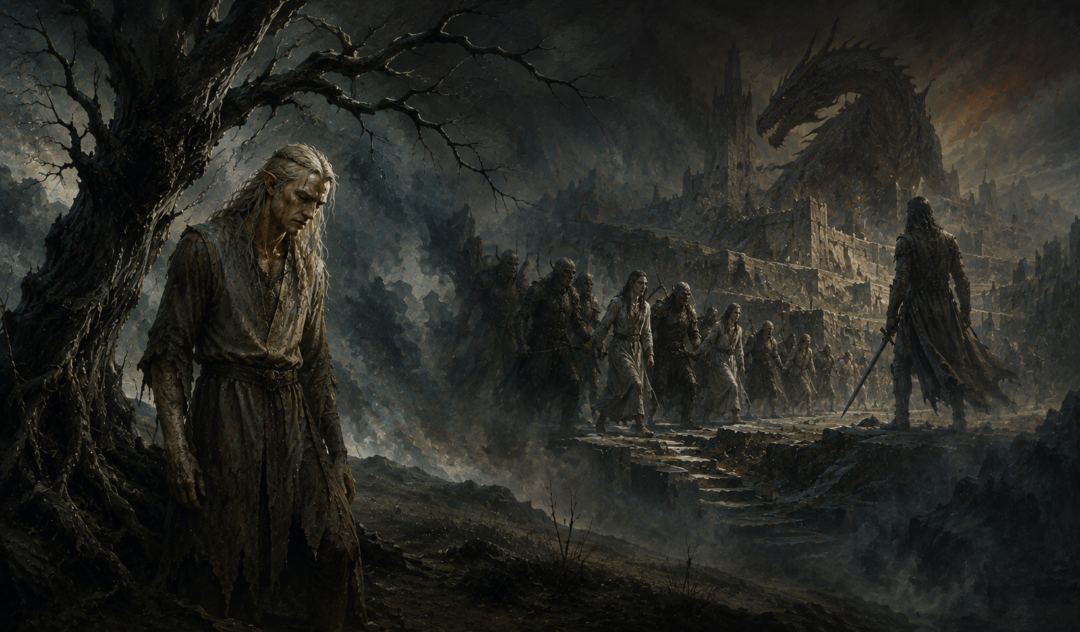
The Cruel Logic Behind Morgoth's Captives
The darkest element of Gelmir's story is therefore not simply that Morgoth was cruel to prisoners. That is obvious throughout the wars of the First Age.
It is that cruelty could be made strategically useful.
A captive Elf possessed relationships, loyalties, memories, and a place within a community. Those things gave the captive value beyond forced labour.
Gelmir mattered because Gwindor loved him.
The heralds of Angband did not need to overpower Gwindor physically. They created a situation in which his own grief overwhelmed the discipline upon which the western battle plan depended.
Yet the episode never makes Gwindor's reaction feel trivial or cowardly. That is why the scene remains tragic rather than merely tactical.
He sees the brother he had mourned tortured and murdered before him.
His response is deeply understandable.
And disastrous.
That contradiction lies near the heart of the Nirnaeth Arnoediad. Morgoth's enemies were brave enough to drive all the way to the doors of Angband. For one terrifying moment, their wrath made even the Dark Enemy afraid.
But courage without restraint could be exploited.
Before the greater armies, dragons, and betrayals decided the Battle of Unnumbered Tears, one blinded captive had already shown how Morgoth intended to fight.
Not merely against armies.
Against the hearts of those within them.
Sources & Notes
- The Encyclopedia of Arda — Gelmir: Gelmir’s capture in the Dagor Bragollach, blinding, display before Fingon’s host, and murder intended to provoke the Elves. https://www.glyphweb.com/arda/g/gelmir.html
- The Encyclopedia of Arda — Gwindor: Gwindor’s response to his brother Gelmir’s killing, his premature charge, later capture, enslavement, and escape from Angband. https://www.glyphweb.com/arda/g/gwindor.html
- The Encyclopedia of Arda — Nirnaeth Arnoediad: the coordinated battle plan, Morgoth’s provocation of Fingon’s western host, and the wider course of the Battle of Unnumbered Tears. https://www.glyphweb.com/arda/n/nirnaeth.html
- The Encyclopedia of Arda — Dagor Bragollach: background on the earlier battle in which Gelmir was captured and the Siege of Angband was broken. https://www.glyphweb.com/arda/d/dagorbragollach.html
Sources cover Gelmir’s captivity and execution, Gwindor’s provoked charge and enslavement, the Nirnaeth battle plan, and the Dagor Bragollach background.