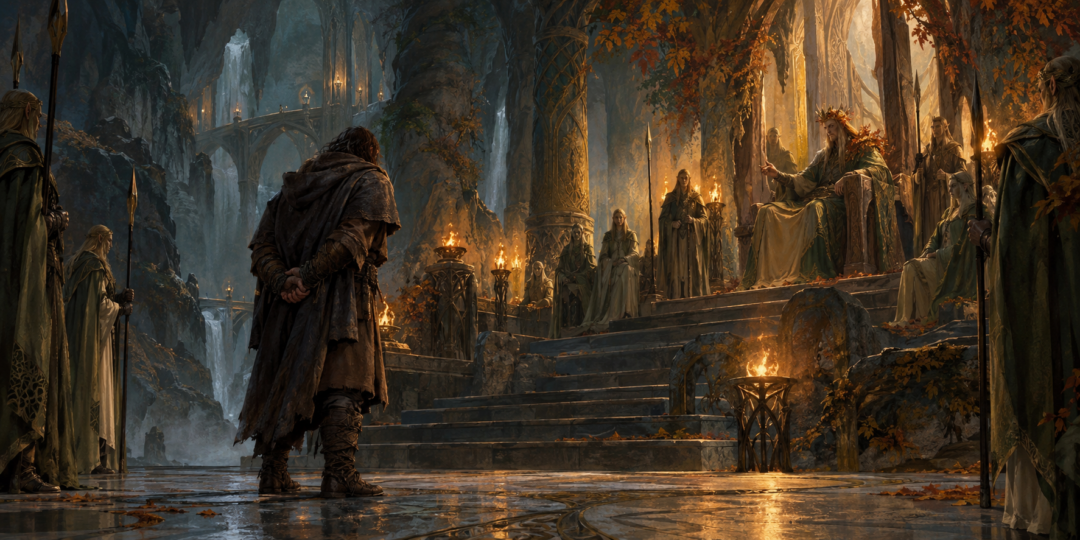
When Thorin Oakenshield disappears in Mirkwood, his companions do not know that their leader has already become a prisoner.
That detail can feel like just another misfortune in a journey crowded with them. Yet the order of events matters. Thorin reaches the Elvenking alone, before the other dwarves have been captured, before their stories can be compared, and before either side can attempt anything resembling a collective bargain.
It creates an unusual political situation. The Elvenking possesses the leader but not the company. Thorin, meanwhile, does not know exactly what has happened to his followers.
Most importantly, the king still does not know what Thorin is actually trying to accomplish.
That information gap helps explain why the interrogation becomes a contest of patience rather than a negotiation over Erebor.
Thorin Reaches the King Alone
The separation begins during the strange woodland feasts.
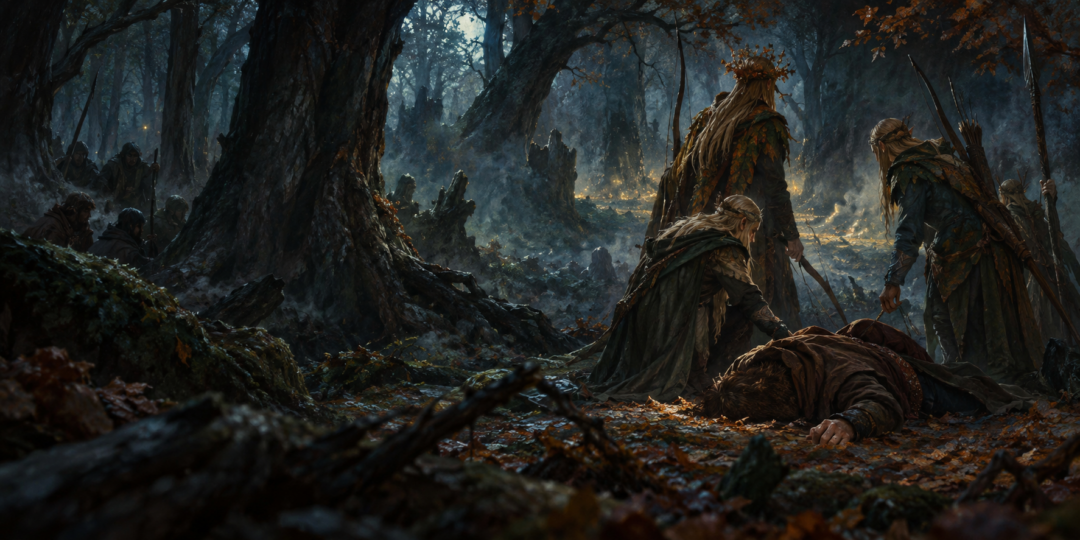
After the starving company repeatedly approaches the lights among the trees, Thorin steps into the illuminated clearing. The lights vanish, and he falls unconscious. His companions lose him.
The later struggle with the giant spiders happens without him.
Thorin therefore misses one of the most important developments of the Mirkwood journey: Bilbo openly taking command during the rescue of the dwarves. While the company is fighting for survival, Thorin is found by the Wood-elves, bound, and carried away.
When he wakes, he is already in their power.
This gives the Elvenking something valuable—a captive who is plainly connected to the disturbances surrounding the woodland feasts—but it does not yet give him the whole expedition.
His questions reveal the limits of what he knows. He wants to know why Thorin and his companions troubled the feasting elves, where Thorin's friends are, what they were doing in the forest, and ultimately what brought them into the forest at all.
Thorin answers the immediate questions with one repeated explanation: hunger.
When the questioning reaches the larger purpose of the journey, he stops answering.
The Most Important Secret Is Erebor
Thorin's silence is deliberate.
The narrative specifically connects his attitude to treasure. He knows traditions of hostility between elves and dwarves, although it also explicitly notes that Thorin's own family had nothing to do with the ancient quarrel being described. Angry at his capture, he resolves that the elves will not drag information about gold and jewels from him.
That distinction matters.
Thorin is not incapable of explaining himself. He explains why the company approached the feasts: they were starving. What he refuses to disclose is the larger purpose behind their presence in Mirkwood.
The Elvenking therefore has a prisoner whose conduct appears suspicious but lacks the crucial fact that would transform his understanding of the situation.
He does not learn from Thorin that this is Thorin son of Thrain returning toward the Lonely Mountain to reclaim the kingdom and treasure of his house from Smaug.
Compare that with what happens later at Lake-town. There Thorin announces his identity publicly as the heir returning to the Mountain. His identity immediately changes the political atmosphere because old songs, expectations of restored prosperity, and the possibility of renewed wealth suddenly become relevant.
Inside the Woodland Realm, none of that has yet been put on the table.
Why One Prisoner Is Not Yet a Collective Bargain
It would go beyond the text to say that the Elvenking consciously develops a sophisticated theory of hostage leverage. Nothing requires that interpretation.
But the practical limitation is clear.
With Thorin alone, the king cannot question the whole company. He cannot compare answers from twelve other dwarves. He cannot pressure weaker members of the expedition separately. He cannot even be certain from Thorin where the others presently are.
Thorin himself says he does not know where they are, though he expects them to be starving somewhere in the forest.
That makes the first interrogation remarkably narrow.
The king has custody of the expedition's leader without possessing the expedition itself. Thorin has lost his freedom but retains control of the central secret.
And because the others are absent, there is not yet a group with whom the Elvenking can bargain collectively over release.
The result is stalemate.
The king orders Thorin held safely until he becomes willing to speak. Thorin is imprisoned and given food and drink. The coercion is confinement and indefinite waiting, not torture.
For the moment, time is the Elvenking's principal advantage.
Capturing the Twelve Changes the King's Position
The situation changes dramatically after Bilbo rescues the other dwarves from the spiders.
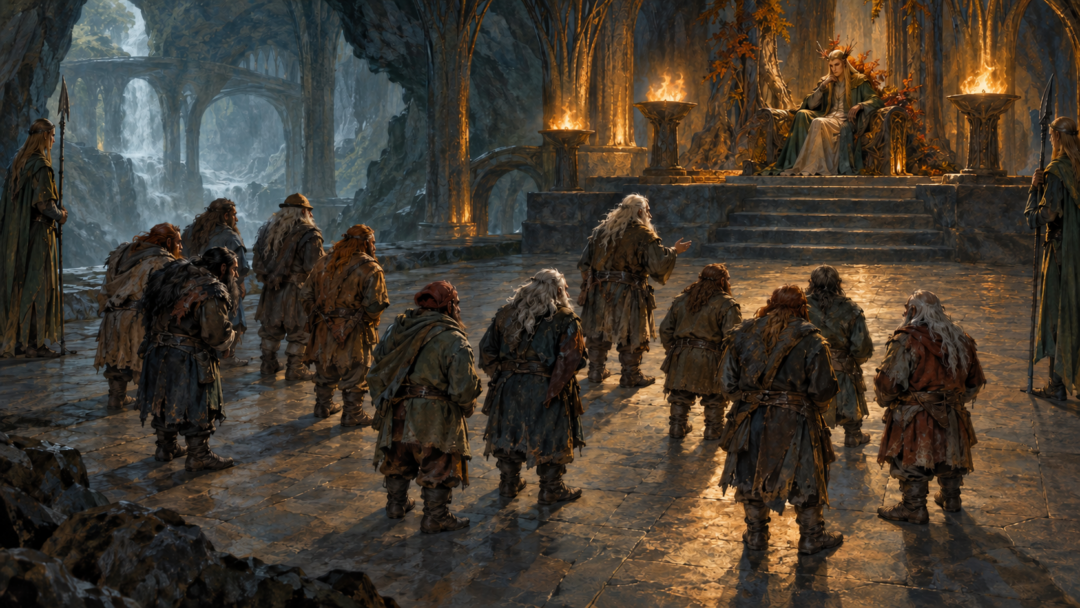
The Wood-elves capture the twelve surviving members of the company who are together—while invisible Bilbo avoids capture—and bring them before the king.
Now the Elvenking can ask essentially the question that Thorin refused to answer: where have they come from, where are they going, and what are they doing in his realm?
Yet possessing more prisoners does not automatically produce more information.
The questioning is long and searching, but the king obtains little more from the twelve than he obtained from Thorin.
Balin, as the eldest among them in Thorin's absence, challenges the premise of their imprisonment. He emphasizes that they were lost, hungry, thirsty, and attacked by spiders. The king answers from the perspective of territorial authority: they have entered his realm without leave, used his people's road, disturbed his people, and caused considerable commotion.
The disagreement is therefore deeper than simple stubbornness.
The dwarves describe themselves as desperate travelers.
The Elvenking sees unexplained armed strangers moving secretly through his kingdom and refusing to reveal their purpose.
Both descriptions capture part of what has happened.
The Elvenking Finally Has Leverage—but Not the Answer
After questioning the twelve, the king separates them into individual cells.
His stated strategy is straightforward: they will remain imprisoned until at least one tells him what he wants to know.
This is much closer to real informational leverage than the situation created by Thorin's first capture.
Instead of one silent leader whose companions remain somewhere beyond the king's custody, the Elvenking now holds thirteen dwarves in total, though the newly captured twelve are not told that Thorin is already imprisoned there.
That secrecy is important.
The king can wait to see whether isolation breaks their common refusal. The dwarves cannot initially coordinate with Thorin because they do not even know that he is nearby.
But there is one factor the Elvenking has failed to capture.
Bilbo.
Invisible and overlooked, the hobbit turns the prison from a collection of isolated captives into a hidden communications network.
Bilbo Restores Thorin's Control
For a time, the pressure nearly works.
After prolonged imprisonment, Thorin becomes miserable enough to consider telling the king about the treasure and the quest.
This is one of the most revealing details in the episode because it shows that Thorin's silence is not effortless. Confinement is wearing him down. The Elvenking's policy might eventually have produced disclosure.
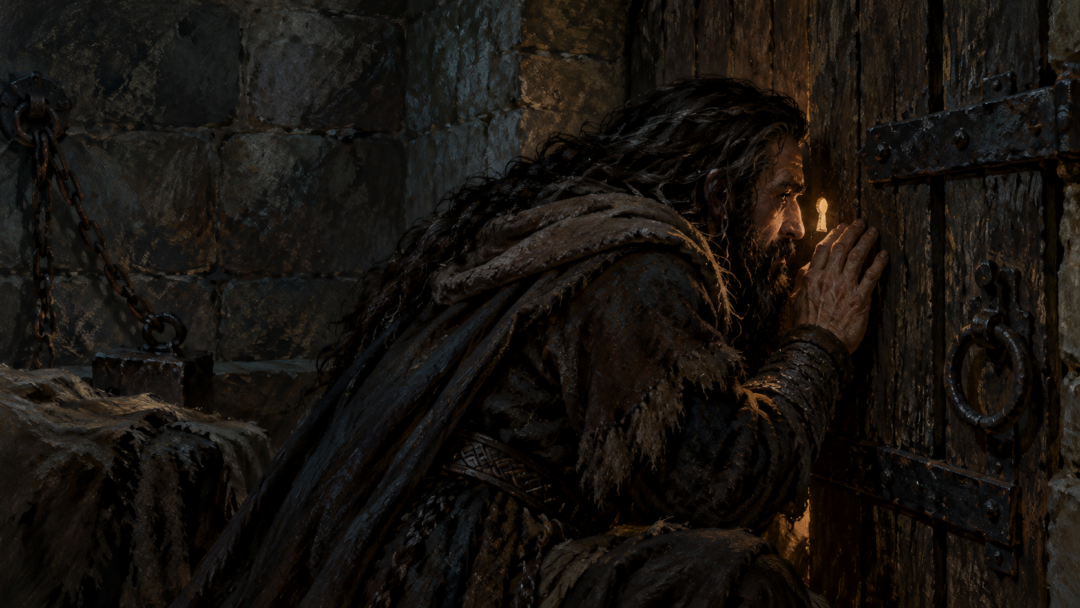
Then Bilbo finds him.
Once Thorin learns that Bilbo remains free and has already rescued the others from the spiders, his calculation changes. Escape is again imaginable.
Through Bilbo, Thorin sends instructions to the other prisoners: they are not to reveal their errand until he gives permission.
The Elvenking's separation strategy is therefore undermined by a prisoner he never knew he had failed to capture.
More precisely, Bilbo restores something Thorin lost when the company was divided: command.
Thorin cannot leave his cell. He cannot assemble his followers. But he can once again coordinate their response.
That is enough.
Thorin Is Protecting His Bargaining Position
The text later makes Thorin's reasoning especially clear.
He does not want to purchase his freedom by promising the Elvenking a share of the treasure while another possibility remains. Once Bilbo gives him hope of escape, Thorin again refuses to reveal the quest.
This explains the deeper significance of the entire sequence.
The secret is economically and politically valuable.
If Thorin explains that he is returning to Erebor and seeking the treasure beneath the Mountain, the conversation changes. The Elvenking would no longer merely be dealing with unexplained trespassers. He would know that their journey concerns an enormous treasure and the domain occupied by Smaug.
Thorin understands at least one immediate danger: disclosure could make his freedom something to be purchased with promises concerning that treasure.
So he withholds the information.
His separate capture initially makes this easier because there is nobody else present who can accidentally disclose the larger plan. Later, when the whole company is imprisoned, maintaining the secret becomes harder—but Bilbo allows Thorin to impose a common policy of silence.
The Irony Is That the Secret Cannot Stay Secret Forever
Thorin succeeds in keeping the purpose of the quest from the Elvenking during the imprisonment.
But only temporarily.
After the barrel escape, the company reaches Lake-town. There concealment becomes politically useless. Thorin needs recognition, provisions, and support, so he publicly identifies himself as the heir of the King under the Mountain.
Wood-elves involved in the river trade are present in Lake-town, and news does not remain confined there.
The expedition that passed anonymously through Mirkwood is becoming a public event.
That reversal reveals why the prison episode is so interesting. Thorin's secrecy is not a permanent principle. It is a bargaining decision shaped by circumstances.
Before the Elvenking, revealing Erebor might create a price for release.
At Lake-town, revealing Erebor creates legitimacy and assistance.
The same information changes value depending on who possesses it and when.
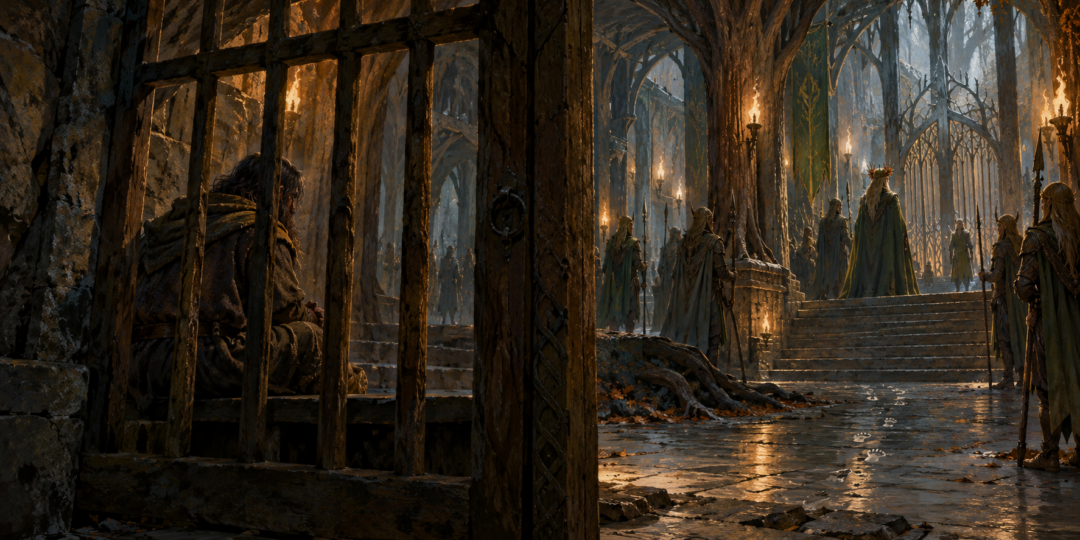
What the Separate Capture Really Changes
Thorin's early disappearance therefore does more than separate the company for an adventure.
It structures the entire confrontation with the Wood-elves.
The Elvenking's first interrogation is information-poor: he has Thorin but not the company, and Thorin refuses to disclose the expedition's true destination and purpose.
The later capture gives the king far more coercive opportunity. He can question twelve additional dwarves, isolate them, and wait for somebody to speak.
Yet even that does not guarantee knowledge.
Thorin's followers refuse to explain themselves, Bilbo remains free, and the hobbit eventually reconnects the imprisoned leader with his scattered company. What should have been thirteen isolated prisoners becomes, secretly, a coordinated group again.
There is no need to imagine an elaborate hostage strategy on the Elvenking's part. The text gives us something subtler.
Information itself is the contested resource.
The king controls the doors, the guards, the cells, and every visible member of the expedition.
Thorin still controls the secret.
And for just long enough, that proves to be the more important possession.
Sources & Notes
- Penguin Random House — The Hobbit teacher’s guide — Chapters 8–9: Thorin’s separate capture and the later imprisonment of his companions. https://www.penguinrandomhouse.com/books/179206/the-hobbit-by-jrr-tolkien/teachers-guide/
- LitCharts — The Hobbit, chapter 8, Flies and Spiders — The vanished feasts, Thorin’s disappearance and his interrogation by the Elvenking. https://www.litcharts.com/lit/the-hobbit/chapter-8-flies-and-spiders
- LitCharts — The Hobbit, chapter 9, Barrels Out of Bond — The remaining Dwarves are imprisoned and Bilbo discovers Thorin’s separate cell. https://www.litcharts.com/lit/the-hobbit/chapter-9-barrels-out-of-bond
Primary passages: The Hobbit, chapters 8–9, “Flies and Spiders” and “Barrels Out of Bond.” The sequence of separate captures is textual; its effect on negotiation and information is close-reading interpretation, not evidence of a formal bargain over Erebor.