The Mouth of Sauron appears for only a moment, and yet he leaves a lingering discomfort that outlasts the battle that follows.
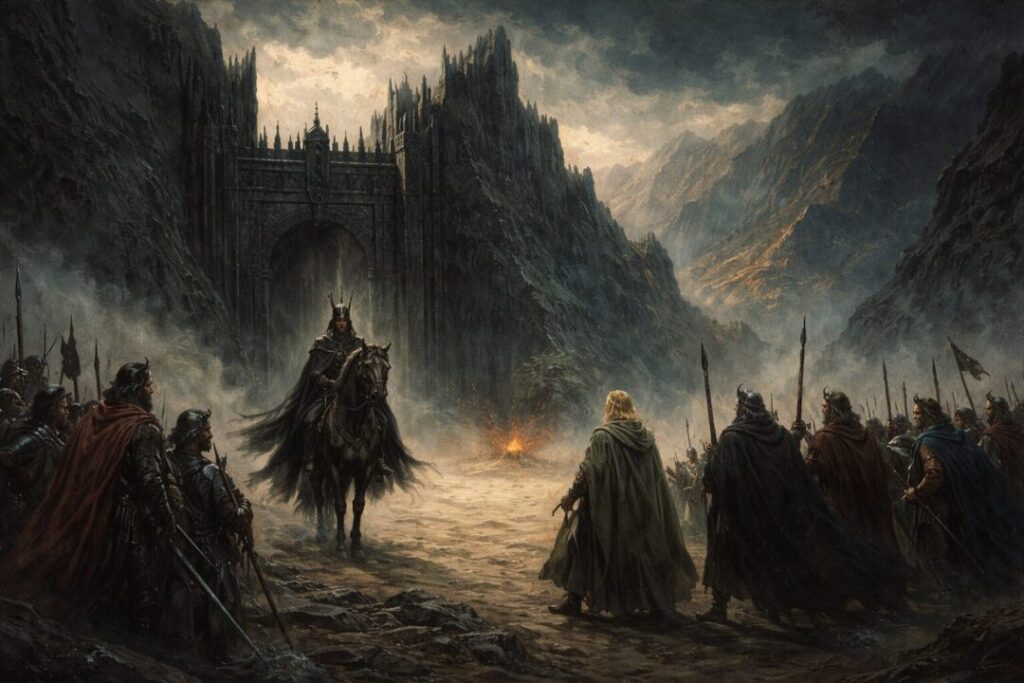
Part of that is obvious. He arrives at the Black Gate with cruelty in his voice and trophies in his hands, offering “peace” that is really surrender. He speaks with practiced contempt. He knows exactly which words to use to wound.
But the deeper unease comes from something quieter: the story introduces him like a man who should be knowable, and then refuses to let him be known.
He is not a Ringwraith. The text stresses this. He is a living man—one who has risen high enough to serve as the Dark Lord’s chosen voice at the most critical parley of the War.
And yet, he has no personal name.
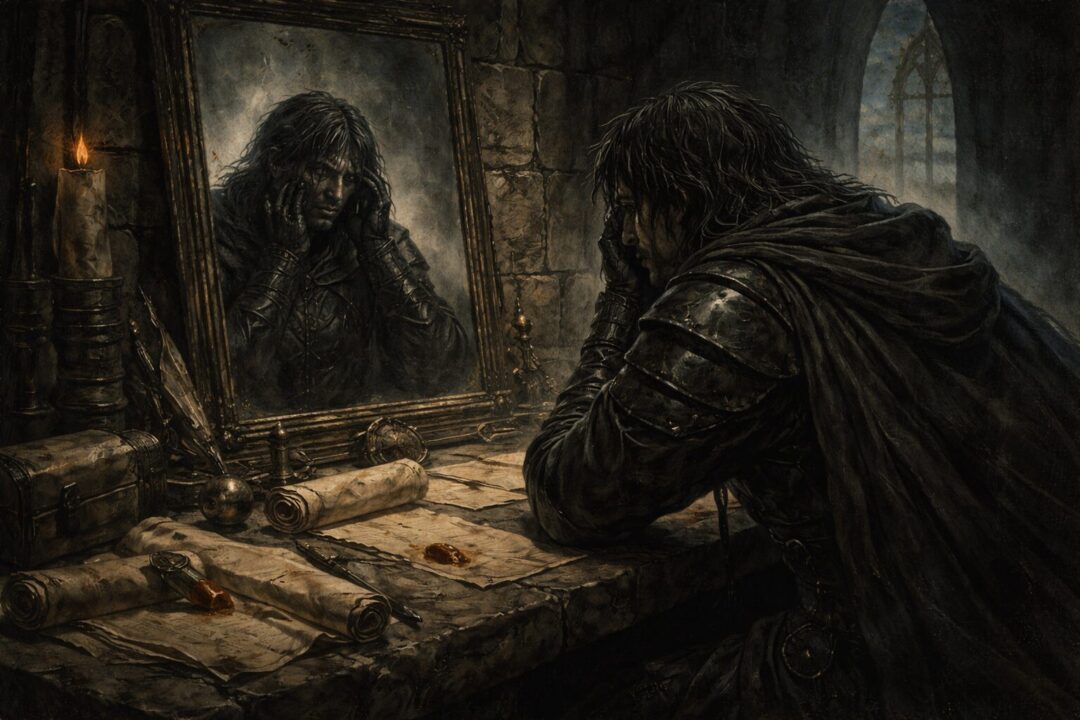
More than that: we are told he has forgotten it.
That one detail turns him from a mere messenger into a theme. Because in Middle-earth, names are rarely casual. To lose a name is to lose a place in the world’s memory. It is to become a function, a tool, an instrument that can be lifted and used by a greater will.
So what is the Mouth of Sauron, exactly?
The answer is both clear and incomplete—because the text gives hard boundaries, and inside those boundaries it leaves deliberate shadow.
What the text states plainly
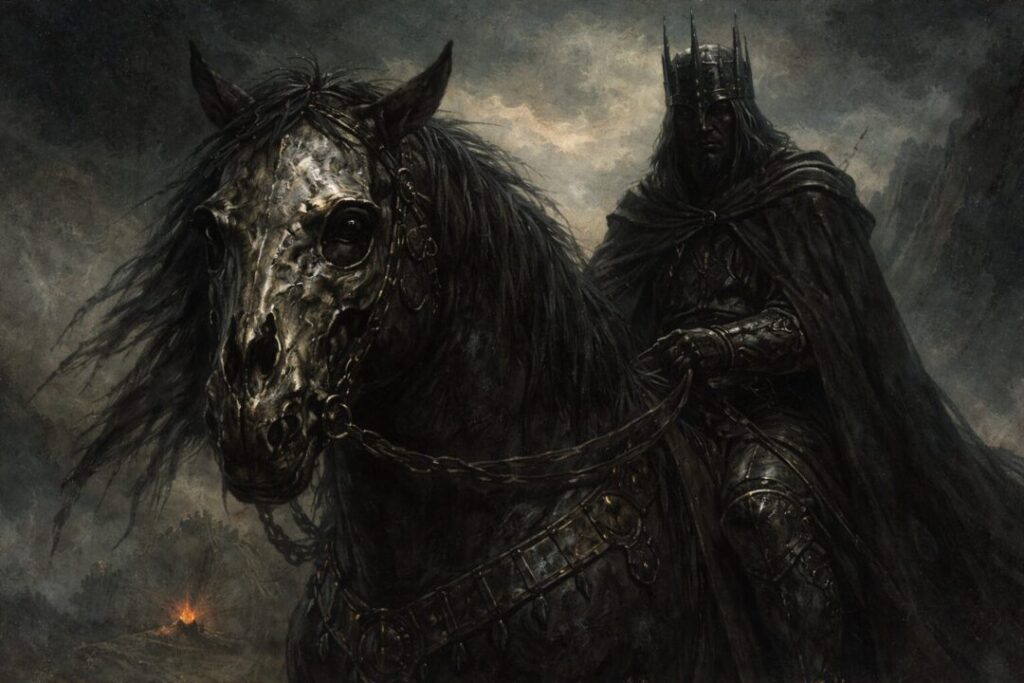
In the chapter at the Morannon, the Mouth of Sauron is described as a man who rides out robed in black, wearing a lofty black helm. The narration explicitly distinguishes him from the Nazgûl: he is not an unseen wraith, but “a living man.”
We are also told he is “Númenórean.” More specifically, he is of the darker Númenórean heritage—the group often called the Black Númenóreans, descendants of those Men who fell under the Shadow and allied themselves with the Enemy.
The text adds two more defining claims.
First: he entered the service of the Dark Tower “when it first rose again.”
Second: he learned “great sorcery.”
Then comes the line that makes him feel less like a character and more like a warning: he had forgotten his own name.
These statements are not presented as rumor. They are given as narrative description—facts the reader is meant to accept.
And yet, once you hold them together, questions begin immediately.
“When it first rose again” — a phrase that creates ambiguity
That single phrase, “when it first rose again,” is one reason the Mouth of Sauron feels like a “maybe” even while the text sounds confident.
Because “rose again” can be read in more than one historical frame.
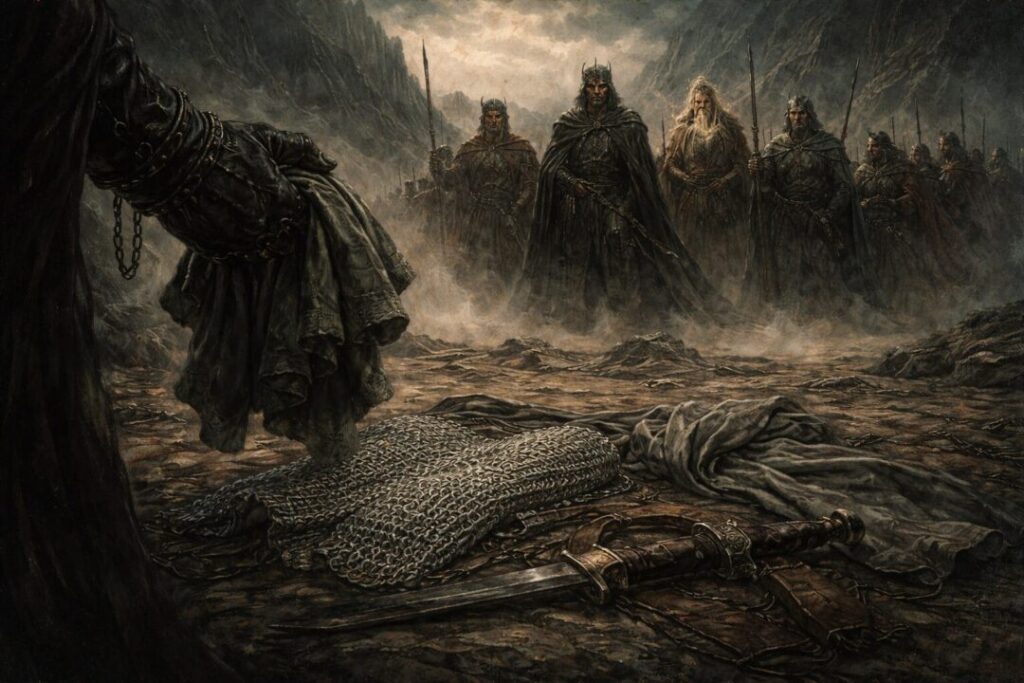
Barad-dûr rose after the return of the Enemy in the Second Age, following the downfall of Númenor—when he came back to Middle-earth and took up the building of his power anew. But the Dark Tower also “rose again” in the Third Age, after it had been thrown down in the War of the Last Alliance and later rebuilt.
The main text does not pause to clarify which “again” is meant. Appendix B gives the broader timeline for the Tower’s destruction and rebuilding, but it does not attach the Mouth explicitly to a numbered year. So the phrase leaves two possibilities open:
- He entered the service when the Tower rose again in the late Second Age (which would imply an extremely long lifespan, achievable only by unnatural means if he is truly mortal), or
- He entered when the Tower rose again in the late Third Age (which makes him easier to place as a later descendant of Black Númenórean stock).
This is not an invitation to invent a hidden biography. It is simply the honest result of how the wording sits against the timeline: the text supplies a phrase that can point in more than one direction, and does not close the door.
So the safe conclusion is narrow: the Mouth is associated with the Tower’s renewal, but the exact renewal event is not pinned down in the published narrative.
What “great sorcery” does — and does not — mean here
The Mouth of Sauron is said to have learned “great sorcery.” That is a strong phrase, and readers often rush to turn it into a full catalogue of powers.
The text does not support that.
It does not show him casting spells at the Gate. It does not present him as a supernatural combatant. His role in the scene is rhetorical and psychological: he is there to threaten, to bait, to humiliate, and to offer terms crafted to break hope.
So “great sorcery” must be held in a conservative way. It tells us he learned the arts of the Enemy beyond ordinary lore, and that his education was deep enough to be remarked upon in the narrative voice.
But it does not tell us which arts, or how they manifested.
The stronger “magic” of the scene is the way he speaks: confidently, coldly, as a man trained to turn language into a weapon.
The detail that matters most: he forgot his own name
The Mouth of Sauron is not described as someone who hides his name as a strategy.
He has forgotten it.
That is different.
Forgetting is erosion. It implies long service, long habit, long submission. Not just loyalty, but identity reduced until only the role remains.
In a legendarium where names carry lineage and memory, forgetting one’s own name is a kind of spiritual ruin—especially for a Númenórean-descended man, a people whose history is bound tightly to long life, inheritance, and record.
It is also an inversion of the way many heroic figures are remembered. Great captains of the West are named. Their fathers are named. Their houses are named. Their swords and banners are named.
The Mouth is deliberately not granted that dignity.
Instead, he becomes a title attached to a function: the voice of the Enemy.
And that, in itself, is an answer to “what he was.” He was what happens when a man is turned into an instrument.
Why even his title feels slightly “off”
There is another small tension in the background.
Elsewhere, we are told the Enemy did not permit the name “Sauron” to be used openly. Aragorn remarks that the name was not allowed to be spoken or written among the servants of the Dark Lord.
So why would the chief herald call himself the “Mouth of Sauron” in front of the Captains of the West?
One conservative way to handle this is simple: the title may be our title for him, the name used by his enemies or by the narrative voice, not necessarily what he calls himself before his master.
Another possibility is that he uses it precisely because he is speaking to enemies—because it is meant to be a declaration, a deliberate provocation, not an internal courtesy.
The text does not explain it outright. It just lets the slight dissonance remain. And that dissonance contributes to the feeling that this figure is not designed to be neatly categorized.
Identity speculation — bounded strictly by the text
So who was he, personally?
The published text does not say.
It does not give a homeland, a family, or a former title. It does not connect him to any named character. Any confident identification (as “this specific person”) would be invention.
But we can outline what the text allows.
1) A Black Númenórean descendant in the late Third Age (most conservative fit)
The simplest fit is that he is a later descendant of Black Númenórean blood—one of the dwindling remnants of that corrupted Númenórean tradition, raised in regions where the Shadow’s influence endured, and drawn to Mordor when the Dark Tower’s power returned.
This reading matches the idea of “entered the service… when it first rose again” as referring to the Tower’s rebuilding in the Third Age, and it requires no extraordinary lifespan.
It also fits his role: not a war-chief like the Nazgûl, but a high-ranking lieutenant—someone whose value lies in knowledge, diplomacy, intimidation, and the Enemy’s “statecraft.”
2) A man of Númenórean blood whose life was unnaturally prolonged (possible, but not stated)
If one takes “when it first rose again” as a Second Age reference, the timeline pressure increases sharply.
Could a mortal man survive from that era into the end of the Third Age? Only through unnatural means—and while the text says he learned “great sorcery,” it does not explicitly say that sorcery extended his life.
So this remains a possible interpretation, not a stated fact: the idea that his sorcery may have had effects beyond ordinary human limits.
It is tempting, but the safest way to phrase it is: the wording allows the question, and does not fully answer it.
3) A fallen Gondorian or captive youth (draft evidence, not published canon)
There is also an important “maybe” preserved outside the final published narrative.
In early drafts of the Morannon chapter (preserved in the material often grouped under The History of Middle-earth), the Mouth is sketched differently: in one version as a captive taken young; in another as someone from a noble house in Gondor who desired evil knowledge and entered the Dark Tower’s service.
These drafts are valuable because they reveal that the author considered grounding this figure more explicitly in the tragedy of the West—turning him into a kind of fallen mirror of Gondor.
But they are not the final published version.
So they cannot be treated as “what happened.” They can only be treated as evidence of an approach that was considered and then withdrawn—which, intriguingly, reinforces the point: the finished text chooses anonymity.
Why he is written as a “maybe” on purpose
Not every mystery in Middle-earth is an unsolved puzzle meant to be cracked.
Sometimes ambiguity is doing thematic work.
The Mouth of Sauron embodies what the Shadow does to Men: it does not only kill them. It uses them. It hollows them. It gives them roles that feel like elevation—lieutenant, herald, ambassador—while stripping away the person who would have worn those honors under the Sun.
That is why the loss of his name matters more than his rank.
He is the image of a man turned into a mouthpiece—literally and spiritually.
And the text refuses to individualize him too much, because the scene is not about his story. It is about the offer he represents: an invitation to accept despair as “reason,” and slavery as “order.”
In that moment at the Gate, he is not a biography.
He is the voice of the world the Enemy would build if he won.
So what was the Mouth of Sauron?
As far as the text allows us to say with confidence: he was a living man of Númenórean (Black Númenórean) descent, trained in the Enemy’s arts, risen to become the Dark Tower’s lieutenant and chosen herald—so consumed by that service that he forgot his own name.
Everything beyond that is either careful implication or draft-history “maybe.”
And that is exactly why he lingers.
Because the story lets you see the shape of the ruin… without letting you comfort yourself by pinning it to a single, safely distant identity.