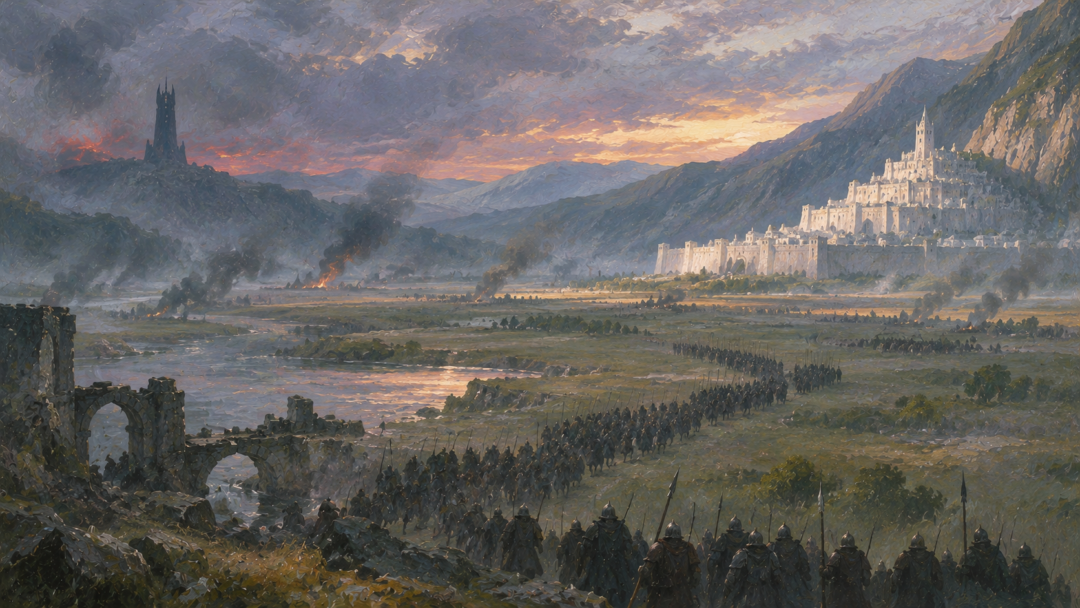
On the Pelennor Fields, the Witch-king has fallen, but Mordor’s armies are still fighting. Beyond the immediate battle lie the ruined streets of Osgiliath, where fresh troops have been waiting to join the attack on Minas Tirith. When those reinforcements move, the name attached to their commander is Gothmog. For anyone who remembers a terrifying figure of fire and shadow from the First Age, that is a startling name to find here.
The answer is simple, though the stories behind it are not: Middle-earth has two different characters named Gothmog. One is the Lord of Balrogs, Morgoth’s high-captain in the ancient wars of Beleriand. The other is the lieutenant of Morgul, a commander serving Sauron during the War of the Ring. They belong to different ages, and there is no established personal connection between them. The shared name is not evidence that the first survived to become the second.
The Lord of Balrogs
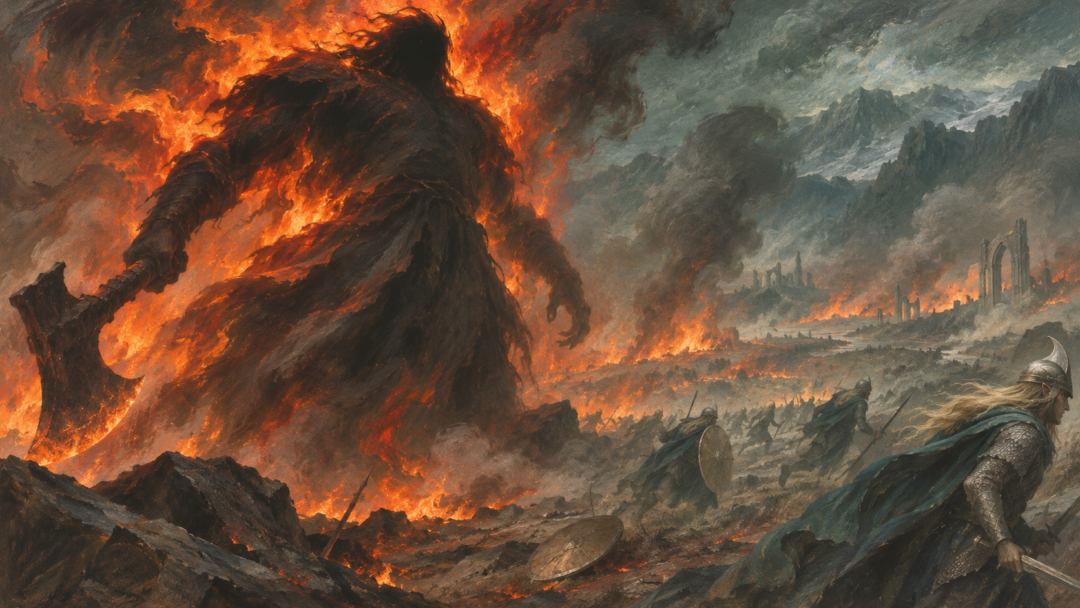
The older Gothmog is not a particularly powerful Orc or an unusually large battlefield monster. He is a Balrog, one of the dreadful beings of shadow and flame that served Morgoth. Their presence brings a terror that even the mightiest Elves struggle to withstand. Gothmog stands at the head of that company.
His rank matters as much as his nature. The Silmarillion calls him Lord of Balrogs and high-captain of Angband, the great fortress from which Morgoth wages his wars against the Elves. That second title places him in the chain of command, not merely among the frightening creatures unleashed when a battle turns desperate. He strikes at the leaders and cohesion of the Elven hosts.
The narrative offers no intimate portrait or explanation of his ambitions. What we know comes chiefly through battlefield actions. The black axe he carries becomes his most recognizable weapon, while his title identifies the power behind it. He arrives at moments when an entire campaign may be lost.
Fëanor’s pursuit ends at Angband
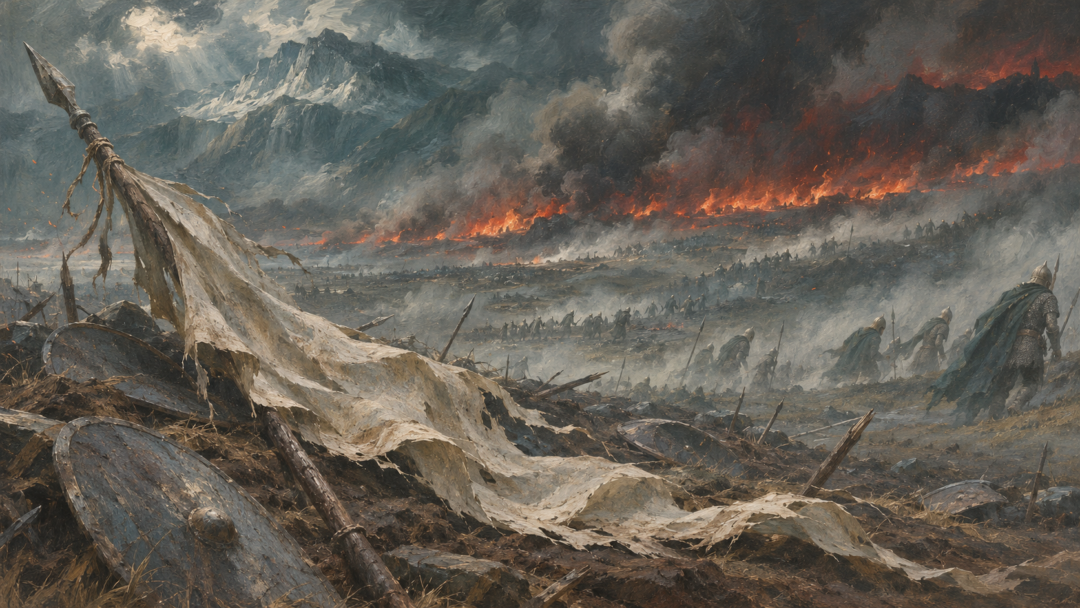
Gothmog’s earliest great encounter with the Noldor comes after the Dagor-nuin-Giliath, the Battle-under-Stars. Fëanor and his followers have defeated the Orcs sent against them after their return to Middle-earth. But victory is not enough for Fëanor. He presses toward Angband, outrunning much of his own force in his determination to confront Morgoth. Near the enemy’s country, the pursuit becomes a trap, and Balrogs emerge against him.
The account is direct: “at the last he was smitten to the ground by Gothmog, Lord of Balrogs, whom Ecthelion after slew in Gondolin”. Fëanor’s sons arrive and drive back his attackers, but they cannot reverse the wounds. The Elf who forged the Silmarils, whose oath and choices have already reshaped the fortunes of his people, never reaches Morgoth’s stronghold as a conqueror. His defeat exposes the distance between a dazzling battlefield victory and the strength required to overthrow Angband itself.
It is worth keeping the battles straight. This is connected with the Battle-under-Stars, not the later Dagor Bragollach, when Morgoth’s fire breaks the long Siege of Angband. Gothmog belongs to the history of both the Noldor’s early hopes and their eventual catastrophe, but Fëanor’s death comes near the beginning of that struggle. His sons inherit the war without their father.
The black axe at the Battle of Unnumbered Tears
The next decisive meeting is the Nirnaeth Arnoediad, the Battle of Unnumbered Tears. Here the Elves and their allies attempt something vastly harder than pursuing a retreating Orc army: a coordinated assault against Morgoth’s power. Fingon leads a great host from the west, while Maedhros and his allies are to press from the east. Turgon also comes out of hidden Gondolin with his warriors, bringing unexpected strength to the attempt.
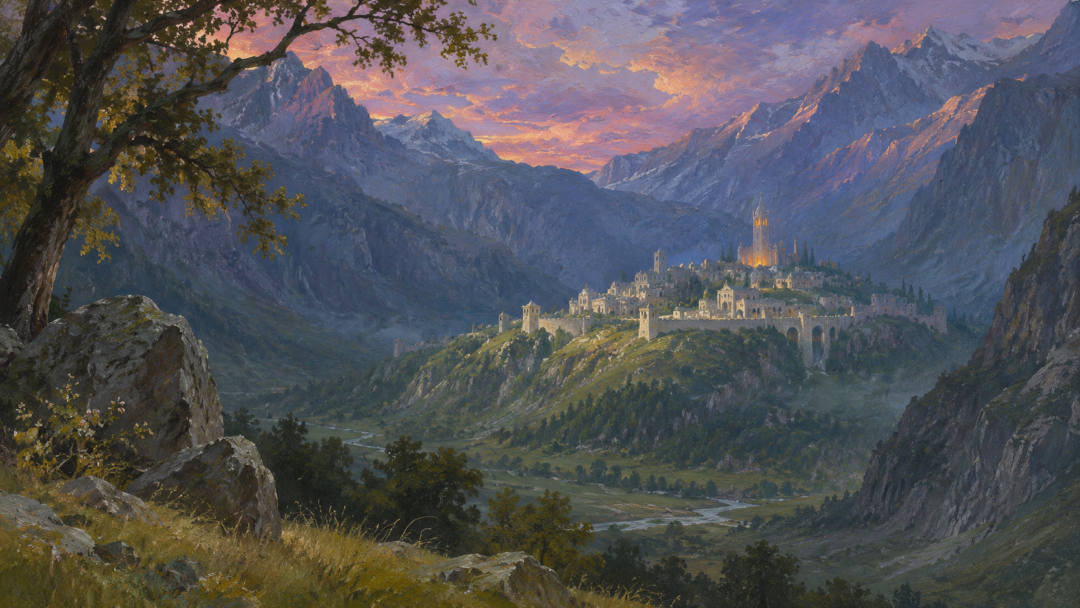
The plan unravels amid the fighting, treachery, and overwhelming forces released from Angband. Then comes the moment that shows Gothmog as a battlefield commander rather than simply a formidable fighter: “Gothmog, Lord of Balrogs, high-captain of Angband, was come; and he drove a dark wedge between the Elvenhosts”. That wedge is a tactical disaster. It separates forces that need to support one another, surrounds Fingon, and pushes Turgon’s people away toward the Fen of Serech.
Fingon does not fall because he is portrayed as weak or easily frightened. He stands against Gothmog amid the collapse of his guard. Another Balrog comes behind him and catches him with a thong of fire, leaving him exposed to the axe. Then the account delivers its terrible conclusion: “Gothmog hewed him with his black axe, and a white flame sprang up from the helm of Fingon as it was cloven. Thus fell the High King of the Noldor”. The detail of that bright flame makes the death impossible to mistake for an anonymous casualty.
There is another consequence on the same field. As Turgon withdraws toward the safety of his hidden city, Húrin and the Men of Dor-lómin hold the enemy back. Húrin is eventually overwhelmed, taken alive, and brought to Angband by Gothmog. His capture leads into the terrible history of Húrin’s family. So Gothmog’s role in the Nirnaeth reaches beyond the death of a king: through a broken alliance, a forced retreat, and a prisoner delivered to Morgoth, the disaster continues into other stories.
Gondolin and the end of the first Gothmog
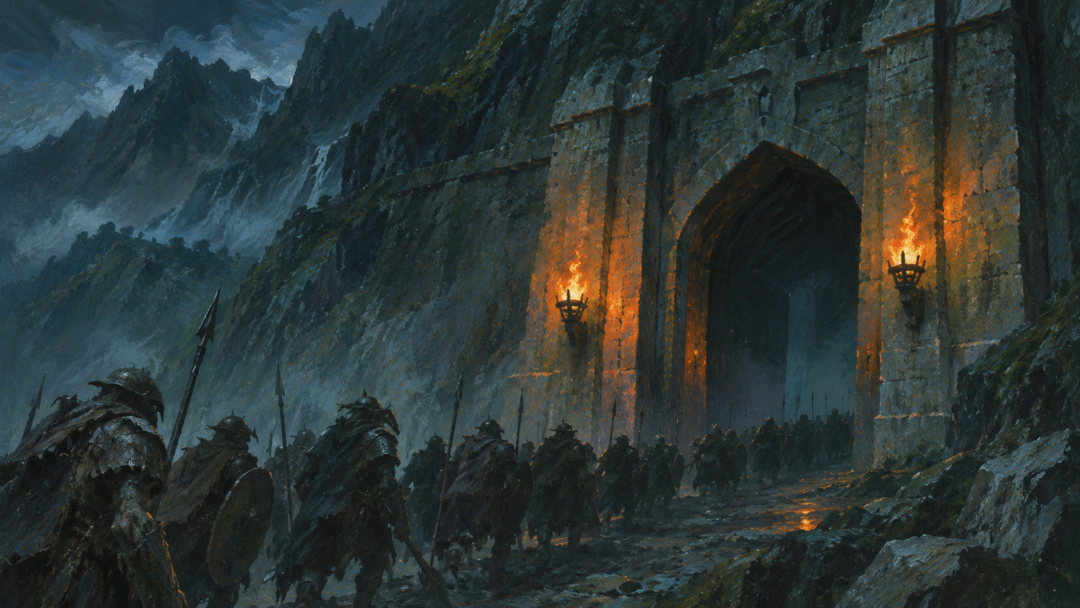
Gondolin survives because its location is concealed among the Encircling Mountains. Turgon has preserved there a realm of beauty, craft, and strength while the wider lands of Beleriand suffer. Its secrecy also means that its people have a chance to remain beyond Morgoth’s reach, even when so many other defenses have fallen.
That protection ends when the hidden way to Gondolin becomes known to the enemy through Maeglin’s betrayal. Morgoth’s forces descend upon the city, bringing the destructive power that had defeated armies in the open field into its streets and squares. Gothmog is among the leaders of the assault. Now he fights not on an open battlefield but inside a city with few ways to escape.
There Ecthelion of the Fountain meets him. The Silmarillion records that Ecthelion slays Gothmog and dies in the encounter himself; the fuller, earlier telling of Gondolin’s fall places their struggle by the king’s fountain, where both perish. It is a fitting reversal without needing to invent a personal feud. The figure who brought down Fëanor and Fingon finally falls to another defender of the Noldor, yet the victory cannot save Gondolin. It belongs to the terrible courage of a city already being lost.
The lieutenant of Morgul on the Pelennor
Thousands of years later, the name surfaces in The Return of the King. This Gothmog belongs to the forces of Minas Morgul, the dreadful stronghold associated with the Nazgûl and their lord. Sauron is now the Dark Lord, and Minas Tirith stands against his armies. The book does not introduce Gothmog with a genealogy or describe him arriving in a dramatic personal confrontation. Instead, it reveals him through an order that changes the immediate shape of the battle.
The Witch-king has been destroyed by Éowyn and Merry, but the forces assembled for the destruction of Gondor still have reserves waiting around Osgiliath. At a moment when the Rohirrim are struggling against the Southrons and their great war-beasts, fresh enemy troops begin streaming onto the field. The narrative explains their arrival with one short statement: “Gothmog the lieutenant of Morgul had flung them into the fray”.
The newcomers include Easterlings with axes, Variags of Khand, and Southrons. Their movement is not random. Some press behind the Rohirrim, while others move west to obstruct the men of Gondor trying to reach their allies. Gothmog’s intervention threatens to isolate Rohan’s riders at the moment their charge has spent its first overwhelming force. His brief order makes the battle suddenly more dangerous.
One detail often gets lost in pictures of this scene: the book never actually says what kind of being the lieutenant is. An Orc commander is a plausible reading, and Peter Jackson’s film adaptation makes Gothmog a recognizable Orc officer. That is an adaptation choice, not proof of his race in the text. The lieutenant might be an Orc, but the description leaves the question open. His individual fate after the Pelennor is not fully told either, so a specific death scene cannot be supplied from the novel.
Why the same name keeps causing confusion
The resemblance is unusually tempting because both Gothmogs serve Dark Lords and hold military authority. Morgoth was Sauron’s master in the Elder Days, and the later war repeats some of the ancient world’s language of terror, siege, and desperate resistance. Readers familiar with the Silmarillion can therefore hear a great deal of history in that single name when it appears beside Minas Tirith. But resemblance in role is not continuity of identity.
Their stories also occupy very different amounts of space. The first Gothmog appears at several defining disasters of the First Age, and his death is explicitly recorded. The second enters the story almost in passing, identified by his position and by the reserves he commits. Nothing in the books tells us why he bears the older name. It is possible to imagine an ominous namesake, but that remains interpretation rather than an established explanation.
The old Gothmog ends among Gondolin’s fountains, brought down by an Elf defending a doomed city. The later Gothmog appears through troops advancing out of ruined Osgiliath toward another city under siege. Between those images lies the long history of Middle-earth, where names can echo across the ages even after their first bearers have gone. The older captain’s black axe is far beyond the reach of that later war.
Sources & Notes
- Tolkien Gateway, Gothmog (Lieutenant of Morgul) — the Third Age commander and the limits of what the book says about his identity — https://tolkiengateway.net/wiki/Gothmog_(Lieutenant_of_Morgul)
- The Encyclopedia of Arda, Gothmog — Morgoth's Lord of Balrogs in the First Age — https://www.encyclopedia-of-arda.com/g/gothmog.php
- Tolkien Gateway, The Battle of the Pelennor Fields — the chapter in which the lieutenant sends in the reserves — https://tolkiengateway.net/wiki/The_Battle_of_the_Pelennor_Fields
Reading references: The Silmarillion, Of the Return of the Noldor, Of the Fifth Battle, and Of Tuor and the Fall of Gondolin; The Return of the King, The Battle of the Pelennor Fields. The First and Third Age Gothmogs are separate figures; the lieutenant's race is unspecified in the novel.