
The tragedy of Denethor is most often reduced to a single, ugly moment: a Steward driven mad by grief, lashing out at allies, and choosing fire over surrender. In popular memory, he stands as a warning about pride, a contrast to nobler leaders who trust in hope.
But that reading is incomplete—and deeply unfair.
Denethor was not a fool who stumbled into forbidden knowledge out of curiosity or arrogance. He was a man of Númenórean descent, trained in lore, hardened by decades of rule, and painfully aware of Gondor’s slow decline. He inherited a realm under siege, abandoned by kings, watched by enemies, and sustained largely by memory and stubborn will.
When Denethor took up the Palantír of Minas Tirith, he did so knowingly.
A Tool Meant for the Strong
The Palantír were not evil artifacts by nature. They were ancient works of Númenórean craft, created to see far, to communicate across distance, and to bind the realms of the Faithful together in vigilance and unity. They were dangerous only insofar as knowledge itself is dangerous—especially when wielded alone.
Denethor understood this.
He did not approach the stone with superstition or hunger for domination. He approached it as a ruler who needed truth. Gondor stood as the last great defense against Sauron, and Denethor believed that ignorance would be a greater sin than risk.
Unlike Saruman, who used his Palantír to rival Sauron and imitate his power, Denethor sought no mastery beyond understanding. Saruman wanted to reshape the world. Denethor wanted to preserve what little remained.
For years, he studied the stone in secret.
He did not surrender his will to it. He questioned what he saw. He compared visions against reports from scouts, messengers, and captains. And for a long time, it worked.
Why Sauron Could Not Break Him
This point is crucial: Sauron could not dominate Denethor outright.
The Steward’s mind was too disciplined, too rooted in duty, too resistant to command. Unlike weaker wills, Denethor did not bow, did not kneel, did not offer himself up in exchange for false promises of power or safety.
So Sauron changed tactics.
He did not lie—because lies can be contested. Lies provoke doubt, and doubt leaves room for resistance. Instead, Sauron revealed truths without balance, without mercy, without the context that gives meaning to facts.
Denethor saw the Corsairs gathering in the South, black sails filling the harbors—but not Aragorn riding to meet them.
He saw Gondor’s enemies multiply on every road—but not the Dead who would answer an ancient oath.
He saw the isolation of Minas Tirith—but not the quiet resolve growing in unexpected hearts.
What he was shown was real. What he was denied was possibility.
This is the cruelty of the Palantír: it shows what is, not what may yet be.

The Weight of Unshared Knowledge
By the time the War of the Ring reached Gondor’s gates, Denethor was already exhausted.
For years, he had been fighting Sauron alone, in silence, locked in a battle of perception and endurance that no one else even knew was happening. Every grim report confirmed what the stone had already shown him. Every delay in aid reinforced the sense that Gondor stood alone.
This is why Denethor hardened.
Why he fortified the city relentlessly.
Why he trusted no promise that could not be proven.
Why he measured allies with suspicion instead of faith.
His coldness was not born of cruelty, but of knowledge gained at terrible cost.
Even his rejection of Gandalf is often misunderstood. It is tempting to see it as jealousy or pride—an old ruler resenting the influence of a wizard. But Denethor did not dismiss Gandalf because he thought himself wiser.
He dismissed him because he believed hope itself had become a lie.
From Denethor’s perspective, Gandalf spoke in possibilities while Denethor had seen inevitabilities. To trust Gandalf meant to deny years of evidence, years of visions, years of watching the noose tighten.
Certainty as the True Enemy
When Boromir died, something in Denethor finally cracked—not because he loved Boromir alone, but because Boromir’s death seemed to confirm everything the Palantír had already told him.
Loss, defeat, and the futility of resistance.
By the time Faramir was wounded, Denethor’s certainty was complete. In his mind, Gondor’s line was broken, its future extinguished. There was nothing left to preserve—only suffering to delay.
And so, when Denethor finally broke, it was not in ignorance.
It was in certainty.
Certainty that the war was lost.
Certainty that hope was cruelty.
Certainty that prolonging the fight would only multiply pain.
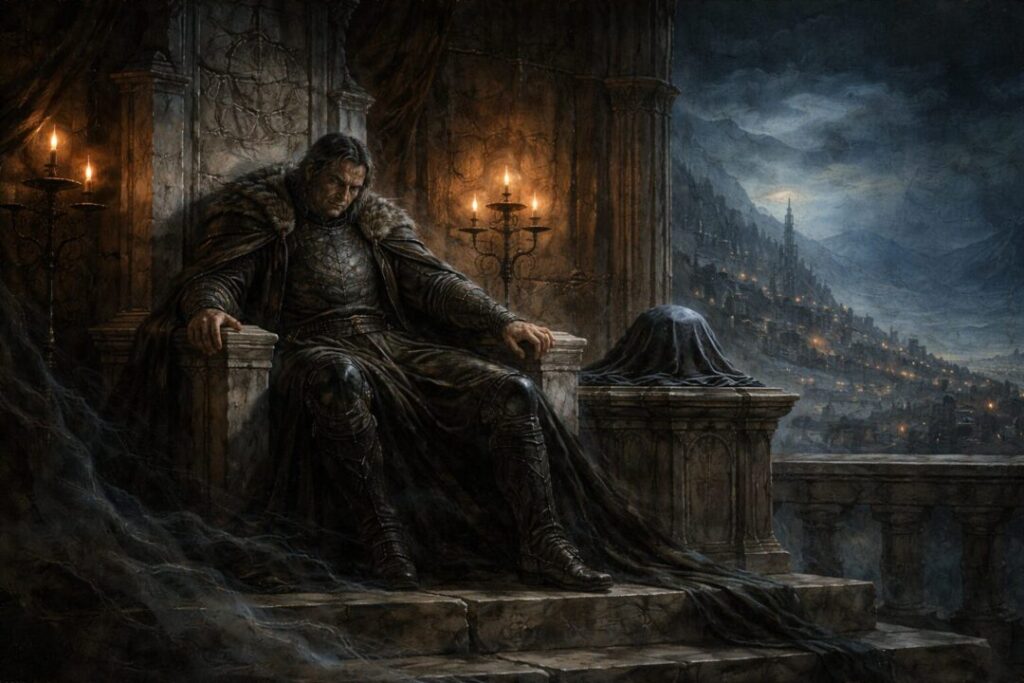
A Tragedy, Not a Moral Failure
This does not excuse Denethor’s choices. His despair wounded others, especially Faramir. His final act was one of abandonment, not stewardship.
But understanding his fall restores something essential: his dignity.
Denethor was not a weak man undone by fear. He was a strong man undone by knowledge stripped of hope. He saw too much, too clearly, and too alone.
Middle-earth was saved not by those who saw everything, but by those who believed despite seeing nothing at all—hobbits walking into darkness without proof, men answering oaths centuries old, and leaders willing to act without certainty.
Denethor could not make that leap.
And that is what makes his story so painful.
Not that he was blind—but that he believed he had already seen the end.