At first glance, Tolkien’s world feels governed by rules that are almost comforting in their clarity. Steel wounds flesh. Fire consumes wood. Evil corrupts the heart. Power, when misused, destroys both the wielder and the world around them. Unlike much modern fantasy, The Lord of the Rings does not rely on spectacle or elaborate systems of magic. There are no glowing spell circles, no named techniques shouted in battle, no codified abilities that can be learned through repetition.
And yet—there are moments where those rules appear to bend.
Not loudly. Not spectacularly. Quietly.
Moments where a character stands before a force that should annihilate them, erase them, or utterly consume them… and instead endures.
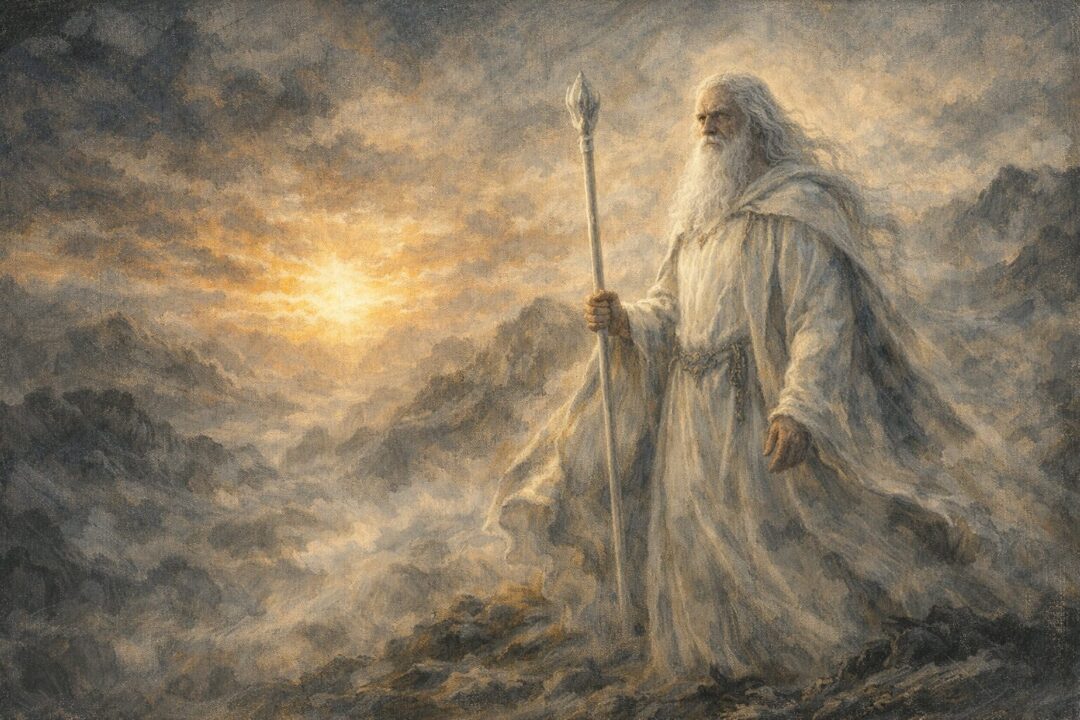
A wizard halts a demon of fire with a single sentence.
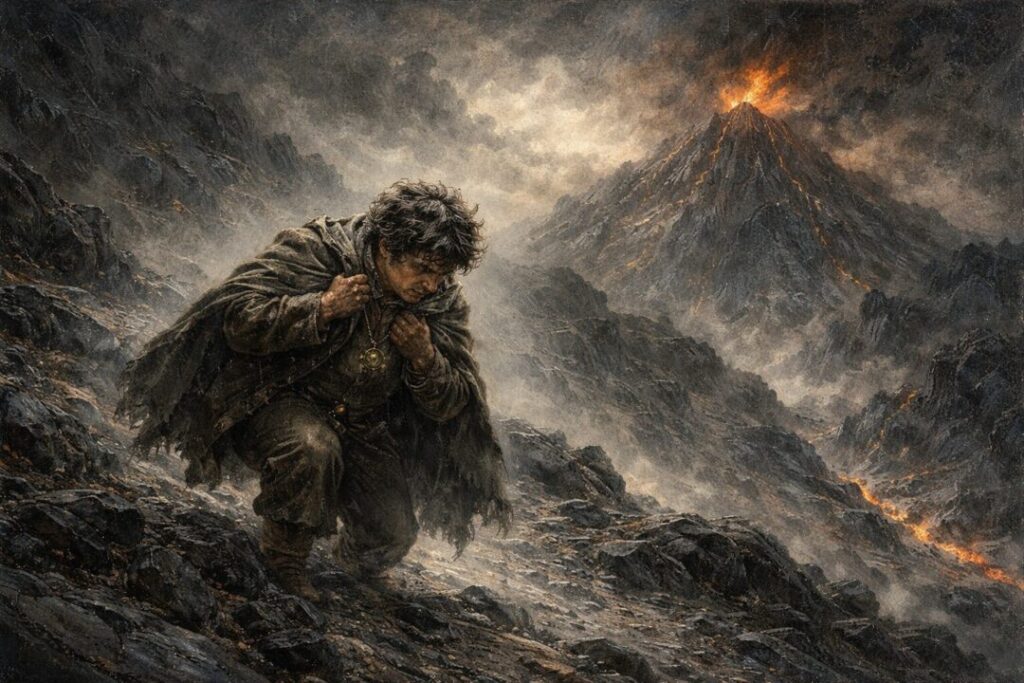
A small hobbit carries the concentrated malice of a fallen god across an entire continent.
An elven queen allows absolute power to pass through her grasp without taking hold.
These moments are not accidents, nor are they contradictions. They are Tolkien revealing a deeper truth about how power works in Middle-earth—one that has less to do with strength, and far more to do with authority, sacrifice, and moral alignment.
So what is actually happening in these scenes? Is Tolkien breaking his own rules—or showing us the only rules that ever truly mattered?
Gandalf and the Authority to Withstand
The clearest and most dramatic example occurs in the depths of Moria.
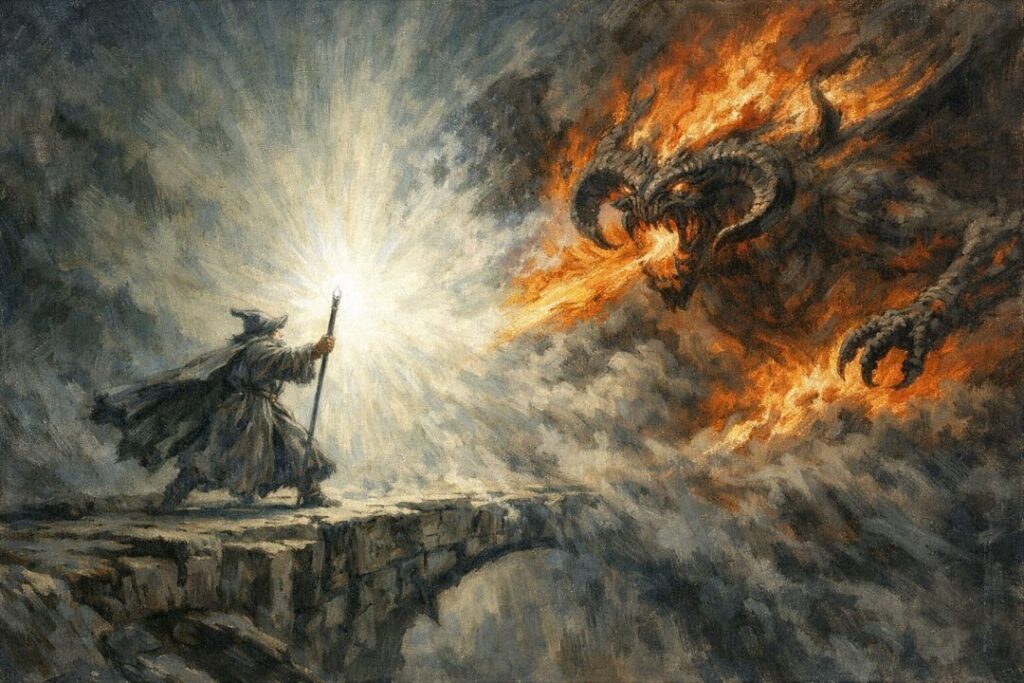
When Gandalf confronts the Balrog upon the Bridge of Khazad-dûm, the scene is often remembered for its visual grandeur: fire and shadow, abyss and stone, ancient powers clashing in a narrow place. But the true nature of the moment lies not in spectacle—it lies in restraint.
Gandalf does not rush forward. He does not strike first. He plants his staff, names himself, and speaks a command:
“You cannot pass.”
This is not bravado. It is not a test of strength. Gandalf is not attempting to physically block the Balrog’s fire with wood and flesh. He is asserting authority.
As a Maia—one of the same order of beings as the Balrog itself—Gandalf stands not as a mere combatant, but as an emissary of the divine order that shaped Arda. His power does not come from domination, but from alignment with that order. He does not oppose the Balrog’s force with greater force; he meets it, holds it in balance, and denies it passage.
And for a moment, it works.
The Balrog is checked. Its advance halted. The bridge holds—until it does not.
The cost of this endurance is absolute. Gandalf falls, dies, and passes beyond the world. His return as Gandalf the White is not a reward, but a transformation. He comes back altered, diminished in some ways, heightened in others, no longer the same being who stood on the bridge.
Middle-earth permits endurance against overwhelming power—but it never allows it without consequence.
Frodo and the Long Absorption of Evil
If Gandalf’s endurance is sudden and catastrophic, Frodo Baggins represents something far more unsettling: endurance stretched thin across time.
Frodo does not block the power of the One Ring. He does not deflect it. He does not master it.
He absorbs it.
From the moment he takes the Ring at Bag End, Frodo becomes a vessel for concentrated malice, will, and domination. The Ring’s power presses inward constantly—whispering, tempting, eroding. Every step toward Mordor is an act of containment, holding that corruption inside himself so it does not spill outward into the world.
Tolkien is careful to make one thing clear: Frodo is not strong in the conventional sense. He is not wiser than Gandalf, nobler than Aragorn, or braver than Boromir. What sets him apart is not strength, but willingness.
He is willing to carry what others cannot.
That willingness does not make him immune. The Ring wounds him repeatedly—at Weathertop, in Shelob’s lair, upon Mount Doom itself. These wounds are not merely physical. They are spiritual fractures that never fully heal.
Frodo completes the quest, but he does not conquer the Ring. In the end, it conquers him. Only mercy, chance, and forces beyond his control bring about its destruction.
Middle-earth does not reward this endurance with triumph. Frodo survives, but he cannot remain. The Shire is saved, yet he must leave it behind.
To absorb evil, Tolkien tells us, is to be forever changed by it.
Galadriel and Power Refused
Then there is Galadriel, whose moment of endurance takes an entirely different form.
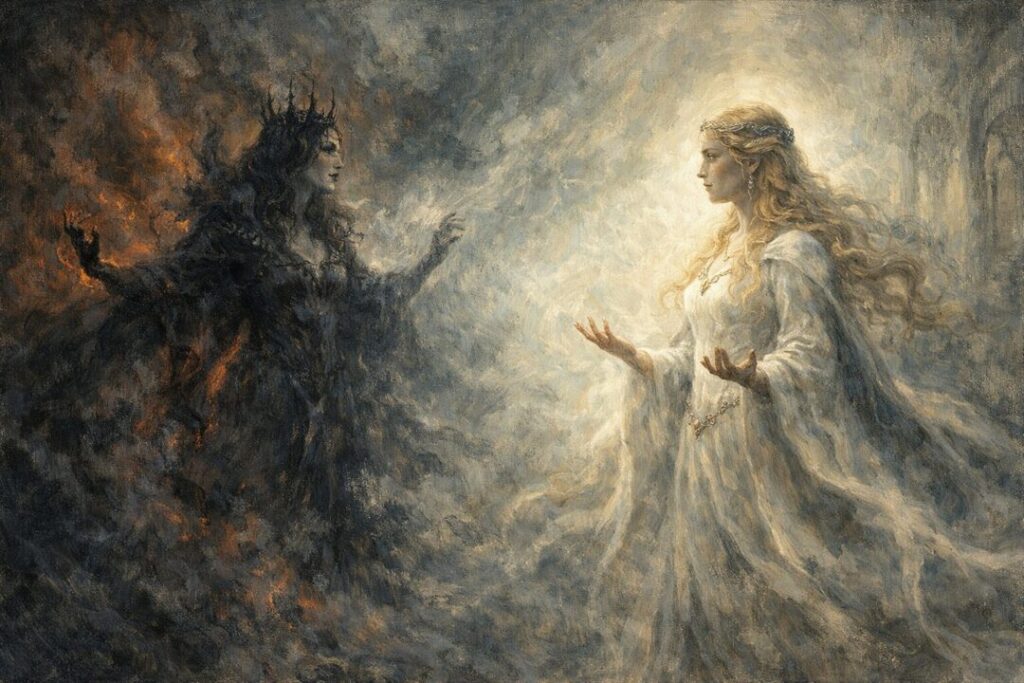
When Frodo offers her the One Ring, Galadriel does not recoil. She does not deny its power or pretend immunity. Instead, she allows herself to see—to fully envision what she would become if she accepted it.
A queen beautiful and terrible. A ruler adored and feared. A force of order imposed upon the world.
For a moment, she does what Gandalf and Frodo do: she contains the power. She lets it pass through her understanding. And then—she refuses it.
This is endurance not through absorption, but through renunciation.
Galadriel understands something that many in Middle-earth never do: some powers cannot be safely held, no matter how wise, ancient, or well-intentioned the bearer. To endure them is not always to carry them—it is sometimes to let them go untouched.
In Tolkien’s moral universe, restraint is not weakness. It is clarity.
Why Tolkien Never Names the Technique
Modern fantasy often demands labels. Techniques are named, categorized, mastered. Power is treated as a neutral resource, available to anyone skilled enough to wield it.
Tolkien rejects this entirely.
He never names what Gandalf does on the bridge. He never classifies Frodo’s endurance as a skill. He never frames Galadriel’s refusal as an ability.
This is not oversight—it is philosophy.
Power in Middle-earth is moral before it is mechanical. Who can endure it depends not on training, but on alignment: with purpose, humility, and one’s place in the design of the world.
Those who attempt to wield power for themselves—Saruman, Denethor, even Boromir—are undone by it. Their intentions may begin as noble, but their desire to control becomes their downfall.
Those who endure power for the sake of others are not exalted by the act. They are diminished by it.
The Real Rule of Middle-earth
So does Middle-earth have its own version of “absorbing the blade”?
Yes—but it is nothing like a repeatable technique or hidden discipline.
It is rare.
It is dangerous.
And it always exacts a cost.
Power can be endured.
Evil can be contained.
But no one walks away unchanged.
And that, perhaps, is Tolkien’s most important rule of all.
In Middle-earth, true strength is not found in what you can wield—but in what you are willing to carry, refuse, or lose for the sake of the world.