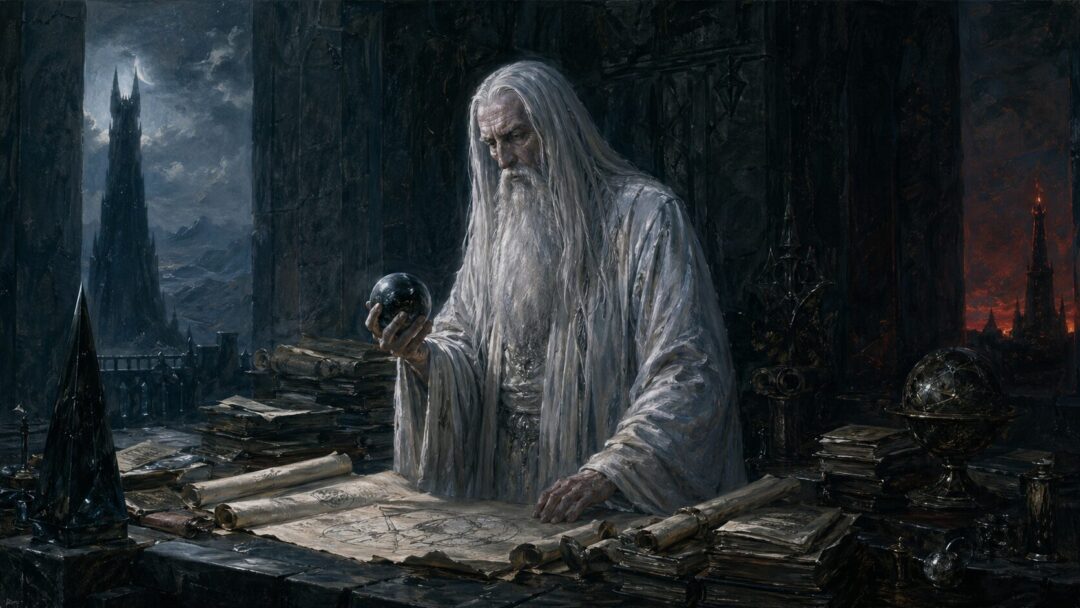
Most readers notice it sooner or later.
Sauron.
Saruman.
The names look and sound close enough that they almost seem designed to echo one another. Both begin with the same sharp sound. Both belong to powerful enemies in The Lord of the Rings. Both are associated with command, fear, craft, and corruption.
So it is natural to ask:
Are the names connected?
Did Saruman’s name come from Sauron’s?
Do they share a hidden meaning?
Was Saruman always meant to be a lesser version of the Dark Lord?
The answer is both simpler and more interesting than that.
The names are not the same in origin. They do not mean the same thing. In the languages of Middle-earth, they come from different places.
But the similarity still matters.
Not because it reveals a secret linguistic code, but because it quietly reflects one of the central tragedies of The Lord of the Rings: Saruman was sent to oppose Sauron, and yet he gradually began to resemble him.
Not completely.
Not equally.
But enough to make the echo feel deliberate.
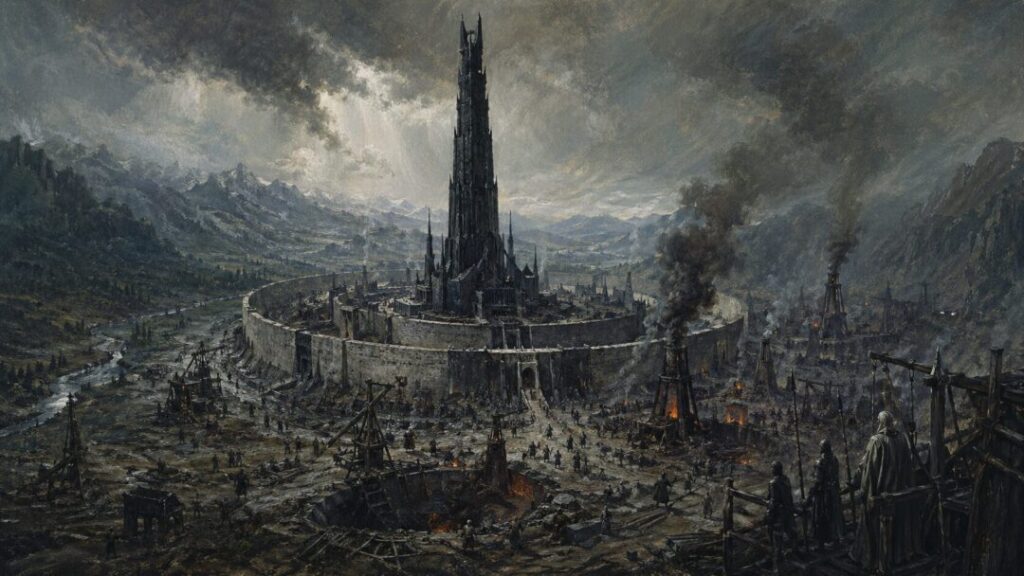
Sauron Is a Name of Hatred
The name Sauron is not a noble title.
In the lore, Sauron is an Elvish name meaning “the Abhorred.” It is not presented as a name of admiration, kingship, or divine authority. It is a name of rejection.
That already tells us something important.
“Sauron” is not simply a personal name in the ordinary sense. It describes what he became in the eyes of those who opposed him. It is a name attached to corruption, dread, and moral ruin.
Sauron was originally a Maia, one of the angelic spirits of the world. He was not evil from the beginning. He was associated with order, craft, and knowledge before his fall into the service of Morgoth.
That last detail matters.
Sauron’s evil is not the evil of chaos for its own sake. He is not merely destructive. His desire is domination through order. He wants control. He wants wills bent beneath his own. He wants the world arranged according to his design.
The Ring is the perfect expression of that desire.
It is not just a weapon. It is a tool of mastery.
So the name “Sauron” carries a terrible irony. It belongs to a being who sought to make himself the center of order, yet is remembered by his enemies as “the Abhorred.”
He wanted reverence.
He received revulsion.
Saruman Means Something Very Different
The name Saruman has a very different meaning.
Saruman is a name used among Men, and it is usually understood as meaning something like “Man of Skill.” It is connected with craft, cleverness, contrivance, and cunning.
That fits him perfectly.
Saruman’s original identity is not simply “evil wizard.” He is one of the Istari, the Wizards sent into Middle-earth to help resist Sauron. He is also the head of the White Council for a time. He is learned, persuasive, and powerful.
His other names point in the same direction. In Elvish he is known as Curunír, often understood as “Man of Skill,” and his Quenya name Curumo likewise belongs to the same general field of craft and ability.
So Saruman’s name does not mean “abhorred.” It does not mark him as a Dark Lord. It does not say he was always doomed to evil.
It says he is skilled.
That is the danger.
Because in Middle-earth, skill is never automatically evil. Craft can be noble. Knowledge can be good. Making can be beautiful. The Elves are makers. The Dwarves are makers. Even the Valar include great powers of craft.
But skill can become corrupted when it is severed from humility.
Saruman’s name points to what he was gifted with.
His fall shows what happens when the gift becomes an idol.
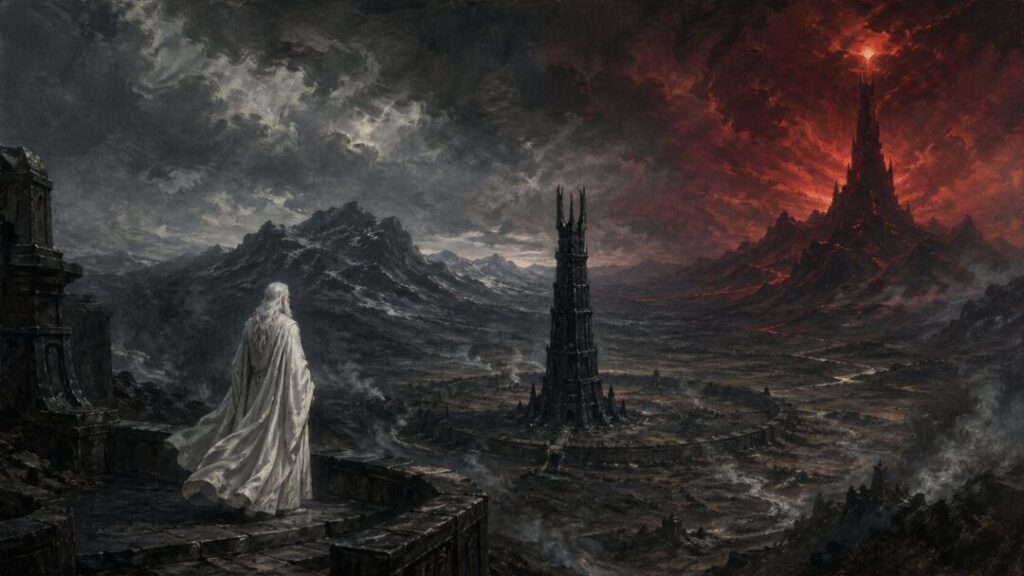
The Similarity Is Not a Shared Meaning
This is the key point:
Sauron and Saruman do not mean the same thing.
Sauron means “the Abhorred.”
Saruman means something closer to “Man of Skill.”
Their similarity in English sound does not mean they come from the same in-world root. One is an Elvish name of rejection. The other is a Mannish name connected with craft and cunning.
So the answer is not that Saruman’s name secretly means “little Sauron.”
That would be too simple.
The deeper connection is literary and thematic. The names sound close to us because the characters become close in function. Saruman begins as Sauron’s appointed enemy, but his path bends toward the same kind of evil.
The similarity is not a dictionary clue.
It is a moral echo.
Saruman Was Sent to Oppose Sauron
Saruman’s tragedy depends on one fact that is easy to forget:
He was not Sauron’s servant at first.
He was sent to Middle-earth to help resist Sauron. The Wizards were not meant to rule by force or dominate the peoples of Middle-earth. Their task was to guide, counsel, encourage, and strengthen resistance against the Shadow.
That makes Saruman’s fall especially bitter.
He does not begin as a creature of Mordor. He begins with authority, wisdom, and a mission. He knows much about Sauron. He studies the Rings of Power. He understands more than most about the danger rising again in the East.
And then knowledge becomes temptation.
Saruman does not merely fear Sauron. He envies him.
He begins to imagine power as the only answer to power. If Sauron rules by domination, Saruman decides that domination must be met with domination. If Sauron has armies, Saruman will build armies. If Sauron has a tower, Saruman will make Isengard into a rival power.
This is where the resemblance begins.
Not in the name.
In the method.
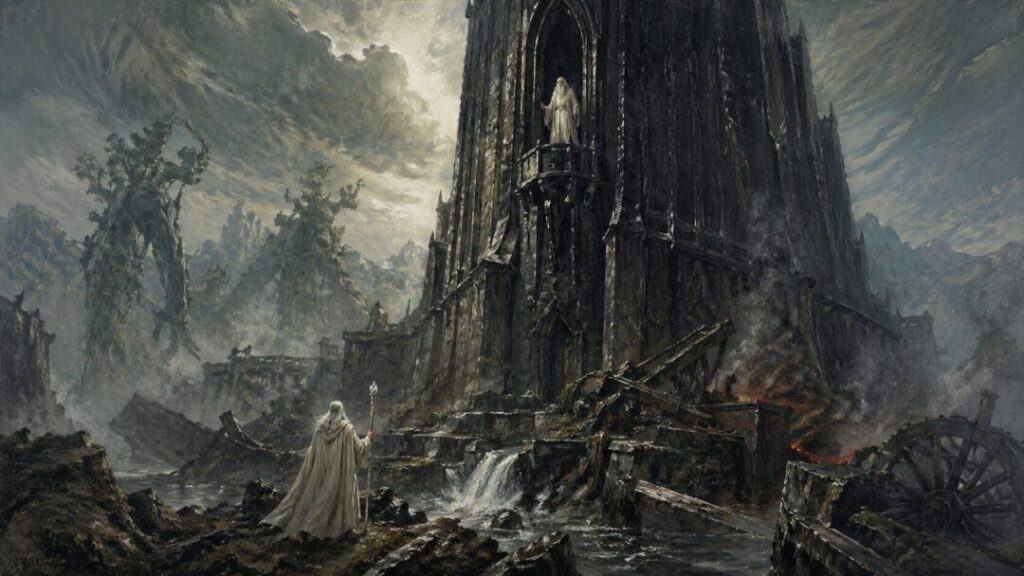
Isengard Becomes a Smaller Mordor
The transformation of Isengard is one of the clearest signs of Saruman’s inner change.
Isengard was not originally a place of filth and ruin. It was an ancient stronghold, ringed and ordered, with the tower of Orthanc at its center. But under Saruman, it becomes increasingly industrial, violent, and unnatural.
Trees are cut down. Furnaces burn. Weapons are made. Orcs and Men are organized into war.
Saruman’s mind turns toward machinery, control, and production. Treebeard famously says that Saruman has “a mind of metal and wheels,” and that phrase captures the shape of his fall.
He no longer sees the world as something to be guarded.
He sees it as something to be used.
That is why Isengard becomes so disturbing. It is not Mordor in size or strength. Saruman is not Sauron’s equal. But Isengard begins to resemble Mordor in spirit: a place where living things are consumed for power.
The resemblance is partial, but unmistakable.
Saruman becomes a maker of instruments.
And then he becomes an instrument himself.
Saruman Imitates What He Hates
One of the most unsettling things about Saruman is that he still imagines himself independent.
He does not simply bow to Sauron in the way a lesser servant might. He wants the Ring for himself. He wants to become a great power in his own right.
That makes him dangerous, but also pathetic.
Saruman thinks he is competing with Sauron. In reality, he is being drawn into Sauron’s pattern. He uses secrecy, deception, fear, armies, and domination. He tries to master others through voice and will. He turns wisdom into manipulation.
He does not become Sauron.
But he becomes Sauron-like.
That distinction matters. Saruman remains smaller, weaker, and more limited. He cannot match the Dark Lord’s ancient malice or vast power. Yet morally, his fall moves in the same direction.
He begins as a guardian against tyranny.
He ends as a tyrant in miniature.
This is why the names feel so fitting together. The similarity is not an explanation of Saruman’s origin. It is a reflection of his corruption.
The ear notices what the story later proves.
The Danger of Skill Without Humility
Saruman’s name means “Man of Skill,” and that may be the most tragic part of all.
His gift is real.
He is not a fool. He is not weak. He is not merely greedy in a simple way. His knowledge is vast, his voice is powerful, and his understanding of craft and devices is extraordinary.
But skill without humility becomes dangerous.
Saruman begins to trust his own mind above all else. He treats others as pieces on a board. He believes he can use Sauron’s methods without becoming like Sauron. He believes he can study evil, manipulate evil, perhaps even control evil, and remain master of himself.
The story proves otherwise.
In Middle-earth, evil often works by imitation. It does not always begin by asking someone to become a monster. Sometimes it begins by convincing them that power is necessary, that domination is practical, that compromise is wisdom, that the ends justify the means.
Saruman falls because he accepts Sauron’s logic while still pretending to oppose Sauron’s rule.
That is the real horror.
He does not need to worship Sauron to become like him.
He only needs to desire power in the same way.
Why Gandalf Is the Necessary Contrast
The similarity between Sauron and Saruman becomes clearer when we place Gandalf beside them.
Gandalf is also a Maia. He is also wise. He is also sent to Middle-earth as one of the Wizards. He too has power, knowledge, and authority.
But Gandalf’s power works differently.
He does not build an empire. He does not claim a fortress and gather armies for himself. He does not seek the Ring. In fact, when Frodo offers him the Ring, Gandalf refuses it with fear and clarity. He knows that through him the Ring would wield a power too terrible to imagine.
This is the difference Saruman loses.
Gandalf understands that good cannot defeat evil by becoming a more efficient version of it.
Saruman does not.
That is why Saruman becomes a dark mirror of Gandalf as well as a lesser echo of Sauron. He shows what a Wizard becomes when wisdom is separated from pity, patience, and obedience to his true purpose.
Gandalf remains a servant.
Saruman wants to be a master.
And in the moral world of The Lord of the Rings, that difference is everything.
So Why Do the Names Sound So Similar?
The safest lore-accurate answer is this:
The names are similar in sound, but they do not share the same meaning in the established languages of Middle-earth.
Sauron is a name of abhorrence.
Saruman is a name of skill.
But the similarity works because the story itself brings the two figures into a terrible parallel. Both are Maiar. Both are associated with knowledge and craft. Both are drawn toward order imposed by will. Both become enemies of freedom.
The difference is that Sauron is already the great Shadow.
Saruman is the one who should have known better.
That is why his fall is so disturbing. He is not simply another villain standing beside Sauron. He is a warning about how someone can begin in wisdom and end in imitation of the very evil he was meant to resist.
The names sound close.
The meanings are different.
And somewhere between those two facts lies the tragedy.
The Real Answer Is Not Linguistic, But Moral
In the end, the similarity between Sauron and Saruman is not best understood as a hidden etymological puzzle.
It is a story about resemblance.
Sauron is “the Abhorred,” the fallen power who seeks mastery over all wills.
Saruman is “the Man of Skill,” the wise craftsman who slowly turns skill into control, knowledge into pride, and counsel into command.
They do not begin in the same place.
But Saruman moves toward Sauron’s shadow until the resemblance becomes impossible to ignore.
That is why the names feel so hauntingly close.
Not because Saruman was always Sauron.
But because he became the kind of person who could no longer clearly stand apart from him.
And that may be the real warning hidden in the echo:
The most dangerous servant of evil is not always the one who loves darkness from the beginning.
Sometimes it is the one who studies it too long, envies its strength, copies its methods, and still believes he remains free.
Sources & Notes
- J.R.R. Tolkien, The Silmarillion, Index of Names — Sauron is glossed as “the Abhorred,” with his earlier names and identity as a Maia noted in the published mythology.
- J.R.R. Tolkien, Unfinished Tales, “The Istari” — gives Saruman’s Elvish names Curumo/Curunír and the meaning “Man of Skill,” and frames the Wizards as emissaries sent to oppose Sauron by counsel rather than rule.
- J.R.R. Tolkien, The Letters of J.R.R. Tolkien, Letter 131 — describes Sauron’s fall through a desire for order, coordination, and ultimately domination of other wills.
- J.R.R. Tolkien, The Lord of the Rings, Book II, Chapter 2, “The Council of Elrond” — Saruman’s study of Ring-lore, betrayal, and desire for the One Ring show him moving from resistance to rivalry and imitation.
- J.R.R. Tolkien, The Lord of the Rings, Book III, Chapter 4, “Treebeard” — Treebeard’s “mind of metal and wheels” and the ravaging of Isengard support the article’s contrast between craft, machinery, and corrupted power.