
At first glance, it seems like a problem.
The One Ring was the ruling Ring. The Three Elven Rings were bound to it. Elrond, Galadriel, and Gandalf were among the wisest beings left in Middle-earth. By the end of the Third Age, each of them bore one of the Three.
So why did none of them immediately know when Sméagol wore the One?
Why did they not sense Bilbo using it?
Why did decades pass before Gandalf became certain that Bilbo’s “magic ring” was the Ruling Ring of Sauron?
It feels as if the Three should have reacted.
After all, when the One Ring was first made, the Elves became aware of Sauron’s treachery. The whole disaster of the Rings of Power turned on that moment. Sauron put on the One, and the Elven ring-bearers perceived him. They removed their Rings and hid them.
That much is clear.
But that single event is often stretched too far.
The texts show that the bearers of the Elven Rings perceived Sauron when he revealed himself through the One. They do not show that the Three became permanent warning bells, ringing every time any later bearer slipped the One onto a finger.
That difference matters.
Because when Sméagol wore the Ring, and when Bilbo wore it, the Ring was not being wielded by Sauron. It was not being used to command the Three. It was not being raised as a weapon of mastery over other Ring-bearers.
It was being used by small, hidden, mortal bearers who barely understood what they possessed.
And that may explain why the Wise remained in the dark for so long.

The Three Were Bound to the One, But Not Made by Sauron
The Three Elven Rings were different from the others.
They were made by Celebrimbor, not by Sauron’s own hand. That does not make them free from the One. They were still made with the craft Sauron had taught, and the One was designed to rule the whole system of the Great Rings.
But the Three were not like the Nine.
They were not instruments Sauron had personally touched and corrupted in the same way. Their chief purpose was not conquest, fear, or enslavement, but preservation: the slowing of decay, the healing of weariness, and the protection of beauty against time.
That is why Rivendell and Lothlórien feel different from the rest of Middle-earth.
They are not simply defended places. They are preserved places. They seem to stand slightly apart from the ordinary flow of the world.
Yet this preservation depended on a terrible risk.
If Sauron regained the One, the bearers of the Three would be exposed. Their works and thoughts would be open to him. The very Rings they had used to protect what they loved would become channels of domination.
That is why the One had to be destroyed.
But dependence is not the same thing as constant awareness.
The Three were bound to the fate of the One. Their power endured while the One endured, and failed when the One was destroyed. But the texts do not say that their bearers could always locate the One, identify its wearer, or feel every act of invisibility performed through it.
That idea is tempting.
It is also more than the story actually gives us.
What Happened When Sauron First Wore the One?
The strongest objection is obvious.
When Sauron first put on the One Ring, the Elves knew.
So why would they not know when anyone else put it on?
The answer is that those two situations were not the same.
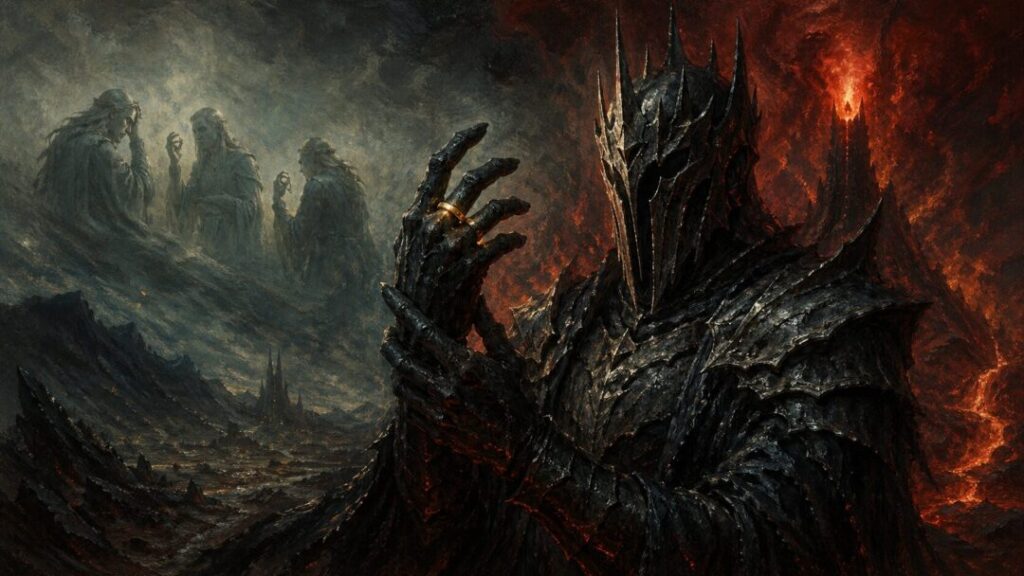
When Sauron set the One upon his finger in the Second Age, he was not merely becoming invisible. He was revealing the ruling purpose of the One Ring. He had made it to govern the other Rings and bring their bearers under his will.
This was the moment the trap closed.
The Elves perceived him. They understood the danger. They took off their Rings.
That moment was not a quiet use of the Ring by an ignorant bearer. It was the maker of the One attempting to exert the power for which it had been created.
Sauron was the master of the Ring. He had poured much of his own power into it. When he wore it, the connection between the One and the other Rings was not passive. It was active, deliberate, and terrible.
Sméagol did nothing like that.
Bilbo did nothing like that.
Even Frodo, until the very end, did not truly wield the Ring in the way Sauron feared a mighty claimant might wield it.
The One could make a mortal invisible. It could lengthen life unnaturally. It could gnaw at desire, isolate the bearer, and slowly bend the mind toward possession.
But full use of its deeper power required far more than putting it on.
The Ring Gave Power According to the Bearer
Galadriel gives one of the clearest explanations in Lothlórien.
When Frodo wonders why he cannot perceive the thoughts of those who wear the Three, she tells him that he has not tried. She also warns him not to try. The Rings give power according to the measure of each possessor, and before he could use that power, he would need to become far stronger and train his will to the domination of others.
That sentence is crucial.
It means the Ring’s power was not automatic in its fullest sense.
A bearer could wear it and vanish. A bearer could be drawn into the unseen world. A bearer could become more exposed to the Eye, especially as the Ring came closer to Mordor.
But using the Ring as an instrument of rule was another matter.
That required strength.
It required knowledge.
It required a will trained toward domination.
Sméagol did not have that. He used the Ring to spy, steal, hide, and survive. Over long years, it consumed him, but he did not become a lord of wills. He became smaller, meaner, more secretive, and more enslaved.
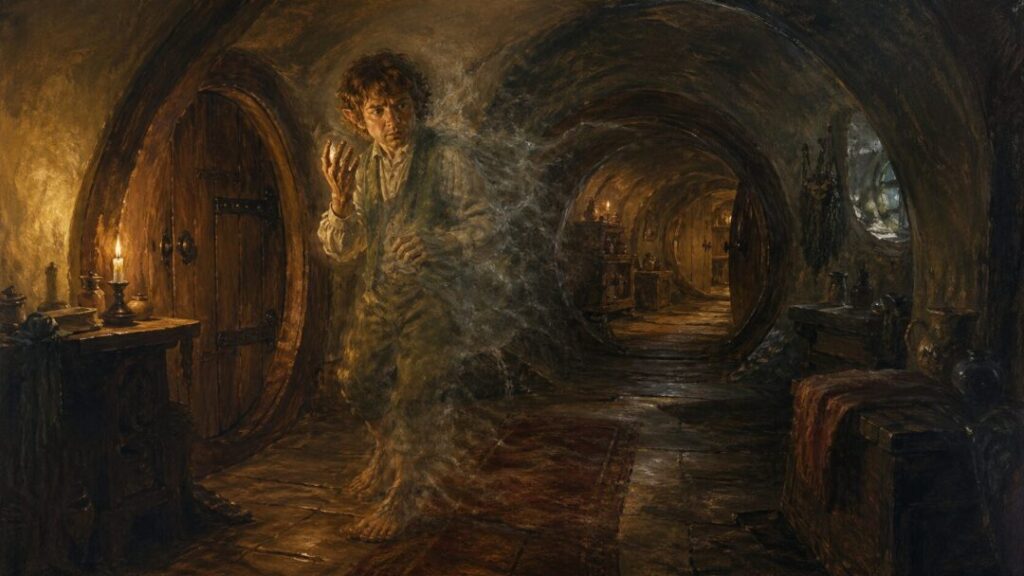
Bilbo did not have that either. His use of the Ring was often practical: escape from goblins, concealment from enemies, avoidance of unwanted visitors. Even when the Ring began to affect him, it did not turn him into a ruler. It made him possessive, evasive, and unnaturally preserved.
Bilbo could wear the Ring.
But he was not wielding the One as Sauron designed it to be wielded.
That distinction is likely the heart of the answer.
Why Galadriel’s “Only Thrice” Line Does Not Prove Everything
There is one moment that seems to complicate this.
In Lothlórien, Galadriel tells Frodo that he has set the Ring upon his finger only three times since he knew what he possessed.
Some readers take this to mean Galadriel could sense every use of the One.
But the text does not require that conclusion.
Galadriel may know through perception, wisdom, conversation, or insight. Gandalf knew much of Frodo’s road. Aragorn and the Company had also passed through dangers where the Ring’s use mattered. Galadriel’s statement shows that she understands Frodo’s situation deeply, but it does not prove that the bearer of Nenya receives a signal whenever the One is worn anywhere in Middle-earth.
In fact, the larger story argues against that.
If Galadriel, Elrond, or Gandalf could automatically detect the wearing of the One, Bilbo’s long possession becomes difficult to explain. Bilbo lived for decades with the Ring. He used it in the Shire. He used it during his adventure. Yet no immediate alarm seems to have reached Rivendell, Lothlórien, or Gandalf.
The safer reading is that Galadriel’s knowledge of Frodo does not establish a universal rule.
She knows more than ordinary people.
She does not necessarily possess an infallible Ring-sensing power.
Gandalf Did Not Know Because the Ring Was Hidden in Plain Sight
Gandalf’s uncertainty is one of the strongest pieces of evidence.
He knew Bilbo had found a ring. He knew it made its wearer invisible. He knew Bilbo had lied about how he obtained it, and that troubled him.
But he did not immediately know it was the One.
That is important because Gandalf himself bore one of the Three: Narya, the Ring of Fire. If simply wearing one of the Three allowed him to identify the One whenever Bilbo used it, there would have been no long investigation.
No uncertainty.
No years of watching, worrying, and searching.
Instead, Gandalf had to reason his way toward the truth. He studied the history of the Rings. He connected Bilbo’s ring with Gollum. He searched for records in Minas Tirith. He tested the Ring in fire and read the hidden inscription.
That is not how someone behaves if his own Ring has already told him the answer.
Gandalf’s ignorance is not a flaw in the story.
It is evidence for how subtle the One could be when it was not being openly wielded by Sauron.
Distance May Matter, But It Is Not the Main Point
It is possible that distance played some role.
Sméagol spent centuries deep under the Misty Mountains. Bilbo lived quietly in the Shire. Neither was standing in Mordor, challenging Sauron, or attempting to command the bearers of other Rings.
But the texts do not give a simple distance rule.
The deeper issue is not merely that the Ring was far away.
The deeper issue is that the Ring was dormant in its highest purpose.
It was active enough to corrupt. Active enough to preserve life unnaturally. Active enough to make its bearer invisible. Active enough to abandon Gollum when the time came for it to be found.
But it was not being used as the Ruling Ring.
No one was trying to bend Elrond, Galadriel, or Gandalf through it.
No one was using it to claim mastery over the Rings.
The One was dangerous even in hiding, but its danger was not always loud.
Sometimes it worked by secrecy.
Sometimes by delay.
Sometimes by making itself look smaller than it was.
Why Sauron Did Not Know Either
This point becomes even clearer when we remember that Sauron himself did not know where the Ring was for most of the Third Age.
If anyone might be expected to sense the One, it would be its maker.
Yet Sauron did not immediately discover Gollum. He did not immediately discover Bilbo. He did not know the Ring was in the Shire until much later, after Gollum had been captured and questioned.
That does not mean Sauron had no connection to the Ring.
He did.
The Ring remained bound to him. It contained a great part of his power. Its survival allowed him to rise again, and its destruction brought him down.
But even Sauron did not possess simple, constant knowledge of its location or every use.
This matters.
If Sauron could not automatically detect every wearing of the One, there is no reason to assume the bearers of the Three could do so.
The Ring’s bond to Sauron was profound.
It was not a map.
Bilbo’s Ring Looked Like a Lesser Mystery
There is also a practical problem.
In the early stages, Bilbo’s ring did not announce itself as the One.
The Wise knew that many rings had existed. Gandalf says there were lesser rings, essays in the craft before the Great Rings. A ring that made its wearer invisible was suspicious, but not instantly conclusive.
That is why Gandalf’s fear grows gradually.
Bilbo’s long life becomes troubling. His possessiveness becomes troubling. His lie about the Ring becomes troubling. Gollum’s long possession becomes troubling. The lack of any visible aging becomes troubling.
Each clue matters.
But none of them alone proves the Ring’s identity until Gandalf confirms it.
This slow discovery is part of the terror of the One.
It did not arrive with thunder.
It sat in a Hobbit-hole.
It passed as a useful secret.
It became “my birthday-present.”
That was precisely the kind of hiding place no great power was prepared to look for.
The Three Were Powerful, But Not Omniscient
Elrond, Galadriel, and Gandalf were wise, but wisdom is not omniscience.
Their Rings gave them power in keeping with their purposes. Elrond’s house became a refuge of memory and healing. Galadriel’s realm became a preserved land of extraordinary beauty. Gandalf’s work was to kindle courage and resistance against despair.
None of that means they knew everything.
Middle-earth is full of hidden things that even the Wise do not fully perceive until too late. Saruman’s treachery grows under their noses. Gollum survives in darkness for centuries. The Shire remains, in some ways, overlooked by the great.
The bearers of the Three were not careless.
They were limited.
And the One Ring was at its most successful when it exploited limits.
The Real Answer
So why didn’t the bearers of the Three know when Sméagol or Bilbo wore the One?
Because the texts never establish that they could.
They knew Sauron’s purpose when Sauron first wore the One and revealed the design of domination.
But Sméagol and Bilbo were not Sauron.
They did not wield the Ring as a master. They did not command other Ring-bearers. They did not attempt to dominate wills through it. They used it in small, secretive ways, while the Ring worked on them slowly from within.
The Three were bound to the One’s fate.
But they were not instruments of detection.
Galadriel’s insight into Frodo does not prove otherwise. Gandalf’s long uncertainty strongly suggests the opposite. And Sauron’s own ignorance shows that even the maker of the Ring did not simply feel every hidden use of it across the world.
That is what makes the Ring so frightening.
It was not only powerful when raised in open war.
It was powerful in silence.
It could sit in darkness beneath the mountains. It could lie in a Hobbit’s pocket. It could become part of an ordinary life. And while the Wise watched the great movements of kings, wizards, and shadows, the fate of Middle-earth could rest unnoticed in the hands of someone who thought he had merely found a useful little ring.
The bearers of the Three did not fail because they were foolish.
They failed to notice because the Ring’s deepest danger was not always visible as power.
Sometimes it looked like secrecy.
Sometimes it looked like luck.
And for many years, it looked like Bilbo Baggins simply disappearing when he did not want to be found.
Sources & Notes
This article is based on close reading and interpretation of Tolkien's published works and related source material where relevant.