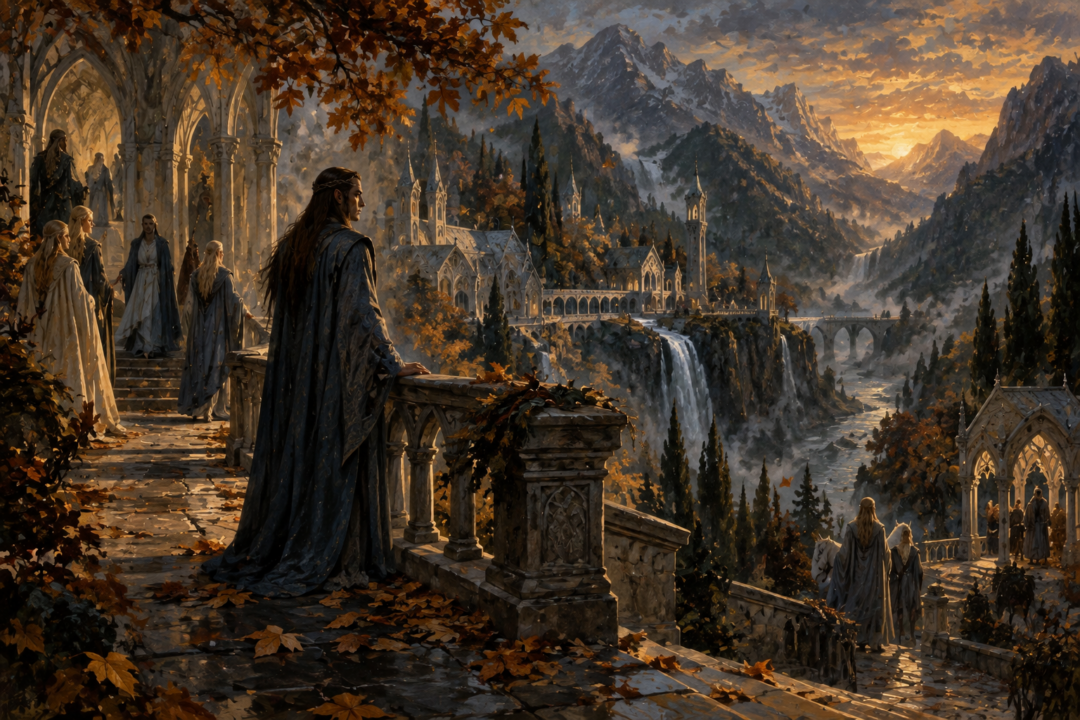
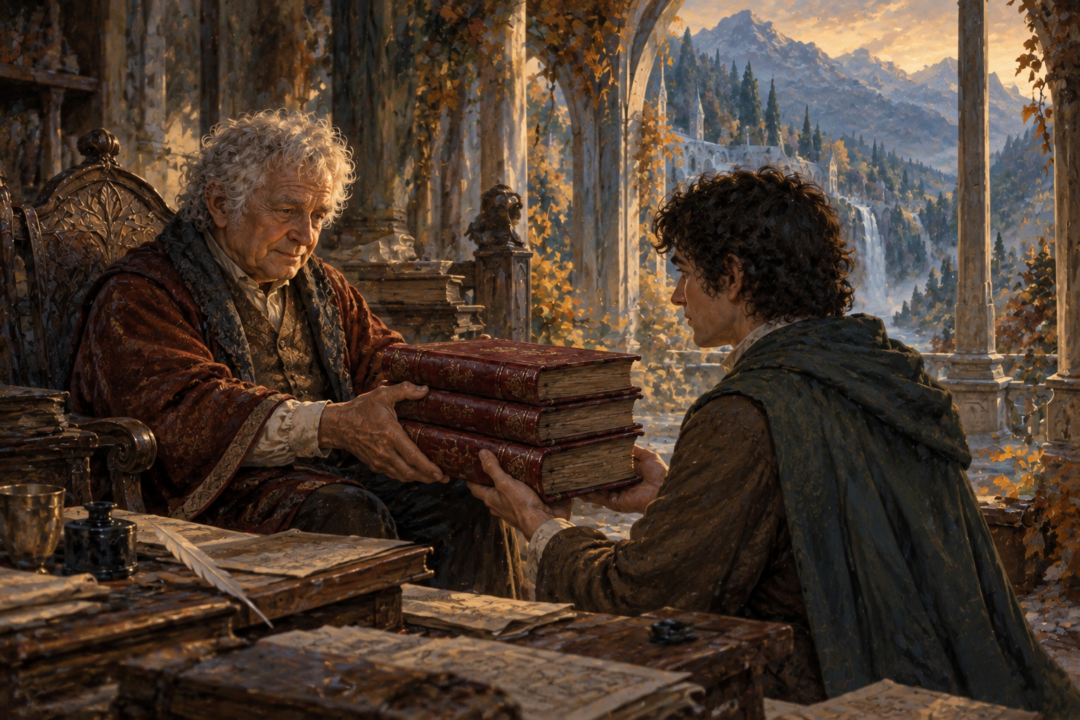
When Frodo prepares to leave Rivendell after the War of the Ring, the elderly Bilbo gives him an unexpectedly heavy inheritance: three books bound in red leather. They are not treasure in the usual Middle-earth sense. They contain no spell that can defeat an enemy, no secret road to a hidden kingdom, and no weapon forged in an elder age.
They are Bilbo’s Translations from the Elvish.
At first, these volumes can seem almost secondary beside the Red Book’s account of the Ring. Bilbo has spent years in Rivendell gathering and translating traditions concerning the Elder Days. Yet their importance changes dramatically when we remember what happens to Rivendell itself.
The Three Rings lose their power after the destruction of the One. Elrond eventually departs over Sea. Many of the High Elves leave Middle-earth. The Third Age ends, and places that had preserved living contact with the ancient world begin to pass out of history.
Bilbo’s books therefore acquire a value that they did not possess when he was writing them.
In Rivendell, the past could still speak.
After Rivendell faded, much of that past survived only because someone had written it down.
Bilbo Was Working Inside a Living Archive
Bilbo settles at Rivendell after leaving the Shire in 3001 of the Third Age. According to the account of the Shire records in the Prologue to The Lord of the Rings, his three volumes of translations were made between 3003 and 3018.
The crucial detail is where he made them.
Rivendell was not simply a library containing old manuscripts. It was a surviving center of Elvish memory.
Elrond himself had lived through the end of the First Age and had witnessed many of the decisive events of the Second and Third. His household belonged to a world in which ancient names, genealogies, languages, songs, and histories were not merely archaeological subjects.
Bilbo also had access to written and oral sources available in Rivendell. The Prologue specifically describes his work as drawing upon sources available to him there.
That makes the Translations from the Elvish something more interesting than the work of a solitary scholar deciphering forgotten documents.
Bilbo was translating while the culture preserving those traditions was still present around him.
He could listen, compare, question, and learn.
That opportunity was about to disappear.
Rivendell’s Preservation Was Never Permanent
Rivendell feels timeless when the hobbits encounter it, but its apparent timelessness depends partly upon Elrond’s Ring.
Elrond bears Vilya, one of the Three Rings of the Elves. The Three had never been touched by Sauron, but they were nevertheless subject to the One because they had been made using the knowledge derived from him. Their power could therefore continue only while the One endured.
Gandalf explains after Sauron’s defeat that the power of the Three has ended and that many things preserved through them will fade.
This is one of the great costs hidden inside the victory.
Destroying the One Ring does not simply destroy Sauron’s power. It also ends the age in which the Elves can use the Three to preserve their enclaves against change.
Rivendell does not instantly collapse when the Ring falls into the Fire. The texts do not describe some sudden physical destruction of the valley. Its fading should instead be understood as part of the wider departure and diminishing of the Eldar.
Elrond sails from the Grey Havens in 3021 with Galadriel, Gandalf, Frodo, and Bilbo.
The house where Bilbo had completed his translations has lost its master.
The world that made those translations possible is passing away.

Bilbo Preserved More Than Words
Translation can easily sound mechanical: take a text in one language and reproduce its meaning in another.
Bilbo’s project was far more ambitious.
His three volumes dealt chiefly with the Elder Days. The Prologue calls them works of great skill and learning. Tolkien never provides a complete table of contents, so it would be too strong to identify every surviving First Age narrative directly with a particular page in Bilbo’s manuscripts.
But the framework is clear: Bilbo translated Elvish lore concerning a past unimaginably older than the Shire.
That matters because languages carry memory.
Names such as Beren, Lúthien, Gondolin, Númenor, and Eärendil are not isolated legends in The Lord of the Rings. The characters inhabit a world built upon those older histories. Aragorn sings of Beren and Lúthien. Elrond is descended from the great unions of Elves and Men. Eärendil is his father. The star seen by Frodo and Sam is connected to a story reaching back into the First Age.
For Bilbo, therefore, translating Elvish lore means helping to carry an enormous historical inheritance into a form that could survive among people who were not Elves.
That task becomes increasingly important precisely because the Elves themselves are leaving.
The Strange Importance of a Hobbit Translator
There is a quiet irony here.
One of the people helping preserve the memory of the Elder Days is not an immortal Elf or a Gondorian loremaster.
He is a hobbit from Bag End.
Bilbo begins his adventures as someone whose cultural horizon is overwhelmingly local: food, relatives, property, comfort, and the customs of the Shire. By the end of his life he has become a poet, linguistically curious scholar, and translator living among the Eldar.
That does not make him an Elf, nor does it give him perfect access to everything they know.
But it places him at a remarkable junction between cultures.
Bilbo can receive traditions from Rivendell and transmit them into the Common Speech. His work can then travel somewhere Elvish memory itself cannot remain forever.
The books go east with Frodo when he leaves Rivendell.
That physical movement is almost symbolic.
Ancient Elvish memory leaves the Last Homely House in the luggage of a hobbit.
The Red Book Outlives the World That Produced It
Bilbo’s translations eventually become associated with the collection known as the Red Book of Westmarch.
The transmission history described in the Prologue is important because it shows how precarious preservation can be.
Not every copy of the Red Book contained everything.
Indeed, the Translations from the Elvish were not widely reproduced. The manuscript tradition described in the Prologue says that the copy made in Gondor by Findegil, the King’s Writer, in the year 172 of the Fourth Age was especially important because it alone contained the whole of Bilbo’s three-volume translations among the surviving textual witnesses discussed there.
The Thain’s Book from which Findegil copied had itself been brought to Gondor and received corrections and annotations, particularly concerning Elvish names, words, and quotations.
The pattern is striking.
First the lore exists among the Elves.
Then Bilbo translates it in Rivendell.
The books travel to the Shire.
A copy of the Red Book reaches Gondor.
Gondorian scholars annotate and preserve it.
Findegil copies it generations later.
Knowledge once held within an Elvish refuge has entered the historical inheritance of Men and Hobbits.
That is exactly what the beginning of the Fourth Age requires.

Memory Becomes More Precious When Witnesses Disappear
During Bilbo’s years in Rivendell, an imperfect translation could theoretically be checked against people and records still present there.
Later generations would have fewer such opportunities.
This is the deeper reason the translations become more valuable after Rivendell fades.
A record changes when the witnesses vanish.
Imagine possessing an account of an ancient event while someone who remembers its traditions is still available. The document is valuable, but it exists within a much larger living network of memory.
Now imagine possessing the same document centuries later.
The witnesses are gone.
Their homes are empty.
Their language is spoken by fewer people.
Their songs are no longer heard in the halls where the document was composed.
The book has not changed.
Its historical environment has.
That is essentially what happens to Bilbo’s work.
The victory over Sauron opens the Fourth Age, traditionally understood as the beginning of the dominion of Men. But every transition of ages in Middle-earth carries loss alongside renewal.
The Elder Days recede farther into memory.
Bilbo’s translations become bridges across that widening distance.
Bilbo Could Not Stop the Fading — But He Could Carry Something Through It
There is an important distinction between preservation and prevention.
The Elves repeatedly confront the desire to preserve what they love against time and change. The power associated with the Three Rings is closely connected with maintaining places such as Rivendell and Lórien. Yet the defeat of Sauron necessarily brings that mode of preservation to an end.
Bilbo’s books offer a humbler form of resistance to loss.
They cannot preserve Rivendell.
They cannot keep Elrond in Middle-earth.
They cannot restore the Elder Days or prevent the departure of the Eldar.
They can preserve stories.
That difference is central to the moral texture of Middle-earth. Possessing something forever and remembering it faithfully are not the same act.
The first may be impossible.
The second remains a duty available even to ordinary hands.
Bilbo does not conquer fading. He accepts that the past must be handed onward in another form.

The Last Homely House Becomes a Book
By the Fourth Age, Rivendell belongs increasingly to memory.
Yet something of what was preserved there travels beyond it.
Not its waterfalls or halls. Not Elrond’s Ring. Not the living presence of the Eldar.
Its lore.
Bilbo’s three red volumes are therefore more than an eccentric retirement project. Within the fictional history of Middle-earth, they stand at the moment when living Elvish memory begins to become inherited written history.
And Bilbo is perfectly placed at that threshold.
He belongs neither to the Elder Days nor to the great kingdoms of Men. He is a small person from a small country who loves stories enough to preserve stories far larger than himself.
When Rivendell still flourished, his translations were books surrounded by the world that explained them.
After the Elves departed, the relationship reversed.
Now the books helped explain a world that was no longer there.
That is why their value grows as Rivendell fades.
Bilbo could not save the Elder Days.
But when their last living echoes began disappearing from Middle-earth, he had already made sure that some of their memory could travel on.
Sources & Notes
- Tolkien Gateway — Translations from the Elvish https://tolkiengateway.net/wiki/Translations_from_the_Elvish
- Tolkien Gateway — Bilbo Baggins https://tolkiengateway.net/wiki/Bilbo_Baggins
- Tolkien Gateway — Rivendell https://tolkiengateway.net/wiki/Rivendell
These references document Bilbo’s three volumes of translations, his scholarly work during retirement in Rivendell, and Rivendell’s role as a repository of Elvish memory. The article’s argument that the translations gain value as living witnesses depart is interpretive synthesis.