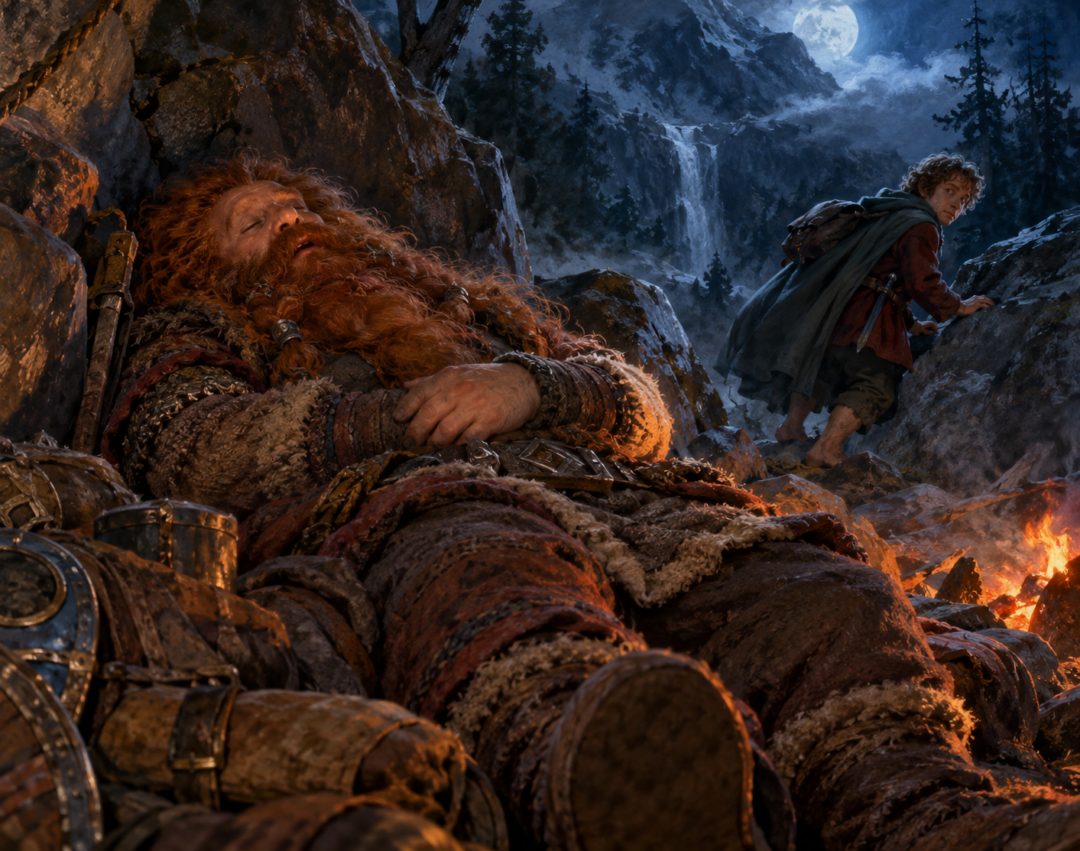
One of Bilbo Baggins’s boldest acts begins with an almost absurdly ordinary problem: Bombur is cold.
Outside the Front Gate of the Lonely Mountain, armies are waiting. Thorin Oakenshield refuses to surrender any portion of Smaug’s treasure under threat. Dáin is approaching from the Iron Hills with more than five hundred Dwarves. Winter is coming. Bilbo has secretly taken the Arkenstone, the one treasure Thorin values above all others, and has decided to carry it into the enemy camp as a bargaining weapon.
Everything depends upon Bilbo getting out of Erebor unnoticed.
And when he climbs to the watch-wall on a black, moonless night, the only Dwarf standing between him and freedom is Bombur.
It is tempting to imagine that Bombur has been deliberately assigned this duty because he is somehow the company’s least reliable guard. But that is not what the text says. The explanation is much simpler—and, in some ways, more interesting.
Bombur is there because it is his turn.
What makes the scene work is not that Bilbo has arranged the perfect guard. It is that he recognizes exactly what kind of opportunity Bombur’s ordinary turn on watch has given him.
Bombur Was Not Specially Chosen to Guard Bilbo
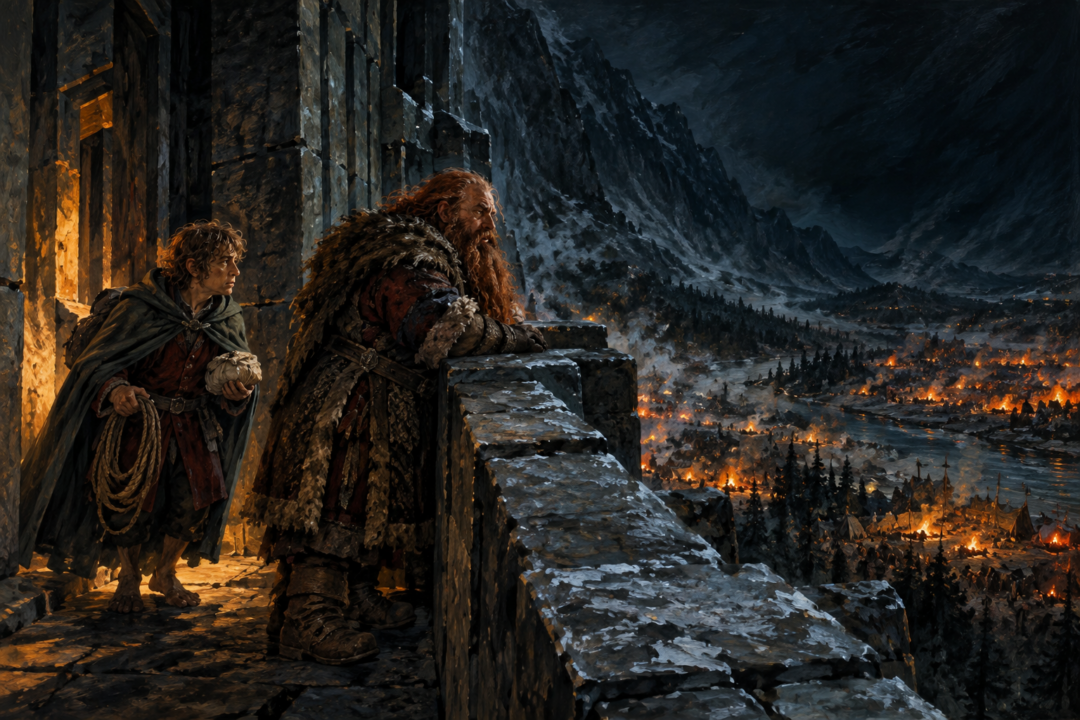
The crucial detail appears in “A Thief in the Night.” Bilbo waits until full darkness, retrieves a rope and the rag-wrapped Arkenstone, and climbs to the wall.
There he finds Bombur alone.
The text explicitly explains both circumstances: it is Bombur’s turn to watch, and the Dwarves are keeping only one watchman at a time.
That matters because it rules out a more elaborate explanation. There is no indication that Thorin selected Bombur for this particular watch because of his strength, loyalty, alertness, or relationship with Bilbo. Nor is there evidence that Bilbo manipulated the watch schedule beforehand.
Bombur simply happens to occupy the right place at the right moment.
Bilbo’s cleverness comes afterward.
He sees a lone guard who is uncomfortable, exhausted by the siege, and already expressing doubts about the situation. Instead of sneaking past him immediately, Bilbo turns those circumstances into an invitation for Bombur to leave voluntarily.
The burglar does not defeat the guard.
He offers to do the guard’s job.
The Dwarves’ Watch System Creates the Opening
The larger weakness Bilbo exploits is actually the company’s arrangement.
Only one Dwarf is standing watch.
That is understandable. Thorin’s company is tiny, and its members have spent days fortifying the entrance to Erebor while facing Bard’s Men and the Elvenking’s host. They cannot maintain a large guard detail indefinitely. The Mountain itself provides enormous defensive advantages, but manpower remains limited.
For Bilbo, however, the single-watchman system creates a remarkable vulnerability.
He does not need to deceive several Dwarves. He does not need to coordinate movements through a crowded guard post. Once Bombur leaves, there is nobody beside Bilbo to notice what he does next.
The narrative even makes clear why Bilbo can expect the wall to remain undisturbed. The others are occupied with Thorin, and it is unlikely that another member of the company—even Fíli or Kíli—will appear before his own turn.
Bilbo therefore has something extraordinarily valuable: time.
After Bombur goes inside, Bilbo estimates that he has roughly five hours.
For a hobbit attempting to leave a besieged fortress, cross unfamiliar ground in complete darkness, negotiate with the opposing camp, and return before anyone notices, those hours are everything.
Why Bombur Accepts So Easily
Bombur’s behavior is completely consistent with the character established throughout The Hobbit.
His size is repeatedly emphasized, sometimes comically, and physical discomfort follows him through much of the journey. Yet reducing this moment to “Bombur likes sleeping” misses something important.
He is genuinely miserable.
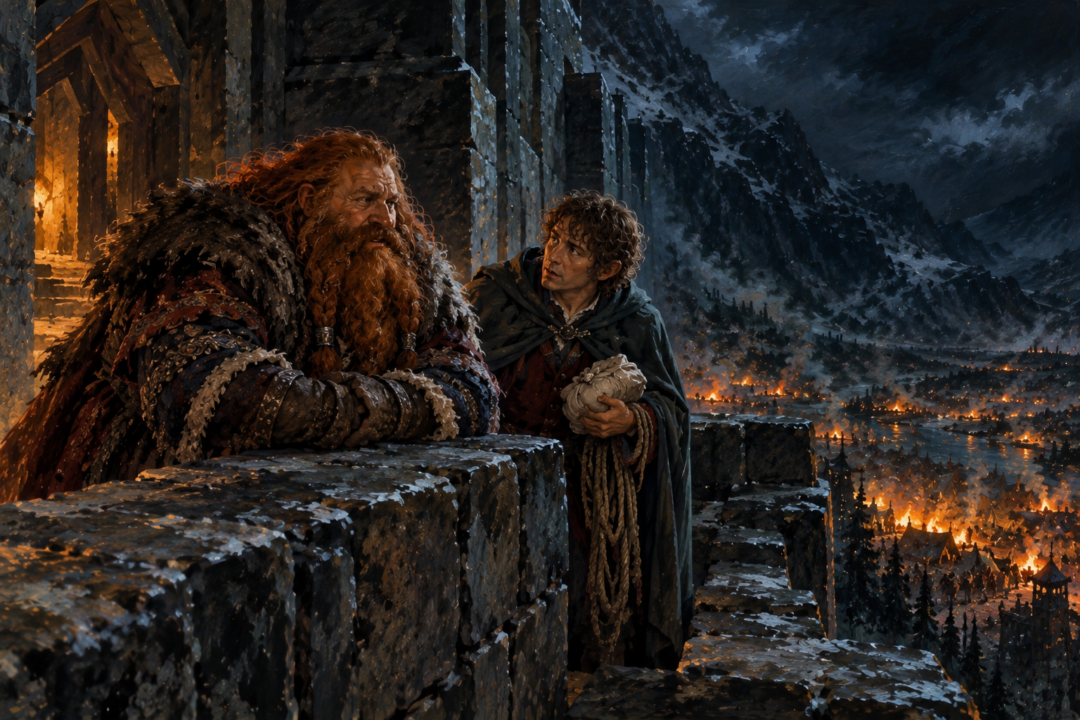
The night is bitterly cold. Bombur wishes for the warmth enjoyed by the opposing camp. Bilbo points out that it is warmer inside, but Bombur explains that he is bound to remain at his post until midnight.
Then their conversation becomes revealing.
Bombur calls the entire situation a sorry business. He is careful not to openly challenge Thorin, but he nevertheless remarks upon Thorin’s stubbornness. Bilbo answers by complaining about stone passages and longing to feel grass beneath his feet. Bombur responds with his own desires: a strong drink, a soft bed, and a good supper.
These are small comforts, but that is precisely the point.
While Thorin is thinking about treasure, claims, honor, siege, and the arrival of Dáin, Bombur and Bilbo are talking about warmth, food, sleep, and grass.
Their conversation briefly strips away the grandeur of the dispute.
Two exhausted travelers want ordinary life back.
So when Bilbo says he will take Bombur’s turn because he cannot sleep, the offer does not sound suspicious. It sounds generous.
Bombur accepts.
Bombur’s Sleepiness Is Real—but Bilbo Understands It
There is another detail that makes Bombur particularly convenient.
After he leaves the wall, the narrative observes that Bombur can sleep readily and has been especially eager to recover the beautiful dreams associated with his enchanted sleep in Mirkwood.
That earlier episode began disastrously. Bombur fell into the black stream in Mirkwood and entered an unnatural sleep, forcing the others to carry him until he finally awakened. When he did, he spoke of dreams involving a woodland feast.
The later reference gives Bilbo additional confidence that Bombur will remain asleep during his absence.
But even here, the distinction matters.
Bilbo does not appear to have engineered the situation because he knew Bombur would be on duty. Rather, once he discovers Bombur on the wall, he understands the advantages immediately.
Bombur is cold.
Bombur wants to go inside.
Bombur is tired.
Bombur trusts Bilbo enough to accept his offer.
And Bombur is unlikely to wake without being roused.
The opportunity almost seems designed for the burglar—but Bilbo still has to recognize it and act.
The Deeper Reason Bilbo Can Manipulate Bombur
There is also a moral dimension to their exchange.
Bombur is not among the Dwarves most enthusiastically aligned with Thorin’s increasingly uncompromising position.
Earlier, when Thorin refuses to negotiate, the company largely appears to support him, but Bombur, Fíli, and Kíli are notable exceptions to that general mood. Bombur’s comments during his watch reinforce the point. He does not openly rebel against Thorin, yet he plainly dislikes where events are heading.
Bilbo knows something similar himself.
He has watched Thorin become increasingly consumed by the treasure and by his claim to it. He has heard Roäc warn that treasure may become deadly even though Smaug is gone. He knows Dáin’s armed force is approaching. He can see that the confrontation may end in bloodshed.
Bilbo’s plan is therefore not merely an escape attempt.
He intends to give Bard the Arkenstone so that Bard possesses something Thorin desperately wants. Bilbo hopes that this will create leverage for negotiation.
Whether every part of Bilbo’s action is justified is something the story leaves readers room to consider. What is explicit is Bilbo’s desire to prevent matters from ending disastrously.
Bombur’s dissatisfaction makes him an especially easy person to relieve because Bilbo does not have to overcome enthusiasm for the siege. Bombur already wants out of the cold and away from the whole miserable affair.
The Arkenstone Leaves Erebor While Bombur Sleeps
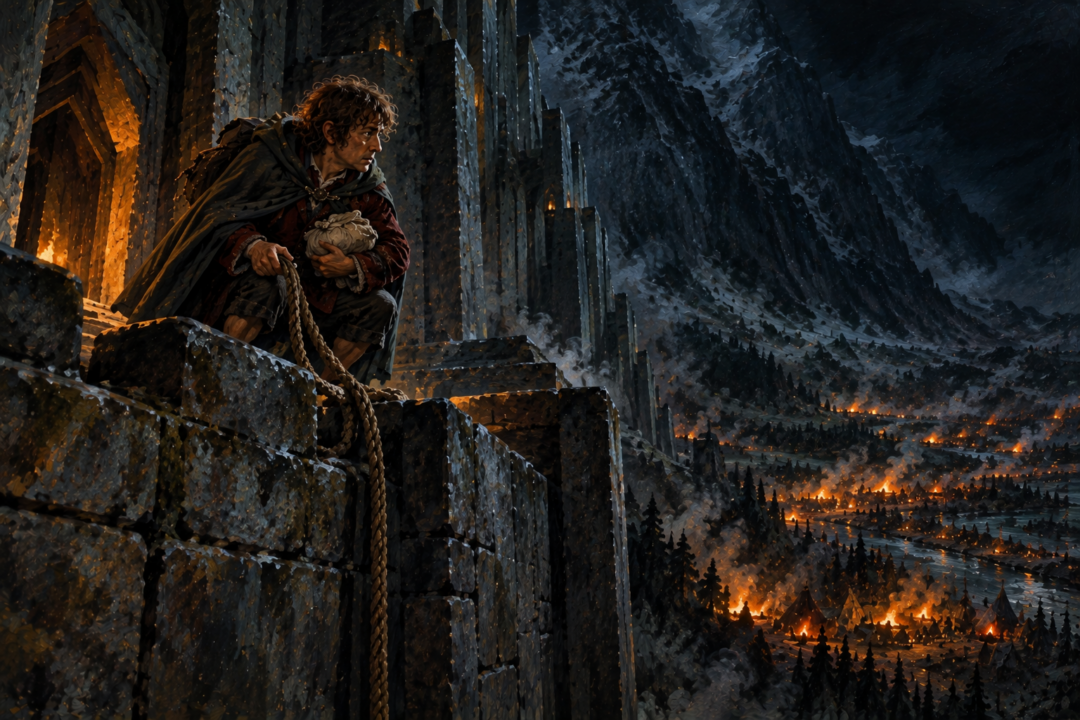
As soon as Bombur goes inside, Bilbo acts.
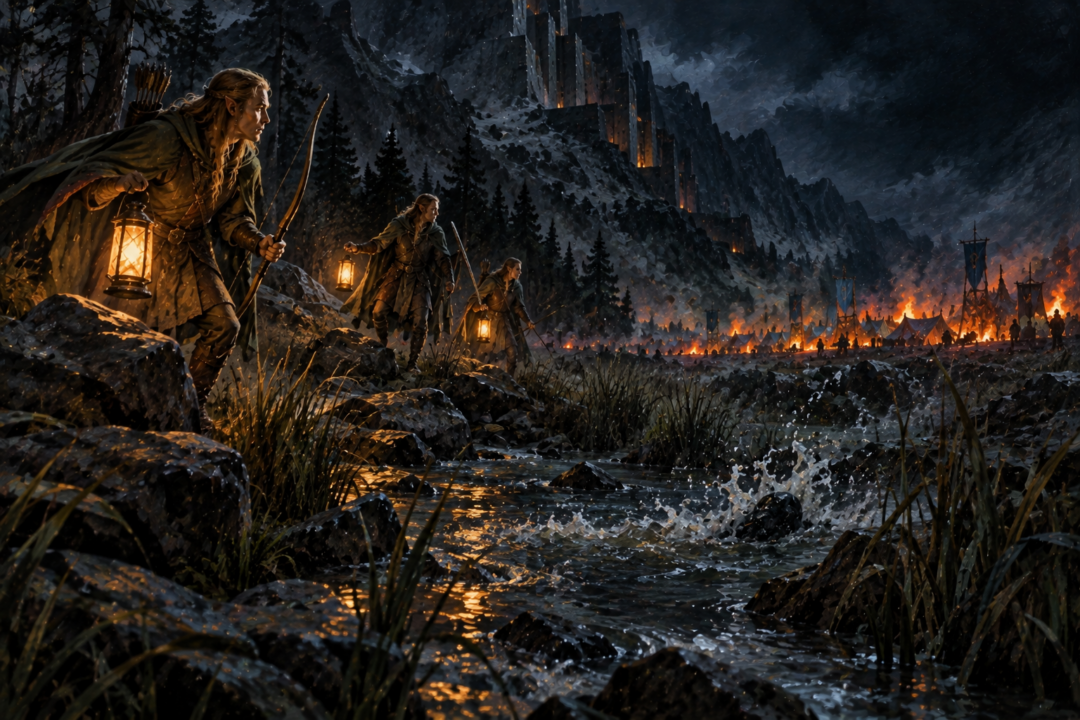
He puts on the Ring, secures his rope, climbs down from the wall, and disappears into the night.
The journey is not effortless. Bilbo must cross the stream in darkness, slips on a stone, and splashes into the cold water. Elves with lanterns investigate. His invisibility does not prevent him from making noise, and eventually he reveals himself and asks to be taken to Bard.
There, before Bard and the Elvenking, Bilbo explains what he is attempting.
Then he produces the Arkenstone.
The object Thorin has searched for obsessively has been inside Bilbo’s possession, wrapped inconspicuously in a rag, and now Bilbo deliberately hands it to the people besieging the Mountain.
It is an extraordinary reversal of the role Gandalf originally imagined for him.
Bilbo was recruited as a burglar to help Thorin reclaim his treasure.
Now he uses his burglar’s skills to remove Thorin’s most precious treasure from the Mountain.
And the physical opening that makes it possible is Bombur’s abandoned watch.
Bilbo Does Something Even Riskier: He Comes Back
Bilbo could remain with Bard and the Elvenking.
They would have reason to protect him, especially after receiving the Arkenstone. Gandalf is also outside Erebor by this stage, though Bilbo had not known that when he began his mission.
Instead, Bilbo returns.
That choice is essential to understanding the episode.
He is not simply abandoning Thorin’s company. He still considers himself connected to them, even while acting against Thorin’s wishes. His intervention is meant to change the situation, not merely save himself from it.
He crosses back through the darkness and returns to the wall in time to preserve the deception.
Then he wakes Bombur.
Bombur resumes the watch, apparently unaware that during his sleep Bilbo has crossed enemy lines, spoken with the leaders outside, surrendered the Arkenstone, encountered Gandalf, and returned.
Soon afterward Bilbo sleeps too, dreaming characteristically of food.
The scale of what he has done is almost comically disproportionate to the quietness of the scene.
Bombur Is Not a Fool in This Story
That distinction is worth emphasizing.
Nothing in the episode requires Bombur to be stupid.
From Bombur’s perspective, Bilbo’s offer is perfectly plausible. They have traveled together through terrible dangers. Bilbo has repeatedly proved useful and courageous. He says he cannot sleep and offers to perform a normal duty for a tired companion.
Bombur even tells Bilbo where he will be sleeping and instructs him to wake him if anything happens.
What Bombur does not know is that Bilbo has already made his decision before approaching the wall.
The rope is ready.
The Arkenstone is wrapped.
Bilbo is not improvising the mission after speaking to Bombur. He is improvising the method by which he gets past the obstacle Bombur represents.
That is a much subtler kind of burglary.
The Perfect Watchman for Bilbo’s Transformation
The episode also marks how far Bilbo has traveled from Bag End.
The hobbit who once worried about missing breakfast is now willing to descend alone from a besieged fortress, invisible in the darkness, carrying the most politically dangerous object in Erebor.
Yet he does not accomplish this through strength.
He reads people.
He understands Bombur’s exhaustion. He understands Thorin’s attachment to the Arkenstone. He understands that Bard needs leverage. And he understands that simply waiting while Dáin approaches may lead to battle.
Bombur’s watch therefore becomes one of the quiet hinges of The Hobbit.
He is not secretly selected because he is the weakest guard. There is no hidden rule explaining why Bombur must stand there that night. The text gives the mundane answer: it is simply his turn.
But that ordinary circumstance reveals something much more important about Bilbo.
A dragon’s fortress, a besieging army, and a legendary jewel do not create his opportunity.
A cold Dwarf who wants a warm bed does.
And Bilbo, finally living up to the unlikely profession written beside his name at the beginning of the adventure, knows exactly what to do with that opportunity.
Sources & Notes
This article is based on close reading and interpretation of Tolkien's published works and related source material where relevant.