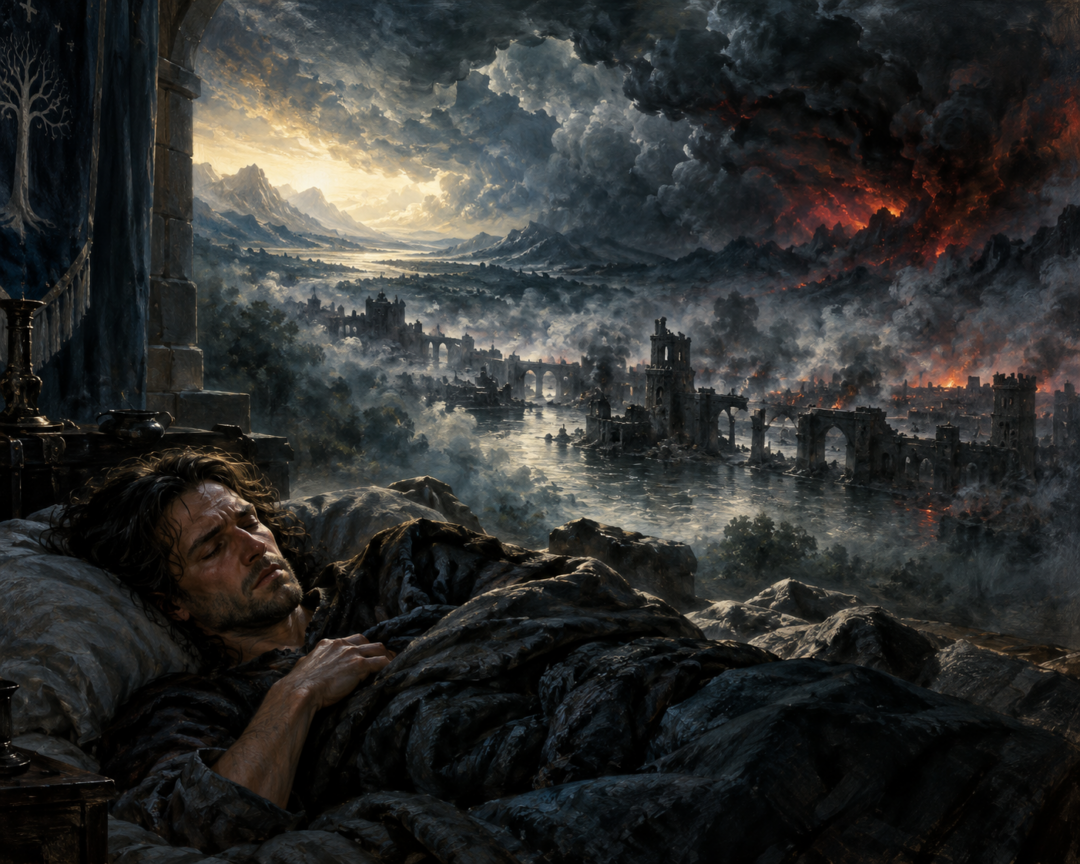
When Boromir arrives at Rivendell, he has travelled far from Minas Tirith because of a mysterious dream. Somewhere in the North, he has been told, lies a broken sword. There, important counsel will be taken, an ancient danger will awaken, and a Halfling will somehow become involved.
For readers who already know Frodo Baggins and the One Ring, the meaning seems obvious.
But Boromir does not possess the reader's knowledge.
He does not know that Frodo carries the Ring. He has not been given the name of the Shire as his destination. He has no reason to seek Bag End or question a particular hobbit about an ancient treasure.
Instead, the dream directs him toward Imladris, the Elvish name for Rivendell.
That distinction reveals something important about the prophecy. It gives Boromir a place where answers may be found, but it does not give him those answers in advance.
The journey is therefore not simply a search for a lost weapon or an unknown Halfling. It is a journey toward knowledge that Gondor no longer possesses.
The Dream That First Came to Faramir
The story begins not with Boromir, but with his younger brother.
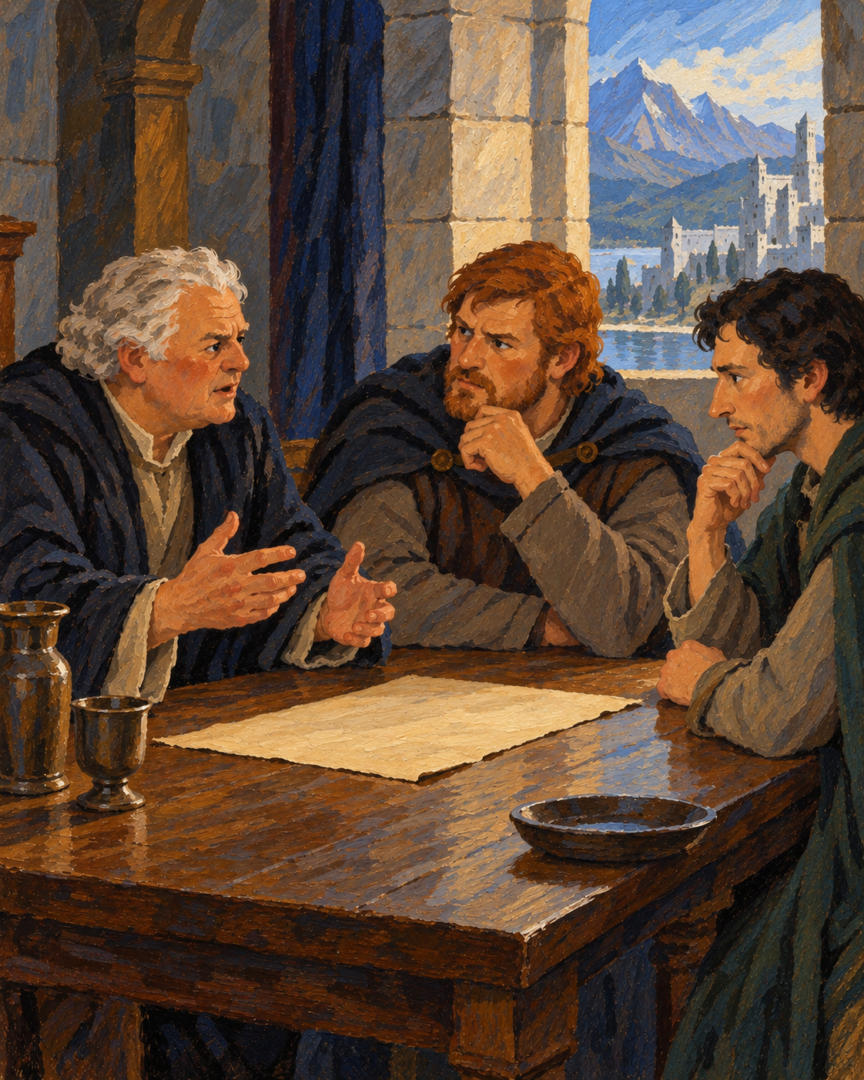
In The Fellowship of the Ring, during the chapter "The Council of Elrond," Boromir explains that a strange dream first came to Faramir shortly before the assault on Osgiliath in June 3018.
The dream returned to Faramir twice more. Only afterward did Boromir experience it himself.
Boromir describes a darkening eastern sky, growing thunder, and a pale light lingering in the West. From that light came a distant but clear voice.
Its message began:
"Seek for the Sword that was broken"
The next line identified where the sword could be found:
"In Imladris it dwells"
The remaining verses foretold important counsels, a sign of approaching doom, the awakening of Isildur's Bane, and the appearance of a Halfling.
These were not ordinary instructions.
The dream contained several connected mysteries, but only one named destination.
It did not identify the Halfling. It did not explain Isildur's Bane. It did not describe the broken sword's history or reveal how these things were connected.
Even the destination required explanation.
This is the first important distinction: the dream was specific enough to inspire a journey, but too mysterious to explain what Boromir would discover when he arrived.
Why Imladris Was the Only Practical Destination
Boromir and Faramir brought the matter before their father, Denethor, Steward of Gondor.
Denethor knew that Imladris was the ancient name of Rivendell, where Elrond dwelt.
Yet this knowledge did not provide an easy road.
Boromir explains that Imladris had become little more than a distant legendary name in Gondor. Its precise location was no longer familiar to the people of Minas Tirith.
That detail matters.
Gondor was an ancient kingdom with a long memory, but the surviving knowledge of its southern rulers did not encompass every hidden place of the North.
Rivendell belonged to a world of Elven learning and northern histories increasingly remote from Gondor's daily struggles.
Nevertheless, the dream offered a clear priority.
Find Imladris.
The sword was associated with that place. The promised counsel would occur there. The other mysteries would somehow become meaningful in connection with it.
The Shire, by contrast, was never named.
Even if Boromir had somehow learned where hobbits lived, the dream gave him no instruction to visit their homeland.
Its reference to a Halfling was a prediction, not a geographical direction.
That is why Rivendell became the destination rather than the Shire.
The Halfling Was a Clue, Not an Address
The final words of the dream are among its most intriguing:
"And the Halfling forth shall stand."
To a reader familiar with Frodo, the line immediately suggests the Ring-bearer.
But Boromir hears something considerably less useful.
The prophecy speaks of a Halfling without providing a personal name, a home, or an explanation of the individual's importance.
It does not even explicitly state that Boromir must find this person.
The difference between predicting someone's appearance and instructing another person to search for them is crucial.
A search requires some means of identifying its object.
The dream gives Boromir no such means.
There is also a wider historical difficulty.
Hobbits had lived in the Shire for centuries, but they remained largely outside the great political affairs of Gondor. The people of the South possessed little practical familiarity with them.
In The Two Towers, Faramir's conversations with Frodo and Sam show how extraordinary the appearance of Halflings remains to a Gondorian captain.
Faramir recognizes the significance of their kind because of the words that had troubled his family.
That later recognition helps illuminate the original dream.
The word "Halfling" was meaningful enough to be remembered, but it did not initially provide a useful destination.
Only when an actual Halfling appeared in the unfolding events could the clue be understood.
Boromir was not sent to find a hobbit. He was sent to a place where the importance of a hobbit would be revealed.
The Broken Sword Was the Stronger Clue
Why did the prophecy begin with a sword rather than with the Halfling?
The text does not explicitly explain why the clues were arranged in that order.
However, their practical effect is clear.
The broken sword provided the central object of the search, while Imladris supplied its location.
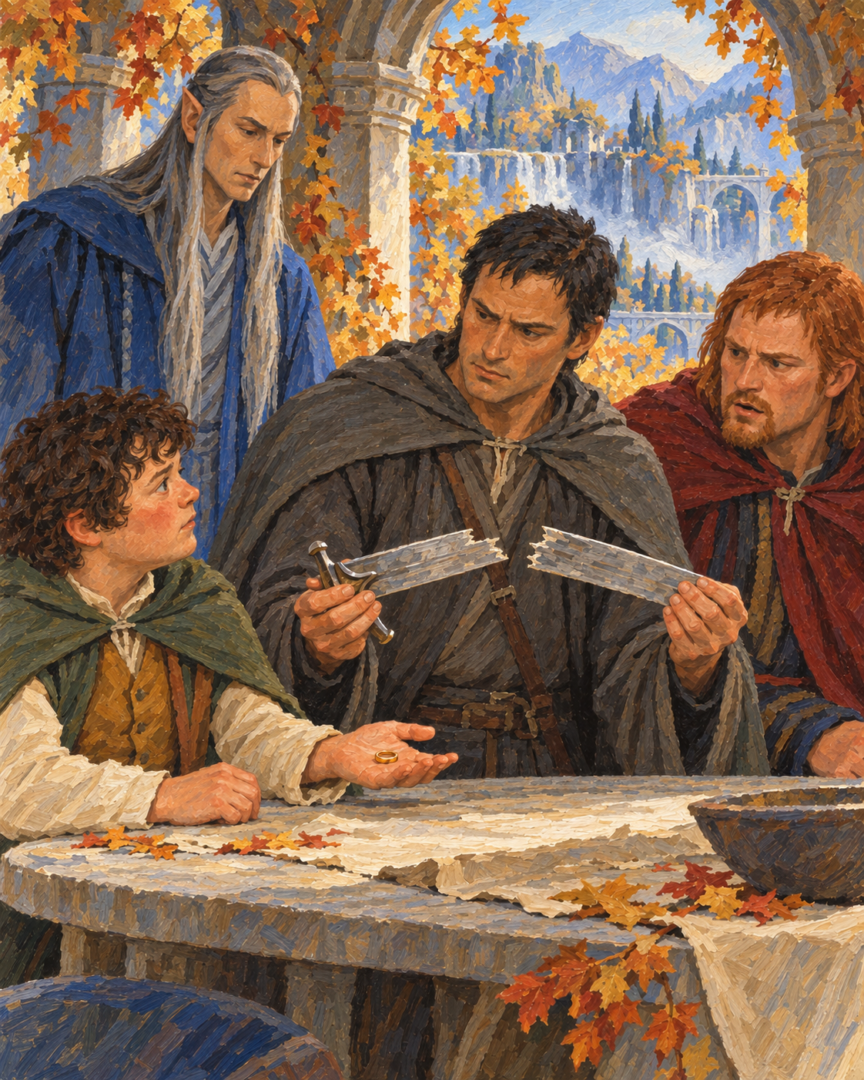
At Rivendell, Boromir discovers that the weapon is Narsil, the sword of Elendil.
Narsil had been broken during the final struggle against Sauron at the end of the Second Age.
Its surviving fragments were preserved by the heirs of Isildur.
Aragorn, who carried those fragments, was descended from the ancient kings of Arnor and Gondor.
For Boromir, the revelation was profoundly significant.
He had come from a kingdom whose kingship had remained vacant for many centuries. Now he encountered a man claiming descent from the royal line, carrying the very sword named in his dream.
Yet this discovery did not by itself resolve the prophecy.
The sword explained one part of the message.
The Halfling and Isildur's Bane remained to be understood.
The dream's clues were connected, but their relationship became apparent only through the testimony shared at Rivendell.
That is what makes the prophecy more than a simple instruction to recover an ancient weapon.
Its destination brings together people and histories that had long been separated.
Why Boromir Could Not Simply Follow the Ring
Another important distinction concerns Isildur's Bane.
Readers know that this name ultimately refers to the One Ring.
Boromir, however, does not begin his journey with that knowledge.
The dream announces that Isildur's Bane will awaken, but it does not identify the object or explain its connection with Sauron.
At the Council, the history becomes clearer.
Isildur took the Ring after Sauron's defeat. He later perished near the Gladden Fields, and the Ring was lost.
The object that had contributed to his downfall was therefore remembered as his bane.
The connection between the ancient disaster and the present danger emerges through the Council's discussion.
Frodo then reveals the Ring that has come into his possession.
For Boromir, this is an astonishing development.
The mysterious Halfling is not merely a traveller from a distant land. He carries an object connected to the fall of Isildur and the continuing power of Sauron.
But none of that information was available to Boromir when he departed Minas Tirith.
He could not knowingly pursue the Ring into the Shire because he did not yet understand that the Ring was the object named in the dream.
Nor did the prophecy tell him that it had been kept in the Shire.
A journey directly to Frodo's home would require information the dream never supplied.

A Long Road Toward an Uncertain Answer
Boromir's actual journey reinforces how incomplete his instructions were.
He departed Minas Tirith on 4 July 3018 and reached Rivendell shortly before the Council in October.
His journey lasted 110 days.
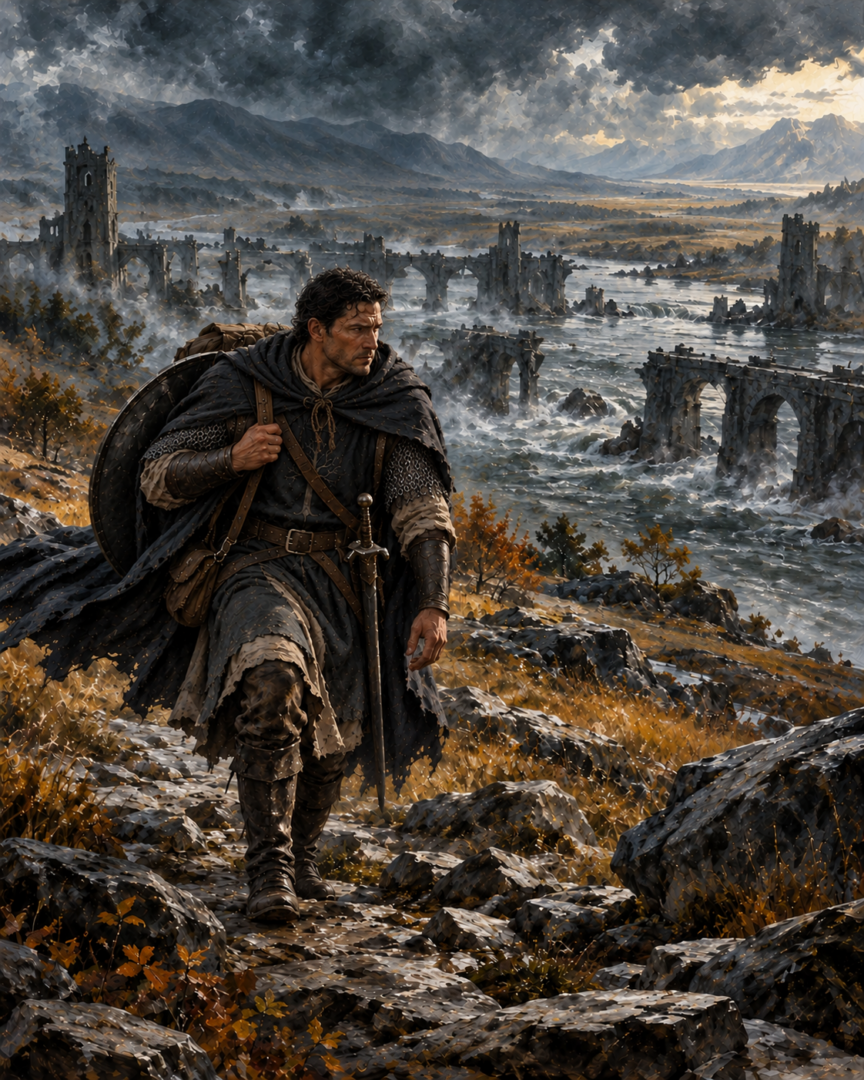
He travelled alone, crossed dangerous and unfamiliar lands, and lost his horse while crossing the Greyflood at Tharbad.
He then continued on foot.
These details make his mission more remarkable.
Boromir was not following a carefully prepared itinerary to a well-known destination. He was searching for a hidden valley whose location had become uncertain in Gondor.
He had left behind a kingdom under growing military pressure.
His departure also followed the terrible assault on Osgiliath, where the forces of Mordor had struck Gondor's eastern defences.
Faramir had wished to undertake the northern errand, but Boromir claimed it because of its danger.
The decision was consistent with his identity as a warrior and defender of Gondor.
Yet the journey required something different from battlefield strength.
Boromir had to trust an obscure message, seek knowledge beyond his own country, and arrive without knowing exactly what he would find.
The prophecy gave him direction without certainty.
Why the Council Matters More Than the Destination Alone
The dream does not merely say that a sword lies in Imladris.
It also foretells that counsels will be taken there.
This is perhaps the strongest indication that Boromir's errand was never intended to end with finding a single object.
Rivendell was the place where the clues could be interpreted together.
At the Council of Elrond, representatives of different peoples brought knowledge of Sauron's movements, the Ring's history, and the dangers facing Middle-earth.
Boromir contributed Gondor's experience of the war and reported the dream.
Aragorn's sword supplied one connection.
The history of Isildur supplied another.
Frodo's possession of the Ring revealed the significance of the Halfling.
None of these revelations depended on Boromir having previously identified Frodo or travelled to the Shire.
Instead, they depended on information being brought together.
The Council was not simply a meeting arranged to explain Boromir's dream. Its participants had arrived for different reasons, many of them urgent.
That convergence is one of the story's most important features.
The dream directed one man toward a place where several separate journeys would meet.
One reading is that the prophecy guided Boromir toward understanding rather than toward possession of any particular object.
The text supports the distinction between the instructions he received and the discoveries he subsequently made, even if it does not explicitly explain the dream's deeper purpose.
Was the Dream Sent by Providence?
The dream's mysterious origin naturally raises another question.
Who sent it?
The imagery invites speculation.
Darkness gathers in the East, while a pale light survives in the West. A voice speaks from that remaining light, directing the sons of Denethor toward a place associated with ancient wisdom and resistance to Sauron.
Within the wider mythology of Middle-earth, readers may interpret this as a suggestion of providential guidance.
However, the narrative does not explicitly identify the voice.
It does not state that the dream came directly from Eru Ilúvatar, one of the Valar, or any named messenger.
Assigning a definite sender would go beyond the evidence.
What can be said is that the dream proved meaningful.
Its references corresponded to discoveries made at Rivendell, and its message helped bring Gondor's representative into the discussions concerning the Ring.
Whether its incomplete instructions were deliberately designed to preserve freedom of choice remains an interpretation rather than an established rule.
Still, the narrative presents a striking contrast.
Boromir receives enough guidance to reach the right place, but he must decide how to respond to what he learns there.
The prophecy does not make those decisions for him.
The Tragic Irony of Boromir's Journey
Boromir travels north seeking help for Gondor.
He discovers the broken sword, learns the meaning of Isildur's Bane, and encounters the Halfling foretold in the dream.
Yet understanding the prophecy does not protect him from temptation.
Once he recognizes the Ring's power, he begins to see it as a possible weapon against Mordor.
His desire to defend Gondor is genuine, but it makes the Ring's promise especially dangerous to him.
The same journey that brings him knowledge also brings him into contact with the object that will test him most severely.
Later, his attempt to take the Ring from Frodo reveals how far that temptation has carried him.
He subsequently repents and dies defending Merry and Pippin.
The dream did not command his fall, and the text gives no reason to believe that his choices were inevitable.
Its fulfilment simply placed him within events where those choices became possible.
This is the deeper tragedy behind his journey.
Boromir followed a mysterious summons in the hope of helping his people. He found the answers he sought, but those answers included a power he could not safely claim.
The Dream Gave Him a Meeting Place, Not the Whole Story
The question of why Boromir went to Rivendell instead of the Shire has a straightforward textual answer.
Imladris was the only destination named in the dream. The Halfling was a promised participant, not a person Boromir had been instructed to locate.
The broken sword gave him something to seek. The ancient Elvish name gave him somewhere to seek it. The remaining words pointed toward revelations he could not yet understand.
Only at Rivendell did those fragments begin to form a coherent picture.
That is what makes Boromir's journey distinctive.
He did not travel north because he already knew the secret of the One Ring.
He travelled because he did not know.
And when he finally reached the hidden valley, the greatest discovery was not simply the identity of a sword, a Halfling, or an ancient bane.
It was that the fate of Gondor had become inseparable from events unfolding far beyond its borders.
The dream had never given Boromir a complete answer.
It had brought him to the place where he would have to hear one.
Sources & Notes
- Tolkien Gateway — The Council of Elrond. https://tolkiengateway.net/wiki/The_Council_of_Elrond
- Tolkien Gateway — Seek for the Sword that was broken. https://tolkiengateway.net/wiki/Seek_for_the_Sword_that_was_broken
- Tolkien Gateway — Boromir. https://tolkiengateway.net/wiki/Boromir
Primary text: The Fellowship of the Ring, “The Council of Elrond”; The Two Towers, “The Window on the West.” These references document the dream, verse, and journey. The argument distinguishes the named destination Imladris from the unexplained Halfling; it does not invent an instruction to visit the Shire.