It is one of those questions that seems simple until you look closely.
Gollum had the One Ring for centuries.
He loved it. He hated it. He called it his Precious. It had become the center of his thoughts, his memory, his hunger, and almost his identity. By the time Bilbo Baggins stumbled into the dark beneath the Misty Mountains, Gollum was not merely someone who owned the Ring.
He was someone who had been consumed by it.
So why was he not wearing it?
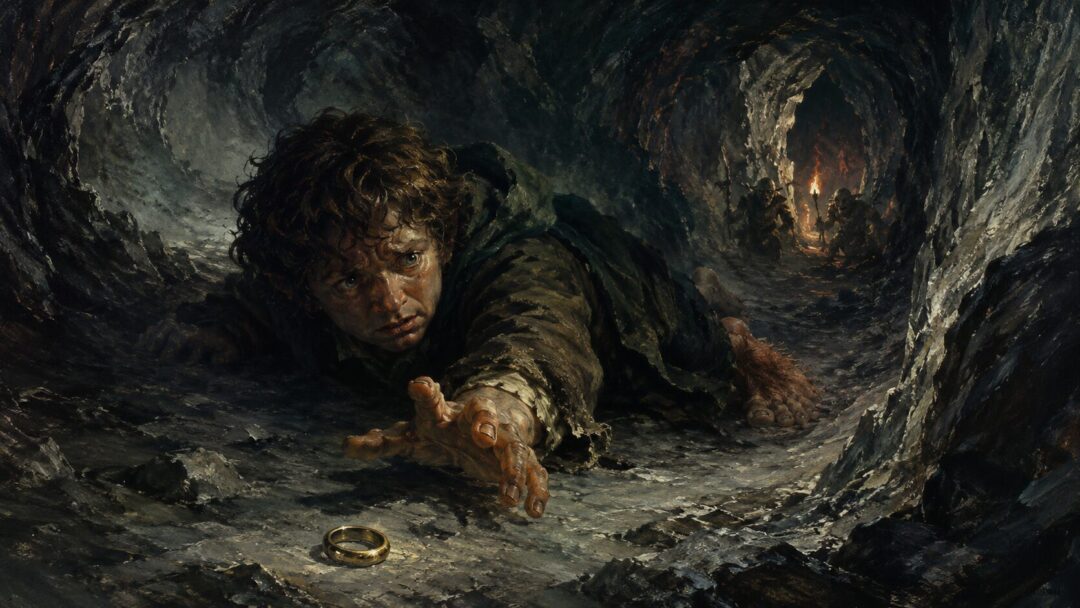
Why was the most important object in his world lying alone in a dark tunnel, waiting for Bilbo to put his hand on it blindly?
At first, it sounds like carelessness.
But that answer does not fit Gollum.
Gollum was many things—miserable, murderous, cunning, degraded—but careless with the Ring is not how the story presents him. He knows what it means. He knows what it does. He depends on it. When he realizes Bilbo may have found it, his panic is immediate and terrifying.
The deeper answer is far stranger.
Gollum did not simply take off the Ring and forget it.
The Ring left him.
Gollum Did Not Wear the Ring All the Time
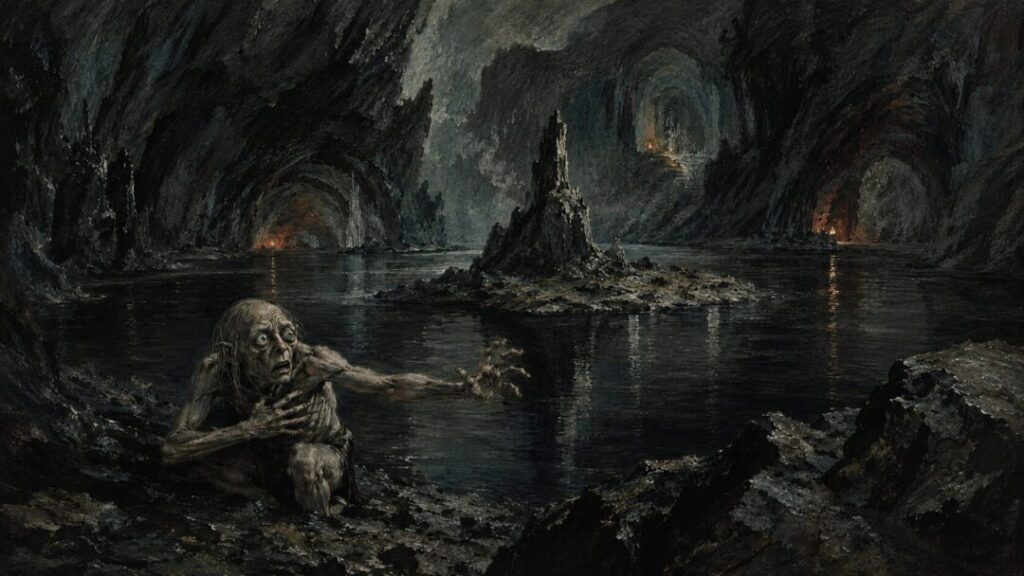
The first thing to understand is that Gollum was not walking around with the Ring on his finger every moment.
That is easy to imagine, especially because the Ring is so central to him. But the texts suggest a more practical pattern.
Gollum lived in deep darkness. Beneath the Misty Mountains, invisibility was not always necessary. In a world with little or no light, there was often nothing to vanish from.
The Ring’s power of invisibility mattered most when Gollum needed to move unseen among others. He used it when hunting goblins in the tunnels. It allowed him to creep where he otherwise could not. But when he was alone on his island, among the black water and the roots of the mountain, the Ring did not need to be on his hand.
This does not mean he cared for it less.
It means possession mattered more than constant wearing.
To Gollum, the Ring was not merely a tool. It was treasure, comfort, weapon, memory, and torment. He could keep it hidden, hold it close, speak to it, and still not wear it at every moment.
That distinction matters because the real mystery is not why he ever removed it.
The real mystery is why it was no longer safely in his keeping.
The Darkness Made the Ring Less Useful
The Ring’s most obvious visible effect is invisibility.
But invisibility depends on being seen.
Gollum’s world was already one of concealment. He lived far from sunlight. He avoided the open world. He crept through tunnels, listened, smelled, and hunted in places where ordinary sight was already weakened.
In that setting, the Ring was not always needed in the way Bilbo would later need it.
Bilbo uses the Ring to escape goblins, move through guarded spaces, and survive dangers where being seen would mean capture. For Bilbo, invisibility is immediately useful because he is moving through enemy territory and trying to get out.
Gollum’s life is different.
He is not a traveler passing through the dark. He belongs to it, in a miserable and unnatural way. He knows the lake. He knows the passages near it. He knows how to hide.
So when the Ring is not on his finger, that does not mean he has rejected it.
It means the Ring is waiting.
And perhaps, more importantly, it means the Ring is able to be lost.
Gollum Could Not Freely Give It Up
This is where the answer becomes darker.
Gandalf’s explanation to Frodo is one of the clearest statements we have about the matter. Gollum did not abandon the Ring. He could not get rid of it. His will was no longer free in that matter.
That is essential.
By the time Bilbo finds the Ring, Gollum’s relationship with it has passed far beyond ordinary ownership. He is not like someone who misplaces a knife, a coin, or a key. He is bound to something that has eaten into his mind for hundreds of years.
The texts describe this bond with terrible precision.
Gollum loves the Ring, but he also hates it. He hates it because it has hollowed him out. He loves it because he can no longer imagine himself without it. His attachment is not peaceful devotion. It is torment.
So when people ask, “Why did Gollum take off the Ring?” the question needs to be corrected.
He may have removed it when it was not useful to wear. He may have hidden it. He may have carried it close. But he did not willingly abandon it.
The Ring passed out of his possession because something beyond Gollum’s intention was at work.
The Ring Looks After Itself
The One Ring is not a person.
The texts do not present it as a character with ordinary thoughts, speech, or plans in the same way that living beings have them. It does not sit in the dark and reason like a servant of Sauron.
But the Ring is also not a dead object.
It carries Sauron’s power. It bends wills. It tempts. It betrays. It seeks, in some sense, to return to its master.
The safest way to phrase this is carefully: the texts describe the Ring as having a kind of active malice or agency, though not a mind in the ordinary sense.
Gandalf says the Ring left Gollum.
That is not a casual line. It reframes the whole event.
Gollum did not lose the Ring because he stopped wanting it. He lost it because the Ring no longer wanted to remain with him.
For centuries, Gollum had kept it hidden under the mountains. That was useful for concealment, but useless for return. While the Ring stayed with Gollum, it remained buried, far from the great movements of the world.
And Sauron was rising again.
The Ring needed a way out.
Why Leaving Gollum Made Sense
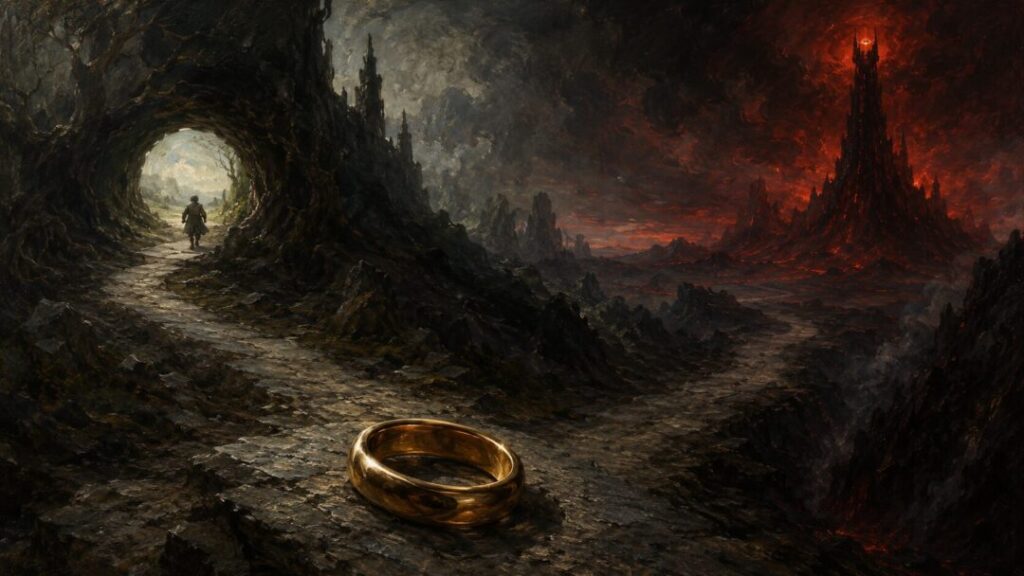
From the Ring’s perspective—if we can use that phrase cautiously—Gollum had become a dead end.
He was secretive. He was isolated. He hated the sun and the open air. He did not move among the powerful. He did not seek thrones, armies, or dominion. He hid below the mountains, eating fish and the occasional goblin, nursing his misery in the dark.
That made him a poor path back to Sauron.
The Ring had once passed from Isildur into the Anduin. It had remained hidden for long ages before Déagol found it. Then Sméagol murdered Déagol and took it. After that, it disappeared again into the roots of the Misty Mountains.
This pattern is important.
The Ring can lie hidden for a time. But it does not remain safely buried forever. When the larger story begins to move again, the Ring begins to move too.
Gollum had carried it as far as he could.
Or more accurately, he had kept it trapped as long as the story allowed.
Then it slipped away.
The Parallel With Isildur
Gollum is not the only bearer the Ring betrays.
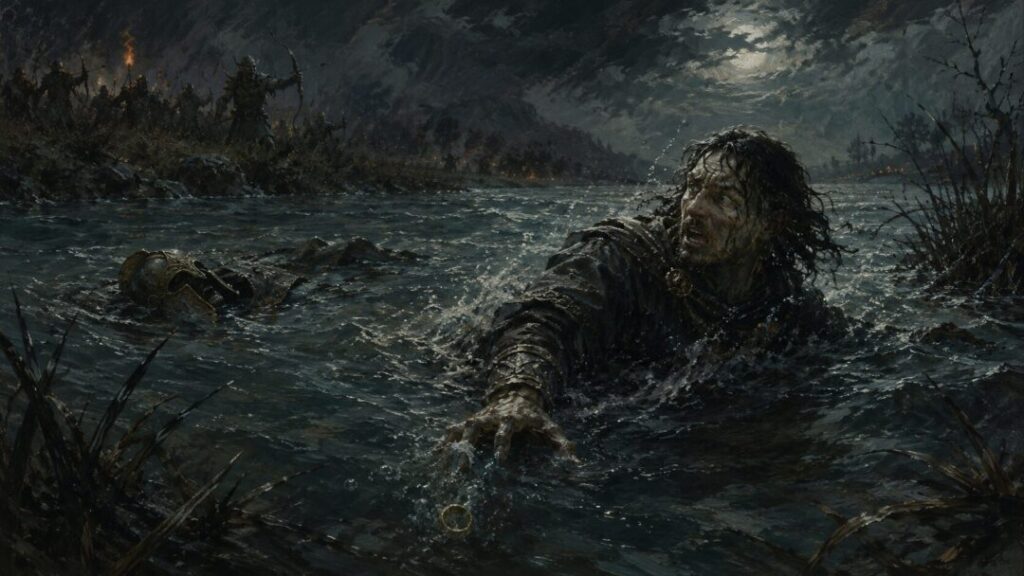
Isildur loses the Ring in the Anduin after the Disaster of the Gladden Fields. As he tries to escape, the Ring slips from him in the water. Once it is gone, he becomes visible and is killed by Orcs.
That earlier loss matters because it shows that the Ring can abandon its bearer when doing so serves its own hidden movement.
It did not save Isildur.
It did not remain loyal to him.
It had no loyalty at all.
The same pattern appears with Gollum. The Ring does not reward centuries of possession. It does not care that Gollum calls it Precious. It does not care that he has ruined himself for it.
When Gollum is no longer useful, the Ring leaves him.
That is one of the coldest truths about the One Ring.
It consumes devotion, but it does not return it.
Why Bilbo Finding It Is So Strange
And then the strangest thing happens.
The Ring leaves Gollum, apparently seeking a path back into the world.
But the one who finds it is Bilbo.
Not a great warrior.
Not a lord.
Not an Orc.
Not a servant of Sauron.
A Hobbit.
And not even a Hobbit searching for power. Bilbo is lost, frightened, separated from his companions, and trying to survive. He does not know what he has found. He puts the Ring in his pocket without understanding its nature.
This is why Gandalf later treats the event with such seriousness.
The Ring leaving Gollum may fit its own dark pattern. But Bilbo arriving at exactly that moment does not look like the Ring’s victory.
It looks like something else has entered the story.
The texts are careful here. They do not reduce the event to accident. Nor do they explain every mechanism. Gandalf suggests that Bilbo was “meant” to find the Ring, but not by its maker.
That is one of the deepest mysteries in the history of the Ring.
The Ring acted to escape Gollum.
But its escape placed it in the hands of someone who would eventually help bring about its destruction.
Gollum’s Loss Was Not Freedom
There is a tragic irony here.
When the Ring leaves Gollum, he is not healed.
He does not become free in any meaningful sense. He is emptied. His loss becomes another form of bondage. From that moment onward, he is driven by absence as much as he was once driven by possession.
He follows the trail of “Baggins.”
He leaves the mountains.
He is drawn into the wider war.
Eventually, he comes all the way to Mordor.
In one sense, the Ring’s departure releases him from his cave.
But it does not release him from itself.
Gollum without the Ring is still shaped by the Ring. He is a creature of longing, resentment, hunger, and memory. He no longer has the Precious, but the Precious still has him.
That is why his story remains so painful. Losing the Ring does not restore what the Ring destroyed.
It only reveals how much has already been lost.
So Why Did Gollum Take It Off?
The most accurate answer is this:
Gollum did not wear the Ring constantly because, in the deep darkness, he did not always need its invisibility. He kept it, used it, hid it, and treasured it. But he did not freely abandon it.
When the Ring was finally lost, the texts place the deeper cause not in Gollum’s carelessness, but in the Ring’s betrayal.
The Ring left him.
That answer is simple, but its implications are enormous.
It means the Ring was already moving before Bilbo understood anything.
It means Gollum’s centuries of possession did not make him master.
It means the Ring’s loyalty was always only to itself and to the power that made it.
And it means Bilbo’s finding of it was not merely a lucky accident in a tunnel.
It was the hinge on which the whole history of the Third Age quietly turned.
The Real Mystery Is Not Gollum
In the end, Gollum is not the strangest part of the scene.
The Ring is.
Gollum’s behavior can be understood. He lived in darkness. He used the Ring when it helped him. He could not give it up. He panicked when it was gone.
But the Ring’s path is harder to explain.
It leaves Gollum to escape a dead end.
It enters the world again.
It seems to move closer to its master.
And then it falls into the hands of Bilbo Baggins.
That is the part no theory of the Ring’s malice can fully contain.
The Ring meant to return to power.
Instead, it found pity.
Bilbo spares Gollum. Frodo later spares him too. And through that long chain of mercy, the creature who once lost the Ring becomes the one who finally brings it to the Fire.
So Gollum did not simply take off the Ring.
The Ring left him.
But in doing so, it stepped into a story larger than its own will.
And that is why the darkness under the Misty Mountains matters so much.
Not because Gollum made a mistake.
Because the Ring did.
Sources & Notes
- J.R.R. Tolkien, The Hobbit, ch. 5, “Riddles in the Dark” — Gollum keeps the Ring as his birthday-present and uses it to move unseen while hunting goblins, but Bilbo finds it after it has fallen from him in the tunnels.
- J.R.R. Tolkien, The Lord of the Rings, bk. I, ch. 2, “The Shadow of the Past” — Gandalf says the Ring was trying to get back to its master and that it had “slipped from Isildur’s hand” and later “abandoned Gollum.”
- J.R.R. Tolkien, The Lord of the Rings, bk. I, ch. 2, “The Shadow of the Past” — Gandalf’s account of Sméagol/Gollum shows how possession of the Ring becomes a consuming love-hate bondage rather than ordinary ownership.
- J.R.R. Tolkien, The Lord of the Rings, bk. II, ch. 2, “The Council of Elrond” — Isildur’s death at the Gladden Fields gives the earlier pattern of the Ring betraying a bearer by slipping away and making him visible.
- J.R.R. Tolkien, The Lord of the Rings, bk. I, ch. 2, “The Shadow of the Past” — Gandalf’s statement that Bilbo was “meant” to find the Ring, but not by its maker, supports the article’s distinction between the Ring’s malice and a larger providential turn.