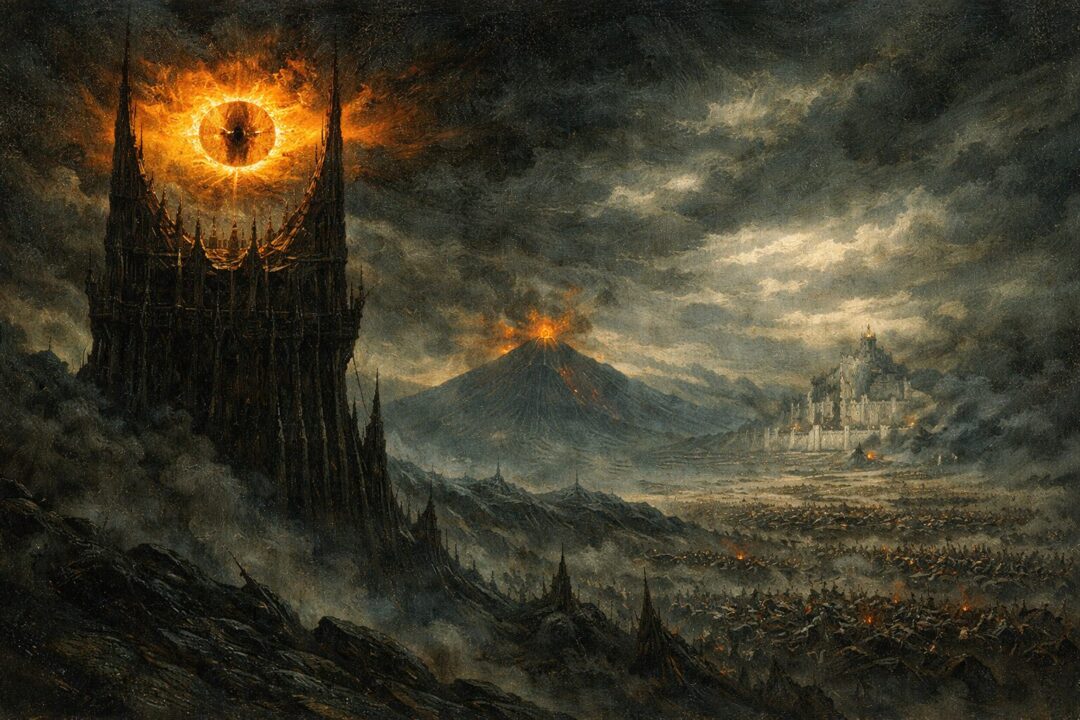
At first glance, the Siege of Gondor appears to be Sauron’s boldest gamble: a direct, overwhelming assault on Minas Tirith, the last great stronghold of the West. It looks like brute force—raw numbers, siege engines, terror, and flame unleashed at the heart of the Free Peoples.
But when examined through Tolkien’s wider lore, the siege reveals something far more calculated.
It was not simply an attempt at conquest.
It was an operation designed to shape perception, provoke predictable responses, and—most importantly—to mask Sauron’s greatest weakness.
To understand why Sauron allowed such a risky confrontation, we must look beyond armies and walls, and instead examine how Sauron understood power, fear, and the minds of his enemies.
The War Had to Feel Inevitable
Sauron did not merely wage war with weapons.
He waged war with certainty.
By the end of the Third Age, Gondor was already a shadow of its former strength. Its population had dwindled. Its borders had shrunk. The line of Kings had failed, leaving the realm governed by Stewards—capable, proud, but lacking the authority and mythic unity that a crowned king once provided.
A swift annihilation of Gondor might seem logical. But paradoxically, it would have been dangerous.
Total, immediate destruction can inspire unity. It can awaken dormant alliances. It can force enemies to act in ways that defy expectation. Sauron did not want a sudden shock—he wanted slow, grinding inevitability.
Fear works best when it feels unavoidable.
The Siege of Gondor was designed to feel like the natural end of history. It was not meant to inspire defiance, but resignation. The message was simple: this is what always happens in the end.
As Minas Tirith was encircled, battered, and isolated, its defenders were forced to look inward—toward walls, gates, food stores, and survival. The larger questions faded into the background. Where was the Ring? What was Sauron truly afraid of? Could the war be ended another way?
Those questions were buried beneath smoke and siege towers.

Gondor Was Meant to Look Alone
One of Sauron’s greatest strategic successes was making Gondor appear isolated—even when it was not.
The Siege forced Gondor to expend its strength visibly and publicly. Every beacon lit, every desperate call for aid reinforced the idea that Gondor was the last stand, the final bulwark against darkness.
This perception mattered.
If Gondor appeared strong, others might hesitate—waiting to see how the war turned out. But a besieged Gondor demanded immediate action. It pulled allies into motion before they could consider alternative strategies.
Sauron needed Gondor to call for aid.
The Ride of the Rohirrim was not a surprise. Sauron expected Rohan to answer, even weakened as it was. Likewise, he anticipated that a claimant to Gondor’s throne might emerge—though he misunderstood the nature of that threat.
From Sauron’s perspective, every army that marched toward Minas Tirith was an army that was not guarding something else. Every banner raised in the West was another confirmation that the war was unfolding exactly as he believed it should.
Drawing Out the Last Strength of the West
The Siege of Gondor functioned as a magnet.
It drew out the last reserves of the Free Peoples—military, political, and symbolic. When Aragorn revealed himself through the palantír, it appeared to confirm everything Sauron already believed.
To Sauron, this was proof that the Ring had revealed itself.
Why else would the Heir of Isildur openly challenge him? Why else would a Man dare to confront the Dark Lord directly unless armed with terrible power?
This moment was pivotal.
From that point on, Sauron’s attention fixed westward. His gaze, his armies, and his expectations were all aligned toward the belief that the Ring would be used against him—as it always had been in the past.
The Siege of Gondor succeeded in its deeper purpose: it forced Sauron to commit.
Sauron’s Fatal Blind Spot
Here Tolkien is explicit, both in the narrative and in his letters.
Sauron could not conceive of anyone willingly destroying the One Ring.
The very idea lay outside his moral and intellectual framework. Power, in Sauron’s mind, exists to be seized, refined, and wielded. Renunciation was weakness. Sacrifice was folly. Destruction without gain was unthinkable.
This assumption shaped every move he made.
Thus, while Minas Tirith burned, Frodo Baggins and Samwise Gamgee passed unseen into Mordor—not because Sauron lacked strength or intelligence, but because his strategy required distraction.
He was not blind.
He was certain.
The Siege of Gondor was not reckless. It was overconfident.

Gondor as the Perfect Decoy
Minas Tirith was immensely valuable—but it was not decisive.
Sauron could afford losses there because his victory did not depend on the city falling. It depended on time, attrition, and misdirection. The longer the Free Peoples committed themselves to visible resistance, the less likely they were to attempt anything unexpected.
Every soldier who died on the Pelennor Fields believed this was the center of the war.
It was not.
The true center lay elsewhere, hidden beneath ash and shadow, in a place Sauron believed no enemy would dare approach without the Ring.
The War That Had to Look Real
Like all great deceivers, Sauron understood that illusion collapses if it feels staged.
The Siege of Gondor had to involve real sacrifice. Real terror. Real uncertainty—even among his own servants. If his forces believed victory was guaranteed, discipline would erode. If his enemies suspected manipulation, desperation might turn into inspiration.
This is why the death of the Witch-king of Angmar is so revealing.
It was not planned.
It shocked Mordor precisely because it was not expected. And that shock proves something essential: the siege was not a rigid script. It was a controlled operation with room for chaos—as long as that chaos served the greater illusion.
And for a time, it did.
The Siege bought Sauron exactly what he wanted: a final opening for the Ring to reveal itself.
Which, of course… never happened.
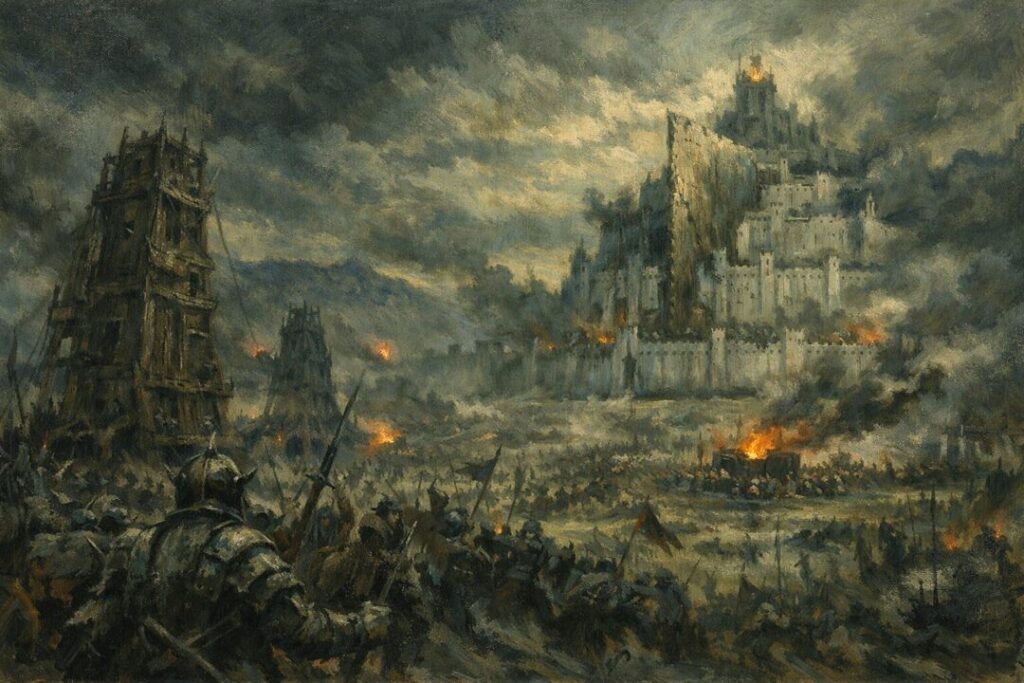
Conclusion: Not a Failure of Strength—but of Imagination
Sauron did not lose the War of the Ring because his armies failed.
He lost because his worldview was too narrow to conceive of humility, sacrifice, and destruction without gain. He understood fear, domination, and power—but not mercy, endurance, or hope.
The Siege of Gondor was flawless strategy, built on every lesson Sauron had learned across Ages of war.
And yet it was built on a single, fatal assumption.
That his enemies would think like him.
So the real question remains:
If Sauron had understood his enemies better… would Middle-earth have fallen?