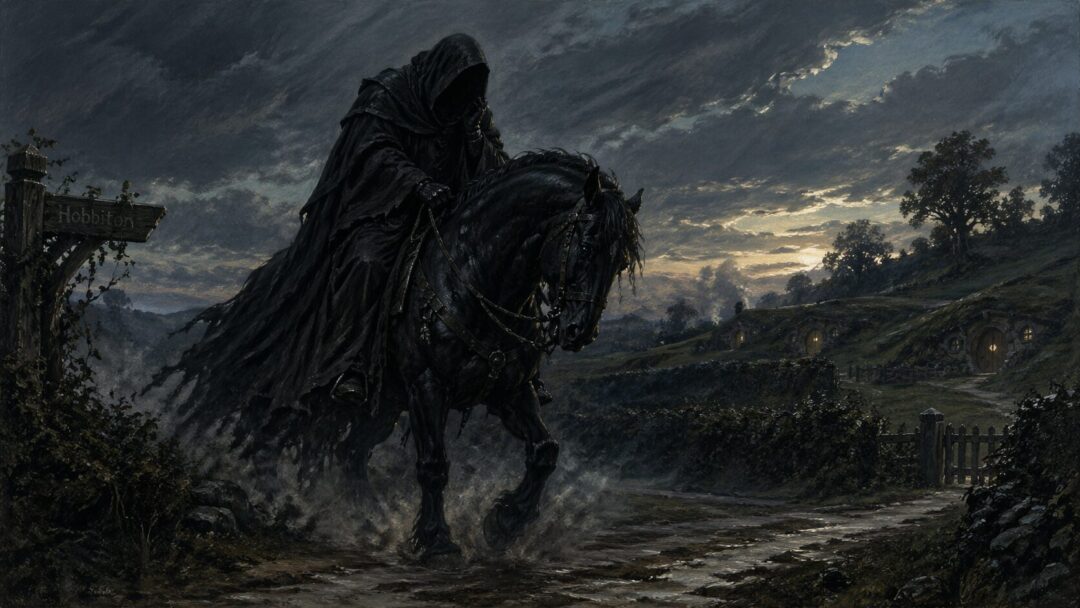
When most people think of the Nazgûl, they imagine them in the sky.
Black wings over Minas Tirith. Terrible cries falling like sickness over soldiers. A shadow circling above the Dead Marshes or sweeping across the darkening lands before Mordor.
By the end of the War of the Ring, the Nazgûl are no longer merely riders.
They are airborne nightmares.
So it raises a quiet but important question:
Why did they begin the hunt for the Ring on horseback?
If Sauron had flying creatures available later, why send his most feared servants into the West as Black Riders, moving by road, ferry, bridge, and gate?
The answer is not given in one simple explanation. The texts never pause to say, “This is why the Nine first rode horses.”
But the story gives us enough to see the shape of the answer.
The Nazgûl on horseback were not a mistake.
They were exactly what that first mission required.
The Hunt Was Not Yet Open War
The first thing to understand is that the Nazgûl’s mission in the Shire was not the same kind of mission they later carried out over Gondor.
When they hunted Frodo, Sauron still did not have the Ring.
That changes everything.
He had learned certain clues. He knew of “Baggins.” He knew of “Shire.” But these were not enough. He did not yet have the Ring-bearer in his hand. He did not know the full situation in the Shire. He did not know exactly how far the Ring had moved, who carried it, or how quickly his enemies might react.
So the Nine were sent as hunters.
Not conquerors.
That is crucial.
A winged terror crossing openly over Eriador would not have been a quiet search. It would have declared that Mordor’s greatest servants were abroad. It would have alarmed every power still capable of resistance. The Wise would have understood at once that something of enormous importance was happening.
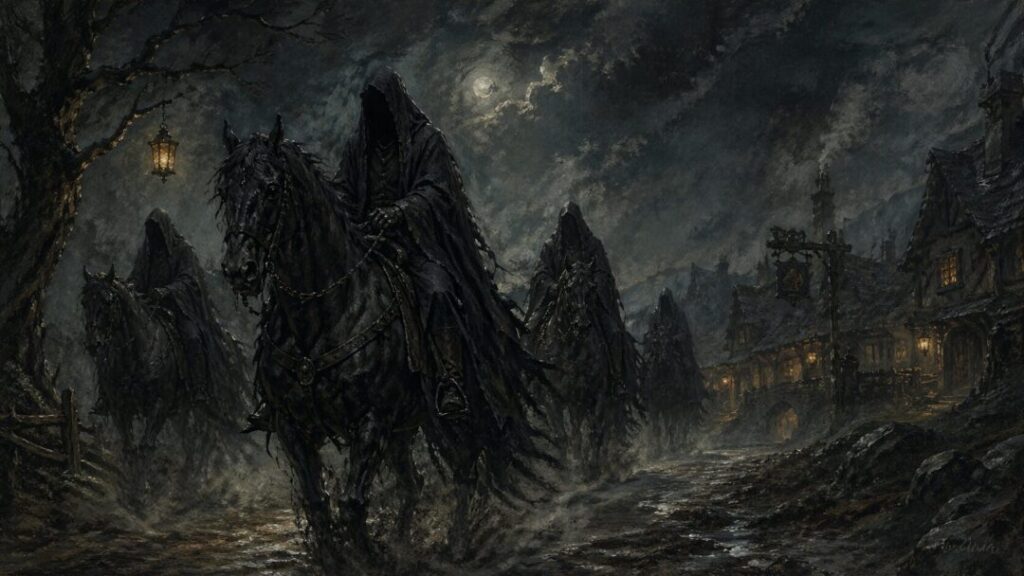
The Black Riders, by contrast, were terrifying but still able to move through the ordinary world.
They could ride roads.
They could approach doors.
They could question people.
They could pass through villages in a form that looked, at least from a distance, like dark horsemen.
That did not make them harmless. It made them worse.
Their horror was hidden inside something the world could still almost recognize.
Horses Made the Nazgûl Useful in the Visible World
The Ringwraiths are not ordinary warriors.
They exist in a strange condition between the seen and unseen worlds. Their bodies have faded from mortal sight, and their black cloaks give shape to what would otherwise be invisible to living eyes.
This matters because the hunt for the Ring required more than terror.
It required practical movement through Middle-earth.
The Nazgûl had to follow roads, cross rivers, search settlements, and track a small Hobbit through lands that were not yet conquered by Sauron. They were not simply flying toward a visible army or fortress. They were trying to locate one person carrying one small object.
The texts indicate that the Riders did not perceive the ordinary world of daylight as living beings do. Their senses were terrible, but not simple. They were drawn to the Ring. They could sense living things. They were more dangerous in darkness. But the visible world was not their natural mode of being.
This makes the horses important.
The black horses were not just transportation. They helped connect the Nazgûl to the roads and movements of the physical world.
The books make clear that ordinary animals feared the Ringwraiths. These mounts had to be specially suited to them, able to endure what most living creatures could not bear. That alone tells us the horses were part of Sauron’s design.
They were instruments of the hunt.
Not decorative details.
The Black Riders Needed to Interrogate, Not Simply Destroy
Another reason horseback travel fits the early mission is that the Nazgûl were looking for information.
In the Shire and near Bree, they are not simply burning everything in their path. They ask questions. They seek “Baggins.” They look for the road the Ring-bearer has taken.
This is one of the creepiest parts of the early chapters.
The Ringwraiths are not only monsters. They are patient. They listen. They follow. They wait outside houses. They appear at moments when the Hobbits are just barely ahead of them.
That kind of pursuit needs proximity.
A winged mount might be useful for speed and terror, but the first stage of the hunt is not about battlefield domination. It is about narrowing a search.
The Nazgûl need names, directions, tracks, rumors, and fear.
On horseback, they can enter the human and Hobbit world just enough to pressure it.
A rider can stop at a gate.
A rider can speak to a farmer.
A rider can appear on a road at twilight and make the heart turn cold before anyone understands why.
That is exactly what happens.
The Black Riders are frightening because they are not yet distant.
They are close.
The Winged Mounts Would Have Changed the Meaning of the Mission
The winged creatures later ridden by the Nazgûl are never treated as subtle.
They belong to the war-phase of the story.
Once the Nine appear in the air, their role changes. They are no longer merely searching the lanes of the Shire. They are messengers of terror. They are weapons of despair. Their cries break courage. Their presence weakens armies.
That makes sense during the siege of Gondor.
It would make far less sense during the first search for the Ring.
If a winged shadow had passed over the Shire, it might have spread fear faster, but it also would have exposed the danger faster. The Shire was guarded quietly by the Rangers. Rivendell still stood. Gandalf was moving. Saruman was still playing his own game. Sauron had enemies watching for signs of his next move.
The hunt required a kind of secrecy that winged monsters could not provide.
This is not stated directly as Sauron’s reasoning, so it should be treated as interpretation.
But it fits the pattern of the story.
The Nazgûl begin as riders because the Ring is still hidden.
They rise into the air when concealment is no longer the point.
The Ford of Bruinen Changes Everything
The turning point comes at the Ford of Bruinen.
There, the Black Riders almost succeed.
Frodo is wounded. He is fading. The Nazgûl are close enough to command him, and the Ring is almost within reach.
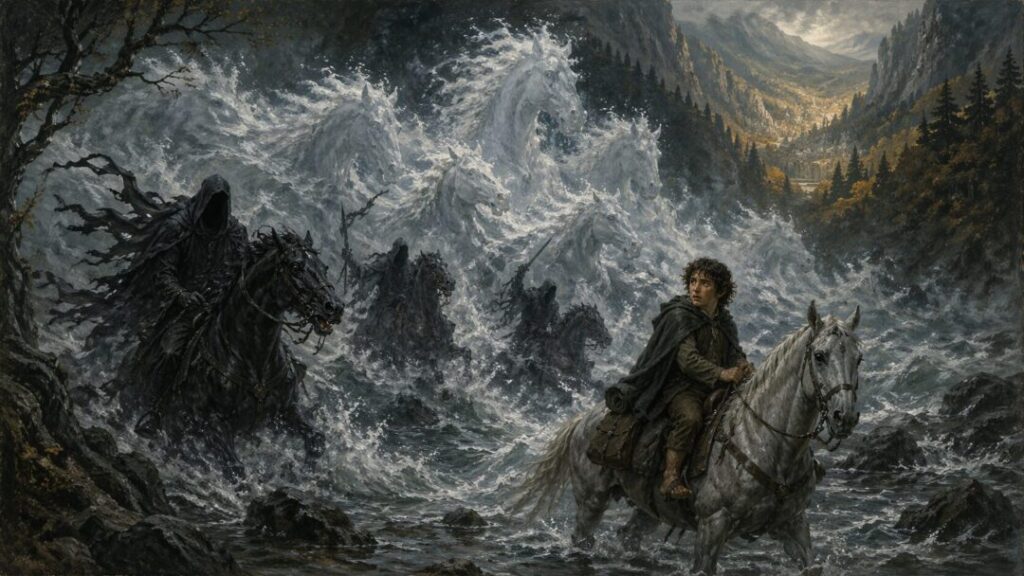
Then the river rises.
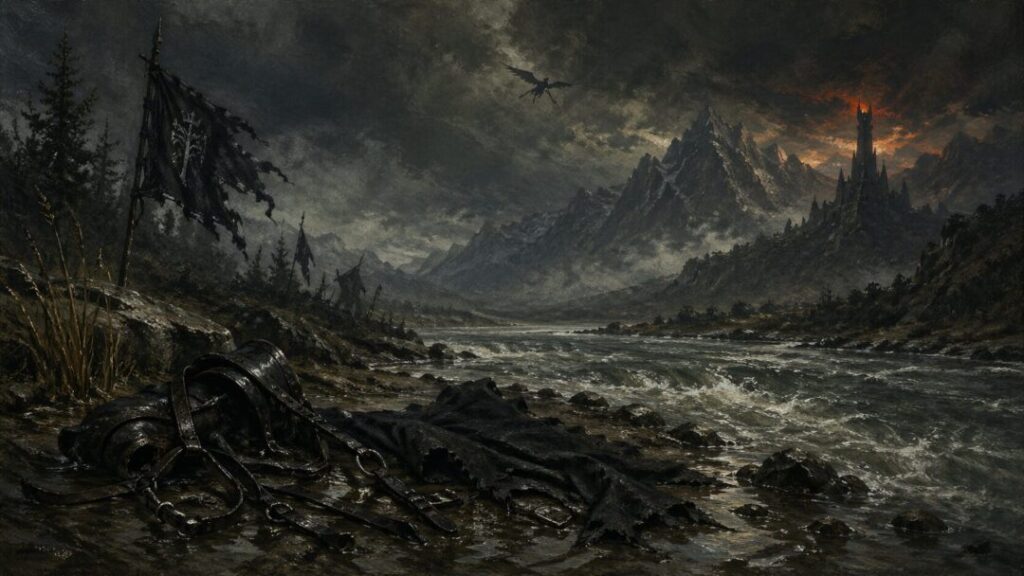
The flood sweeps away the Riders’ horses. The Nazgûl themselves are not finally destroyed there, but their mission collapses. Their forms are broken. Their mounts are lost. They are forced to return to their master.
This is one of the most important transitions in the story.
The Black Riders fail at the edge of Rivendell.
When the Nazgûl return later, they are no longer simply the same figures on new animals. Their reappearance marks a new stage in the war.
The secret hunt has failed.
The Ring has reached Rivendell.
The Fellowship is formed.
Sauron’s enemies now understand far more than before.
After that, the Nazgûl can be used more openly. Their winged mounts allow them to move with terrible speed and to cast fear from above. But this belongs to a later phase of the conflict.
The horses belong to the first phase.
The hidden phase.
The phase where the Ring might still be captured before the West fully understands what is happening.
Were the Winged Beasts Available from the Beginning?
This is where careful phrasing matters.
The texts do not clearly state that Sauron lacked the winged creatures at the beginning of the hunt. Nor do they clearly state that he had them ready and deliberately held them back.
What we can say is simpler.
The Nazgûl first appear in the hunt on horses.
After their horses are destroyed at the Ford, they later reappear mounted on flying creatures.
Anything beyond that must be treated cautiously.
It is possible to interpret the sequence as practical escalation. Sauron first sends them in a form suited to secret pursuit. When that fails, and when the war moves closer to open conflict, he equips them for speed, terror, and command from the air.
That interpretation fits the story, but it should not be presented as an explicit statement from the text.
The safer conclusion is this:
The books show a change in how the Nazgûl are deployed.
They begin as hunters.
They later become aerial instruments of war.
The Horses Make the Early Nazgûl More Frightening
There is a reason the Black Riders are so memorable before they ever take to the sky.
They invade ordinary places.
A road in the Shire.
A lane near Hobbiton.
The Buckland Gate.
The streets of Bree.
A dark hill under ruined stones.
They do not begin as distant symbols of war. They begin as something that can appear just behind you on a path.
That is part of their power.
The winged Nazgûl are terrifying because they are vast, loud, and overwhelming.
The Black Riders are terrifying because they are intimate.
They ask for your name.
They sniff at the air.
They pause outside the wrong door.
They stand between the familiar world and the shadow behind it.
The horse makes that possible. It gives the wraith a shape the world almost understands. It lets terror wear the outline of a traveler.
And that is why the early chapters feel so tense.
The danger has not yet become apocalyptic in scale.
It is still personal.
The Ringwraith is not above the city.
It is on the road behind you.
Why This Detail Matters
The Nazgûl starting on horseback is not a small visual choice.
It tells us what stage of the story we are in.
At first, Sauron is not yet unleashing everything openly. He is searching. Testing. Pressing into the West through fear, spies, and pursuit. The Ring is still hidden enough that stealth matters.
The Black Riders belong to that uncertainty.
They are not weak versions of the winged Nazgûl.
They are the right form for the hunt.
Only after the Ford of Bruinen does the story shift. The Ring has escaped them. Rivendell has acted. The quest has begun. The road to open war becomes unavoidable.
Then the Nazgûl rise into the sky.
And that is what makes their first appearance on horseback so important.
Before they became shadows over battlefields, they were something more disturbing:
dark riders on ordinary roads, searching for one small bearer before the world knew how close the end had come.
Sources & Notes
- J.R.R. Tolkien, The Lord of the Rings, Book I, Chapter 2, “The Shadow of the Past” — gives Sauron’s clues from Gollum, especially “Shire” and “Baggins,” framing the Nine’s first task as a search rather than open conquest.
- J.R.R. Tolkien, The Lord of the Rings, Book I, Chapter 3, “Three Is Company” — shows the Black Riders moving by road, questioning Hobbits, and using fear and pursuit in the ordinary countryside.
- J.R.R. Tolkien, The Lord of the Rings, Book I, Chapter 12, “Flight to the Ford” — the pursuit reaches its crisis at Bruinen, where the Riders’ horses are swept away and the first hunt fails.
- J.R.R. Tolkien, Unfinished Tales, “The Hunt for the Ring” — the fullest supplementary account of Sauron sending the Nazgûl to find the Shire and the Ring-bearer, with secrecy and uncertainty still shaping the mission.
- J.R.R. Tolkien, The Lord of the Rings, Book V, Chapter 4, “The Siege of Gondor” — shows the later aerial Nazgûl as weapons of war and terror, a different deployment from the earlier road-bound hunt.