Why Do Bilbo and Frodo Carry the SAME Sword?
This post may have affiliate links, and I might earn a small commission at no extra cost to you. Learn more.
If you put Bilbo Baggins’s sword next to Frodo Baggins’s, you’ll notice something unusual.
Not similar craftsmanship.
Not a shared Elvish style.
The same blade.
The same leaf-shaped Elvish design.
The same pale blue glow when Orcs are near.
The same name: Sting.
At first, this feels like a practical detail. Bilbo is finished with adventures. Frodo is not. The sword is passed down like any other family heirloom—no different from a walking stick or a waistcoat.
But in Middle-earth, weapons are never just possessions.
They carry memory.
They carry purpose.
And sometimes, they wait.
So is this simply convenience…
—or is there a deeper, in-world reason the same sword follows the same family into darkness?
Sting Was Never a Hobbit’s Weapon
Sting was never forged for Hobbits.
Long before Bilbo ever left the Shire, the blade was made in Gondolin, during the First Age. This was a time when the world itself was locked in open war against Morgoth, and survival often depended on fighting in darkness—through tunnels, ruins, and sudden ambushes.
By Elvish standards, Sting is small. Too small, in fact, to be a primary weapon for a warrior of Gondolin. That detail matters.
The blade’s size suggests it was designed for close, desperate encounters. A secondary weapon. A last defense. Something carried when escape mattered more than victory.
This makes its later history feel less accidental.
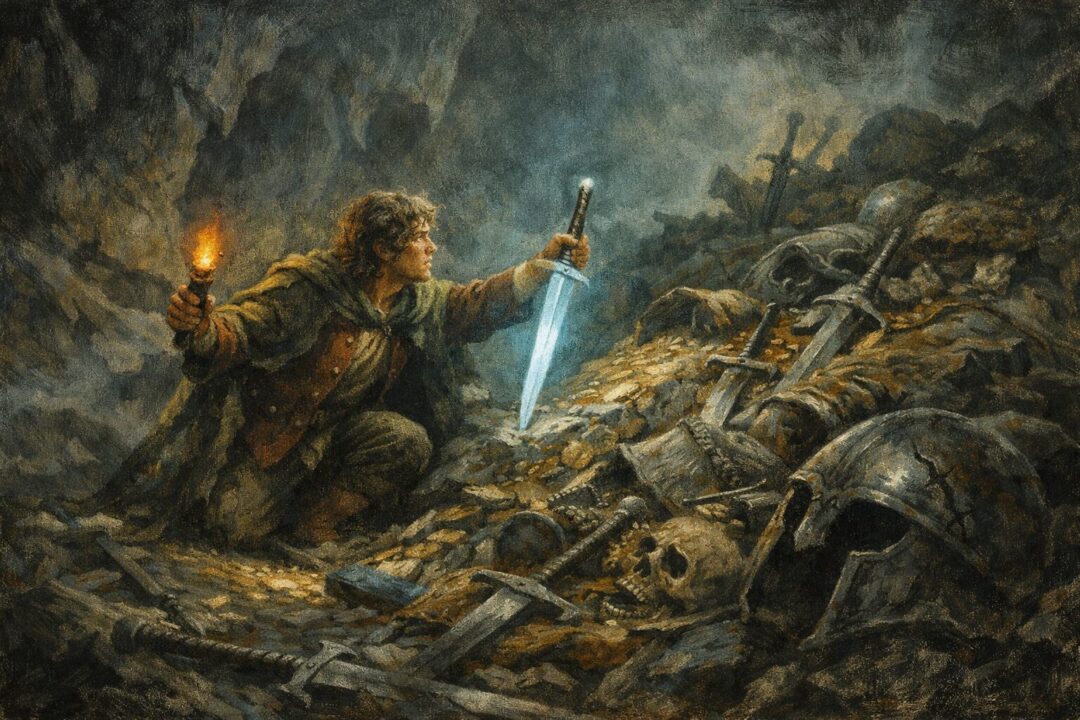
When Bilbo finds Sting among the trolls’ hoard, he doesn’t recognize its origin. To him, it’s simply a useful knife—well-made, balanced, and sharp. The sword has no name. No story. No meaning yet.
That comes later.
Why Naming Sting Matters
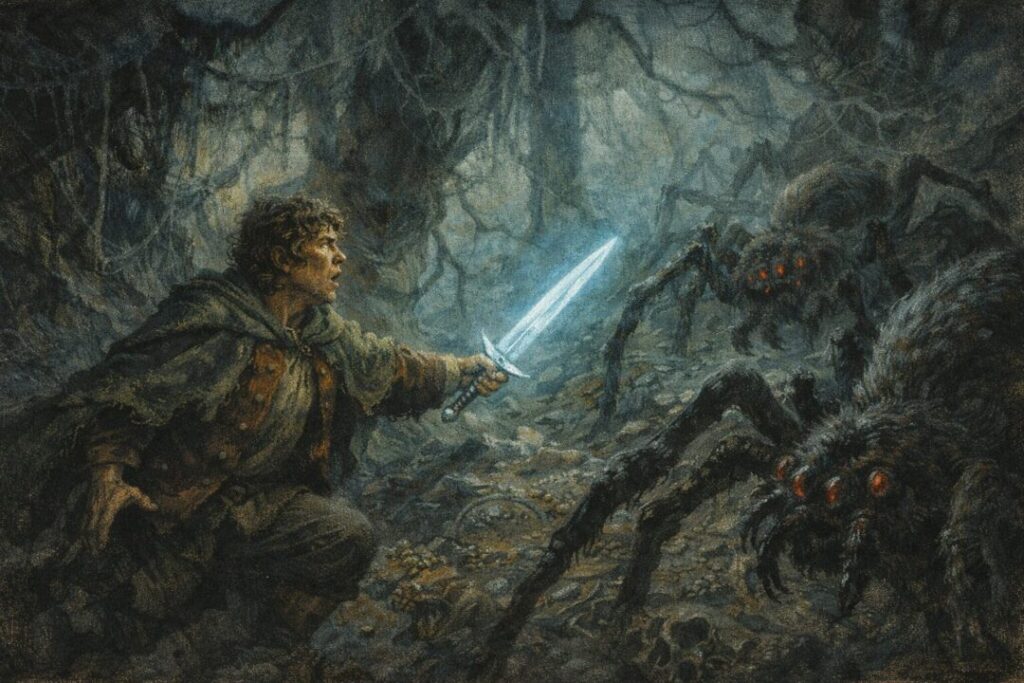
Bilbo names Sting only after using it in Mirkwood, defending himself against the giant spiders.
This moment is easy to overlook, but in Middle-earth, naming a weapon is never casual.
Names are acts of recognition.
Swords are named when they have proven their purpose—and when their bearer understands what that purpose is. Sting earns its name not through great feats of war, but through survival against overwhelming fear.
That sets the pattern for everything that follows.
Why Sting Fits Bilbo
Bilbo Baggins is not a warrior.
He does not defeat enemies through strength or skill at arms. He survives by cleverness, patience, and an instinct for mercy. Even when he draws Sting, it is rarely to kill.
Sting does not make Bilbo powerful.
It makes him aware.
The blade glows before danger arrives. It doesn’t encourage boldness—it encourages caution. It gives warning, not dominance. That quality mirrors Bilbo’s role in the story perfectly.
Bilbo’s greatest victories are not battles. They are moments of restraint: sparing Gollum, refusing the Arkenstone for personal gain, walking away from violence even when he could justify it.
Sting supports that kind of courage.
By the end of The Hobbit, Bilbo no longer needs the sword—not because he is weak, but because his journey is complete. The blade has done its work.
And so it waits.
Why Sting Must Pass to Frodo
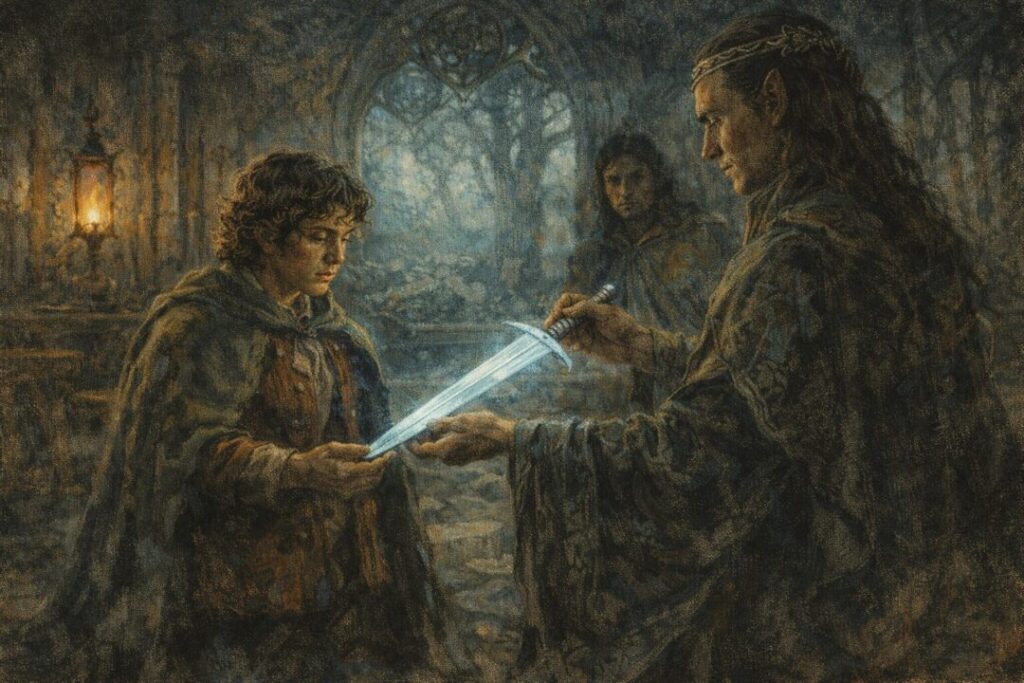
When Sting is passed to Frodo in Rivendell, it isn’t a grand ceremony. There is no prophecy spoken over it. No declaration of destiny.
That quietness is the point.
The sword passes hands not because Frodo is Bilbo’s replacement—but because he is his continuation.
Like Bilbo, Frodo does not walk into danger seeking glory. He does not expect to overcome darkness by force. His task is heavier, longer, and far more isolating.
And Sting is uniquely suited for that.
The blade does not change when Frodo takes it.
The task does.
Sting as a Warning, Not a Weapon
Throughout The Lord of the Rings, Sting is rarely used to strike.
Its most important function is revelation.
It glows in Moria, when the Fellowship is already deep underground and escape is uncertain.
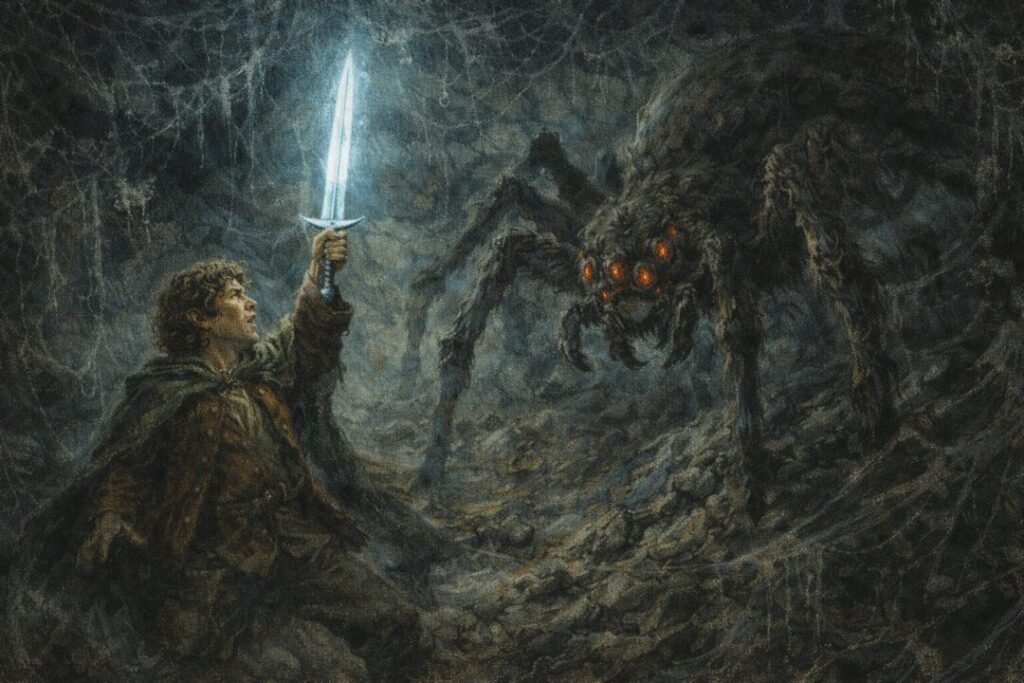
It glows in Shelob’s lair, where Frodo is nearly overwhelmed by terror and darkness.
It glows when danger is close—but not yet unavoidable.
Sting does not prevent harm.
It prepares the bearer to face it knowingly.
This is crucial to Frodo’s journey. His greatest danger is not Orcs or spiders—it is despair. Sting becomes a physical reminder that fear can be faced before it consumes him.
That is why the sword belongs with him.
Why the Sword Doesn’t Go to Someone Stronger
It is worth asking why Sting is never claimed by anyone else.
Elrond does not keep it in Rivendell.
Aragorn does not wield it, though he could.
Boromir is never offered it, despite his skill in battle.
This is not oversight.
Sting is not meant for victory.
It is meant for survival in the margins—where great powers fail and small endurance succeeds. The blade belongs to those the Enemy underestimates.
Just like Hobbits.
The Same Blade, Because the Same Courage Is Needed
Sting passes from Bilbo to Frodo not because history is repeating itself.
But because the world still requires the same kind of courage.
Quiet courage.
Unassuming courage.
The courage to walk forward without hope of winning—and to keep walking anyway.
When Frodo finally leaves Middle-earth, Sting does not return to legend. It does not reappear in another age. Its story ends.
Because the age that required it is over.
And in Middle-earth, that is how the greatest tools are remembered—not by how loudly they were used…
…but by how much darkness they helped someone endure.