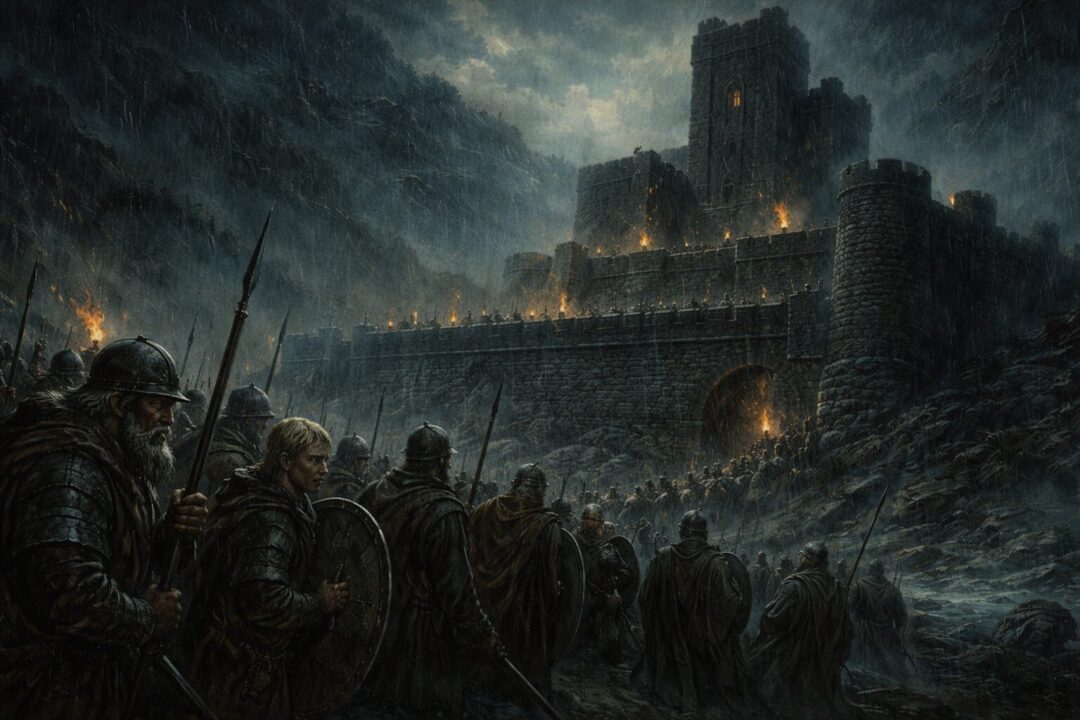
There is a reason the Elves at Helm’s Deep feel so emotionally “right.”
When the rain is falling and the torches are burning low, it is hard not to want the old world to show up one last time. Not just one Elf—an entire company. Not just Legolas as a lone bridge to earlier Ages, but a visible alliance: the elder race stepping into the war of Men before it fades.
On film, that choice lands like a chord you already know.
But in the book, Helm’s Deep is doing something more severe—and more specific.
It is not an image of unity.
It is an image of isolation.
And once you understand that, the presence of Elves does not merely “add help.” It changes the argument the battle is making.
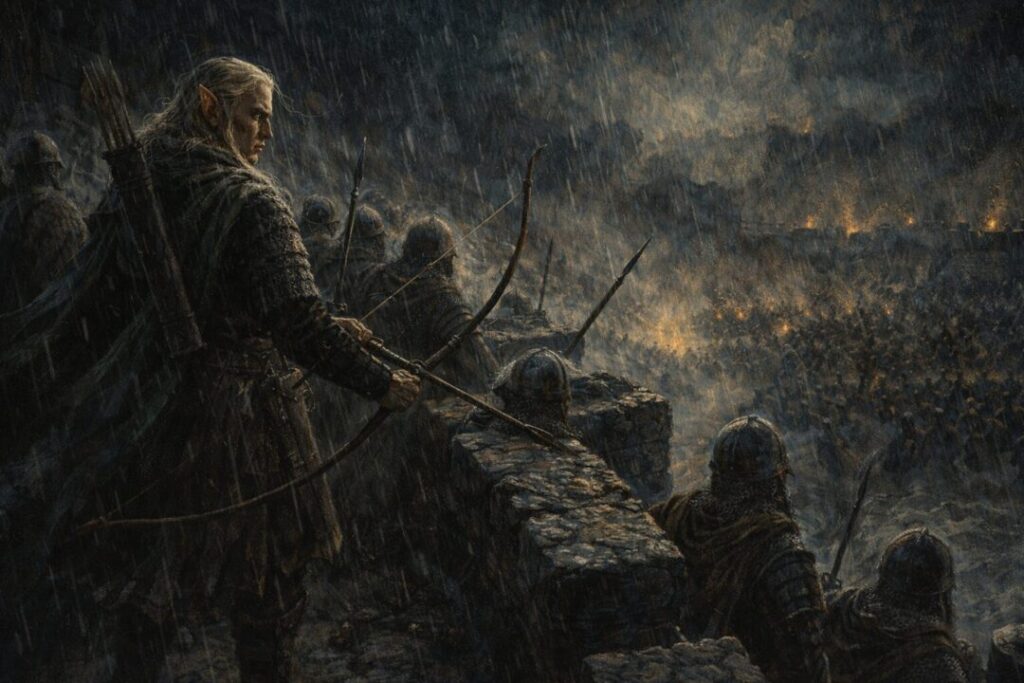
In the book, Helm’s Deep begins as a retreat—into what is left
In The Two Towers, Helm’s Deep is not framed as a planned battlefield where allies gather. It is a refuge chosen because time is gone and options are worse.
Rohan has already been struck. The Westfold is being burned. Men have been scattered, and those who survive are running toward the mountains because there is nowhere else to hold.
When the riders reach Helm’s Gate, they learn the truth of the defense they’ve inherited: Erkenbrand has left men to hold the place, and more have escaped there—but the core is thin and uneven. Gamling, who commands the men of the dike, gives a line that tells you exactly what kind of stand this will be:
“Maybe, we have a thousand fit to fight on foot… But most of them have seen too many winters… or too few.”
That isn’t the language of a grand alliance.
It is the language of a people scraping the bottom of the barrel.
The book wants you to feel the rough edge of it: boys, old men, and a kingdom that has been caught unready. Helm’s Deep is not “where the armies meet.”
It is where the remnants go.
The film’s Elves change the emotional center: from endurance to reunion
When an Elven company arrives in the film, it reframes the battle instantly.
Now the Hornburg is not only a fortress. It becomes a stage where the Free Peoples stand shoulder-to-shoulder one last time. It becomes a visual echo of older unity—like a remembrance of the Last Alliance, even if no one says those words.
That carries a clear emotional message: the world may be fading, but it is not yet broken into solitude.
The book’s message is harsher.
In the book, the fading is not solved by a late return of Elvendom to Men’s wars. It is shown through absence. The Elves are not gathering at Rohan’s wall because the Age is shifting, and the great unions of the past are no longer the shape of history.
This is why Tolkien keeps the Elven presence at Helm’s Deep narrow: it is Legolas—and Legolas alone.
You can see the author’s restraint in the way the survivors are named after the battle turns. When the leaders meet on the grass, the text does not list any Elven captain or fallen company. It names Théoden, Aragorn, “Legolas the Elf,” and “Erkenbrand of Westfold,” with the lords of the king’s household.
Legolas is there as a thread.
Not as an army.
So in the book, Helm’s Deep is not about the West re-uniting.
It is about whether Men can stand when the world does not come running.
What Tolkien actually gives them: not Elves, but something stranger
This is where many readers remember the battle incorrectly—because the film trains your eyes to watch the wall for reinforcements.
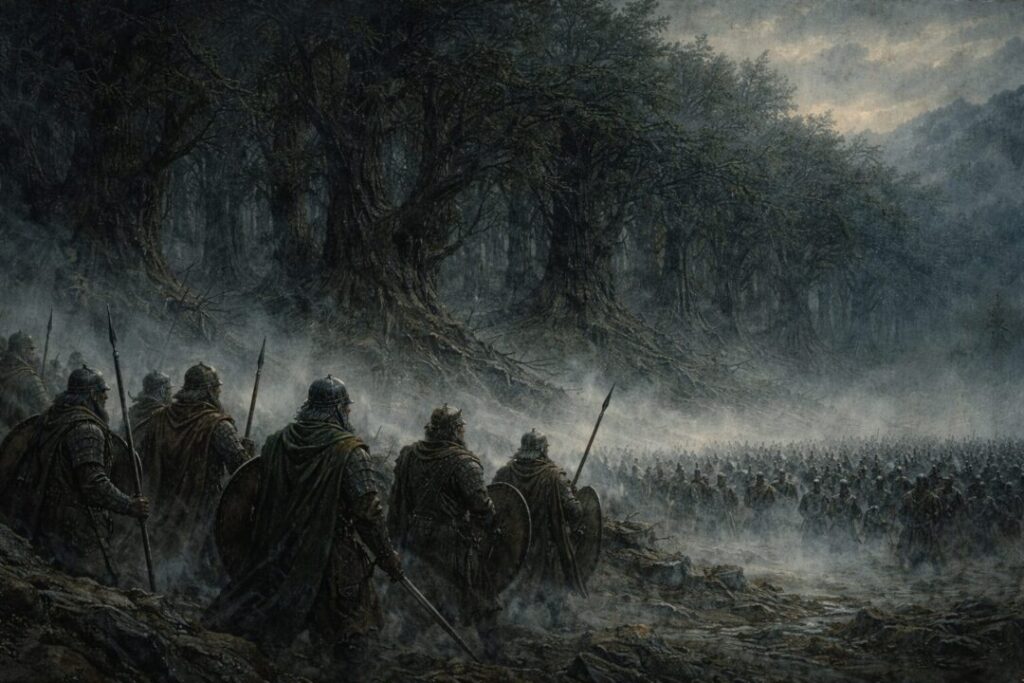
In the book, the most uncanny “arrival” does not come through the gate. It grows outside it.
When dawn breaks and Gandalf returns, the valley is no longer the same valley. The enemy begins to flee—and then finds something waiting: a wood that should not be there.
The narrative underlines the shock of it. The Rohirrim stare toward the trees, and the victory is suddenly mixed with unease.
Later, as the riders move past that wood, Legolas and Gimli sense its anger, and Gandalf gives a line that refuses neat certainty:
“What has become of the miserable Orcs?” Legolas asks.
“That, I think, no one will ever know,” Gandalf answers.
The implication is clear enough to feel, but Tolkien keeps it mythic at the edges: Huorns—tree-like beings of Fangorn—have come, and the fleeing Orcs vanish among them.
This matters, because it reveals what kind of help Helm’s Deep is allowed to have.
It is not the clean comfort of allies arriving in formation.
It is the wild, half-understood force of the world itself turning against what is unnatural in it.
That is a different mood entirely.
Elves at the wall say: the elder world still stands with you.
The Huorns say: the elder world is awake—and it is not gentle.
Erkenbrand, not Elves, is the “reinforcement” Tolkien emphasizes
The book also gives you a very specific human return: Erkenbrand.
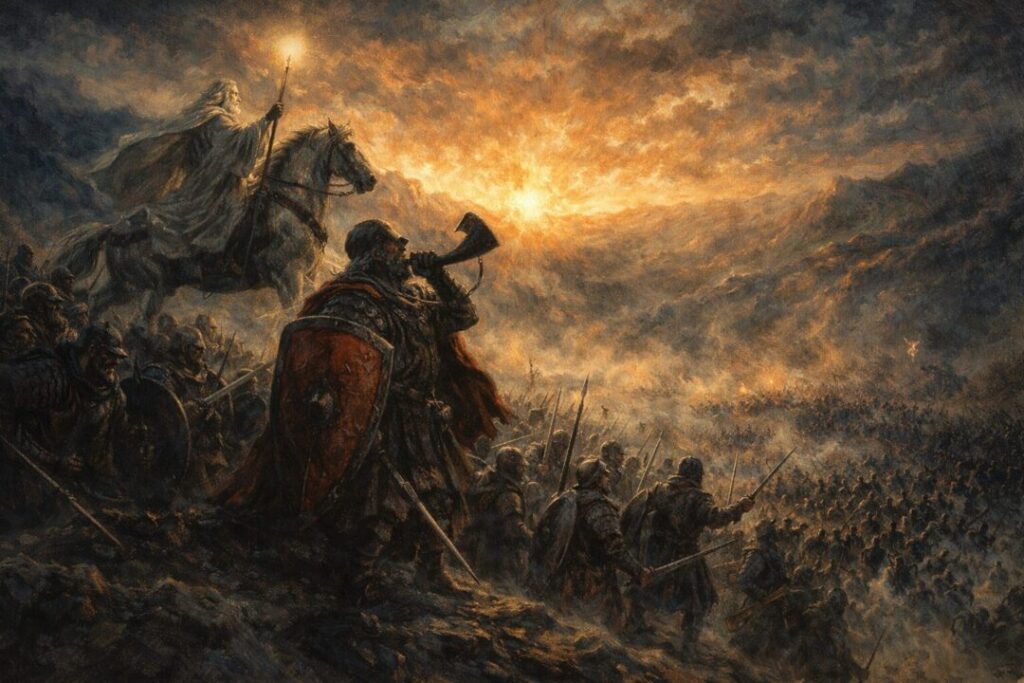
When the tide turns, the text doesn’t present a newly arrived Elven host. It presents Gandalf at dawn with men on foot, and among them the lord of Westfold, shield red, blowing a great horn as the Riders cry his name.
That choice is deliberate.
Instead of shifting the battle into a symbol of Elves and Men united, Tolkien makes it about Rohan gathering itself back together. The Westfold marshal is not a foreign ally. He is Rohan’s own strength—scattered, bruised, and returning when it can.
This supports the book’s deeper movement: Théoden is not saved by outsiders. He is restored, and then his own people rally.
If you add Elves to the defense, you inevitably soften that emphasis. The victory becomes less about Rohan recovering its nerve and more about Middle-earth briefly reassembling the old pattern.
The film is allowed that poetry.
The book is making a different point.
Why the loneliness matters: Helm’s Deep is a hinge into the Age of Men
In the book, the battle sits inside a long theme: the world is changing, and the older powers are receding.
The Elves do not “fail” to help at Helm’s Deep. The story simply refuses to make them the answer, because the answer is increasingly meant to be Men—Men learning to stand, not borrowing the strength of the Elder Days.
This is not presented as triumphal. It is bittersweet.
You can feel the old world still present in fragments: an Elf fighting with a Dwarf; a wizard riding like lightning; a strange forest arriving out of legend. But it is not assembled into an army of Elvendom marching to save a human fortress.
It is scattered—like the Age itself.
And that scatter is part of what makes Helm’s Deep so heavy on the page.
It is a night where courage isn’t performed for glory. It is scraped up out of fear and duty and stubborn refusal. It is a king riding into darkness with what he has, not with what he wishes he had.
That is why the film’s change matters so much.
It doesn’t just add spectacle.
It changes the moral weather.
So does the film “ruin” Helm’s Deep?
No—because the film is doing its own work.
Visually, Elves at Helm’s Deep externalize something real: the sorrow of the fading Elder Days, and the desire to see them burn bright one last time. And thematically, it highlights a genuine truth of the War of the Ring: the Free Peoples are resisting one Shadow, even if they cannot all stand in the same place at once.
But if you want to read the book’s Helm’s Deep accurately, you have to let it be what it is:
A battle where Rohan endures with what Rohan has.
A battle where the only Elf present is a single companion, not a relieving host.
A battle where the strangest help comes not as shining allies—but as a dark, angry wood that swallows the enemy and leaves even the victors uneasy.
And once you see that, the meaning of Helm’s Deep sharpens.
On film, it becomes a last flare of unity.
On the page, it becomes something closer to a threshold: the old world is still near enough to touch—but it is no longer organizing itself around the needs of Men.
Men must stand anyway.
That is why the absence of Elves in the book is not a missing feature.
It is the point.