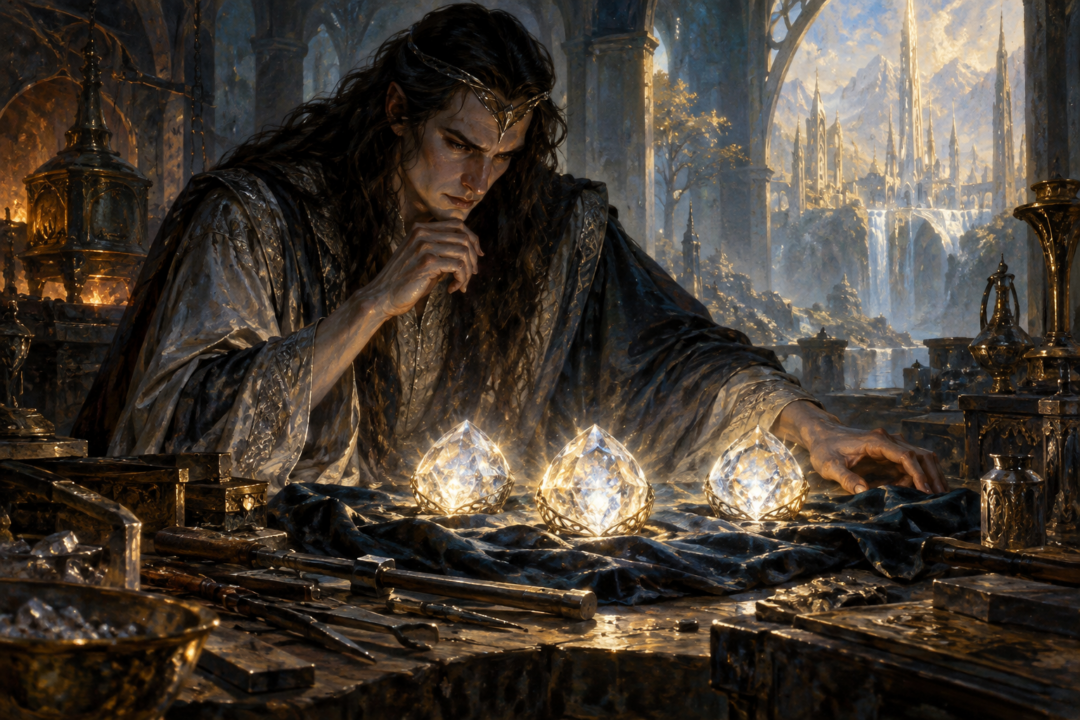
Imagine recovering Celebrimbor’s workshop intact.
The furnaces still stand. The hammers are there. Every alloy has been identified. Better still, suppose someone discovers detailed instructions describing every stage in the making of an Elven Ring of Power.
Would Middle-earth suddenly possess a factory for magical rings?
Almost certainly not.
Again and again, the great artifacts of Middle-earth resist the modern assumption that craftsmanship can be reduced to materials plus instructions. The Silmarils, the Rings of Power, the palantíri, and even less obviously spectacular Elvish works belong to traditions in which the maker matters enormously. Knowledge can be taught, techniques can be transmitted, and works can sometimes be imitated. Yet the greatest creations remain inseparable from the particular skill, history, intention, and—in some cases—power of the person who made them.
There is no single canonical rule saying, “Elvish artifacts cannot be mass-produced.” But the texts repeatedly show why a recipe alone would not be enough.
Fëanor Could Not Simply Make the Silmarils Again
The clearest example is also the most extreme.
Fëanor created the Silmarils before the destruction of the Two Trees. Within them he preserved the mingled light of Telperion and Laurelin. Their substance was extraordinarily durable, and their making represented the summit of his craft.
Then the Trees were poisoned.
The Valar asked Fëanor whether he would surrender the Silmarils so that their light might be used in an attempt to restore the Trees. His answer reveals something fundamental about great works in Tolkien’s world: Fëanor believed that if he broke the Silmarils, he could never make their like again.
This was not because he had forgotten how.
He was their maker.
If the Silmarils were merely products of a reproducible procedure, Fëanor should have been the person best equipped to manufacture replacements. Instead, their creation had apparently consumed something unrepeatable in his achievement. The work could be understood by its creator and still remain impossible to reproduce.
The episode does not establish a universal law governing every Elvish object. But it destroys the idea that technical knowledge automatically guarantees repeatability.
Some creations happen once.
The Maker Is Part of the Making
This pattern appears elsewhere.
Fëanor is also credited with the palantíri in the traditions preserved in The Lord of the Rings, although their exact making is not described. By the end of the Third Age, these seeing-stones are inherited relics from an older world. Gondor can use them, lose them, misunderstand them, or fight over them—but nobody simply establishes a workshop and replaces the missing stones.
The same broader principle surrounds many exceptional works of the Eldar.
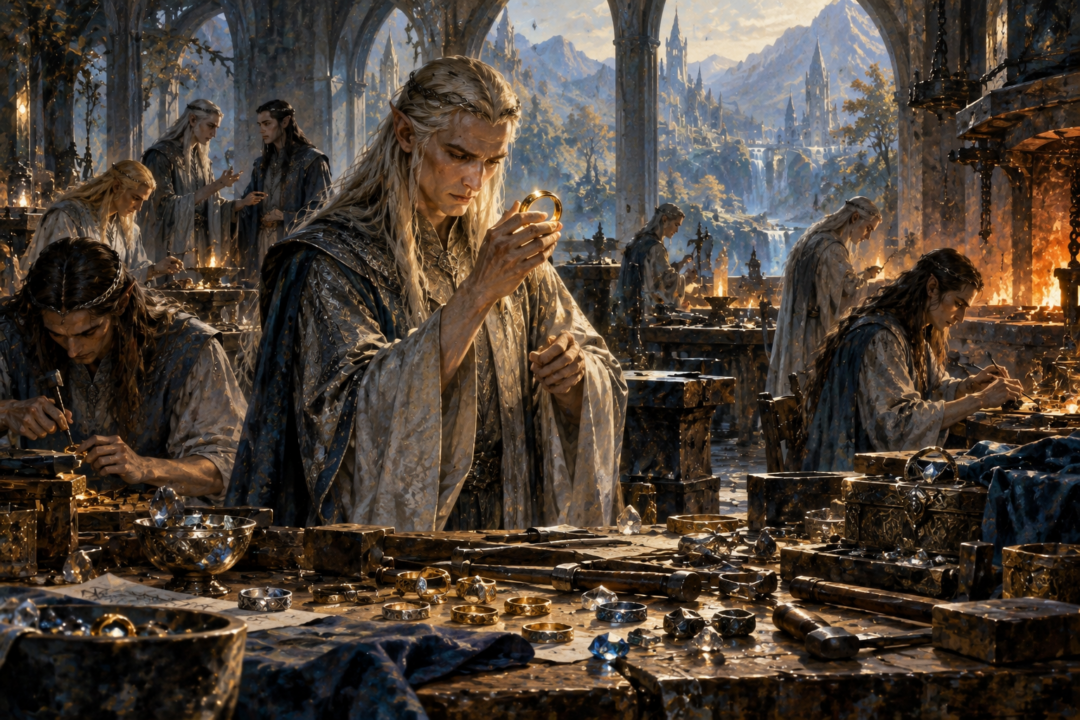
Elvish craftsmanship is certainly craftsmanship. Elves learn skills, operate workshops, work metals and jewels, transmit knowledge, and improve through practice. Eregion even possessed the Gwaith-i-Mírdain, a renowned brotherhood of jewel-smiths.
Yet mastery is personal.
A description of how Fëanor shaped a jewel would not make another smith Fëanor. Knowing the sequence of operations performed by Celebrimbor would not give another craftsman Celebrimbor’s abilities.
A recipe can preserve procedure. It cannot automatically reproduce the maker.
The Rings of Power Prove That Knowledge Can Be Transmitted
The Rings of Power provide an especially useful test because here knowledge really was taught.
In the Second Age, Sauron approached the Elven-smiths of Eregion in a fair form. They desired knowledge, and he possessed knowledge they did not. Under his instruction and influence, their craft advanced until the smiths made Rings of Power.
This immediately prevents an overly mystical interpretation.
Elvish craftsmanship was not purely instinctive or impossible to teach. Sauron could communicate techniques and lore. The smiths could learn them. They first produced lesser rings, described by Gandalf as essays in the craft before it was full-grown, and eventually created the Great Rings.
There was therefore something resembling technological development: experimentation, accumulated knowledge, instruction, and increasing mastery.
But that does not mean anyone possessing written directions could reproduce the result.
Celebrimbor eventually made the Three without Sauron touching them. They were his own greatest works, although the underlying ring-lore had developed through knowledge associated with Sauron.
Then Sauron forged the One alone.
The result was not merely another specimen produced from the same pattern.
The One Ring embodied Sauron’s particular purpose: domination. He placed a great measure of his own power into it, binding the Ring intimately to himself. Its extraordinary properties therefore cannot be separated from the being who created it.
A smith copying the Ring’s dimensions, metal, furnace temperature, and inscription would not thereby reproduce Sauron’s investment of power.

Why the One Ring Is the Perfect Counterexample to a “Recipe”
The One Ring looks almost absurdly simple.
It is a plain golden band.
That simplicity makes it tempting to imagine that its secret lies in hidden manufacturing instructions. But everything important about the Ring contradicts that idea.
Its significance comes from what Sauron did through it and placed into it. The Ring was designed to master the other Rings and their bearers. Its fate became bound to Sauron’s own power to such an extent that destroying it brought about his final overthrow.
The material object and the maker’s power had become inseparable.
That does not mean every magical object in Middle-earth requires its creator to pour personal power into it in precisely Sauron’s fashion. The One Ring is an exceptional case, and it would be unsafe to turn its mechanism into a universal law.
What it does prove is narrower and more important: at least some great artifacts cannot be explained by physical composition and construction instructions alone.
Something belonging to the maker can be essential to the result.
Even Identical Intentions Do Not Guarantee Identical Works
The traditions concerning the Elessar, or Elfstone, offer another revealing example precisely because they are not entirely consistent.
In material published in Unfinished Tales, different accounts are preserved concerning the jewel associated with healing and renewal. One tradition attributes an earlier Elessar to Enerdhil of Gondolin. Another involves Celebrimbor making a new jewel for Galadriel.
These accounts should not be forced into a single definitive history where the texts themselves preserve alternatives.
Yet one version contains an intriguing distinction: Celebrimbor’s later stone was said to be in some respects more subtle and clear, but to possess less power than the earlier one.
That is exactly what we would expect in a world where craftsmanship is not simple industrial replication.
A later master can understand an earlier achievement, pursue a similar purpose, and produce another extraordinary object without producing a mechanically identical duplicate.
The maker changes, and therefore the work changes.

Lembas Shows That Even a “Recipe” Is More Than Ingredients
Lembas provides a quieter example.
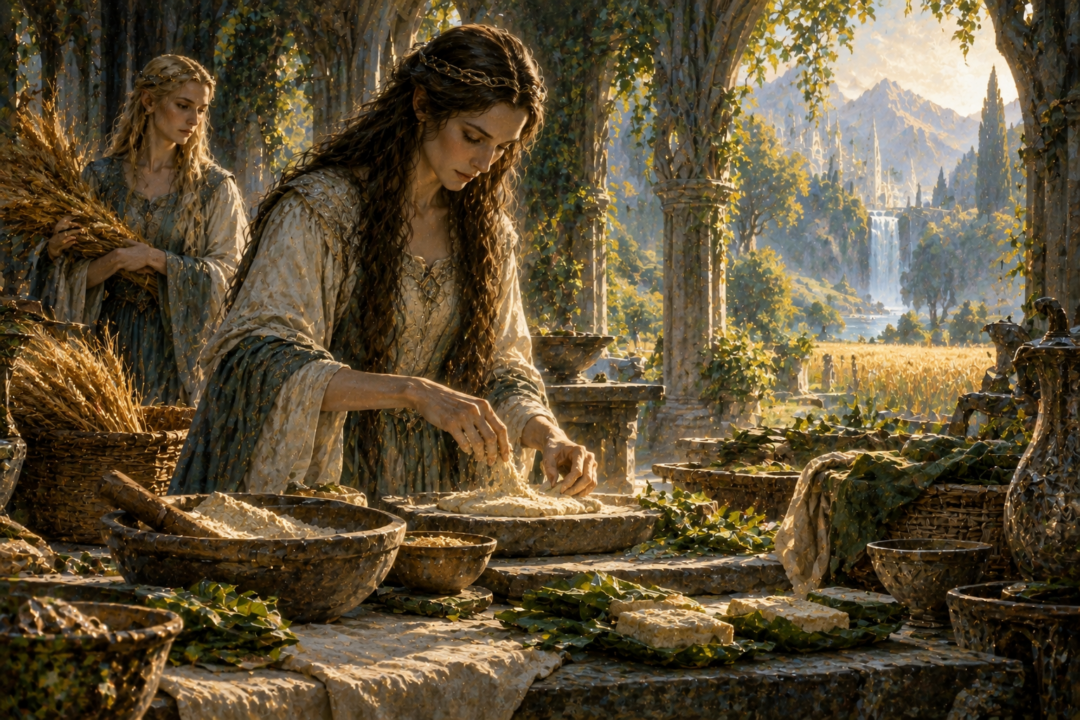
Unlike the Silmarils or Rings, lembas is food. Yet the surviving traditions about its making emphasize controlled knowledge, special grain, inherited custom, and designated makers.
In the text known as “Of Lembas,” the grain ultimately derives from Yavanna’s gift, and the knowledge of its preparation belongs to the Elven women entrusted with that tradition. The making and distribution of lembas are surrounded by rules that connect the food to its origin and cultural meaning.
It would be excessive to claim that another person was metaphysically incapable of baking something similar. The texts do not establish such a prohibition.
But lembas demonstrates that an Elvish “recipe” may involve far more than a list of ingredients.
The provenance of the material matters. The transmitted knowledge matters. The people entrusted with the craft matter. Tradition itself is part of the artifact’s identity.
Elvish “Magic” Is Not an Industrial Technology
Galadriel gives Sam one of the best clues when he struggles to understand what the Elves mean by magic.
To the Elves, the category is strange because outsiders use the same word for radically different things—including the works of the Enemy.
That distinction matters.
Many Elvish creations are extensions of artistry, preservation, perception, and an unusually deep understanding of the created world. Their makers do not necessarily experience a clean division between “ordinary craft” and “magic” comparable to the categories outsiders impose upon them.
This helps explain why reverse engineering an Elven artifact would be difficult.
A modern observer might ask:
What is it made from?
What process activates it?
What formula produces the effect?
Those questions are not useless. But they may capture only part of what happened.
The more important questions might be: Who made it? What did that maker understand? What was the maker trying to preserve or accomplish? What unique material was available? What knowledge had been inherited? And, in exceptional cases, what did the maker put of himself into the work?
The Lost Artifact Often Means the Lost Art
Middle-earth is filled with things that cannot simply be replaced.
The Silmarils are gone from ordinary reach. Most of the palantíri are lost or inaccessible by the end of the Third Age. Celebrimbor dies in the destruction of Eregion. The Ring-making tradition that reached its terrible culmination in the Second Age does not become a permanent industry producing endless replacements.
This reflects one of the deepest patterns in the history of Arda.
Knowledge can diminish.
Masters can die.
Materials can disappear.
Circumstances that once made a masterpiece possible may never return.
Later generations can inherit extraordinary objects without possessing the complete ability to create them anew.
That is why ancient artifacts matter so much. They are not merely expensive examples of things that could be manufactured again with enough investment. They can be surviving fragments of combinations that history itself has broken apart: a particular maker, a particular tradition, particular materials, particular knowledge, and a particular moment in the world.
A Recipe Could Preserve the Steps, But Not the World That Made Them Possible
If someone discovered Celebrimbor’s complete notes, they might learn an enormous amount.
They might discover metallurgical methods, jewel-craft, techniques inherited from the Noldor, and perhaps elements of the knowledge Sauron once taught in Eregion.
But possessing those notes would not automatically make the reader Celebrimbor.
Nor would it restore Eregion.
It would not recreate Fëanor’s genius, recover the unmarred light of the Two Trees, duplicate Sauron’s native power, or guarantee access to every material and tradition upon which an ancient work depended.
That is the crucial distinction.
Tolkien’s great artifacts are often reproducible in some limited sense: skills can be taught, related objects can be made, and one craftsman can build upon another’s knowledge. The Rings of Power themselves demonstrate this.
But the greatest works are not merely formulas embodied in matter.
They are historical events embodied in matter.
And once the maker, the knowledge, the materials, or the moment passes away, knowing the recipe may tell you exactly how the masterpiece was made without giving you the power to make it again.
Sources & Notes
- Silmarils — Fëanor could not duplicate his creation: https://tolkiengateway.net/wiki/Silmaril
- Rings of Power — Annatar's instruction and Celebrimbor's independent Three: https://tolkiengateway.net/wiki/Ring_of_Power
- Palantíri — their probable making by Fëanor and survival as inherited stones: https://tolkiengateway.net/wiki/Palant%C3%ADri
Sources checked for relevance and availability.