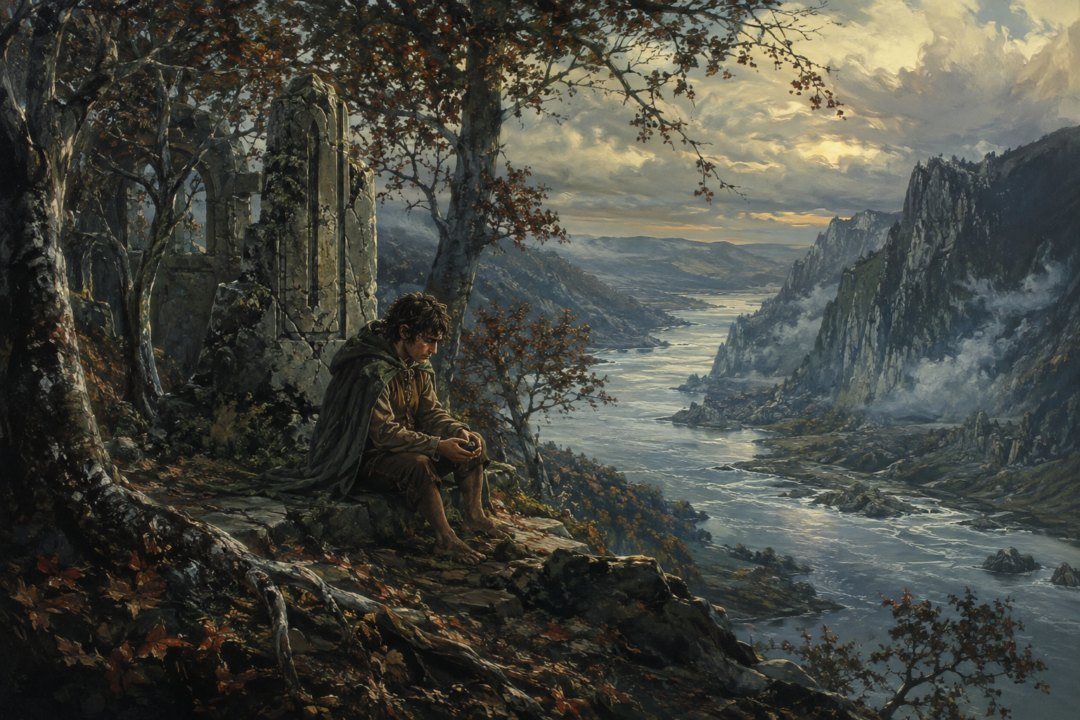
At Amon Hen, Frodo Baggins faces one of the loneliest choices in The Lord of the Rings. The Fellowship has crossed mountains, darkness, grief, and hundreds of miles together. Aragorn is prepared to accompany him toward Mordor. Merry and Pippin have no intention of abandoning him. Gimli and Legolas are loyal to the Company. Sam has followed him from the Shire.
Yet Frodo decides to disappear.
There is no farewell beside the Anduin. No final council. No speech thanking his companions. He takes a boat and attempts to cross the river alone.
At first this can look almost cruel. But the text makes Frodo's reasoning unusually clear. His silent departure is not a rejection of the Fellowship. It is the consequence of finally understanding what the Ring can do to the people who love him.
The Decision Frodo Cannot Avoid
The Fellowship reaches Parth Galen below Amon Hen with a question that can no longer be postponed.
Boromir intends to return to Minas Tirith. Frodo must decide whether to continue east toward Mordor, and the other members of the Company must decide what they will do once he chooses.
Aragorn places the central decision where it belongs: with the Ring-bearer.
Frodo asks for an hour alone.
Importantly, his difficulty is not simply uncertainty about geography. Sam understands his master better than the others do. While the Company discusses possible routes, Sam realizes that Frodo already knows, in essence, where he must go. What Frodo lacks is the courage to announce the consequences.
He must continue toward Mordor.
And increasingly, he believes he must do it without them.
That distinction matters. Frodo does not secretly abandon the Quest. He secretly accepts its most terrible road.
Boromir Proves Frodo's Fear Is Real
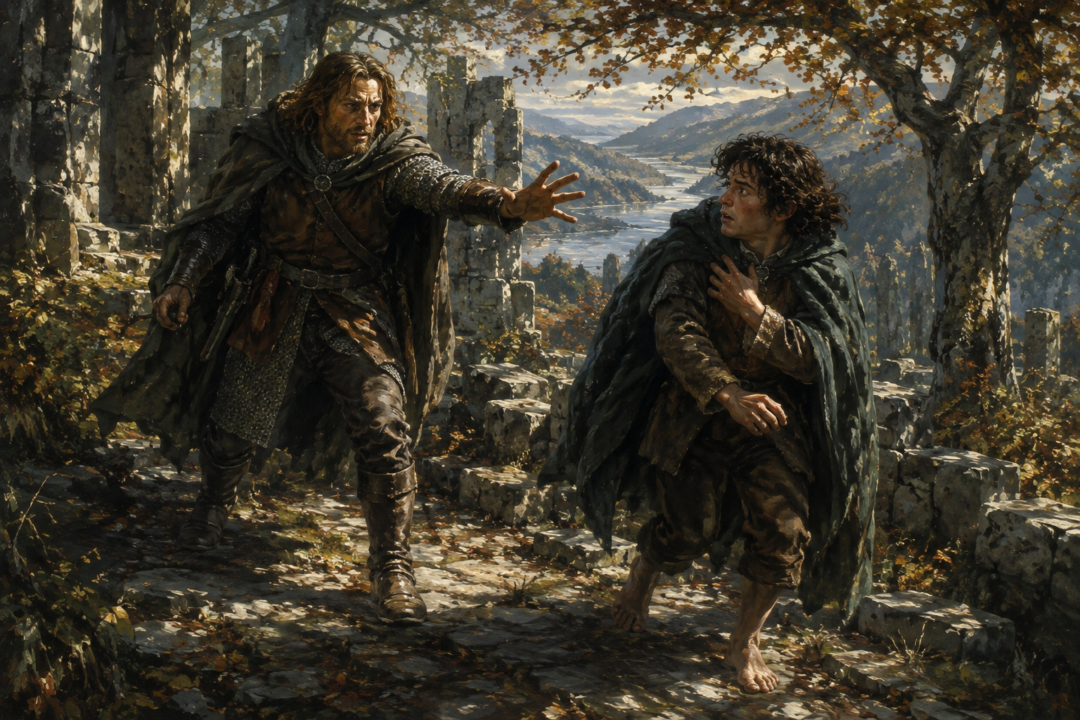
Frodo's private deliberation is interrupted by Boromir.
Boromir has long argued that the Ring should be brought toward Gondor rather than carried into Mordor to be destroyed. At Amon Hen, that temptation reaches its crisis. He attempts to persuade Frodo that the Ring could become a weapon against Sauron.
Frodo refuses.
Boromir's desire then overwhelms his judgment, and he tries to take the Ring.
Frodo escapes by putting it on.
Boromir quickly comes to himself and bitterly regrets what he has done. The episode should therefore not be reduced to the idea that Boromir was simply evil or secretly treacherous. His fall is frightening precisely because he is a brave man who has endured much beside Frodo and sincerely desires the defeat of Sauron.
And that is exactly what makes the encounter decisive.
If Boromir can fall, who is safe?
Frodo has already watched the Ring affect people in different ways. Bilbo struggled to surrender it. Gandalf refused to take it, fearing what he might become through its power. Galadriel rejected the temptation to possess it when Frodo freely offered it to her.
Now one of Frodo's own companions has actually attempted to seize it.
Frodo does not need to assume that Aragorn, Legolas, Gimli, Merry, Pippin, or Sam will inevitably do the same. The text never establishes such a rule.
He only needs to understand that remaining near him exposes them to the Ring.
After Boromir, that danger is no longer theoretical.
Amon Hen Shows Frodo the Scale of the War
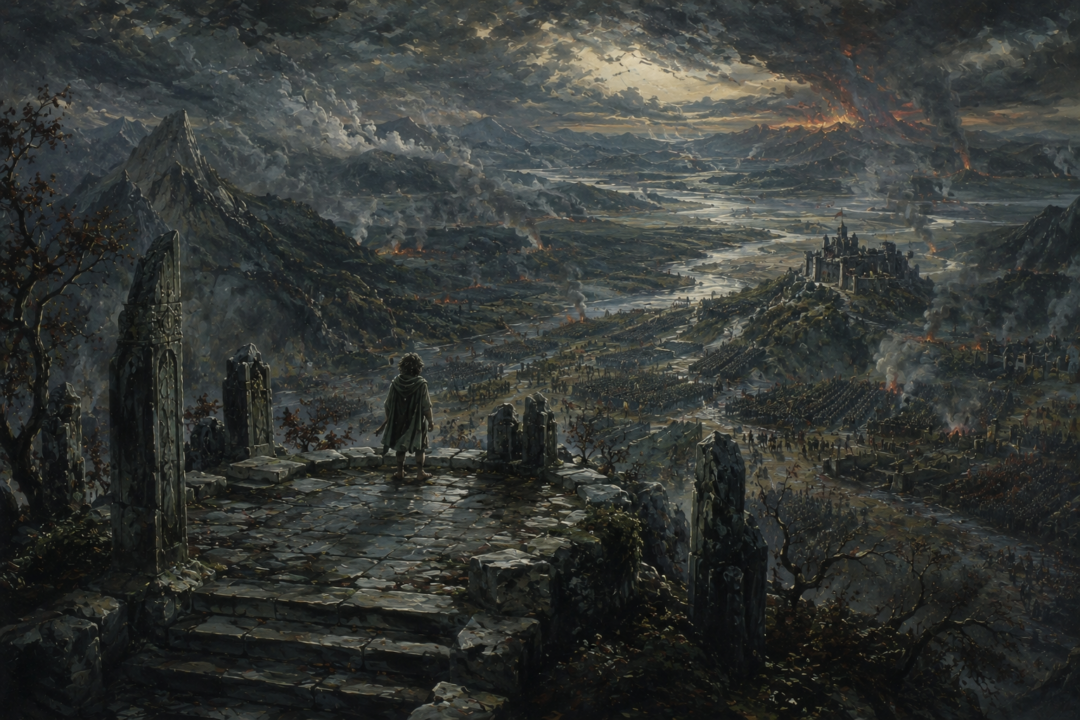
Frodo's escape carries him to the summit of Amon Hen, the ancient Hill of Seeing.
While wearing the Ring, his perception reaches astonishing distances. He sees signs of war and preparation across Middle-earth: armies, fortifications, and lands threatened by the gathering Shadow. Eventually his attention is drawn toward Barad-dûr, and he becomes aware of the searching Eye.
For a terrifying moment, Frodo is caught between opposing pressures before he manages to remove the Ring.
The experience changes the emotional scale of his decision.
The Quest is no longer merely the business of nine travelers trying to reach a distant mountain. Frodo has glimpsed the vast machinery of the war surrounding them.
And amid that enormous conflict, the central truth remains brutally simple.
The Ring has to reach the Fire.
Frodo cannot win the great battles he has glimpsed. He cannot command Gondor's armies. He cannot defeat Sauron in open war.
His task is smaller in appearance and greater in consequence: carry the Ring toward the one place where it can be destroyed.
Why Frodo Believes He Must Go Alone
After the confrontation with Boromir, Frodo reaches his conclusion.
He will go to Mordor.
Alone.
His reasoning combines two forms of protection.
First, he fears the Ring's effect upon his companions. Boromir has shown what proximity to the Ring can eventually produce even in someone fighting for a good cause.
Second, Frodo understands what accompanying him means physically.
The road ahead leads into the Enemy's land. Frodo expects terrible danger and has little reason to believe that everyone who follows him will return.
This makes his decision characteristically self-sacrificial but also tragically limited. Frodo can choose to risk himself. He finds it much harder to accept that his friends may freely choose to risk themselves for him.
His solution is therefore to remove their choice.
If he tells them what he intends, they may refuse to let him leave alone.
Merry and Pippin have already shown extraordinary loyalty. Aragorn has undertaken responsibility for the Company after Gandalf's fall. Sam's devotion scarcely needs explanation.
A formal goodbye would become an argument.
Frodo avoids the argument by leaving.
Sam Had Already Understood Him
There is one person Frodo cannot deceive.
Sam.
While the others debate Frodo's likely choice, Sam recognizes something they have missed: Frodo is not merely struggling over whether to go east or west. Sam believes his master intends to slip away alone.
That insight becomes crucial when the Fellowship scatters in search of Frodo.
Others search the woods.
Sam thinks about Frodo.
He realizes that Frodo will need a boat to cross the Anduin, so he returns toward the landing place.
This is one of Sam's great strengths throughout the story. He does not always possess the knowledge of Aragorn or the wisdom of Gandalf, but he watches Frodo closely. His understanding grows from attention and love.
At the shore, Sam discovers Frodo attempting to depart invisibly.
Frodo almost succeeds.
Almost.
Frodo's Plan Breaks on Sam's Loyalty
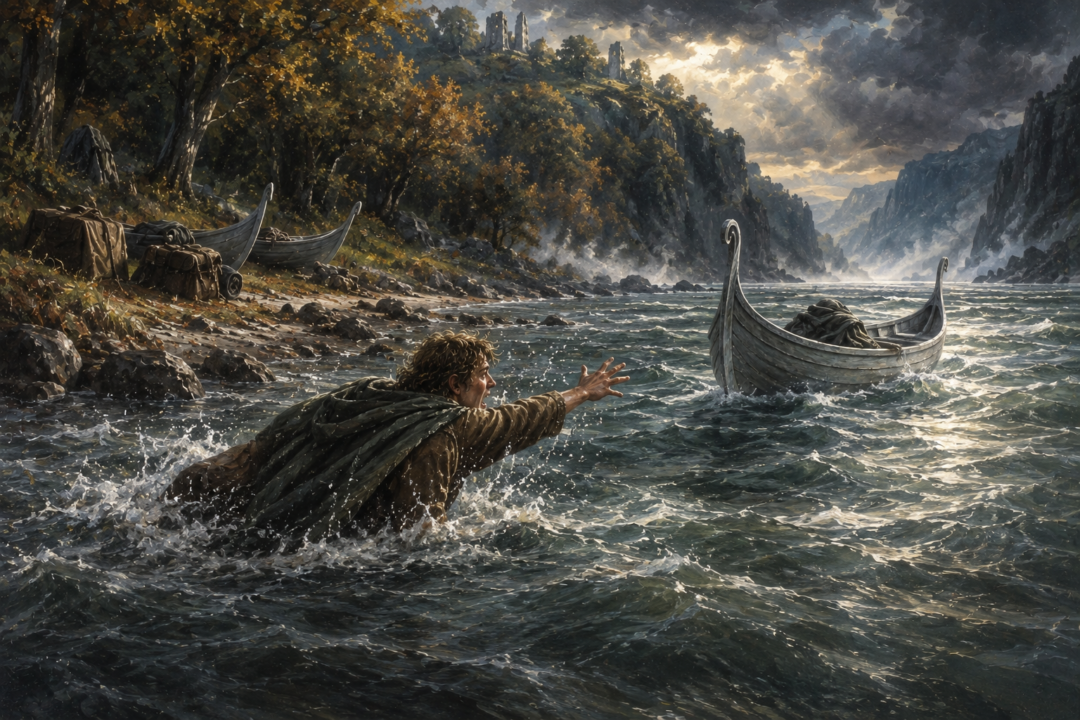
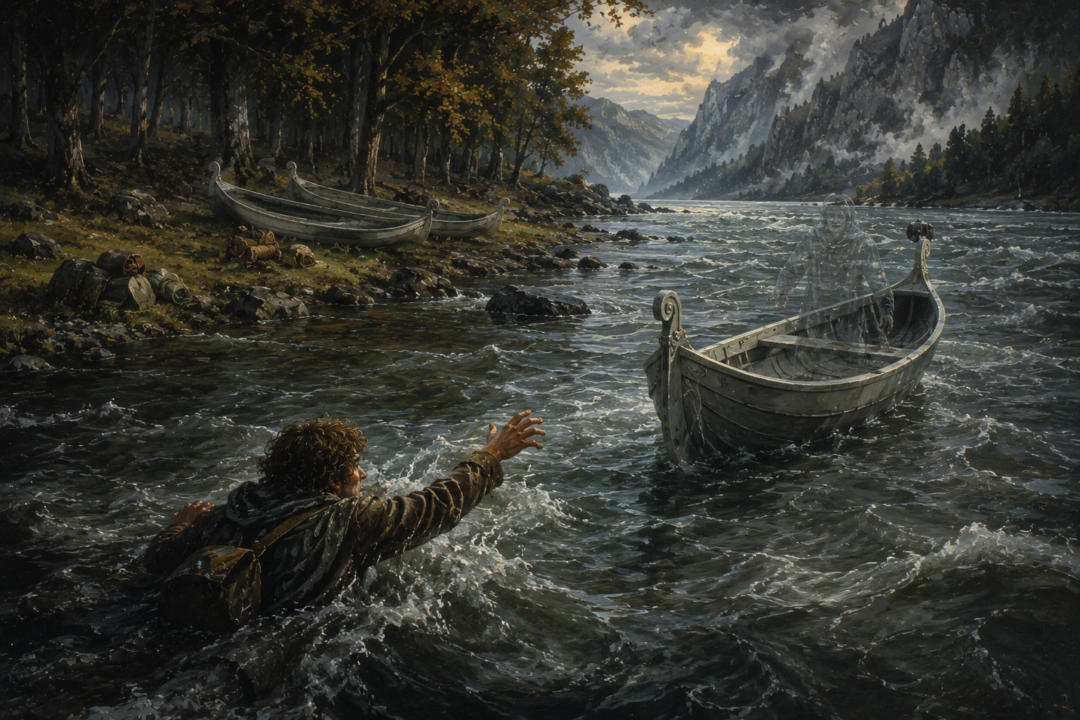
When Sam realizes Frodo is leaving, he follows him into the water.
There is an immediate problem: Sam cannot swim.
He sinks, and Frodo is forced to turn back and save him.
The moment strips Frodo's plan down to its emotional core. He can hide from Sam with the Ring. He can take the boat. He can insist that the road is too dangerous.
What he cannot do is make Sam abandon him.
Sam's determination effectively answers Frodo's decision with a decision of his own.
Frodo intended to sacrifice companionship in order to protect his friends. Sam is willing to risk his life rather than permit Frodo to bear everything alone.
Frodo finally accepts this.
He had wanted to go alone, but the text makes clear that he is glad to have Sam.
That qualification is important. Frodo does not suddenly decide that his original fears were foolish. Mordor remains dangerous. The Ring remains dangerous.
Instead, he accepts that Sam's loyalty is not something he has the right—or perhaps the power—to erase.
Why There Could Be No Proper Farewell
A goodbye would have required Frodo to stand before the Fellowship and explain himself.
Then Aragorn could answer.
Merry could protest.
Pippin could refuse.
Gimli and Legolas could offer to continue.
Sam certainly would.
Frodo's secrecy is therefore practical as well as emotional. He believes departure is necessary, and conversation threatens to make departure impossible.
There is also a deeper irony.
Frodo leaves because the Fellowship matters to him.
Boromir's attempt to seize the Ring has shown him that the Company can no longer protect the Ring without also being endangered by it. Continuing together might expose his friends both to Mordor and to the object they are trying to destroy.
So Frodo performs an act that resembles abandonment while intending protection.
It is not necessarily a perfect decision. Readers can reasonably see something paternalistic in Frodo choosing danger on everyone else's behalf. Sam's response exposes that weakness immediately.
But Frodo's motive is not indifference.
It is love distorted by the terrible responsibility he carries.
The Fellowship Breaks, but Its Purpose Survives
Frodo's silent departure also reveals something important about the meaning of the Fellowship.
Its strength was never dependent upon all nine companions physically reaching Mount Doom together.
Gandalf has already fallen in Moria. Boromir dies defending Merry and Pippin. Aragorn, Legolas, and Gimli will turn away from Frodo's trail to pursue the captured hobbits. Merry and Pippin will travel into entirely different parts of the war.
The Company breaks geographically.
Its loyalty does not.
Indeed, the scattered members of the Fellowship go on to affect events across Middle-earth in ways no carefully maintained marching formation could have accomplished.
Frodo and Sam continue toward Mordor.
Aragorn, Legolas, and Gimli pursue the Orcs.
Merry and Pippin encounter Treebeard and become entangled in the awakening of the Ents.
Their roads divide, but the larger struggle binds them together.
That is why Frodo's departure at Amon Hen is more than the ending of one stage of the journey. It transforms the nature of the story.
The Quest becomes lonelier.
The war becomes larger.
And fellowship itself stops meaning simply traveling side by side.
Frodo Leaves Because He Loves Them
The painful truth of Amon Hen is that Frodo has learned enough about the Ring to fear what continued closeness to it may cost his friends.
Boromir gives that fear a human face.
The vision from Amon Hen gives Frodo a glimpse of the scale of the enemy.
And Frodo responds in the way that increasingly defines his burden: he tries to take the suffering upon himself.
That is why there is no farewell.
A farewell invites others to follow.
Frodo does not want followers walking into Mordor because of him, and he does not want the Ring testing them as it tested Boromir. So he attempts the only solution he believes remains: quietly remove himself from the people he is trying to protect.
Sam proves that love cannot always be protected by distance.
Frodo tries to save his friend by leaving him behind.
Sam saves Frodo from absolute loneliness by refusing to stay.
And so the Fellowship ends at Amon Hen in one sense—but in another, its deepest promise survives in a single small boat crossing the Anduin, carrying two hobbits toward the Shadow.
Sources & Notes
- https://www.glyphweb.com/arda/f/frodobaggins.php — Encyclopedia of Arda: Frodo’s burden, departure from the Company, and decision to continue alone
- https://www.glyphweb.com/arda/a/amonhen.php — Encyclopedia of Arda: the hill where Frodo faced Boromir and the Fellowship broke
- https://www.glyphweb.com/arda/f/fellowshipofthering.php — Encyclopedia of Arda: the Company’s journey and dissolution at Parth Galen
- https://www.glyphweb.com/arda/s/samwisegamgee.php — Encyclopedia of Arda: Sam’s recognition of Frodo’s intent and insistence on accompanying him
Sources document Frodo’s decision at Amon Hen, the Fellowship’s fracture, and Sam’s pursuit.