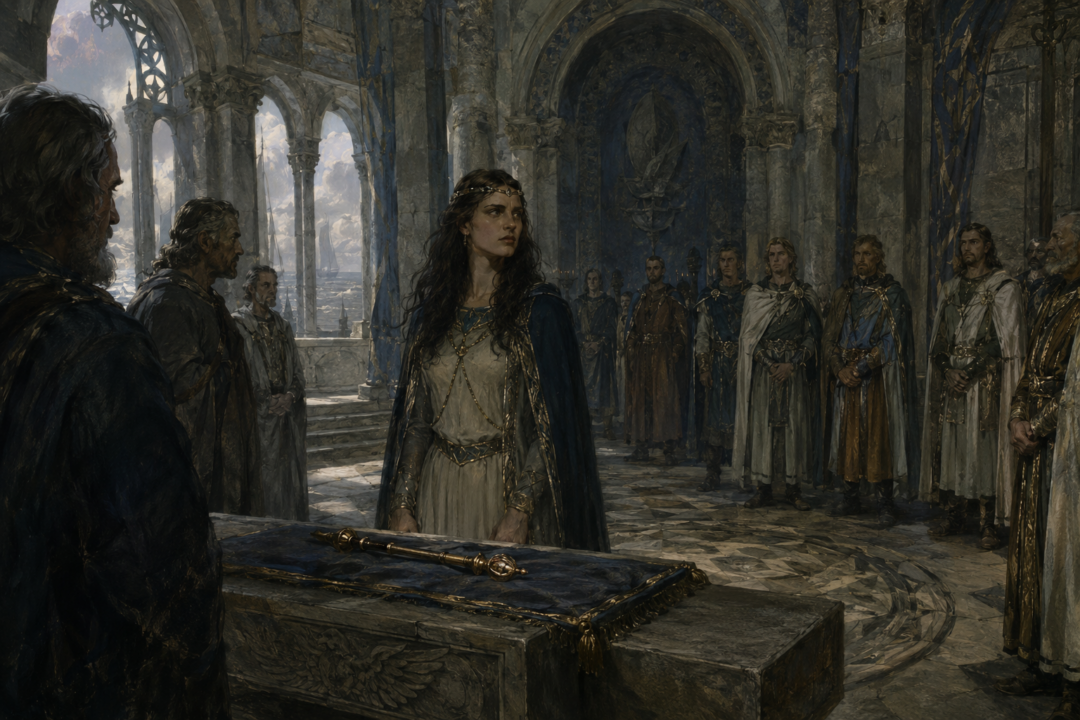
The Sceptre of Númenor was supposed to pass according to law. Yet one of the most revealing details in the island kingdom’s history is that the question of who could marry whom became inseparable from the question of who could rule.
That tension appears most clearly around Númenor’s first Ruling Queen, Tar-Ancalimë. Her father changed the succession law so that a daughter could inherit, but the new arrangements initially tied an heir’s marriage to descent from the Line of Elros. Ancalimë therefore found herself surrounded by eligible relatives, political pressure, and the possibility that another branch of her own family could replace her.
More than two thousand years later, the same royal dynasty reached its final crisis through another marriage between relatives. Pharazôn took his cousin Míriel as wife against her will, despite Númenórean law forbidding so close a union, and seized the Sceptre that should have passed to her.
The two episodes are not identical. In fact, their differences matter. But together they reveal how Númenor’s desire to preserve the prestige of its royal blood gradually turned kinship into a political weapon.

The Succession Problem Began Before Ancalimë
Early Númenórean succession followed a male preference much stronger than the law that governed the kingdom later.
Tar-Elendil’s eldest child was his daughter Silmariën. She did not receive the Sceptre; it passed instead to her younger brother, Tar-Meneldur. Silmariën nevertheless became enormously important to the history of Middle-earth because her descendants were the Lords of Andúnië and, eventually, the line of Elendil.
The old custom therefore created an obvious political problem whenever a ruler lacked a son.
That problem became urgent with Tar-Aldarion.
Aldarion’s marriage to Erendis had collapsed after years of conflict, much of it centred upon his devotion to voyages and the sea and her resentment of his long absences. They had only one child: Ancalimë.
Without a change, the royal succession would have passed away from Aldarion’s daughter.
Aldarion instead altered the rules.
The surviving material in Unfinished Tales contains complexities and differing formulations of the new law, but its historic result is clear: Ancalimë was proclaimed King’s Heir and eventually became Númenor’s first Ruling Queen.
Yet the reform did not separate succession from marriage. It initially made marriage even more politically significant.
The Heir Was Expected to Marry Within the Line of Elros
One provision associated with Aldarion’s new arrangements required the King’s Heir to marry within the Line of Elros or surrender the Heirship.
The immediate background was personal. Aldarion’s own disastrous marriage to Erendis influenced his thinking. Erendis, although Númenórean, did not possess the same ancestry and longevity as the royal house.
For Ancalimë, however, the consequence was extraordinary.
She could inherit because the law had been changed for her, but retaining and transmitting that inheritance became entangled with whom she married.
This effectively narrowed the politically acceptable marriage pool to her own extended dynasty.
It is important not to overstate this as a permanent legal system of royal cousin marriage. The relevant provisions were altered, and a note preserved with Aldarion and Erendis explicitly distinguishes later practice from binding law.
But the idea survived.
Marriage within the Line of Elros became what the text calls a “custom of pride,” and its increasing rigidity is described as a symptom of the growing Shadow.
That description transforms what might look like a genealogical curiosity into something much darker. The royal house increasingly valued its separation from other Númenórean families even when the old differences that had once distinguished Elros’s descendants had diminished.
Ancalimë Turned Marriage Into a Succession Battle
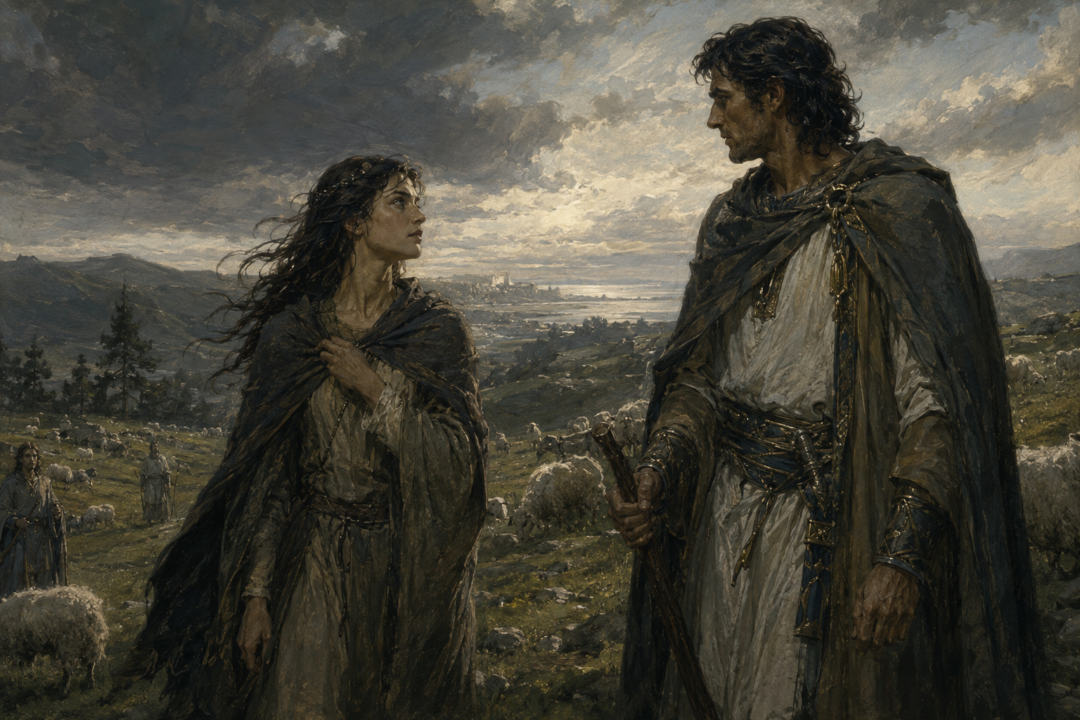
Ancalimë did not eagerly accept the role expected of her.
The wreckage of Aldarion and Erendis’s marriage shaped her childhood, and the surviving accounts portray her as deeply resistant to marriage herself. This created a constitutional problem because other members of the dynasty stood behind her.
One of them was Soronto, her cousin, the son of Aldarion’s sister Ailinel.
The surviving versions of Ancalimë’s story differ on exactly how events unfolded. That uncertainty needs to be preserved rather than smoothed into a single narrative.
In one account, Hallacar’s persistence and pressure from the Council encouraged Ancalimë to marry for the stability of the realm. In another, she remained unmarried until Soronto invoked the succession provisions and pressed her to surrender her position, whereupon she married Hallacar partly to frustrate him. Another notice connects the marriage with preventing Soronto’s eventual succession should Ancalimë die childless.
Whatever sequence is preferred, the underlying political reality is consistent: Ancalimë’s marital status affected the future possession of the Sceptre.
Marriage was no longer merely a private decision by the King’s daughter.
It could determine which branch of Elros’s descendants ruled Númenor.
Hallacar Was Himself of the Royal Line
Ancalimë eventually married Hallacar, son of Hallatan of Hyarastorni.
Crucially, Hallacar was himself descended from Vardamir Nólimon, the son of Elros Tar-Minyatur. He therefore belonged to the extended Line of Elros.
The marriage brought two branches of that lineage together.
But it did not produce domestic harmony.
Ancalimë and Hallacar had one son, Anárion, who eventually succeeded his mother as Tar-Anárion. After his birth, however, strife arose between his parents, and their relationship became bitter.
This is one of the great ironies of early Númenórean history. A system partly intended to protect dynastic continuity succeeded biologically and politically: there was an heir, and the succession continued.
Yet the marriage itself reproduced the unhappiness that had surrounded Ancalimë’s childhood.
Dynastic security did not create personal stability.
The “Custom of Pride” Matters More Than Genetic Speculation
It would be tempting to interpret Númenórean royal intermarriage primarily through modern ideas about hereditary illness or inbreeding. The texts do not provide evidence for such an argument.
The important consequence is political and moral.
A surviving note explains that royal marriage within the Line of Elros was not ultimately a matter of law but became a “custom of pride.” Even more significantly, it became rigid as the differences in lifespan, vigour, and ability between Elros’s descendants and other Númenórean families had diminished or disappeared.
In other words, the distinction was being defended most fiercely when its practical basis was fading.
That pattern mirrors Númenor’s wider decline.
The Númenóreans possessed extraordinary gifts: long life, knowledge, strength, and an island realm granted to the Edain after the overthrow of Morgoth. Over time, gratitude increasingly gave way to anxiety about losing those gifts.
The royal marriage custom reflects the same instinct on a smaller scale.
Instead of accepting change, the dynasty increasingly guarded the boundary around itself.
One reading, therefore, is that endogamous royal marriage became another expression of Númenor’s growing obsession with inheritance: inherited status, inherited longevity, inherited authority, and eventually the desire to escape death itself.
Pharazôn and Míriel Were a Much More Extreme Case
At the end of Númenor’s history, marriage and succession collided again.
Tar-Palantir had only one child, Míriel. Under the established succession law, the Sceptre belonged to her after her father’s death.
But her cousin Pharazôn, son of Tar-Palantir’s younger brother Gimilkhâd, returned to Númenor with enormous wealth, military prestige, and popular support.
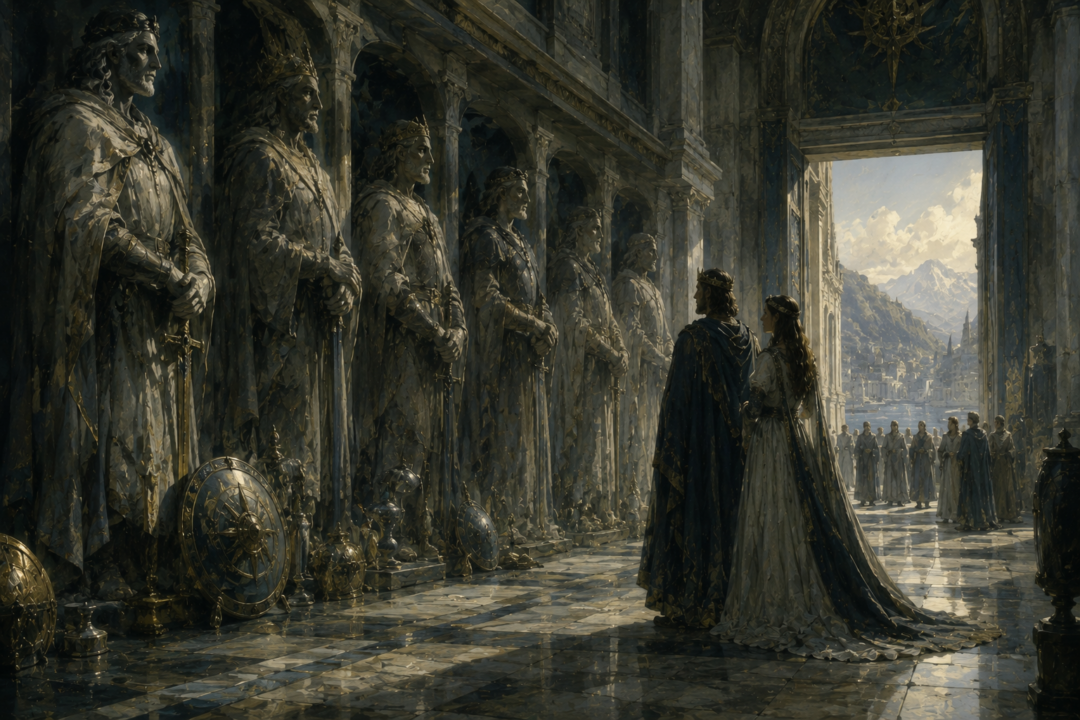
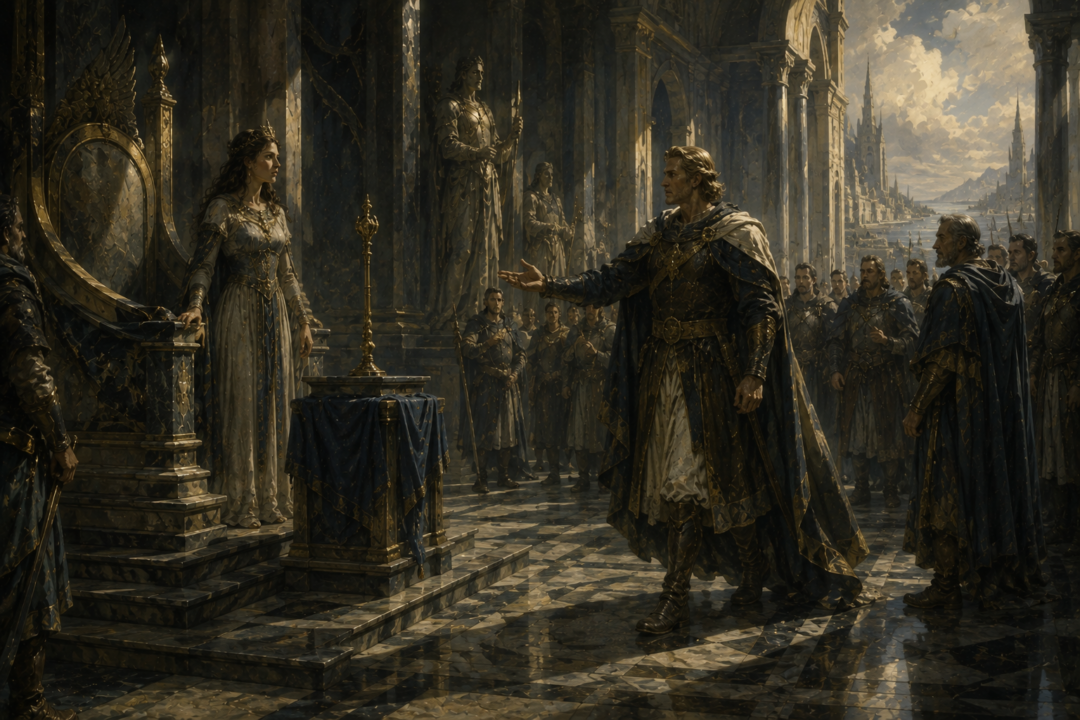
After Tar-Palantir died, Pharazôn took Míriel as wife against her will and seized the Sceptre, becoming Ar-Pharazôn.
Here an essential distinction must be made.
This marriage was not simply an example of accepted royal cousin marriage.
It violated Númenórean law.
The Akallabêth states that marriage was forbidden to those more closely related than cousins in the second degree. Pharazôn and Míriel were first cousins: their fathers were brothers.
Thus the final royal marriage of Númenor crossed a boundary that Númenórean society itself recognized.
And the violation served a political purpose. Míriel possessed the lawful claim to the Sceptre. By taking her as wife and then taking the Sceptre himself, Pharazôn converted a kinship connection to the rightful heir into an instrument of usurpation.
The published account is explicit that Míriel was taken against her will. Other developmental versions of Númenor’s legend differ concerning her feelings toward Pharazôn, but they should not be substituted for the account presented in the published Akallabêth when discussing the familiar form of the story.
From Protecting the Dynasty to Overriding Its Law
The contrast between Ancalimë and Míriel is striking.
In Ancalimë’s era, royal marriage restrictions were connected with an attempt to secure succession. The problem was how a female heir could inherit while preserving the continuity of the royal line.
By Míriel’s era, a close royal kinsman simply broke both the succession settlement and the marriage restriction.
The institution designed to order inheritance could no longer restrain the most powerful claimant.
That does not mean cousin marriage caused Númenor’s downfall. The texts give no basis for such a claim. Númenor’s catastrophe grew from far larger forces: fear of death, imperial ambition, rejection of the Ban of the Valar, the growing Shadow, and finally Sauron’s manipulation of Ar-Pharazôn and his followers.
But royal marriage provides a revealing thread running through that decline.
Early in the kingdom’s history, the Line of Elros debated how blood, marriage, and lawful succession should interact.
Late in its history, pride had overwhelmed the restraint those laws were supposed to provide.
The Dynasty’s Deepest Irony
There is a final irony.
Silmariën, the royal daughter who could not inherit under the ancient custom, became ancestress of the Lords of Andúnië. From that line came Amandil, Elendil, Isildur, and Anárion—the house that survived the Downfall and preserved Númenórean kingship in Middle-earth.
Míriel, who by the later law had every right to inherit Númenor itself, lost the Sceptre to her cousin and died in the Downfall.
The branch excluded from the throne endured.
The branch that possessed the throne perished with the island.
Númenórean succession politics therefore tell a larger story than a sequence of royal marriages. They show a civilization struggling to decide whether ancestry was a responsibility or a possession.
The Line of Elros began as the inheritance of a remarkable past. When preserving the distinction of that blood became a matter of pride, kinship could become restriction, pressure, rivalry, and finally a weapon of seizure.
And at Númenor’s end, the man who claimed the greatest kingship of all did so by violating the very laws of family and succession that were meant to protect it.
Sources & Notes
- https://www.glyphweb.com/arda/t/tarmiriel.php — Encyclopedia of Arda: Tar-Míriel’s status as royal heir and forced marriage to her cousin Ar-Pharazôn
- https://www.glyphweb.com/arda/a/arpharazon.php — Encyclopedia of Arda: Ar-Pharazôn’s ancestry, marriage, seizure of the sceptre, and reign
- https://www.glyphweb.com/arda/t/tarpalantir.php — Encyclopedia of Arda: Tar-Palantir’s reign, daughter and heir, and succession crisis
- https://www.glyphweb.com/arda/l/lineofelros.php — Encyclopedia of Arda: the royal genealogy through which cousinship and succession claims operated
Sources document Númenórean royal succession and the close-kin marriage of Tar-Míriel and Ar-Pharazôn.