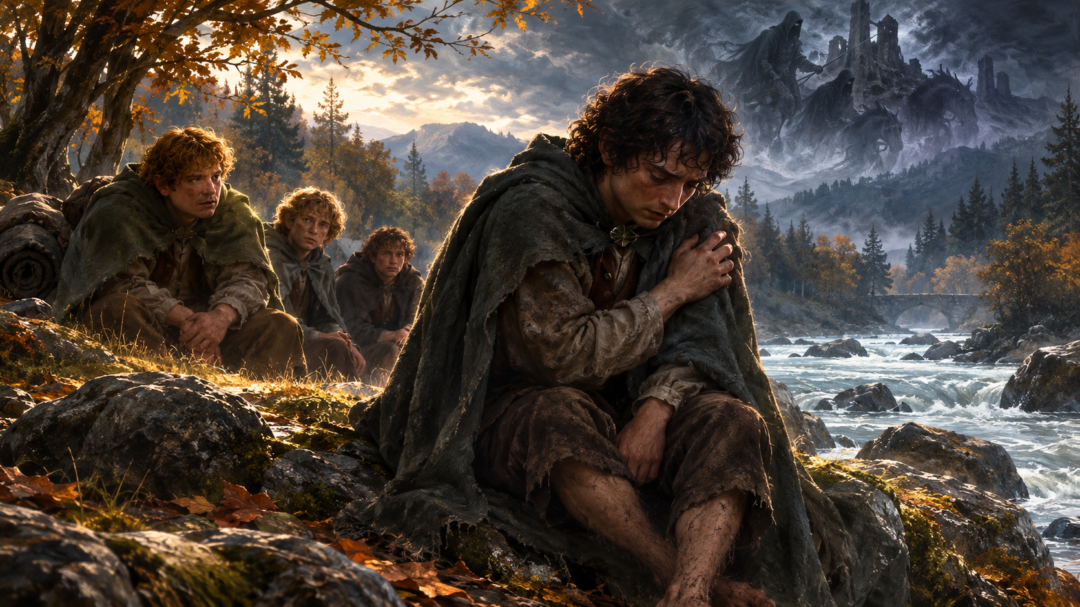
Frodo Baggins returns to the Shire alive. The Ring is destroyed. The Nazgûl are gone. Shelob has been escaped, Sauron has fallen, and even the last violence brought into Hobbiton is eventually overcome.
Yet Frodo does not simply become well.
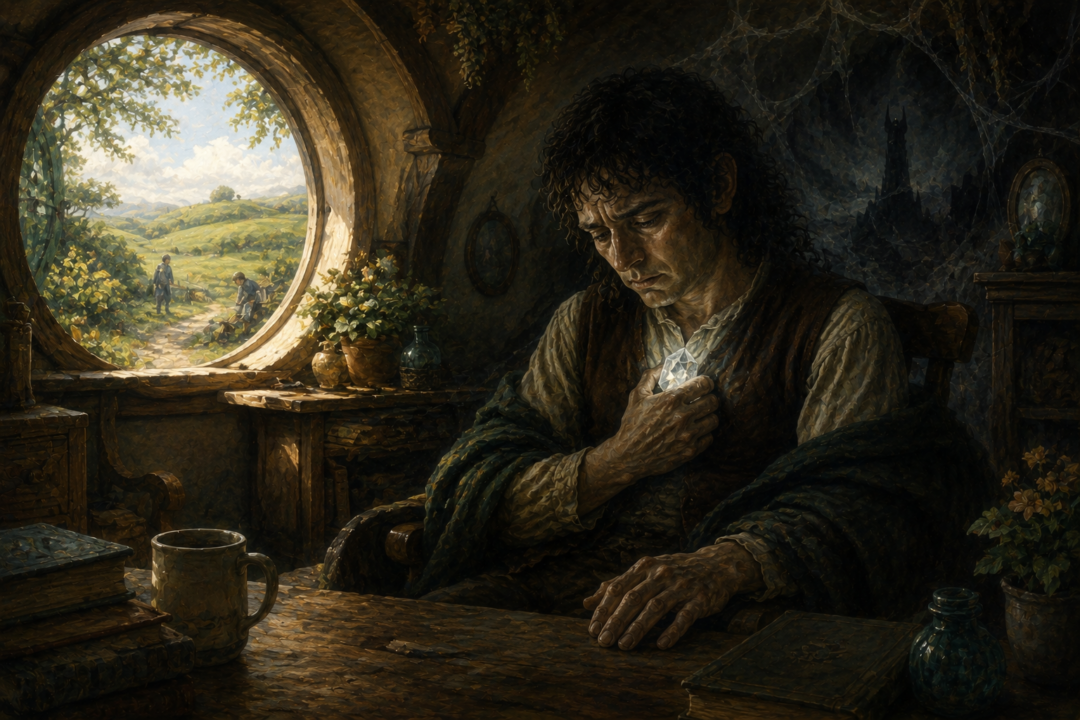
One of the quietest and most unsettling details in the closing history of the War of the Ring is that his suffering returns on particular dates. On 6 October, the anniversary of the attack at Weathertop, his old shoulder wound troubles him. On 13 March, the anniversary of his poisoning by Shelob and capture near Cirith Ungol, he becomes ill again.
The dates matter because Frodo’s wounds are more than scars.
They belong simultaneously to his body, his memory, and the history through which he has passed. His suffering suggests that surviving evil does not necessarily mean escaping every consequence of having encountered it.
Two Dates, Two Terrible Wounds
Frodo’s recurring illnesses are sometimes treated as though they come from one mysterious lingering injury. The chronology is more revealing.
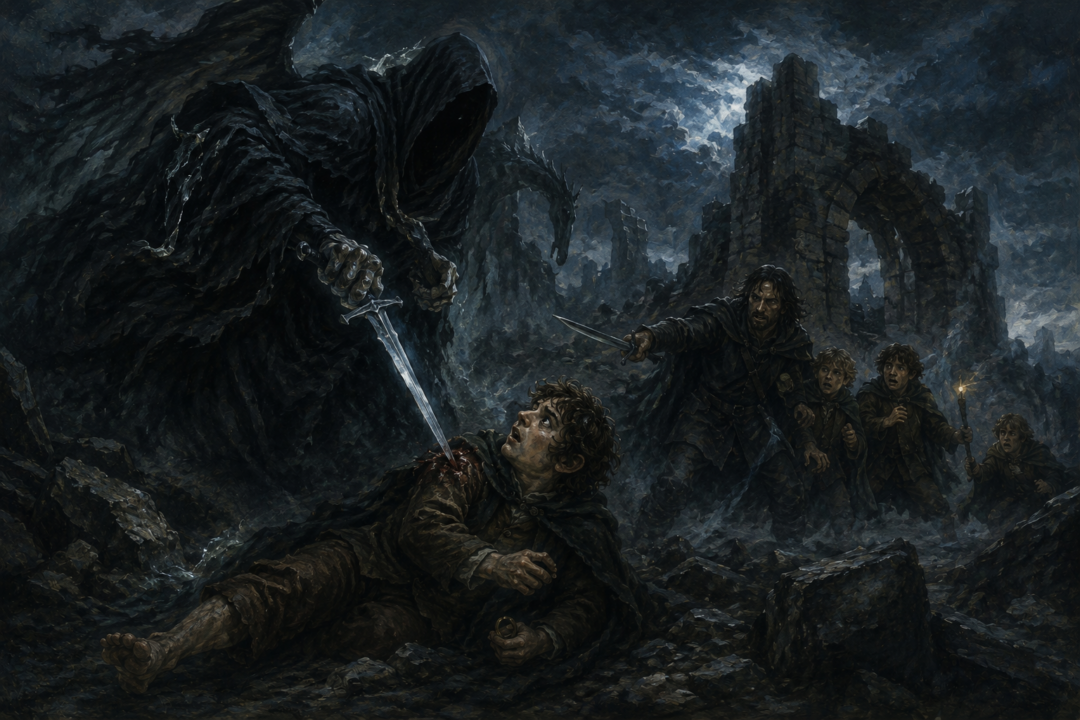
On 6 October 3018 of the Third Age, Frodo is stabbed at Weathertop by the Lord of the Nazgûl. The weapon is no ordinary knife. A fragment remains in his body and works inward, threatening to draw him into the shadow-world and make him subject to the Ringwraiths.
Elrond eventually removes the fragment in Rivendell, and Frodo survives.
But survival does not mean the event has been erased.
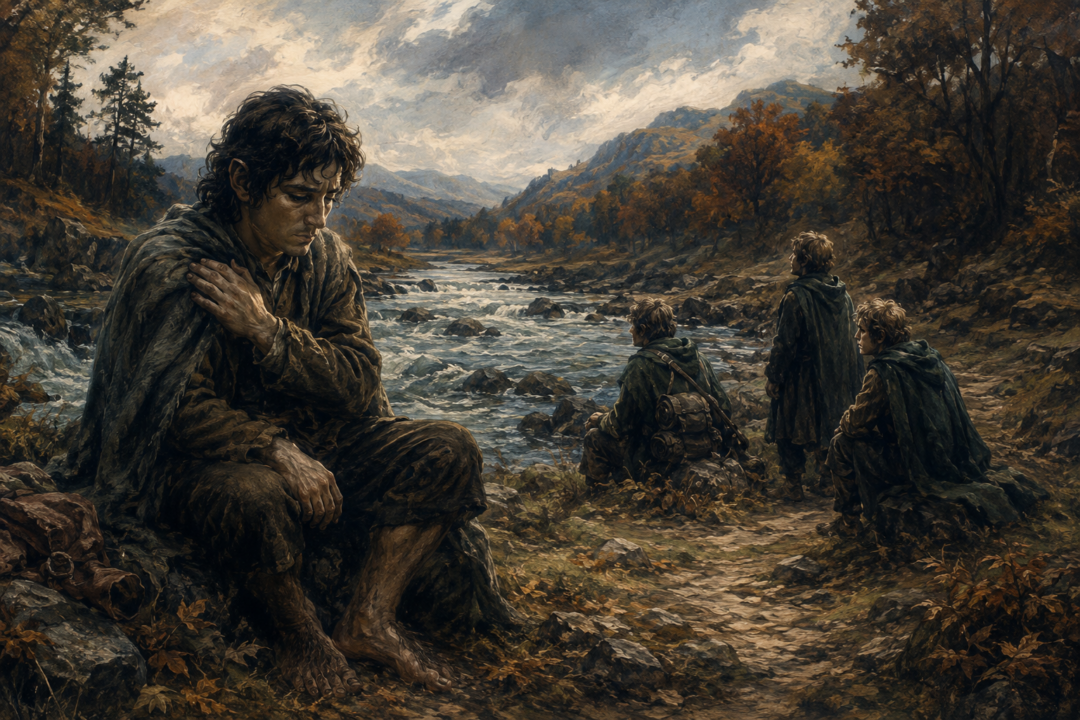
Exactly one year later, on 6 October 3019, Frodo and his companions are returning home and pass the Ford of Bruinen. His shoulder aches again. More importantly, his distress is explicitly connected with remembrance: the darkness associated with his wound returns heavily upon him.
Then there is another date.
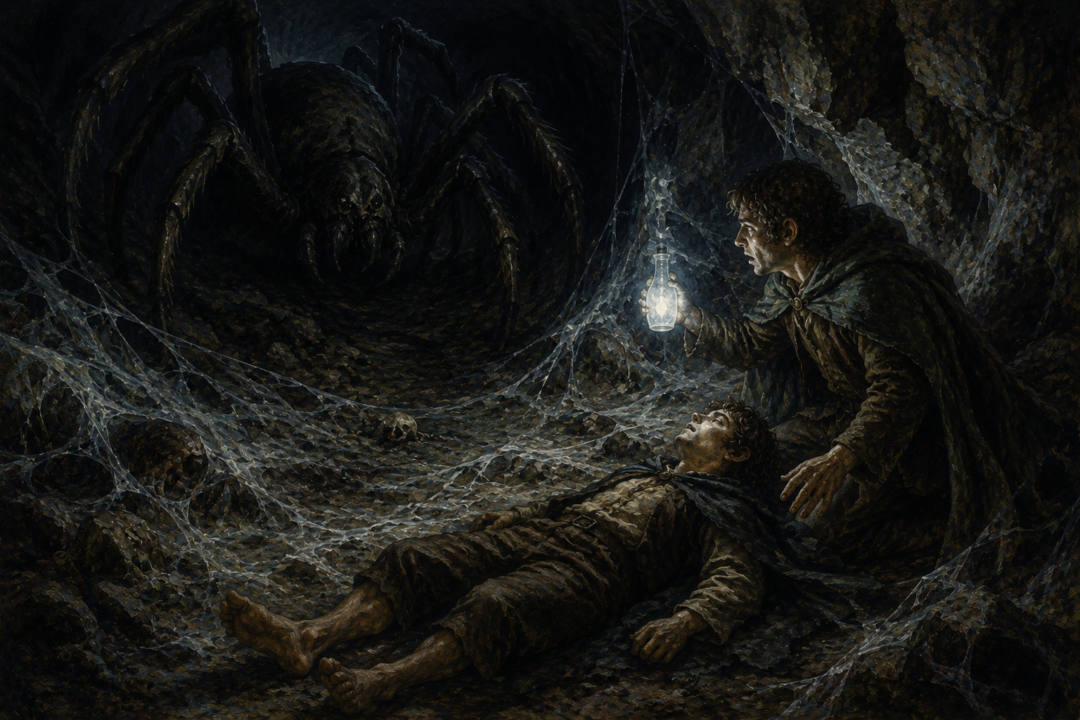
On 13 March 3019, during the journey toward Mordor, Shelob attacks Frodo. Her sting leaves him paralysed so completely that Sam initially believes him dead. Orcs carry Frodo into the Tower of Cirith Ungol, where he awakens stripped, imprisoned, and apparently abandoned.
Appendix B records that on 13 March 3020 Frodo becomes ill on the anniversary of this poisoning. He is ill again on 13 March 3021.
These are therefore not random attacks of weakness. The calendar repeatedly brings Frodo back to moments when his body was overwhelmed and his fate nearly passed out of his control.
The Weathertop Wound Was Never Ordinary
The wound received on Weathertop is especially important because its danger was never merely physical.
After the attack, Frodo’s outward wound begins to close, yet his condition continues to worsen. That contradiction alarms his companions. The broken point of the Morgul-knife remains within him, moving inward toward his heart.
At the same time, Frodo’s perception changes. The ordinary world becomes dimmer while the Ringwraiths become increasingly perceptible to him. He is being drawn toward the condition in which they exist.
Elrond removes the fragment, preventing that transformation. But Frodo has already been exposed to something that penetrated beyond ordinary flesh.
This helps explain why the later anniversary is described through both pain and memory.
The old wound aches, but darkness also returns to Frodo’s mind.
It would go beyond the text to diagnose this in modern medical terms. Middle-earth gives the wound its own supernatural reality. Yet the narrative clearly refuses to separate Frodo’s physical injury from what he remembers.
His body remembers the knife because Frodo remembers what the knife meant.
March 13 Carries a Different Horror
Shelob’s attack is different from the Morgul wound.
Her sting is not presented as transforming Frodo into a wraith. Instead, it paralyses him. But the experience surrounding it is among the most horrifying of his journey.
Frodo is trapped in darkness, poisoned, bound in web, mistaken for dead by Sam, carried away by Orcs, stripped of his possessions, and imprisoned in the Tower of Cirith Ungol.
When Sam eventually reaches him, Frodo has survived, but the psychological devastation of the journey is increasingly visible. He still has Mordor ahead of him. The Ring must still be carried to the Fire.
That is why 13 March should not simply be folded into the Weathertop wound.
The calendar preserves two separate catastrophes.
October recalls the Nazgûl and the Morgul-knife.
March recalls Shelob, paralysis, and captivity.
Frodo’s later life therefore contains not one anniversary of suffering but a small calendar of wounds.
Why the Exact Date Matters
The striking feature is that Frodo’s suffering is tied to anniversaries.
Middle-earth is filled with meaningful dates. Victories, defeats, births, deaths, departures, and restorations are remembered according to the days on which they occurred. The chronology in the appendices reinforces the sense that history leaves patterns behind it.
For Frodo, however, history becomes painfully personal.
The date itself appears capable of reopening what ordinary time has allowed to recede.
On most days he can participate in life around him. He works on the record that will become part of the Red Book. He helps restore order after the Scouring. He lives quietly at Bag End.
Then the calendar circles back.
The implication is not necessarily that the date possesses some independent magical force. The text does not establish such a rule. Rather, the anniversary binds memory to bodily suffering so closely that they cannot easily be separated.
Time has moved forward.
Frodo has moved forward.
But some part of what happened remains present.
The Ring’s Destruction Did Not Undo the Journey
This is one of the most important consequences of Frodo’s ending.
Destroying the Ring ends Sauron’s power over Middle-earth. It does not reverse everything Sauron’s power has done.
The Morgul-knife was removed. Shelob’s poison did not kill Frodo. The Ring itself is gone.
Yet Frodo has carried the Ring for months, endured the Nazgûl’s assault, crossed lands dominated by the Shadow, suffered starvation and exhaustion, and finally reached the point where he could no longer voluntarily surrender the Ring at the Cracks of Doom.
Victory removes the great external threat.
It does not restore Frodo to the Hobbit who left Bag End.
That distinction gives the ending much of its power. The Shire can be repaired. Trees can be replanted. Houses can be rebuilt. Families can begin again.
Frodo’s restoration is harder.
The destruction of evil does not automatically erase the history of having borne it.
Why Sam Can Return More Fully Than Frodo
The contrast with Sam makes Frodo’s condition even clearer.
Sam has also been wounded by the journey. He has known hunger, terror, battle, grief, and the burden of briefly carrying the Ring. Yet after returning home, his life expands.
He marries Rosie Cotton. He becomes a father. He plants Galadriel’s gift throughout the Shire. He participates in the renewal of the community.
Frodo increasingly withdraws.
This is not because Sam cared less or suffered nothing. Their burdens were different.
Frodo carried the Ring for far longer and became its principal bearer during the quest. He also received the Morgul wound and Shelob’s sting. Finally, at Mount Doom, the Ring’s pressure reaches its culmination in his claim of it.
Frodo’s inability to settle completely into restored Shire life is therefore connected to an accumulation of experiences, not to a single injury.
His anniversary illnesses make that accumulation visible.
The White Gem and the Limits of Healing
Arwen gives Frodo a white gem before he returns to the Shire, telling him that when the memory of fear and darkness troubles him, it may bring him aid.
That gift is revealing.
Frodo does not merely need medicine for a shoulder scar. He needs comfort against memory.
The distinction between body and mind becomes increasingly difficult to maintain. The shoulder aches; the old darkness returns; other anniversaries bring illness. Frodo’s wounds exist at several levels at once.
Even Rivendell, where his life was saved after Weathertop, cannot provide a final answer when he returns there after the war.
His deepest healing lies elsewhere.
Why Frodo Leaves Middle-earth
Frodo’s departure from the Grey Havens is sometimes misunderstood as a reward granting him ordinary immortality. That is not what the texts establish. Frodo remains mortal.
The journey into the West instead offers the possibility of healing and peace unavailable to him in Middle-earth.
This makes his recurring illnesses essential to understanding why he leaves.
Without them, his departure might seem strangely unnecessary. The war is over. Bag End is restored. Sam is beside him. Why sail away?
Because Frodo has discovered that returning to a place is not the same as returning to the person who once lived there.
The Shire is still his home, but it cannot wholly heal what happened beyond its borders.
His dates keep proving that.
Every 6 October, Weathertop is not entirely past.
Every 13 March, Cirith Ungol is not entirely past.
The body hurts, memory awakens, and history becomes present again.
The Quiet Cost of Saving the Shire
Frodo once hoped to save the Shire, and in the deepest sense he succeeds.
But the final irony is that the peace he preserves for others is a peace he cannot completely inhabit himself.
That does not make his story a failure. It reveals the cost of his success.
Frodo’s annual illnesses prevent the ending from pretending that great suffering disappears when the enemy is defeated. His scars are not decorative reminders of adventure. They are consequences.
The dates make those consequences impossible to dismiss.
A scar can seem passive: something left behind.
An anniversary is active. It returns.
And so Frodo’s final years in Middle-earth are shaped by a strange rhythm. Ordinary days carry him forward into the restored life of the Shire, while certain dates draw him backward toward Weathertop and Cirith Ungol.
Eventually he takes the road west.
The calendar of Middle-earth continues without him, but Frodo is given the chance to go somewhere his wounds may finally cease to govern the turning of the year.
Sources & Notes
- https://www.encyclopedia-of-arda.com/f/frodobaggins.php — The Encyclopedia of Arda: Frodo Baggins (his wounds, recurring illnesses, and departure from Middle-earth).
- https://www.encyclopedia-of-arda.com/w/weathertop.php — The Encyclopedia of Arda: Weathertop (the Nazgûl attack whose anniversary renewed Frodo’s pain).
- https://www.encyclopedia-of-arda.com/m/morgulknife.php — The Encyclopedia of Arda: Morgul-knife (the supernatural wound and splinter that endangered Frodo).
- https://www.encyclopedia-of-arda.com/s/shelob.php — The Encyclopedia of Arda: Shelob (her poisoning of Frodo and the second traumatic anniversary recorded in the chronology).
Sources checked for relevance and availability.