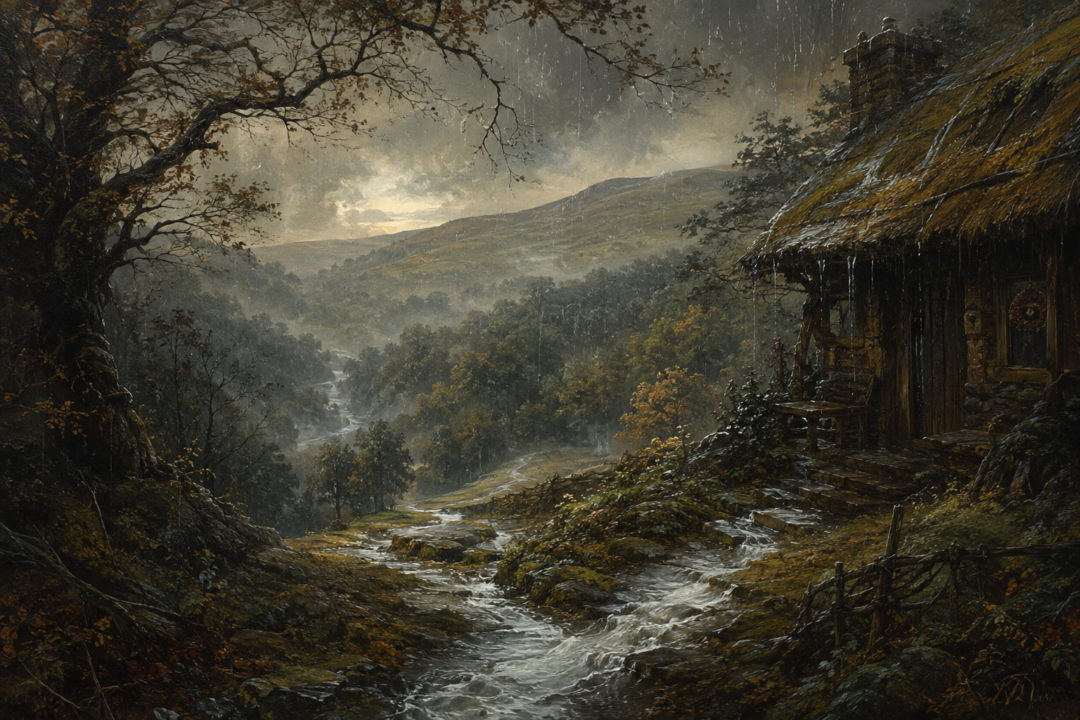
The morning after the hobbits first sleep in Tom Bombadil’s house, rain closes around them.
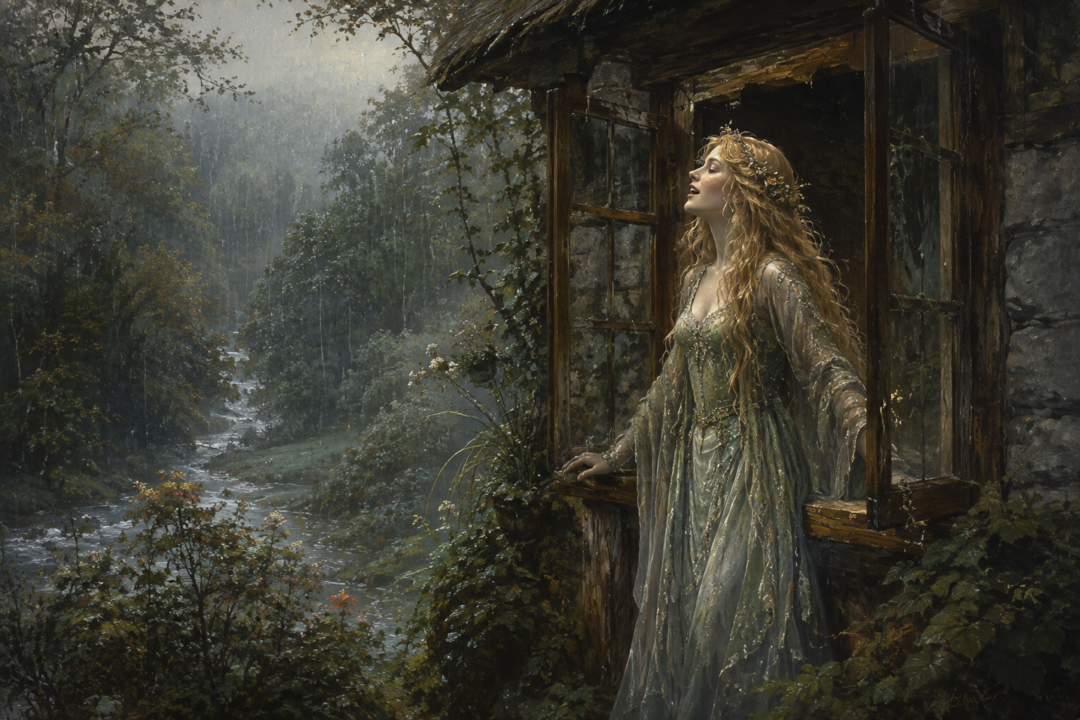
It is not a violent storm. The clouds gather into a grey roof, steady rain hides the Old Forest, and water begins running from the hills. Somewhere above the hobbits, Goldberry is singing. Her voice seems almost to descend with the rain itself.
Then Tom returns and gives the weather an extraordinary name: it is Goldberry’s “washing day” and “autumn-cleaning.”
It sounds like one of Bombadil’s jokes. Yet the episode quietly reveals something important about the strange country around the Withywindle. This valley is not merely scenery through which supernatural beings happen to wander. Water, weather, season, song, memory, and living things continually overlap there.
Goldberry’s washing day is one of the clearest glimpses we receive of that relationship.
The Valley the Hobbits Tried to Avoid
Before the hobbits ever meet Goldberry, Merry warns them about the Withywindle.
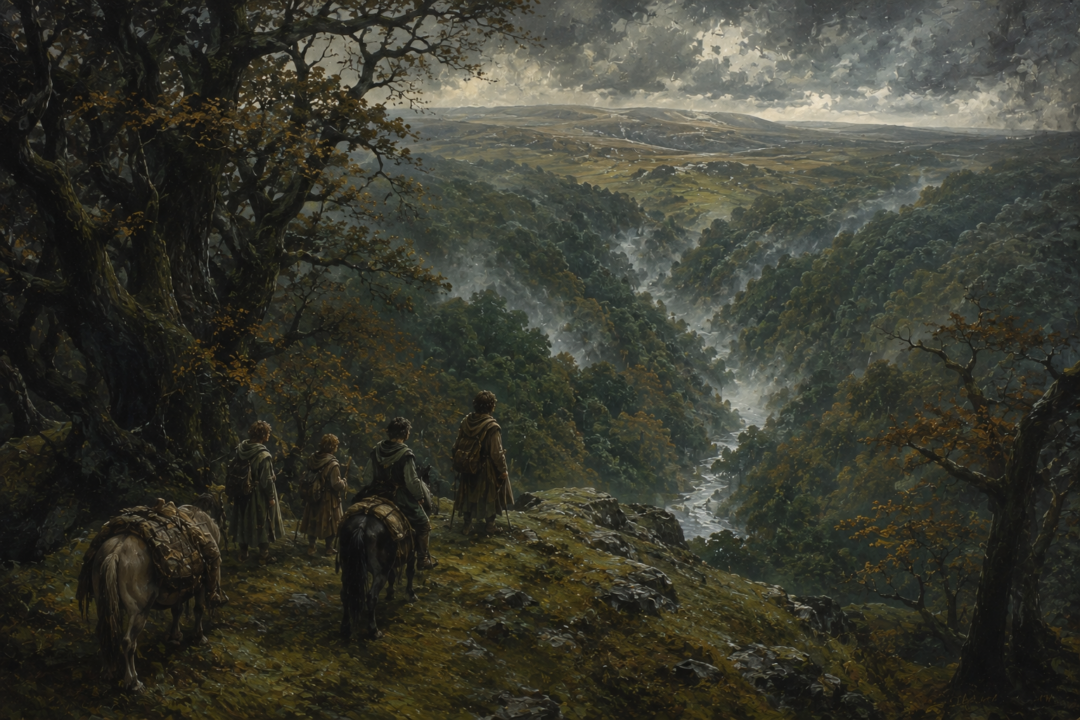
From a bare hill above the Old Forest, he identifies the river running out of the Barrow-downs, south-west through the Forest, eventually joining the Brandywine. More importantly, he repeats the local reputation of its valley: it is considered the strangest part of the entire wood, almost the centre from which the Forest’s strangeness spreads.
The hobbits emphatically do not want to go there.
But the Old Forest seems to have other ideas. Paths bend. Trees obstruct them. Their intended direction becomes increasingly difficult to maintain until they are drawn downhill toward the river.
Later, Bombadil explains that this was not simply bad navigation. Old Man Willow possesses great influence in that region. Tom describes him as a powerful singer whose cunning makes escape difficult for small travellers. The hobbits have entered a landscape in which intention does not belong exclusively to people.
That distinction matters.
The Old Forest is not portrayed merely as a collection of dangerous monsters. Tom’s later stories help the hobbits perceive its creatures as possessing lives independent of them. For perhaps the first time, they understand themselves as the outsiders.
The Withywindle Valley is therefore strange partly because human or hobbit assumptions about ownership and control become unreliable there.
And Goldberry fits that world perfectly.
Goldberry Is the River-Daughter
Goldberry is repeatedly associated with water.
Tom calls her the River-woman’s daughter. Frodo, overwhelmed when he meets her, compares her to clear water, reeds, springtime, waterfalls, and moving leaves. Her clothing likewise evokes the riverside world: green like young reeds, silver like dew.
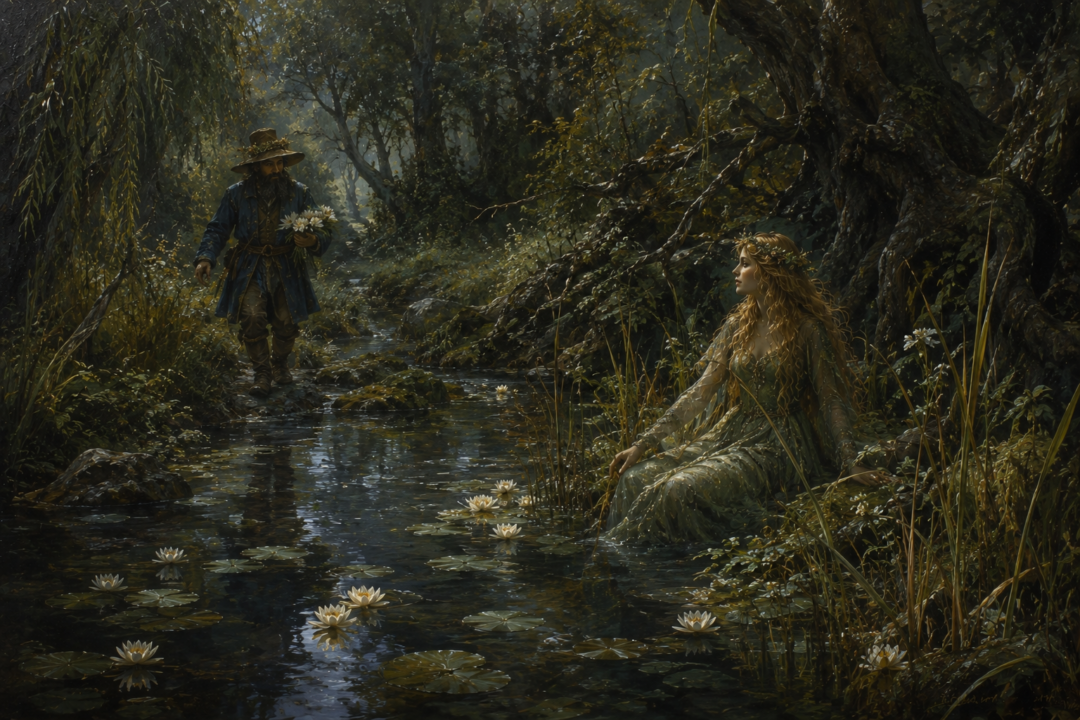
Tom also reveals that he originally encountered her beside a deep, clear pool far down the Withywindle, sitting among the rushes.
Her connection to the river is therefore explicit.
Exactly what Goldberry is, however, is not.
The text never provides a tidy classification for her. Calling her literally a “river spirit” can be useful as shorthand, but it goes beyond what the narrative explicitly defines. “River-daughter” or “River-woman’s daughter” is safer because those are the identities the story itself gives her.
This uncertainty becomes particularly important on washing day.
Goldberry is deeply associated with water. Rain covers the valley. She sings a song about water. Tom calls the entire event her washing day.
But does she cause the rain?
The text never says so.
Her Rain-Song Is Bigger Than the Withywindle
As the rain begins, the hobbits hear Goldberry singing.
They cannot distinguish many words, but they understand the shape of the song. It tells of a river travelling from its spring in the highlands all the way to the distant Sea.
That is a revealing choice.
Goldberry is associated with one small river in one secluded corner of Eriador, yet her song imagines the complete movement of water through the world: source, river, descent, Sea.
Her imagination is not confined to the doorstep of Bombadil’s house.
Later that evening she sings again. This time the songs begin in the hills and descend into silence. In those silences, the hobbits imagine pools and waters greater than any they have personally seen, reflecting the sky and stars.
Water in Goldberry’s songs therefore connects different scales of existence.
Hill and valley.
Rain and river.
Pool and sky.
Source and Sea.
This does not prove that she magically controls any of them. What it does establish is that her character is consistently presented through the imagery and movement of water.
Her washing day belongs to that pattern.
Rain Reveals the Shape of the Land
The weather also physically exposes the valley’s geography.
As the rain deepens, Frodo watches a pale chalk path beside the house become a little stream and run downhill. Earlier, Pippin has looked westward from the house and seen mist lying over the Forest, with the channel of the Withywindle visible through it.
Water is tracing the contours of the country.
That makes “washing day” especially suggestive. The rain does not merely make everything wet. It gathers on the high ground and moves downward, temporarily turning paths into streams and feeding the valleys below.
Goldberry’s rain-song describes exactly this kind of movement on a larger scale.
The connection is poetic rather than a stated mechanism of magic. Tolkien never explicitly tells us that Goldberry summoned the weather or that her washing literally cleanses the valley.
What the scene does is align her song, the rainfall, and the drainage of the land so closely that they feel like different expressions of one process.
The Withywindle Is Not Simply Evil
That matters because the hobbits’ first experience of the river valley is terrifying.
Old Man Willow stands beside the Withywindle. He overwhelms them with sleep, traps Merry and Pippin, and nearly ends their journey before it has properly begun.
It would be easy to conclude that the valley itself is malignant.
Tom’s house complicates that conclusion.
Goldberry belongs to the same watery landscape. Tom finds her far down the same river. The water-lilies he gathers for her come from a pool along the Withywindle, where they open early and linger late. In spring, Tom says, Goldberry goes down the riverside path to bathe.
The river that leads the hobbits toward Old Man Willow also belongs to Goldberry’s world.
The valley therefore cannot be reduced to “evil nature.”
Tom later describes the Forest in more complicated terms: good and evil, friendly and unfriendly, cruel and kind things coexist within it. Its ancient trees have memories and grievances of their own.
Old Man Willow represents one dangerous will within that landscape, not necessarily the moral meaning of the entire landscape.
Goldberry shows another side of it: beauty, refreshment, hospitality, seasonal renewal, and song.
Mastery Here Does Not Mean Ownership
Goldberry also gives Frodo one of the most important explanations of Bombadil.
When Frodo hears that Tom is Master, he naturally asks whether the strange land belongs to him.
Goldberry rejects the idea.
The growing and living things belong to themselves.
That statement helps make sense of washing day.
Tom and Goldberry do not behave like rulers administering a territory. Bombadil walks through wood, water, and hill without fear, but his mastery is explicitly distinguished from possession. Goldberry is profoundly connected with the river without the narrative telling us that she owns or commands it.
The valley contains many independent centres of life and will.
Old Man Willow has his influence.
The trees possess memories.
Bombadil wanders freely among them.
Goldberry belongs intimately to the waterside world.
The hobbits, meanwhile, arrive believing the landscape is something they merely need to cross.
Tom’s stories change that perspective. They begin to understand that the Forest existed before them and does not arrange itself for their convenience.
Goldberry’s washing day reinforces the same lesson in gentler form.
For one day, the travellers stop moving and the landscape moves instead.
Autumn Cleaning Is Also About Time
There is another detail easy to miss: Tom calls it Goldberry’s autumn cleaning.
The season matters throughout their stay.
Tom has been gathering the last water-lilies before winter. He tells the hobbits that he makes this journey at summer’s end each year. He will not go deep along the forest river again while the year is old, nor pass Old Man Willow until spring.
The household therefore lives according to seasonal rhythms.
Summer is ending.
The last lilies have been gathered.
Rain falls.
Water runs downhill.
The Forest approaches winter.
Then spring will return, and Goldberry will once more go down to the Withywindle.
Her washing day sits directly inside this cycle.
Nothing in the text requires us to turn that cycle into a formal supernatural ritual. It is enough to notice that Tom and Goldberry's life is unusually synchronized with the seasonal landscape around them.
Their domestic life and the natural world almost overlap.
A Day of Rain Becomes a Day of Memory
The rain also creates something the hobbits desperately need: time.
They cannot travel safely, so they remain indoors.
Tom talks.
He tells them about flowers and bees, trees and strange creatures, Old Man Willow, the ancient Forest, the Barrow-downs, and finally things reaching back beyond ordinary historical memory.
The weather has halted the physical journey, but that interruption produces another kind of journey.
The hobbits begin the day knowing almost nothing about the country surrounding them. By its end, their sense of time has expanded enormously.
There is a beautiful irony here.
They are trying to reach Bree and ultimately Rivendell. Every delay feels dangerous because the Black Riders are hunting Frodo.
Yet this delay is beneficial.
Frodo himself is glad that the rain prevents their departure.
The travellers need shelter before they can continue. They need stories before they can understand where they are. And, very soon, they will need what Bombadil has taught them when they enter the Barrow-downs.
Goldberry’s washing day therefore becomes a pause between dangers—a day when rain temporarily closes the road so that older knowledge can enter.
The Valley’s Strangeness Is a Different Way of Belonging
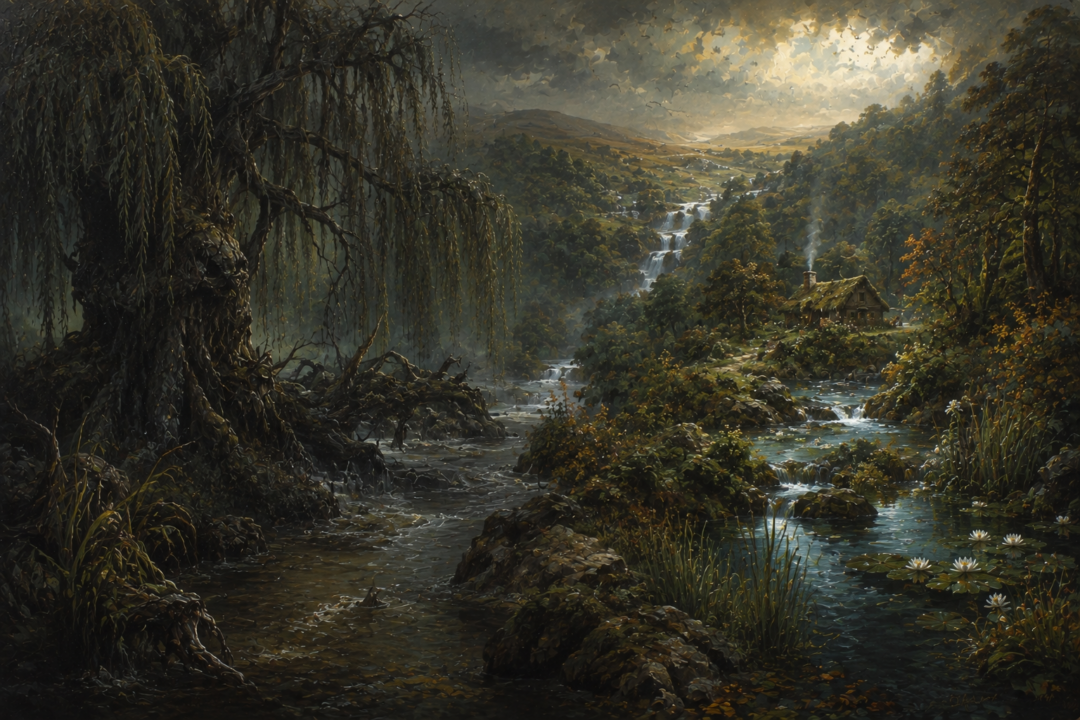
When Merry calls the Withywindle Valley the centre of the Old Forest’s strangeness, he speaks as someone looking at it from outside.
After visiting Tom and Goldberry, the hobbits have seen something different.
The valley is dangerous, certainly. Old Man Willow proves that beyond question.
But it is also inhabited by forms of life that cannot easily be fitted into Shire categories. The trees remember. Songs possess power. Tom can be Master without being owner. Goldberry can be intimately bound to the river without the story explaining exactly what she is.
And rain can simultaneously be weather, seasonal change, household “washing,” and the subject of a song carrying water from distant hills toward the Sea.
Perhaps that is what Goldberry’s washing day tells us most clearly about the Withywindle.
Its strangeness does not come from a single enchantment.
It comes from entering a place where the boundaries familiar to the hobbits—between house and wilderness, personality and landscape, ordinary weather and wonder—have become unexpectedly thin.
For one rainy autumn day, the hobbits stop trying to escape that world.
They sit inside it.
And they listen.
Sources & Notes
- https://tolkiengateway.net/wiki/Goldberry — Tolkien Gateway: Goldberry, her identity as the River-woman’s daughter, water imagery, and ‘washing day’
- https://tolkiengateway.net/wiki/Withywindle — Tolkien Gateway: the Withywindle’s course through the Old Forest and its place in Goldberry and Tom Bombadil’s country
- https://tolkiengateway.net/wiki/Old_Forest — Tolkien Gateway: the Old Forest as an animate, perilous landscape shaped by trees and the Withywindle valley
- https://tolkiengateway.net/wiki/Old_Man_Willow — Tolkien Gateway: Old Man Willow’s influence, song, and power near the Withywindle
- https://tolkiengateway.net/wiki/Tom_Bombadil — Tolkien Gateway: Tom Bombadil’s house, country, relationship with Goldberry, and knowledge of the Old Forest
Sources cover Goldberry’s water-linked identity and washing day, the Withywindle and Old Forest landscape, Old Man Willow’s local influence, and Tom Bombadil’s relationship to this country.