Everyone asks why Gandalf could stand against the Balrog, but refused the Ring.
But that may be the wrong question.
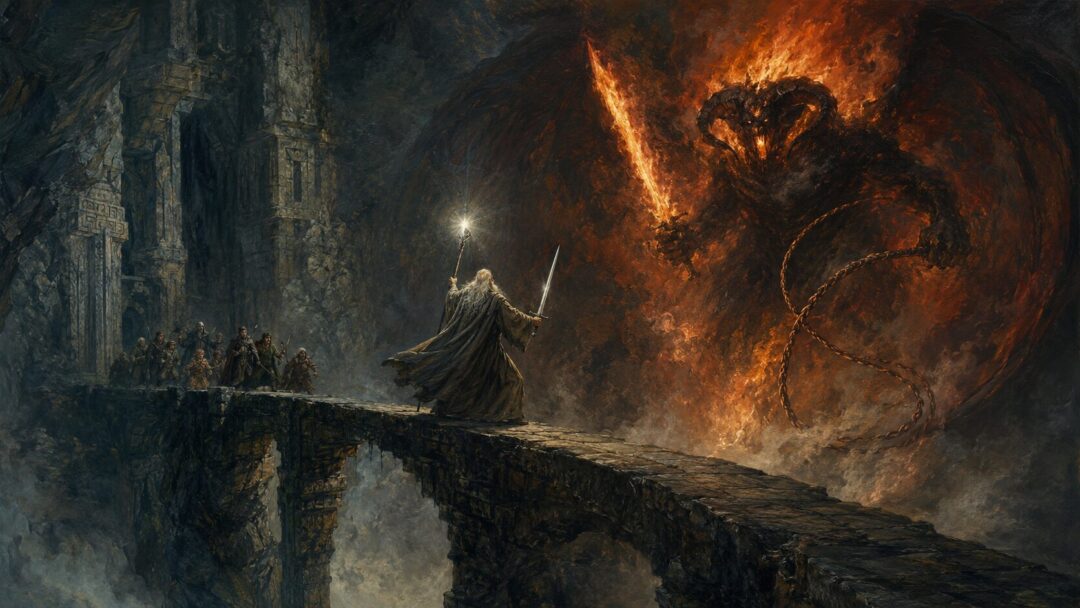
Because the real mystery is not whether Gandalf had power. He clearly did. At the Bridge of Khazad-dûm, Gandalf faced something so terrible that the rest of the Fellowship could not answer it. Legolas knew it for what it was. Gimli was shaken by dread. Aragorn and Boromir were brave, but bravery alone was not enough.
Gandalf stood.
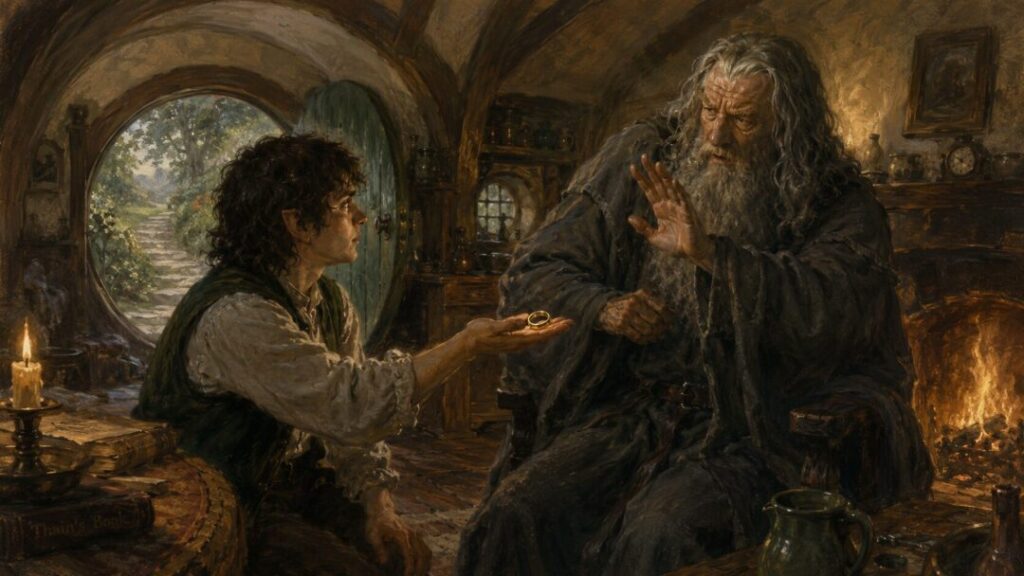
And yet this is the same Gandalf who recoiled when Frodo offered him the One Ring. He did not treat it as a useful weapon. He did not say he would keep it for a desperate hour. He refused it with fear.
That contrast is the whole point.
The Balrog was a danger before him.
The Ring was a danger within him.
And Gandalf knew that the second danger was far more subtle.
The Balrog Was Not Just a Monster
The Balrog of Moria was not merely a large creature of fire and shadow.
It was Durin’s Bane, the terror that had driven the Dwarves from Khazad-dûm. The texts identify Balrogs as spirits of great power corrupted by Morgoth in the Elder Days. Durin’s Bane had survived the ruin of the First Age, hidden itself beneath the Misty Mountains, and later awakened when the Dwarves delved too deep.
That matters.
When Gandalf stood on the bridge, he was not simply facing a beast. He was facing an ancient evil of a kind far beyond the strength of ordinary warriors. His warning to the Fellowship makes this clear: this was a foe beyond them.
So Gandalf’s stand was not a random display of wizardly power.
It was a moment of necessity.
The Quest of the Ring was at stake. Frodo had to escape. The Fellowship had to survive long enough for the Ring to continue south. The Balrog was not offering Gandalf dominion, glory, or control. It was trying to destroy them.
Gandalf’s answer was resistance.
That distinction is crucial.
Gandalf’s Mission Was Never to Conquer Middle-earth
Gandalf was one of the Istari, the Wizards sent into Middle-earth in the Third Age. Their task was not to rule the Free Peoples. It was not to defeat Sauron by becoming rival Dark Lords.
Their role was guidance.
They were to encourage resistance, give counsel, awaken courage, and help Elves, Men, Dwarves, and Hobbits stand against Sauron. The texts are careful about this. The Wizards were not meant to dominate others through force or fear.
This is why Saruman’s fall is so important.
Saruman does not begin by looking like a servant of evil. He begins as a wise figure who wants order, knowledge, and power enough to direct events. Over time, his desire to control becomes indistinguishable from the thing he claims to oppose.
Gandalf understands this danger better than anyone.
That is why his refusal of the Ring is so immediate.
He does not say, “I am too weak.”
He says, in effect, “I would become too strong.”
The Ring Was Not a Neutral Weapon
The One Ring is often imagined as a tool: dangerous, yes, but useful in the right hands.
That is not how the story treats it.
The Ring was made by Sauron. Its purpose was domination. It was designed to rule other wills, to gather power to itself, and to draw its bearer toward possession and mastery. It does not tempt everyone in the same way, but it always works through what the bearer already desires.
For Boromir, it speaks through the defense of Gondor.
For Galadriel, it appears in the vision of a queen, beautiful and terrible.
For Frodo, it becomes a burden that grows heavier as he draws nearer to Mordor.
For Gandalf, the danger would have been especially terrifying because his desire was not petty. He did not want wealth. He did not want a throne for his own pleasure. He wanted to help. He pitied weakness. He wanted strength to do good.
That is exactly why the Ring was so dangerous to him.
It would not need to turn Gandalf into a villain overnight.
It would only need to persuade him that mercy required command.
Why Gandalf Feared His Own Goodness
Gandalf tells Frodo that the Ring would gain a power over him greater and more deadly. He also names the path by which it would reach his heart: pity, pity for weakness, and the desire of strength to do good.
This is one of the most revealing things Gandalf ever says.
He is not afraid because he secretly wants to be Sauron.
He is afraid because he does not.
A cruel person might use the Ring openly for cruelty. Gandalf’s danger would be different. He might use it to heal, protect, defend, and order. He might begin by saving people from fear. Then he might decide that they must be guided more firmly. Then that they must be prevented from choosing wrongly. Then that all resistance to his wisdom is itself dangerous.
The texts imply that a Ring-bearing Gandalf would not simply become another Sauron in grey robes.
He would become something more troubling: a ruler who believed he was right.
That is the darker layer behind his refusal.
Sauron’s evil is recognizable. Gandalf corrupted by the Ring could make domination look like goodness.
Why the Balrog Was Different
This is where the Bridge of Khazad-dûm becomes clearer.
Gandalf facing the Balrog was not an attempt to seize rule over others. He was not using fear to bend the Free Peoples to his will. He was not claiming a throne, gathering armies under enchantment, or taking Sauron’s own instrument into his hand.
He was defending the Quest.
The Balrog stood between the Fellowship and escape. Gandalf’s action was sacrificial, not possessive. He did not gain power from it. He spent himself.
That difference is everything.
The Ring offers increase.
The Balrog demands loss.
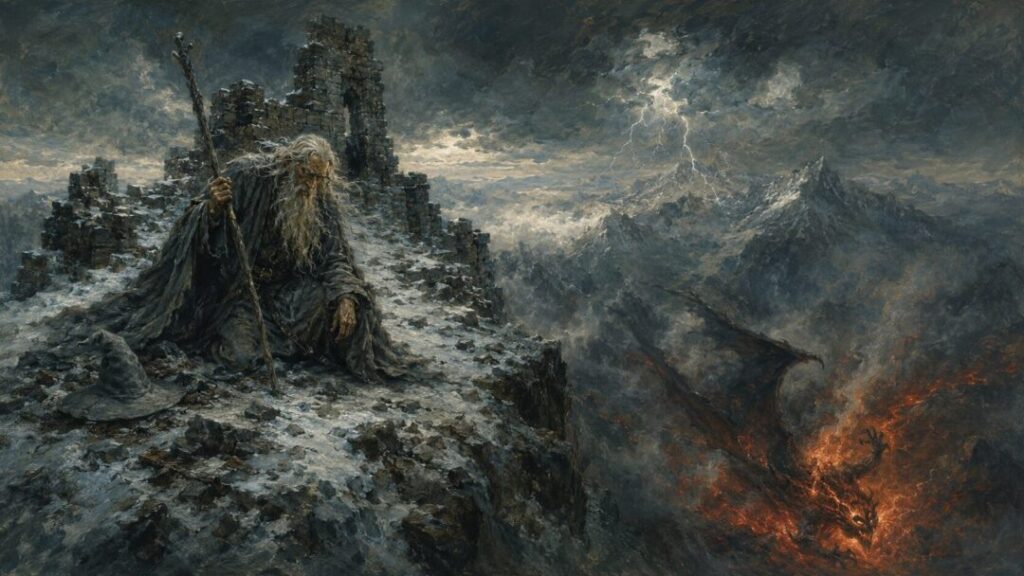
When Gandalf breaks the bridge, he does not rise in triumph. He falls. He pursues the Balrog through the deep places of the world. He fights from the lowest dungeon to the peak of Celebdil. He casts the Balrog down, but he also dies.
This is not the pattern of domination.
It is the pattern of self-sacrifice.
“Power Against Power” Is Not the Whole Answer
Some readers frame the question as a rule problem: if the Wizards were not meant to match Sauron’s power with power, why could Gandalf match the Balrog?
But the story is not quite that mechanical.
The central issue is not that Gandalf may never use power at all. He clearly does. He kindles fire, commands doors, blesses, warns, breaks the bridge, and later returns with greater authority as Gandalf the White.
The issue is what kind of power he uses, and toward what end.
Power used in defense of others is not the same as power used to rule them.
Power spent in sacrifice is not the same as power hoarded for mastery.
Power used to preserve the freedom of the Quest is not the same as power used to replace the choices of others with one will, however wise.
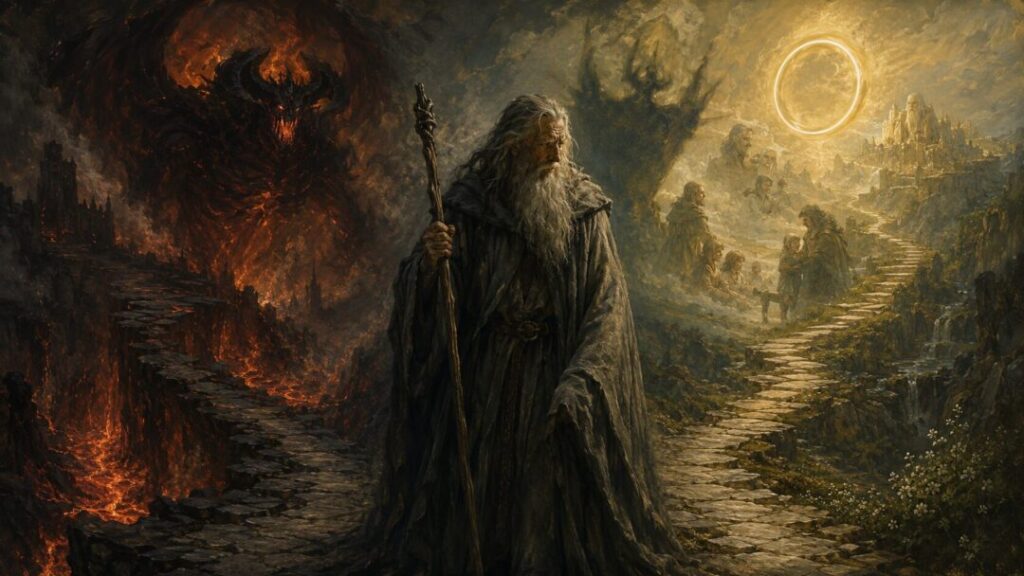
That is why Gandalf can face the Balrog and still refuse the Ring.
The Balrog is an enemy to be resisted.
The Ring is a system of domination to be embraced.
And embracing it, even for good reasons, would be the beginning of the fall.
Gandalf Could Not Save Middle-earth by Becoming Its Master
This is the deeper irony.
Gandalf’s whole purpose in Middle-earth was to help others do what he himself could not simply do for them. The Ring had to be carried by the small, not wielded by the mighty. Sauron had to be defeated not by a greater tyrant, but by the destruction of the very thing that made tyranny possible.
If Gandalf had taken the Ring, the shape of the story would have changed completely.
The Quest would no longer be about renunciation.
It would become a contest of rulers.
And even if Gandalf defeated Sauron, the victory would be poisoned. The Ring would remain. Its logic would remain. The world would still be governed by domination, only under a brighter name.
That is why Gandalf’s refusal is not weakness.
It is obedience to the deepest moral pattern of the story.
Evil is not defeated by using its own method more kindly.
It is defeated by rejecting the method itself.
The Balrog Tested Strength. The Ring Tested Wisdom.
The Balrog tested whether Gandalf could stand.
The Ring tested whether Gandalf could refuse.
Both required courage. But the second kind of courage is easier to miss.
At the bridge, Gandalf’s courage is visible. There is fire, shadow, a broken bridge, and a fall into the abyss. It is the kind of bravery everyone recognizes.
At Bag End, his courage is quieter. Frodo offers him the very thing that could make him mighty. Gandalf sees the temptation clearly and steps back from it.
That moment may be less dramatic, but it is just as important.
Perhaps more so.
Because many characters in Middle-earth can fight. Far fewer can refuse power when it is placed freely in their hands.
Why This Changes Gandalf’s Victory
Gandalf’s battle with the Balrog is often remembered as proof of how powerful he truly was.
It is.
But it is also proof of what kind of power he was willing to use.
He would spend himself to save others. He would stand between his companions and death. He would descend into darkness and fight until his body failed.
But he would not take the Ring.
He would not save Middle-earth by mastering it.
That is why the two scenes belong together. The bridge shows Gandalf’s strength. The refusal shows his wisdom. Without the refusal, the strength would be terrifying. Without the strength, the refusal might seem merely cautious.
Together, they reveal the real Gandalf.
A servant, not a ruler.
A guide, not a master.
A being powerful enough to face a Balrog, but wise enough to fear what he might become with the Ring.
The Deeper Answer
So why could Gandalf face the Balrog but not use the Ring?
Because the Balrog threatened the Quest from outside.
The Ring threatened to corrupt the Quest from within.
The Balrog could kill Gandalf.
The Ring could turn Gandalf into something that still looked wise, still spoke of pity, still claimed to act for the good of others — while quietly becoming a lord of wills.
That is the more frightening danger.
Gandalf did not refuse the Ring because he lacked power.
He refused it because he understood power.
And in Middle-earth, that understanding may be the only reason he was worthy to stand on the bridge at all.
Sources & Notes
- J.R.R. Tolkien, The Lord of the Rings, Book I, Chapter 2, “The Shadow of the Past” — Gandalf refuses Frodo’s offer of the Ring, fearing the pity and desire for strength to do good by which it would master him.
- J.R.R. Tolkien, The Lord of the Rings, Book II, Chapter 5, “The Bridge of Khazad-dûm” — Gandalf identifies the Balrog as a foe beyond the Fellowship and sacrifices himself to hold the bridge.
- J.R.R. Tolkien, The Lord of the Rings, Book II, Chapter 7, “The Mirror of Galadriel” — Galadriel’s temptation shows how the Ring can turn a desire to preserve and protect into terrible rule.
- J.R.R. Tolkien, Unfinished Tales, “The Istari” — the Wizards are sent to counsel and kindle resistance to Sauron, not to rule Middle-earth by force or fear.
- J.R.R. Tolkien, The Silmarillion, “Valaquenta: Of the Enemies” — Balrogs are identified as ancient spirits corrupted by Melkor, giving context for Durin’s Bane as more than a mere monster.
- J.R.R. Tolkien, The Letters of J.R.R. Tolkien, Letter 131 — Tolkien describes Sauron’s Ring as an instrument of domination, supporting the contrast between resisting evil and wielding its method.