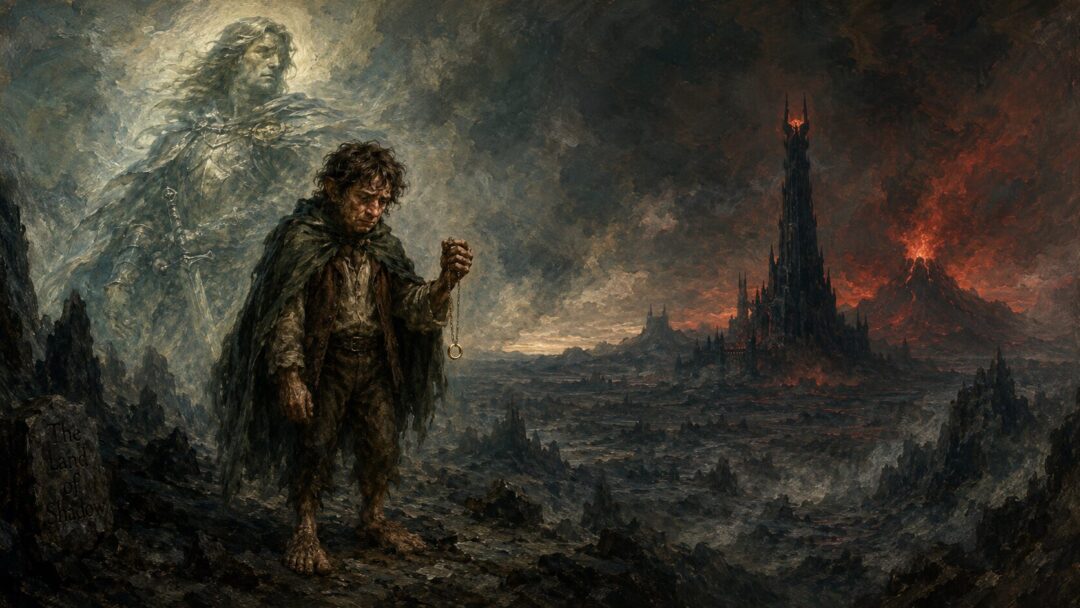
Most readers remember Sam’s vision in Mordor as one of his greatest moments of resistance.
And it is.
But the scene is more unsettling than that.
Because the Ring does not fail to tempt Sam. It reaches him. It finds something real. It does not offer him a random dream of wealth or comfort. It does not misunderstand that he is a gardener. In fact, it uses that truth with terrifying precision.
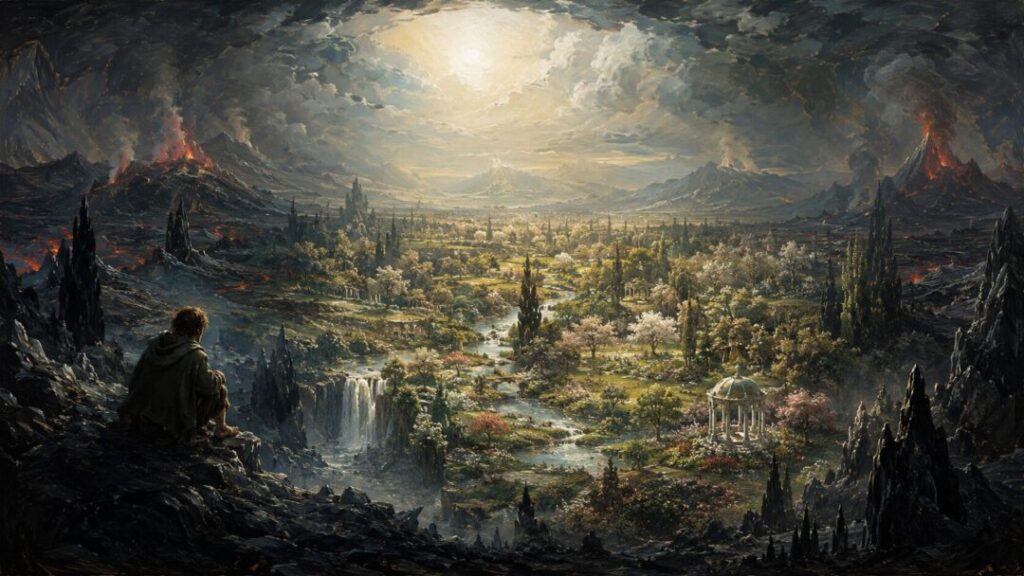
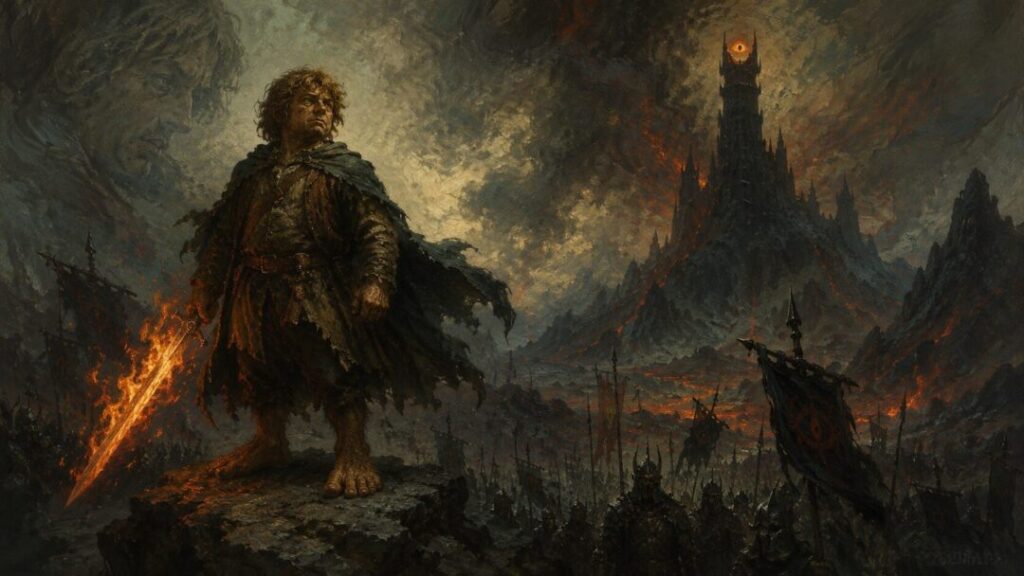
Sam sees himself as “Samwise the Strong,” a hero striding across the dark land with a flaming sword. Armies gather to him. Barad-dûr is overthrown. Then the clouds roll away, the sun shines, and the valley of Gorgoroth becomes a garden of flowers, trees, and fruit at his command.
That is not a small temptation.
It is Sam’s own nature enlarged until it becomes dangerous.
And yet the Ring loses him there.
Not because Sam has no desire.
But because the Ring does not understand the kind of desire he has.
The Ring Does Not Offer Random Dreams
The Ring’s temptations are never merely accidental.
It works through what is already present in a person. Boromir imagines using it as a weapon to defend Gondor. Galadriel sees the terrible shape her own greatness could take if she accepted it. Frodo is gradually worn down by possession, burden, and the impossible nearness of the Ring’s source.
Sam’s temptation belongs in that same moral pattern.
He is not offered something outside himself. He is offered a distorted version of himself.
That matters.
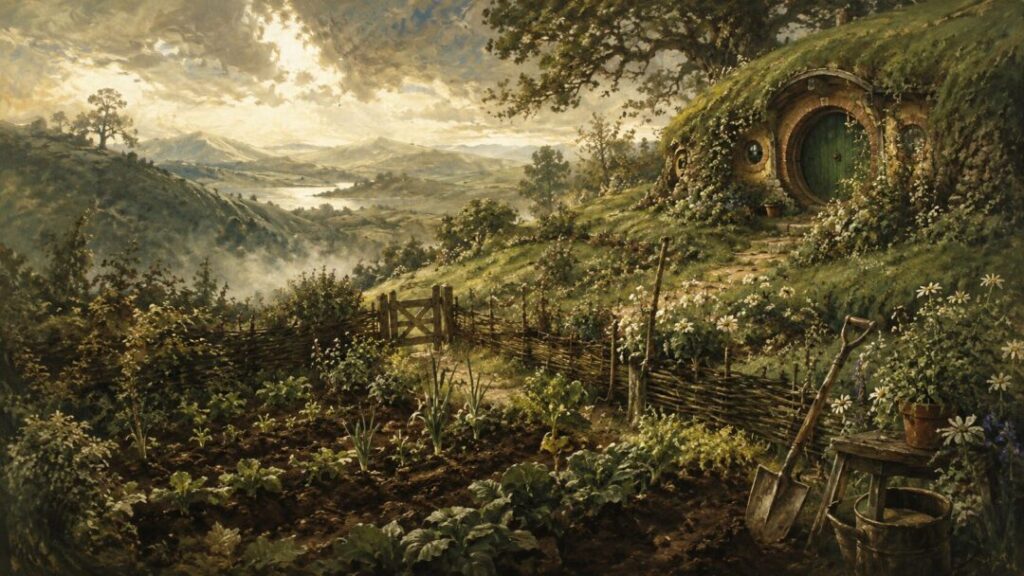
Sam is a gardener. He loves growing things. He loves the Shire. He loves ordinary life: food, rest, work, home, and the hope of returning to Rosie Cotton. His imagination is rooted in soil, not thrones.
So the Ring gives him soil.
But not a garden to tend.
A land to command.
That is the twist.
The vision begins with heroic power and ends with agricultural conquest. Mordor becomes fruitful, but only because Sam wills it so. The Ring does not show him kneeling in earth with dirty hands, planting, pruning, watering, and waiting. It shows him remaking a whole country by command.
That is no longer gardening.
That is domination wearing a gardener’s face.
Why Mordor Matters
The location of the vision is crucial.
Sam is not dreaming of a larger patch in the Shire. He is standing in the shadow of Mordor, near the heart of Sauron’s power, bearing the Ring after believing Frodo has been lost. He is exhausted, frightened, and alone with a burden he was never meant to carry.
The Ring chooses that moment.
It offers a fantasy that answers almost every pressure upon him.
Frodo is gone, or so Sam believes. The Quest appears to have fallen on him. Mordor seems impossible to cross. Sauron’s power fills the land. Sam has no army, no plan, and no visible hope.
So the Ring gives him the dream of becoming enough.
Strong enough to overthrow Barad-dûr.
Great enough to lead armies.
Powerful enough to make Mordor bloom.
This is why the temptation is so dangerous. It is not simply selfish. It almost looks noble.
Would it be so wrong to destroy Sauron?
Would it be so wrong to heal Mordor?
Would it be so wrong to make a dead land fruitful?
The Ring’s most dangerous lies often begin near something good.
But the method is poisoned.
The vision does not ask Sam to serve life. It asks him to rule it.
The Mistake Hidden in the Garden
The Ring’s mistake is not that it chooses a garden.
That part is clever.
Its mistake is that it imagines Sam’s love of gardens can be inflated into the desire to possess the world.
The text answers this directly. Sam’s “plain hobbit-sense” sees through the fantasy. He knows in the core of himself that he is not large enough for such a burden. And more importantly, the story says that one small garden of a free gardener is all his need and due, not a garden swollen to a realm.
That line is the key to the whole scene.
Sam does not reject the vision because gardens mean nothing to him. He rejects it because the Ring has made the garden too large.
A garden, for Sam, is not a symbol of mastery.
It is a place of care.
It is local. Humble. Patient. Bound to seasons, limits, and ordinary labor. You do not conquer a garden into life. You tend it. You work with what is living. You accept that things grow in their own time.
The Ring cannot think that way.
The Ring was made for rule. Its logic is command, possession, pressure, and control. So when it touches Sam’s love of growing things, it translates that love into its own language.
It says: make all Mordor your garden.
Sam’s heart answers: that is not what a garden is.
Sam Is Not Immune
This is important, because making Sam “immune” weakens the scene.
The Ring does affect him.
The text says its temptation gnaws at his will and reason. Later, after he rescues Frodo from the Tower of Cirith Ungol, giving the Ring back is not emotionally effortless. Sam feels a reluctance when the moment comes. Frodo’s desperation also shows how violently the Ring’s hold has tightened around its true bearer.
So Sam’s resistance is not the resistance of someone untouched.
It is the resistance of someone who is touched but not conquered.
That distinction matters.
If Sam were simply beyond the Ring’s reach, the scene would reveal little. But because the Ring can reach him, his refusal becomes much more meaningful. He has a real desire. The Ring finds it. The Ring magnifies it. And still Sam’s deeper self refuses the shape the Ring gives it.
He does not defeat the Ring by being grander than it.
He resists because he remains smaller than the fantasy it offers him.
And in this world, that smallness is not weakness.
It is protection.
The Ring Misreads Service as Power
The Ring also misreads Sam’s love for Frodo.
At this point in the story, Sam’s main purpose is not glory. It is not even victory in the abstract. It is Frodo.
He takes the Ring because he believes Frodo is dead and the Quest must continue. When he learns Frodo is alive, his purpose immediately turns back toward rescue. His identity is bound up with loyalty, not self-exaltation.
The Ring tries to redirect that loyalty into command.
It offers Sam a version of heroism where he no longer serves. He leads. He strides. Armies follow. The world changes because he gives the order.
But Sam’s courage has never worked that way.
His greatness is shown in continuing when hope fails, in carrying burdens that are not his by right, in staying with Frodo when almost anyone else would turn back. His heroism is not the heroic pose of the vision. It is the stubborn refusal to abandon another person.
That is why the Ring’s offer is so revealing.
It knows how to tempt ambition.
It does not know what to do with faithful service except corrupt it into ambition.
The Vision Exposes the Ring’s Limits
The Ring is terrifying because it is so effective. It can work through pity, fear, pride, love, and noble intentions. It does not need a person to begin evil. It only needs something in them that can be bent toward possession.
But Sam’s vision shows that the Ring also has limits.
Not limits of power, exactly.
Limits of understanding.
It cannot imagine goodness except as something to be ruled. It cannot imagine healing except as something imposed by a master. It cannot imagine a garden except as a realm.
That is why the dream becomes too large to seduce Sam completely.
The Ring tries to make him want Mordor as an extension of himself. But Sam’s deepest instincts pull the other way: back to the Shire, back to Frodo, back to a life where a garden is not a kingdom.
This does not make Sam morally flawless. It does not mean he could have carried the Ring forever. No one should turn this scene into a claim that Sam was beyond danger. The Ring was still the Ring, and Sam bore it only briefly.
But in that brief time, the Ring made a mistake.
It showed Sam the difference between caring for life and owning it.
And Sam knew the difference.
Why the Small Garden Defeats the Great One
The contrast between the two gardens is the heart of the scene.
The Ring’s garden is vast, miraculous, and imperial. It covers Gorgoroth. It answers to command. It comes after armies and conquest. It is beautiful in appearance, but its beauty is born from domination.
Sam’s garden is small.
It is not enough for a Dark Lord.
It is not enough for a conqueror.
It is not enough for a Ring that understands greatness only as expansion.
But it is enough for Sam.
That word, enough, is almost fatal to the Ring.
The Ring thrives on more: more safety, more strength, more control, more certainty, more power to make the world come out right. Sam’s plain hobbit-sense draws a boundary. One small garden. One free gardener. That is his need and due.
Not all lands.
Not all wills.
Not all life under his command.
Just enough.
And because he can still recognize enough, the Ring cannot fully possess the meaning of his desire.
The Quietest Victory in Mordor
Sam’s refusal is not dramatic in the way the vision is dramatic.
There is no army.
No flaming sword.
No sunlight breaking over a redeemed Mordor at his command.
There is only a hobbit remembering what he is.
That is why the scene is so powerful.
The Ring offers Sam a myth of himself. It tells him he can become Samwise the Strong, Hero of the Age. But Sam’s real strength lies in refusing to become the kind of hero the Ring can understand.
He does not need to be enlarged into a ruler.
He needs to remain faithful.
The irony is that Sam truly is heroic. He will rescue Frodo. He will go on through Mordor. He will carry Frodo when Frodo can no longer walk. And after the War, he will return to the Shire and help restore what has been damaged.
But his true heroism never looks like the Ring’s vision.
It looks like service.
It looks like endurance.
It looks like gardening after ruin.
The Ring’s Biggest Mistake
Sam’s vision became the Ring’s mistake because it revealed the Ring’s own poverty.
It could imagine a world conquered into bloom.
It could not imagine a world loved back to life.
That is the difference between Sauron’s logic and Sam’s. One seeks order through domination. The other tends what is given. One makes everything answer to a single will. The other accepts limits, place, and care.
The Ring looked into Samwise Gamgee and found a gardener.
Then it made the only offer it knew how to make.
A garden as empire.
And that was why it failed.
Not because Sam had no temptation.
Not because he was untouched by darkness.
Not because a hobbit’s heart is automatically stronger than the Ring.
But because the deepest thing in Sam was not the desire to possess beauty.
It was the desire to care for it.
And in Mordor, where nearly everything has been bent toward power, that small desire becomes one of the most dangerous things in the world.
Sources & Notes
- J.R.R. Tolkien, The Lord of the Rings, Book VI, Chapter 1, ‘The Tower of Cirith Ungol’ — Sam’s Ring-vision of ‘Samwise the Strong,’ Mordor transformed into a garden, and his plain hobbit-sense choosing one small garden of a free gardener.
- J.R.R. Tolkien, The Lord of the Rings, Book IV, Chapter 10, ‘The Choices of Master Samwise’ — Sam believes Frodo dead, takes the Ring and the burden of the Quest, and acts from loyalty rather than ambition.
- J.R.R. Tolkien, The Lord of the Rings, Book VI, Chapter 1, ‘The Tower of Cirith Ungol’ — the Ring still gnaws at Sam’s will, and his reluctance to give it back shows that he is tempted, not simply immune.
- J.R.R. Tolkien, The Lord of the Rings, Book VI, Chapter 3, ‘Mount Doom’ — Sam’s real heroism appears as endurance and service, especially when he carries Frodo toward the end of the Quest.
- J.R.R. Tolkien, The Letters of J.R.R. Tolkien, Letter 131 — Tolkien’s account of Sauron and the Ring as instruments of domination gives storycraft context for the article’s contrast between care and command.