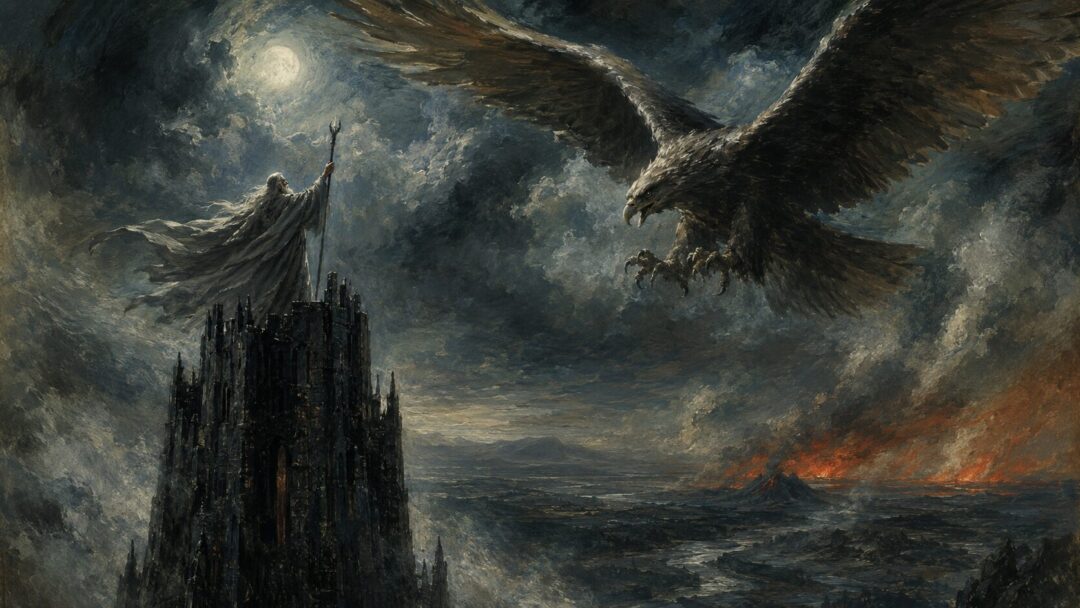
Everyone asks why Gandalf did not simply command the Eagles to carry the Ring to Mordor.
But that may be the wrong question.
The deeper issue is not whether Eagles can fly. They obviously can. They cross great distances. They rescue people from deadly places. They appear at some of the most desperate moments in the histories of Middle-earth.
The real issue is whether Gandalf had the right to use them as instruments.
And the books are much more careful about that than many readers remember.
The Eagles are not treated as convenient transport. They are not giant horses. They are not weapons stored away until a wizard decides to deploy them. They are powerful, speaking beings with their own will, their own limits, and their own place in the order of the world.
That is why the “why not just take the Eagles?” question becomes more interesting the longer you follow it.
Because the answer is not simply distance.
It is authority.
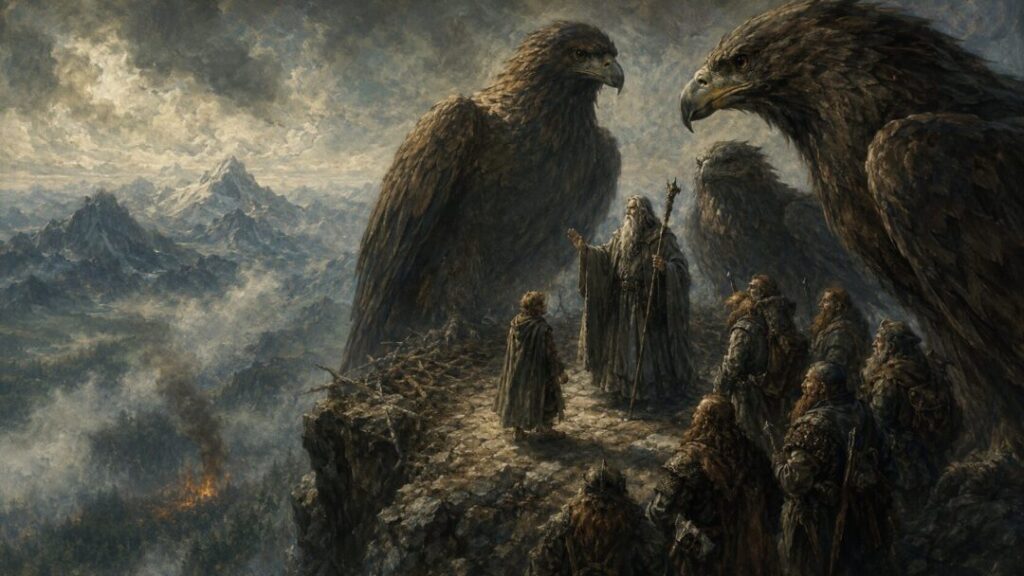
The Eagles Were Not Gandalf’s Servants
The first misconception is that Gandalf could summon the Eagles whenever he pleased.
The texts never support that.
In The Hobbit, the Eagles rescue Gandalf, Bilbo, and the Dwarves from the burning trees, but the help is not presented as obedience to Gandalf’s command. The Lord of the Eagles remembers that Gandalf once healed him from an arrow-wound, and the Eagles repay that service. Even then, they do not agree to carry the Company all the way to the Lonely Mountain. They help within limits.
That matters.
A debt of gratitude is not the same thing as control.
In The Lord of the Rings, the same pattern appears again. When Gwaihir rescues Gandalf from Orthanc, he is not acting as a mount waiting for orders. He has been sent to bring news. Gandalf asks how far Gwaihir can bear him, and the answer is sharply limited: “Many leagues,” but not “to the ends of the earth.” Gwaihir adds that he was sent to bear “tidings, not burdens.”
That sentence is one of the most important pieces of evidence in the entire question.
Gwaihir will help Gandalf.
But he will not become a beast of burden.
“Ask” Is Not the Same as “Command”
Gandalf is powerful, but his power in Middle-earth is restrained.
He counsels. He persuades. He encourages. He reveals enough when the time is right. But he does not usually dominate the wills of others, even when domination would appear useful.
This is not a small detail. It is central to the moral shape of the story.
Sauron works through command, fear, possession, and control. The Ring itself is the supreme expression of that desire: the will to master other wills.
Gandalf’s task moves in the opposite direction.
He does not win by forcing the free peoples into the correct pattern. He wins by awakening courage in others and allowing them to choose.
That is why the Eagles matter.
If Gandalf could simply command them, he would be acting in a way that does not fit his role. The Eagles may aid him. They may answer need. They may appear at moments of mercy or sudden hope. But the story never makes them his property.
To say “Gandalf should have commanded the Eagles” is to imagine a kind of Gandalf the books do not give us.
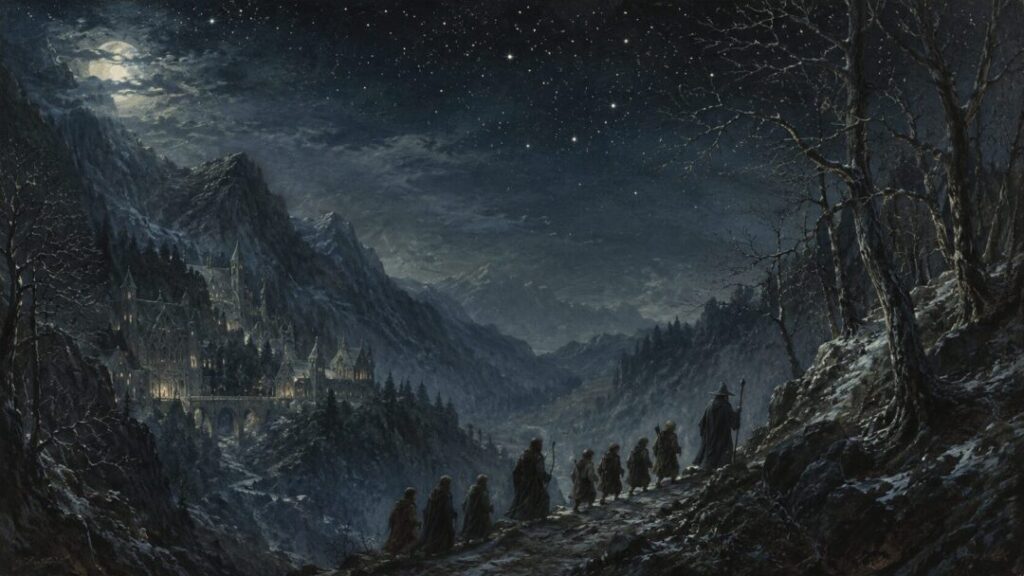
The Quest Was Built on Secrecy
Even if the Eagles had agreed, the plan itself would have violated the logic of the Ring-quest.
At the Council of Elrond, the hope of the Fellowship is not military strength. Elrond says the number must be few because their hope lies in “speed and secrecy.”
That is not decoration.
It is the foundation of the entire mission.
The Ring cannot be taken to Mordor by an army. It cannot be proclaimed. It cannot become the center of a great visible assault. The Wise know they cannot defeat Sauron by matching power against power. Even a mighty host would draw the Eye directly toward the very thing they are trying to hide.
A flight of Great Eagles crossing toward Mordor would be impossible to mistake for ordinary movement.
It would be dramatic.
It would be visible.
It would announce that something of great importance was coming.
And the whole strategy depends on Sauron not understanding the true intention of his enemies.
Sauron Expected Use, Not Destruction
The plan to destroy the Ring works partly because it is almost unthinkable to Sauron.
The Ring is power. It is domination made physical. Sauron assumes that those who possess it will eventually try to use it. That assumption is not foolish. It is exactly what the Ring tempts people to do.
Boromir wants to use it for Gondor.
Saruman desires it.
Even the Wise fear what it would do through them.
The hidden strength of the quest is that Frodo is not trying to wield the Ring as a weapon. He is carrying it toward its unmaking.
That intention is so strange, so contrary to the logic of power, that it can remain hidden.
But an Eagle-borne mission would change the shape of the story. It would turn an act of renunciation into something that looked like a strike from the air. It would draw attention to the one place where attention must not fall.
This is why the “simple” solution is not simple at all.
The Ring does not merely need transportation.
It needs concealment.
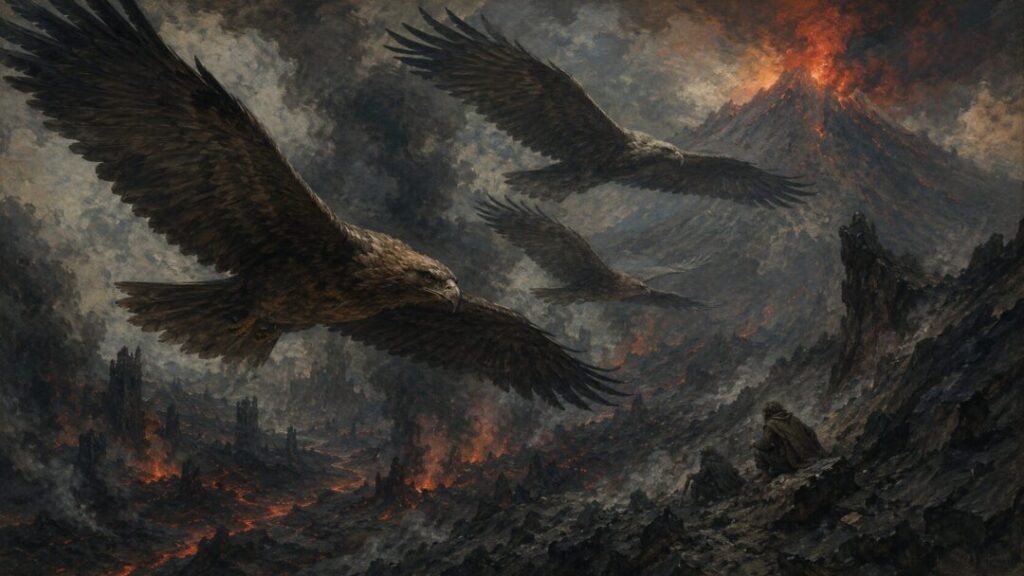
The Eagles Had Limits
The Eagles are mighty, but the texts do not portray them as invulnerable.
In The Hobbit, the Lord of the Eagles refuses to carry the Company near the dwellings of Men, because Men might shoot at them with bows, thinking they were after sheep. That refusal is not cowardice. It is judgment. The Eagles know danger, and they do not spend themselves recklessly.
That point becomes sharper when Mordor is considered.
Mordor is not open countryside. It is the fortified realm of Sauron. It has watchers, armies, servants, and later in the war, Nazgûl mounted on winged creatures. The Eagles do confront those creatures at the Battle of the Morannon, but that happens at the very end, when the Ring is already near its destruction and Sauron’s attention is fixed upon the army before his gate.
That is not the same situation as carrying the Ring into Mordor earlier.
At the Morannon, the Eagles arrive in open battle.
On the Ring-quest, open battle is exactly what must be avoided.
The Eagles Appear at the Edge of Doom
There is a pattern to the Eagles’ appearances.
They do not remove the burden before it must be borne.
They come after endurance has reached the edge of ruin.
In The Hobbit, they save the Company from the trees, but they do not complete the quest for them. Bilbo must still go on. The Dwarves must still reach the Mountain. Smaug must still be faced.
In The Lord of the Rings, Gwaihir rescues Gandalf from Orthanc, but Gandalf must still labor through Rohan, Fangorn, Helm’s Deep, and the war that follows. Later, the Eagles fly to rescue Frodo and Sam from the ruin of Mount Doom, but only after the Ring has already been destroyed.
That distinction is essential.
The Eagles bring deliverance.
They do not replace the moral trial.
If they carried Frodo to the Fire before the burden had done its terrible work, the story would become something else entirely. Not because flight is impossible in a mechanical sense, but because the quest is not a problem of travel alone.
It is a test of pity, endurance, humility, and resistance to power.
The “Machine” Problem
There is also a storytelling reason, and it fits the in-world logic rather than replacing it.
The Eagles are dangerous to use too often because they can flatten the struggle. One letter about a proposed adaptation warns that the Eagles are a dangerous “machine” and says they had already been used sparingly, at the limit of their credibility and usefulness.
That does not mean the Eagles are a mistake.
It means they must appear carefully.
If they become a regular solution, danger collapses. Roads no longer matter. Distance no longer matters. The slow moral pressure of the journey no longer matters.
Middle-earth is not built that way.
Help can come suddenly, but it cannot be demanded whenever the road becomes hard.
Why This Changes Gandalf
The question of the Eagles reveals something important about Gandalf himself.
He is not weak because he does not command them.
He is faithful because he does not.
His strength is not the strength of control. It is the strength of trust. He trusts Hobbits to carry what the mighty cannot safely wield. He trusts free peoples to choose courage. He trusts mercy, even when mercy looks useless.
That is why the Ring is not destroyed by the strongest being available.
It is carried by the small, the overlooked, and the wounded.
The Eagles belong to the moments of rescue around the quest.
They do not replace the quest.
The Real Answer
So why could Gandalf not simply command the Eagles?
Because the Eagles were not his to command.
Because their help was given, not owned.
Because the mission depended on secrecy, not spectacle.
Because Mordor could not be approached as though the Ring were merely a package to be delivered.
And because the deepest victories in Middle-earth do not come from taking the most powerful shortcut.
They come from refusing the logic of domination.
The Eagles are not a plot hole.
They are a boundary.
They show that even in a world of immense powers, not every power may be used as a tool. Not every rescue can come before the suffering. Not every road can be escaped by rising above it.
Frodo and Sam had to walk.
Not because no wings existed.
But because the fate of the Ring depended on something wings could not carry.
Sources & Notes
- J.R.R. Tolkien, The Hobbit, Chapter 6, ‘Out of the Frying-Pan into the Fire’ — the Lord of the Eagles aids Gandalf’s company from gratitude, but refuses to carry them near men’s dwellings or all the way to the Mountain.
- J.R.R. Tolkien, The Lord of the Rings, Book II, Chapter 2, ‘The Council of Elrond’ — Gandalf’s account of Gwaihir stresses that the Eagle was sent to bear tidings, not burdens, and would carry him only a limited distance.
- J.R.R. Tolkien, The Lord of the Rings, Book II, Chapter 3, ‘The Ring Goes South’ — Elrond frames the Fellowship’s hope as secrecy rather than strength, choosing a small company for a hidden errand.
- J.R.R. Tolkien, The Lord of the Rings, Book V, Chapter 10, ‘The Black Gate Opens’ — the Eagles enter the story in open battle at the Morannon, a very different context from secretly carrying the Ring into Mordor.
- J.R.R. Tolkien, The Letters of J.R.R. Tolkien, Letter 210 — Tolkien warns that the Eagles are a dangerous storytelling ‘machine’ and should be used sparingly, supporting their limited role as rescue rather than routine transport.