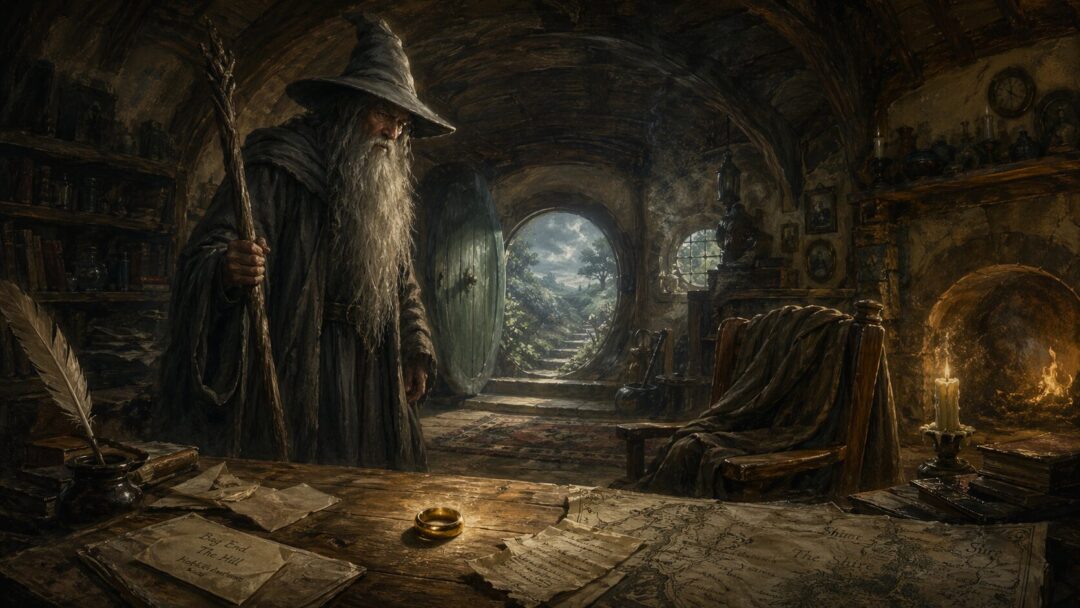
When Bilbo Baggins first returned to the Shire with a magic ring, Gandalf did not immediately cry doom.
That can feel strange.
After all, Gandalf was one of the Wise. He knew the history of Sauron. He knew of the Rings of Power. He understood, better than almost anyone in the Shire could have imagined, that small things could carry terrible importance.
And yet the Ring remained in Bag End for decades.
Bilbo used it. Hid it. Called it his. Lived far too long under its influence. Then, after his birthday party, the Ring passed to Frodo.
Only years later did Gandalf return to Bag End with the answer that changed everything.
This raises one of the most important questions in the early story:
Why did Gandalf have to research the Ring at all?
The answer is not that he was ignorant.
It is that he was careful.
And in Middle-earth, carefulness in the face of the Ring was not weakness. It was wisdom.
Gandalf Suspected the Ring Long Before He Proved It
Gandalf was never simply fooled by Bilbo’s Ring.
From early on, he knew it was dangerous. He warned Bilbo against using it lightly. He was troubled by the way Bilbo spoke of it. And he was especially disturbed by the false story Bilbo first told about how he had obtained it from Gollum.
That lie mattered more than it might seem.
Bilbo was not a naturally deceitful person. Yet the Ring quickly became surrounded by secrecy, possession, and distortion. He did not merely keep it private. He reshaped the story of it.
Gandalf noticed this.
But suspicion is not the same as certainty.
A ring that makes someone invisible is alarming. A ring that seems to preserve its bearer is more alarming still. A ring that inspires lies and possessive language is deeply troubling.
Yet none of that alone proves it is the One Ring.
That distinction is crucial.
Gandalf was not trying to decide whether Bilbo’s Ring was harmless. He already knew it was not. He was trying to decide whether it was the Ruling Ring itself—the one thing Sauron needed above all else.
That required proof.
Middle-earth Had More Than One Magical Ring
One reason Gandalf could not simply assume the worst is that magical rings were not unknown in the histories of Middle-earth.
The great Rings of Power were the most famous: the Three, the Seven, the Nine, and the One. But the lore also allows for lesser works, earlier attempts, and rings whose histories were not widely understood.
To someone like Gandalf, Bilbo’s Ring clearly belonged to a dangerous category. But identifying exactly which ring it was presented a much harder problem.
It looked plain.
It bore no visible stone.
It did not announce itself.
It did not openly reveal Sauron’s power to ordinary sight.
That plainness is part of the horror.
The One Ring did not need to appear majestic. It did not need a crown, a jewel, or a visible flame. Its power was concealed beneath simplicity.
So when Bilbo brought back a small golden ring from the dark places beneath the Misty Mountains, Gandalf had reason to fear it.
But he also had reason not to leap too quickly.
If he wrongly declared it to be the One, the consequences could be disastrous. Fear would spread. The Ring might be moved rashly. Worse still, attention might be drawn to the Shire before anyone understood what danger had truly awakened.
The Ring demanded urgency.
But it also punished haste.
The One Ring Was Believed to Be Lost
There was another obstacle.
The One Ring had vanished long before Bilbo found his ring.
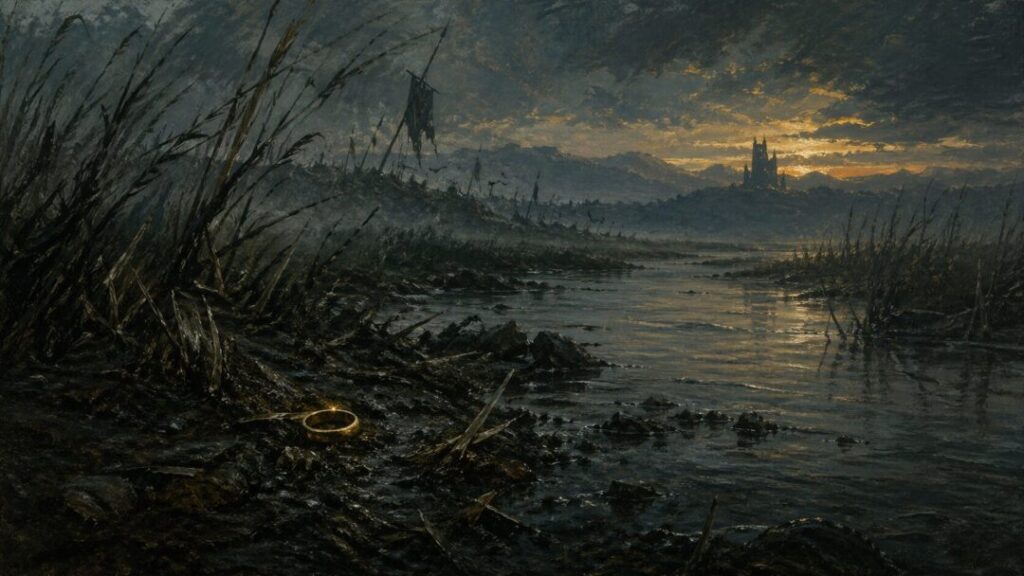
After Sauron’s defeat at the end of the Second Age, Isildur took the Ring. He did not destroy it. Later, near the Gladden Fields, he was attacked and killed. The Ring slipped from him and was lost in the waters.
For centuries, its fate was uncertain.
By the time of Bilbo and Frodo, many among the Wise believed it was beyond reach. Saruman, who was considered learned in Ring-lore, had argued that it had likely been carried down Anduin and out to Sea.
This belief mattered.
It did not make the Ring safe. It did not make Sauron harmless. But it helped explain why even the Wise did not immediately assume the One Ring had resurfaced in the pocket of a hobbit.
The idea was almost too terrible.
The Ruling Ring, lost for an age, found by Gollum, carried beneath the mountains, then passed by chance to Bilbo Baggins?
It sounds impossible.
And yet much of the history of the Ring turns on events that appear accidental until they are seen from a greater distance.
Gandalf eventually comes to understand that Bilbo was “meant” to find the Ring, though not by its maker.
But before that realization could become action, he had to separate fear from fact.
Saruman’s Counsel Made the Matter More Dangerous
Saruman’s role is one of the darkest parts of the answer.
He was the head of the White Council and deeply learned in Ring-lore. Gandalf had reason to listen to him, even when he did not fully trust his pride.
Saruman’s counsel helped quiet concern about the One Ring. He encouraged the belief that it was lost beyond recovery. Yet the later story reveals that Saruman was not merely a neutral scholar. His own desire for the Ring had already begun to corrupt his judgment.
This does not mean Gandalf was foolish for consulting him.
It means the situation was more dangerous than Gandalf knew.
The very person who should have helped clarify the Ring’s history was compromised by desire for it. Saruman’s knowledge did not protect him. In fact, it may have made his fall more terrible, because he understood enough to covet what he should have feared.
Gandalf’s later research, then, was not just about finding old information.
It was about cutting through false certainty.
The Ring had been treated as lost.
Saruman had encouraged that conclusion.
The Wise had allowed the matter to rest.
But the Ring had not rested.
It had passed from Isildur to the river, from the river to Déagol, from Déagol to Sméagol, from Gollum to Bilbo, and from Bilbo to Frodo.
The chain was hidden.
Gandalf had to uncover it.
Bilbo’s Behavior Was a Clue, Not a Verdict
Bilbo’s long life was one of Gandalf’s strongest reasons for concern.
After possessing the Ring for decades, Bilbo remained remarkably unchanged in appearance. But this preservation was not wholesome. The Ring did not give true life. It stretched life, thinning it, delaying its natural course.
Bilbo himself described the feeling with painful clarity: like butter scraped over too much bread.
That image reveals the Ring’s effect better than any dramatic transformation could.
Bilbo was not a monster. He was not a servant of Sauron. He was still generous, witty, affectionate, and capable of surrendering the Ring—though only after a severe struggle.
But he was marked.
The Ring had made itself part of his inner life. He called it precious. He resisted giving it up. For a moment, even with Gandalf before him, something hard and defensive surfaced in him.
Gandalf saw all of this.
Still, the Ring’s corrupting influence did not prove its exact identity. Other Rings of Power could also be dangerous. A lesser ring might still harm a mortal bearer. A Great Ring might still extend life.
The question was not whether the Ring was evil.
The question was whether it was Sauron’s own.
For that, Gandalf needed more than behavior.
He needed history.
The Missing Proof Was in Isildur’s Account
The decisive clue came from Isildur.
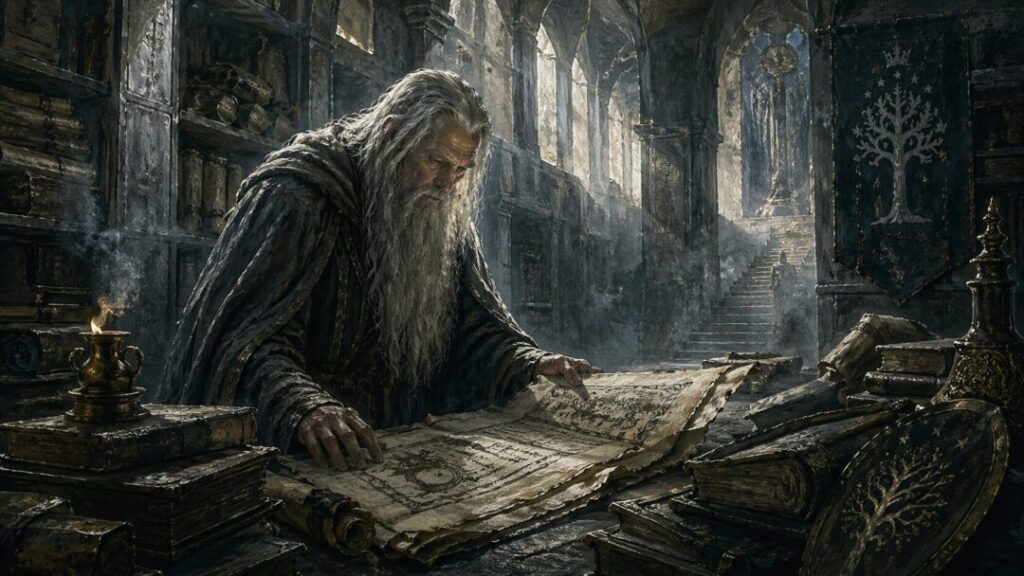
Gandalf eventually searched old records in Gondor and found an account written by Isildur himself. This account described the Ring after it had been cut from Sauron’s hand. Most importantly, it preserved the detail of the fiery inscription that appeared upon it.
This was the key.
The One Ring did not normally display its writing. To ordinary sight, it appeared as a plain band of gold. But when heated, the hidden letters could be revealed.
That meant Gandalf finally had a test.
Not a guess.
Not a fear.
Not a theory.
A test.
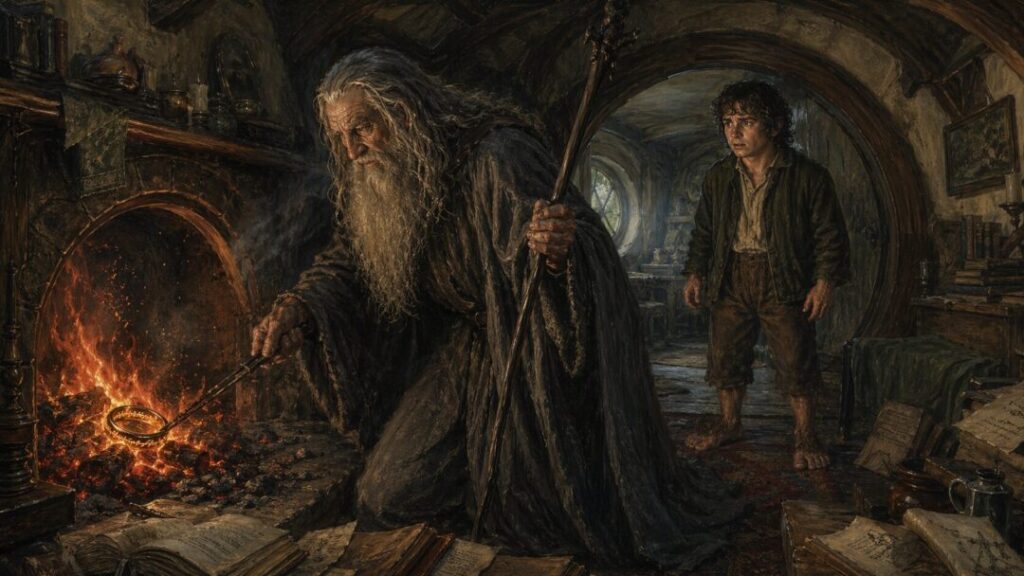
This is why the scene in Bag End matters so much.
When Gandalf throws the Ring into the fire, he is not experimenting blindly. He is using the knowledge he found in Isildur’s record. He already fears the answer. The fire merely forces the Ring to confess what it is.
And when the letters appear, the long uncertainty ends.
The small golden ring in Frodo’s house is not a lesser ring.
It is not merely a dangerous heirloom.
It is not simply Bilbo’s old treasure.
It is the One Ring.
Gollum Confirmed the Path
Gandalf’s research was not limited to books.
He also sought Gollum.
This mattered because Gollum was the living link between Bilbo and the Ring’s older history. Through him, Gandalf could trace how the Ring had come out of the river and into the dark beneath the mountains.
Gollum’s story revealed the names Sméagol and Déagol. It connected the Ring to the Gladden Fields. It showed that this was no ordinary trinket found at random in the deep places of the world.
It had been lost where Isildur fell.
That fact made the truth almost unavoidable.
The Ring had not merely appeared near old legends. It had emerged from the very region where the Ruling Ring vanished.
Even then, the story is handled with care. Gandalf does not need to invent motives or unseen events beyond what the text gives. The known chain is enough.
Isildur lost it.
Déagol found it.
Sméagol murdered him for it.
Gollum kept it.
Bilbo found it.
Frodo inherited it.
The Ring’s path was hidden for centuries.
Gandalf’s task was to make that hidden path visible.
Why He Did Not Act Sooner
The delay can look frustrating only if we already know the answer.
Gandalf did not.
He had suspicions. Strong ones. Growing ones. But the world around him gave him reasons to hesitate.
The One Ring was supposed to be lost.
Saruman had discouraged alarm.
There were other magical rings.
Bilbo’s Ring had no visible inscription.
The Shire seemed far removed from the great designs of Sauron.
And Bilbo, for all his possessiveness, had not become a wraith, tyrant, or servant of Mordor.
Gandalf had to move carefully because the stakes were absolute.
If the Ring truly was the One, then every careless word could become a danger. Every unnecessary movement could expose Frodo. Every open declaration could draw the attention of enemies.
This is why Gandalf’s caution feels so different from indecision.
He does not ignore the Ring.
He watches it.
He studies it.
He follows its trail.
He searches ancient records.
He seeks the one creature who possessed it before Bilbo.
And only when he has enough evidence does he reveal the truth.
The Fire Test Changed Everything
The moment the inscription appears, the story enters a new world.
Before that moment, Frodo possesses a frightening inheritance.
After it, he possesses the central weapon of the Enemy.
That is why Gandalf’s tone changes so sharply. The matter is no longer local. It is no longer only about Bilbo’s strange longevity or Gollum’s misery. It is about Sauron, the Nine, the fate of the Free Peoples, and the return of a power thought lost.
The fire does not make the Ring dangerous.
It reveals the danger that was already there.
And this is the deeper reason Gandalf had to research the Ring. The truth was not lying openly on the surface. It was buried in old records, broken histories, false assumptions, and the ruined lives of those who had carried it.
The Ring survived because it could disappear into smallness.
A plain band.
A useful trick.
A birthday present.
An inheritance.
That was part of its terror.
Gandalf’s Wisdom Was His Refusal to Guess
Gandalf’s greatness in this part of the story is not shown through thunder or open power.
It is shown through restraint.
He does not seize the Ring.
He does not declare himself master of the crisis.
He does not trust his fear alone.
He does not dismiss the smallness of the Shire, but neither does he expose it too soon.
Instead, he does what the Wise should do.
He seeks the truth.
This matters because the Ring constantly tempts people toward certainty of the wrong kind. Boromir believes it can be used. Saruman believes he can master it. Sauron cannot imagine anyone seeking to destroy it.
Gandalf is different.
He knows enough to be afraid.
But he is humble enough to verify.
That humility may be one of the reasons he is able to resist the Ring at all.
The Real Answer
So why did Gandalf have to research the Ring?
Because the One Ring was not obvious.
Because its history had been buried.
Because Saruman’s counsel had misled the Wise.
Because Bilbo’s behavior proved danger, but not identity.
Because the Ring’s inscription was hidden until the right knowledge revealed it.
Because a mistaken guess could have endangered everything.
Gandalf did not research the Ring because he was slow to understand evil.
He researched it because he understood evil too well to treat suspicion as proof.
And when the proof finally came, it did not arrive as a battle cry.
It appeared quietly, in the firelight of Bag End, written on a little golden ring that had waited in the Shire while the shadow in the East grew stronger.
That is the horror of the scene.
The greatest danger in Middle-earth had not been sitting on a throne.
It had been lying in a hobbit-hole, mistaken for an heirloom, waiting for someone wise enough to ask the right question.
Sources & Notes
- J.R.R. Tolkien, The Lord of the Rings, Book I, ch. 2 “The Shadow of the Past”: Gandalf’s long suspicion, Bilbo’s odd possessiveness and longevity, the fire-test inscription, and Gandalf’s discovery of Isildur’s written account in Minas Tirith.
- J.R.R. Tolkien, The Lord of the Rings, Book II, ch. 2 “The Council of Elrond”: Gandalf’s account of questioning Gollum, learning the Sméagol/Déagol story, and tracing the Ring’s path from the Gladden Fields to Bilbo.
- J.R.R. Tolkien, The Silmarillion, “Of the Rings of Power and the Third Age”: the making of the Rings, Isildur cutting the One Ring from Sauron, and the Ring’s loss after Isildur’s death.
- J.R.R. Tolkien, Unfinished Tales, “The Hunt for the Ring”: Saruman’s Ring-lore, his misleading assurances about the Ring’s likely fate, and Gandalf’s growing concern over the Shire and Gollum.
- J.R.R. Tolkien, The Lord of the Rings, Prologue, “Of the Finding of the Ring”: the revised account of Bilbo’s finding of the Ring and the importance of his first false story about Gollum.