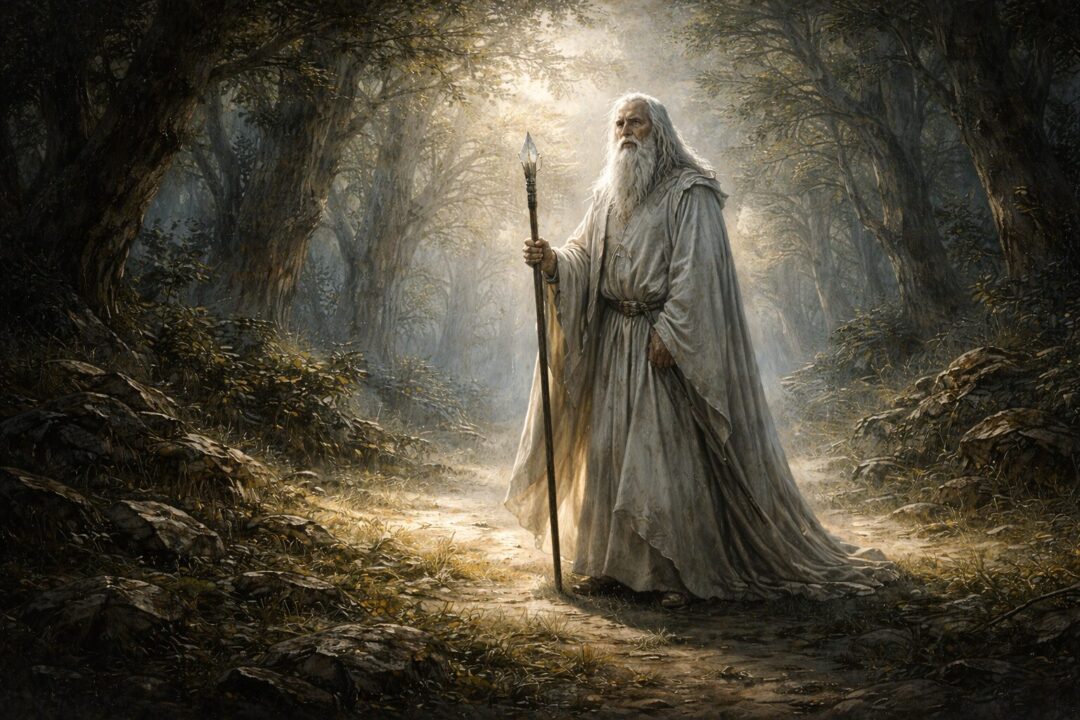
Gandalf’s transformation is one of the most dramatic moments in The Lord of the Rings, and also one of the most frequently misunderstood.
When Gandalf returns after his fall in Moria, clad in white and bearing a new title, it is often read as a kind of reward—a visual shorthand for increased power, higher status, or victory over death. In modern fantasy terms, it can feel like a “level-up,” a moment where the story announces that the mentor character has become even more formidable than before.
But the texts themselves tell a quieter, more restrained, and ultimately more unsettling story.
Gandalf does not return because he defeats the Balrog.
He does not return because he has earned greater power.
He returns because his task is unfinished.
To understand why Gandalf becomes “the White,” we must first understand what Gandalf actually is—and just as importantly, what he is not.
Gandalf Was Never a Mortal Wizard
Although he is called a wizard throughout the story, Gandalf is not a mortal practitioner of learned magic in the conventional sense. He belongs to a far older and more complex order of beings.
According to Unfinished Tales, Gandalf is one of the Istari—a small group of emissaries sent to Middle-earth in the Third Age. These figures are Maiar: immortal spiritual beings of the same order as Sauron himself, though vastly different in purpose and allegiance.
Their mission is specific and tightly constrained.
They are not sent to rule the Free Peoples.
They are not sent to overthrow Sauron by force.
They are not even sent to openly display their full strength.
Instead, they are deliberately placed under limitations. They are given the forms of old Men, subject to weariness, pain, and death. Their knowledge is veiled. Their power is restrained. These limits are not a punishment; they are essential to the mission.
The Istari are meant to guide, advise, and encourage resistance—not to dominate it.
Among them, Gandalf adheres to these restrictions more faithfully than any other. Where Saruman seeks control, and others grow idle or distracted, Gandalf remains committed to persuasion, patience, and trust in the courage of others.
This commitment to limitation is central to understanding everything that follows.
The Fall in Moria Was Not Part of the Plan
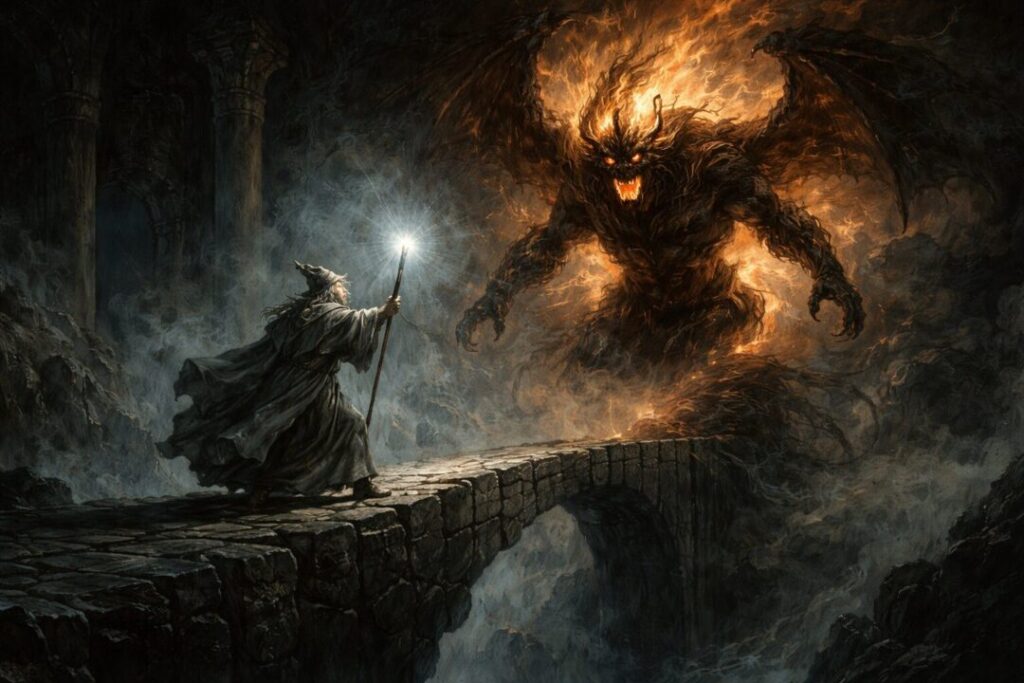
When Gandalf confronts Durin’s Bane on the Bridge of Khazad-dûm, nothing about the moment suggests a calculated sacrifice or a foreseen necessity. His stand is immediate and protective, not strategic.
“You cannot pass,” he declares—not to win glory, but to buy time.
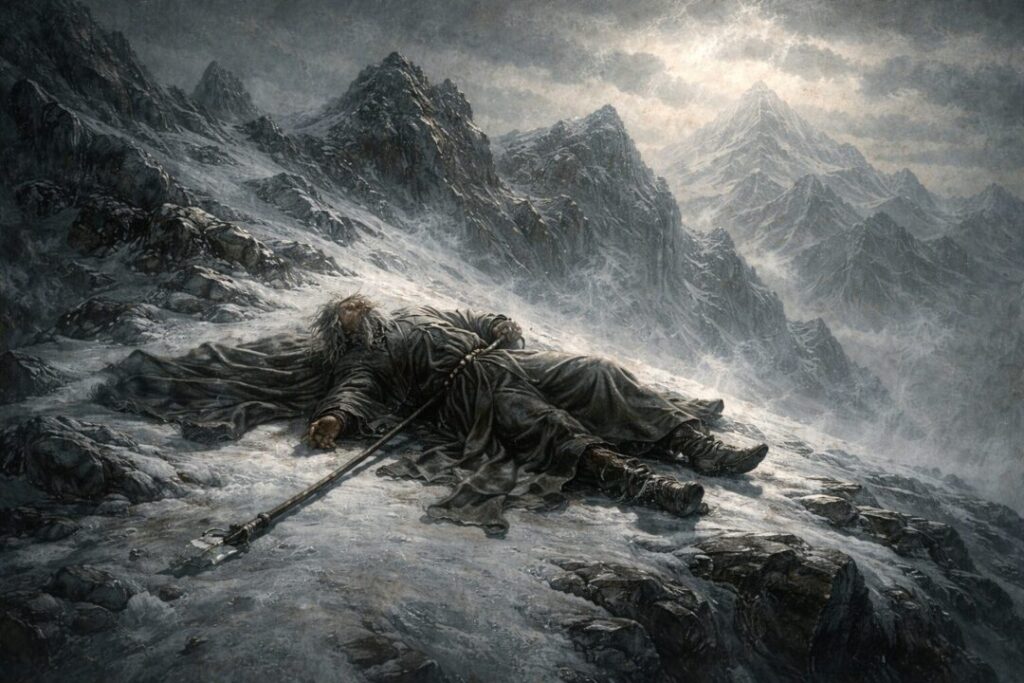
The battle that follows, described later in The Two Towers, is long, brutal, and catastrophic. Gandalf pursues the Balrog from the depths of Moria to the peak of Zirakzigil, where both fall. Gandalf’s body is destroyed, and his spirit passes “out of thought and time.”
This is not a narrow escape.
It is death.
And this matters, because nothing in the Istari’s mission suggests that death was expected—or even permitted. They were sent as guides precisely because they were not meant to replace the Free Peoples in the struggle. The death of an Istar represents a rupture in the original design.
Gandalf does not fall because his role demanded it.
He falls because he chose to protect others at the cost of himself.
“I Was Sent Back”
When Gandalf later explains his return, his words are careful and restrained:
“I was sent back—until my task is done.”
He does not explain who sent him back. He does not describe the experience in detail. He offers no metaphysical justification.
But within the logic of the legendarium, the implication is clear.
A Maia cannot simply return from death by personal will. The authority to restore such a being rests only with the highest powers governing the world. Gandalf does not resurrect himself. He does not escape the afterlife. He is returned by authority beyond Middle-earth.
Importantly, Gandalf does not frame this return as a blessing or a reward.
It is an assignment.
Why White?
Before Gandalf’s fall, Saruman bore the title “the White.” He was the head of the Istari, entrusted with coordination, leadership, and oversight of their shared mission.
White, in this context, is not a color of purity or superiority. It is a symbol of office.
Saruman betrays that office. He seeks mastery rather than guidance, power rather than stewardship. By the time Gandalf returns, Saruman has already failed in the task entrusted to him.
When Gandalf becomes “the White,” he does not become Saruman’s rival in ambition. He becomes his replacement in responsibility.
White signifies that Gandalf now bears the full weight of the mission the Istari were sent to accomplish.
Not freedom.
Not domination.
Responsibility.
Gandalf Is More Restricted, Not Less
One of the most persistent misconceptions is that Gandalf’s return marks the removal of his restraints.
The opposite appears to be true.
After his return, Gandalf intervenes less frequently and more precisely than before. He does not roam freely, testing limits or displaying power. He acts only when the mission itself is endangered.
He breaks Saruman’s staff—once.
He confronts Denethor—once.
He refuses the Ring—consistently and decisively.
Each of these moments is narrow, deliberate, and restrained. Gandalf does not rule Gondor. He does not lead armies for personal glory. He does not impose his will on allies.
Being “the White” does not mean unleashed power.
It means final authority paired with final limits.
Why Gandalf Can Command Saruman
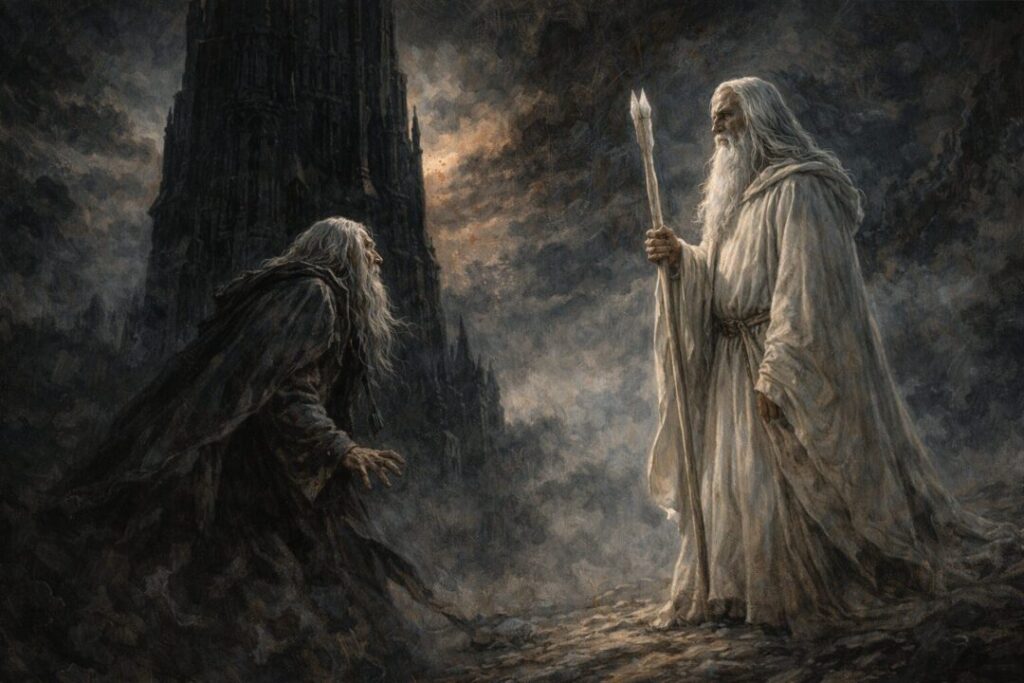
When Gandalf confronts Saruman at Orthanc, the shift in authority is unmistakable. Saruman’s voice, once persuasive and commanding, falters. Gandalf’s words carry weight Saruman can no longer claim.
This is not because Gandalf has become inherently stronger.
It is because Saruman has abandoned his charge.
Authority in Middle-earth does not flow simply from power. It flows from alignment with purpose. Gandalf now speaks with the authority of the mission itself—because he has remained faithful to it.
Saruman has not.
What Gandalf Loses
Gandalf the Grey was a wanderer, a storyteller, and a friend to Hobbits. He laughed easily. He lingered. He delighted in small joys.
Gandalf the White is different.
He is sterner.
More distant.
More focused.
Even Aragorn, Legolas, and Gimli hesitate when they first meet him again, uncertain whether this figure is truly the same companion they knew. The warmth is not gone—but it is muted.
The transformation costs Gandalf something human.
Why This Matters
Gandalf’s return is not framed as a triumph.
It is necessity.
He is sent back because the world cannot afford his absence—not because it needs him to rule it. When the task is complete, Gandalf does not remain to govern the age he helped preserve.
He leaves.
White is not glory.
It is duty.
And Gandalf bears it only as long as the world requires it—no longer.