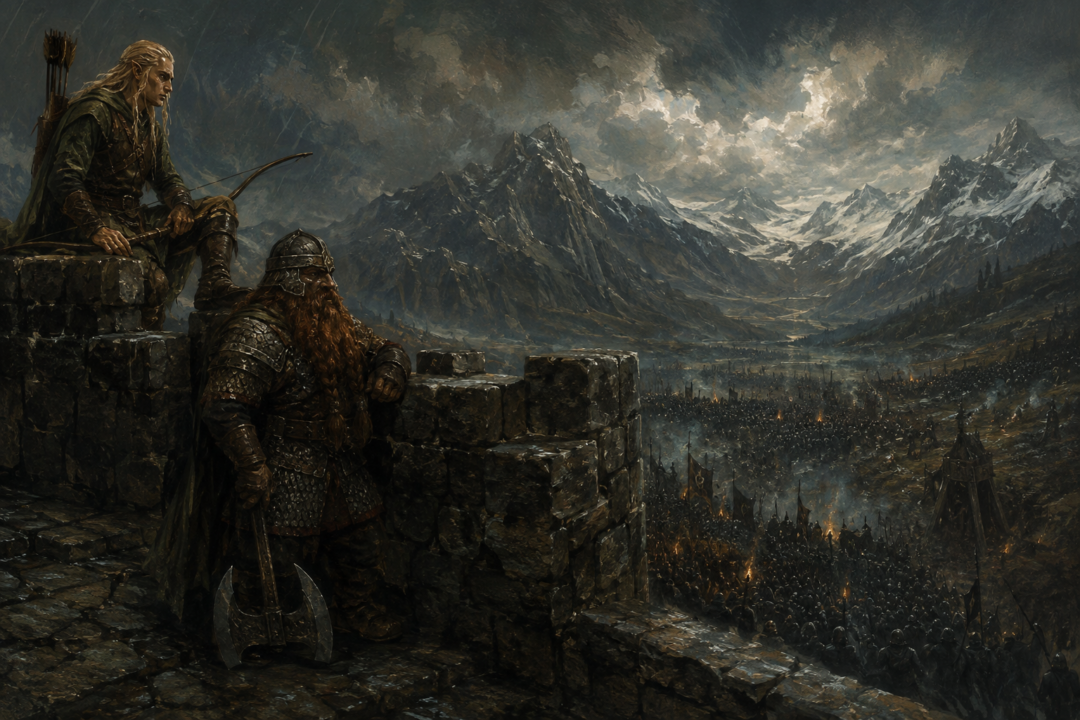
One of the most memorable images of the Battle of Helm’s Deep is Gimli standing upon the Deeping Wall beside Legolas, axe ready while the armies of Saruman gather in the darkness below.
It seems exactly where he ought to be.
Gimli likes the stonework immediately. He stamps upon it approvingly and declares that the country has “tough bones.” Legolas has the advantage of a bow, but Gimli is perfectly capable of defending a wall once the attackers come within reach. And as the assault begins, the two friends turn the battle into their famous contest of Orc-killing.
Yet when dawn finally comes, Gimli is no longer fighting beside Legolas.
He emerges from the caves behind Helm’s Deep with Éomer and the surviving defenders who had been driven there during the battle.
It is easy to remember this as though Gimli simply chose a more Dwarvish battlefield underground. That is not what happens.
Gimli does not abandon the wall because he prefers caves.
The destruction of the Deeping Wall splits the defenders apart, and Gimli is caught on the wrong side of the breach. His retreat into the caverns is forced by the course of the battle.
And that accident leads him into one of the great discoveries of his life.
Gimli Begins the Battle on the Deeping Wall
The geography of Helm’s Deep matters.
The Hornburg stood beside the entrance to the Deep, while the Deeping Wall stretched from the fortress across the valley to the cliff on the opposite side. Behind that barrier, the gorge narrowed into the mountains.
The caverns later celebrated by Gimli lay farther within.
When Théoden’s forces prepare their defense, Éomer places much of his strength on the Deeping Wall because that position appears especially vulnerable to a determined attack.
Gimli is there with them.
Before the fighting even begins, he and Legolas wait together on the wall. Their different temperaments are immediately obvious. Legolas watches the darkness with his bow while Gimli appreciates the quality of the rock beneath him.
This is important because it removes a common misconception from the beginning.
Gimli was not assigned to defend the caves because he was a Dwarf.
He was part of the main defense.
Nor does he spend the battle avoiding exposed positions. When Orcs discover the culvert through which the Deeping-stream passes beneath the wall, Gimli is among those who rush to meet them. He fights where the danger is greatest because that is where he is needed.
The caves become his battlefield only later.
Saruman’s Army Breaks the Defense
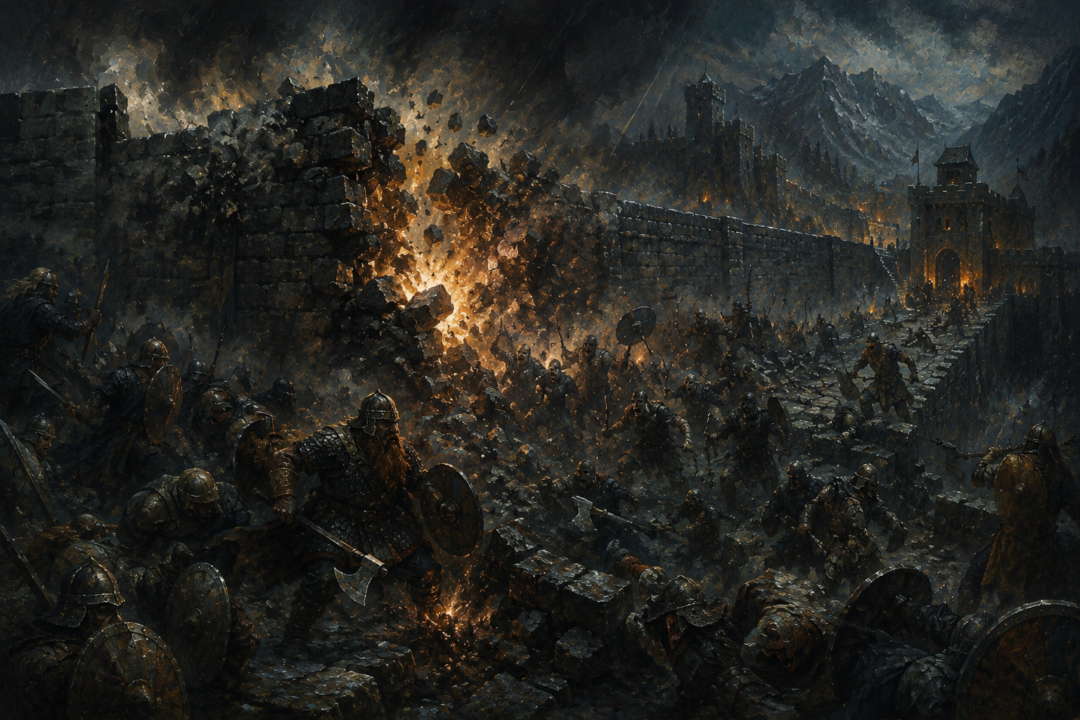
The turning point comes when Saruman’s forces attack the Deeping Wall in a way the defenders do not understand until it is too late.
Earlier, Orcs had attempted to crawl through the culvert. Gimli and the Rohirrim could answer that threat with axes and swords.
The next attack is different.
A blasting fire is used beneath the wall. The resulting explosion tears open the stonework and creates a breach through which the enemy pours.
For Gimli, the destruction is particularly striking because he had admired the craftsmanship of the defenses. Helm’s Deep seemed built upon exceptionally strong stone. Yet Saruman’s forces do not need to climb the whole wall if they can tear a hole through it.
The defenders are thrown into confusion.
Some retreat toward the Hornburg.
Others are driven farther into the Deep.
This is the crucial reason Gimli does not simply remain beside Legolas.
The battlefield has been physically divided.
Gimli Is Cut Off With Éomer
After the wall is breached, Aragorn and Legolas eventually reach the Hornburg.
Gimli does not.
Aragorn later explains that the last time he saw Éomer, the Marshal was gathering men and fighting near the mouth of the Deep. Gamling was with him.
So was Gimli.
The fighting therefore separates the companions through circumstance rather than choice. Gimli remains with Éomer’s group while Aragorn and Legolas fall back toward the fortress.
That relationship is not accidental either.
Earlier in the battle, Gimli had already saved Éomer when Orcs attacked him during the fighting around the gate. Whatever tension had existed between them after their first meeting on the plains of Rohan, they are now comrades in a very literal sense.
When the defense collapses into separate pockets, Gimli stays in the struggle around Éomer and Gamling.
Eventually that group has only one practical direction left.
Back into Helm’s Deep.
Toward the caves.
The Caves Were Already a Refuge
The Glittering Caves were not empty when Gimli entered them.
Before the battle, people from the Westfold who could not take part in the fighting had been sheltered within Helm’s Deep. The caverns offered protection deep beneath the mountains while warriors defended the approaches outside.
To the Rohirrim, that was their obvious value.
They were shelter.
Gimli would later be astonished by how inadequate that description was.
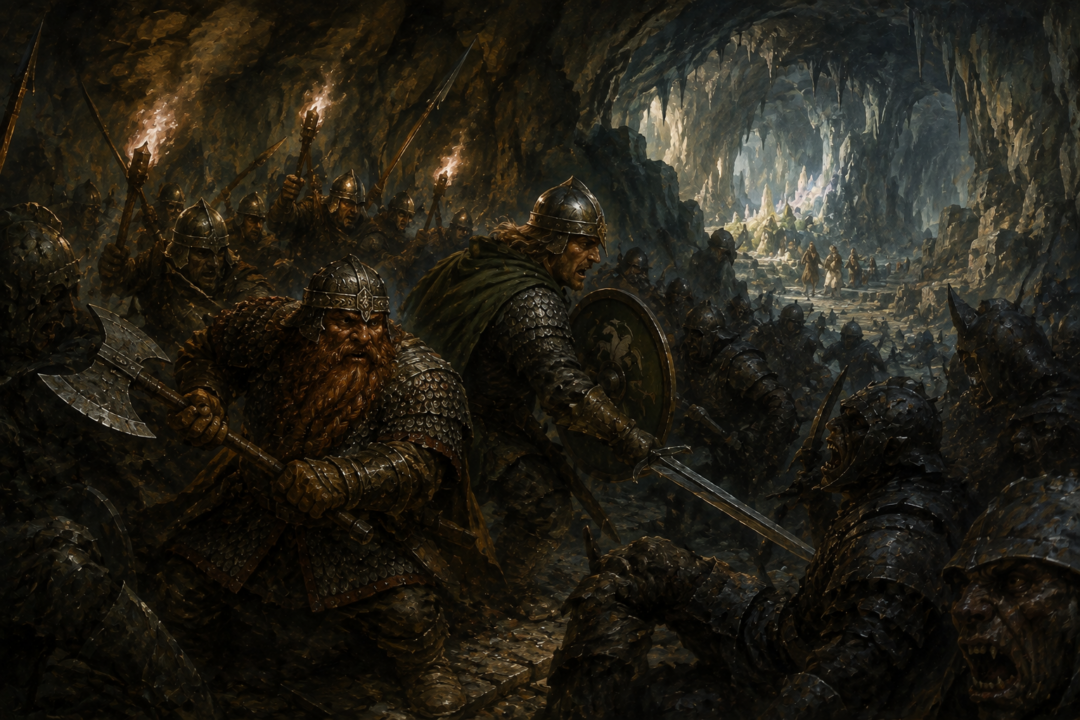
But during the battle, the caves also offered an important military advantage. The entrance lay within the narrowing gorge behind the defensive wall. Once the open defenses had been broken, men driven into the Deep could withdraw toward terrain where the enemy could not bring its full numbers against them so easily.
Gimli, Éomer, Gamling, and the warriors with them therefore make their stand there.
The exact movements of every fighter are not described minute by minute, so it would go beyond the text to invent a detailed underground battle. What is clear is that Gimli and the Rohirrim are driven back toward the caverns and continue resisting there until the battle turns.
The caves are not where Gimli planned to fight.
They are where the collapse of the wall sends him.
Why Gimli Does Not Return to Legolas
Once this is understood, another question disappears: why does Gimli not simply fight his way back to Legolas?
Because Helm’s Deep is no longer functioning as one continuous defensive line.
The breach has allowed Saruman’s forces into the Deep. Aragorn himself cannot reach Éomer’s group and is forced to withdraw into the Hornburg. Gimli cannot reasonably cross an enemy-filled battlefield merely to reunite with his companion.
Both friends continue fighting where they have been trapped.
That separation gives their Orc-counting competition an amusing secondary purpose.
They cannot see what the other is doing.
Each continues keeping score anyway.
When the battle ends and Gimli finally appears again, wounded but vigorous, he proudly announces forty-two. Legolas has killed forty-one.
Gimli wins by one.
The joke works precisely because they spent much of the battle apart.
The Place of Retreat Becomes Gimli’s Greatest Discovery
There is a deeper irony in where Gimli is driven.
The caves are initially treated as a place to retreat when everything outside has gone wrong.
For Gimli, they become something entirely different.
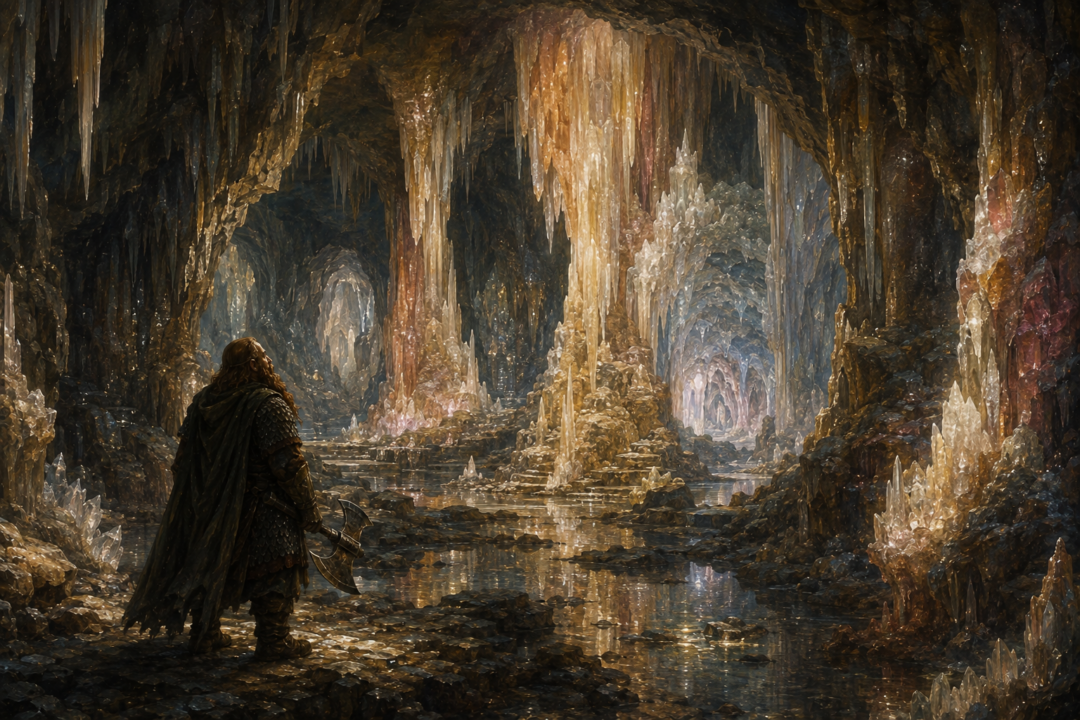
After the battle, he tries to explain their beauty to Legolas. What impressed him was not simply that the caverns contained valuable minerals. His description is filled with wonder at natural stone formations, translucent surfaces, pools, columns, hanging shapes, and vast chambers shaped by water over ages.
This matters because Gimli does not immediately respond like a miner calculating what could be extracted.
He responds like someone encountering a masterpiece.
Indeed, when Legolas worries that Dwarves would damage such beauty by mining it, Gimli rejects the assumption. He imagines Dwarven craftsmen working with restraint: carefully tending the stone, opening passages where appropriate, and using their skill to reveal rather than destroy what already exists.
The warrior who entered the caves because the battle was collapsing comes out speaking almost like a poet.
That transformation is one of the quiet wonders of Helm’s Deep.
The Rohirrim Saw Shelter; Gimli Saw Aglarond
Gimli is amazed that the people of Rohan possess such a place and speak of it merely as caves.
Their perspective is understandable.
For a horse-loving people whose culture belongs largely to open country, the caverns beneath the mountains are useful primarily as shelter and storage.
Gimli sees something they have overlooked.
He calls the caverns one of the marvels of the Northern World.
This contrast should not be exaggerated into a claim that the Rohirrim were incapable of appreciating beauty. Their songs, traditions, craftsmanship, and love of their land show otherwise.
The difference is one of perception.
Gimli understands stone in a way that the Rohirrim do not.
Legolas understands forests in ways Gimli initially does not.
Their friendship increasingly becomes an exchange of those perspectives.
After Helm’s Deep, Gimli promises to visit Fangorn with Legolas if Legolas will visit the caverns with him.
The battlefield therefore produces something unexpected: each friend agrees to enter the landscape that speaks most deeply to the other.
Gimli Eventually Returns by Choice
During the battle, Gimli enters the caves because he is driven there.
Later, he returns because he loves them.
That distinction is essential.
After the War of the Ring, Gimli brings Dwarves of Erebor south and becomes Lord of the Glittering Caves of Aglarond. According to the account in the appendices, his people perform important works in both Gondor and Rohan. Among their achievements is the forging of a new gate for Minas Tirith, made of mithril and steel.
Aglarond becomes Gimli’s home and lordship in the Fourth Age.
So the battle creates a remarkable reversal.
Saruman’s assault destroys the Deeping Wall and forces Gimli away from Legolas. The enemy drives him into a place regarded chiefly as a refuge.
But Saruman cannot know what Gimli will find there.
Behind the broken defenses lies a wonder that will outlast the army attacking it.
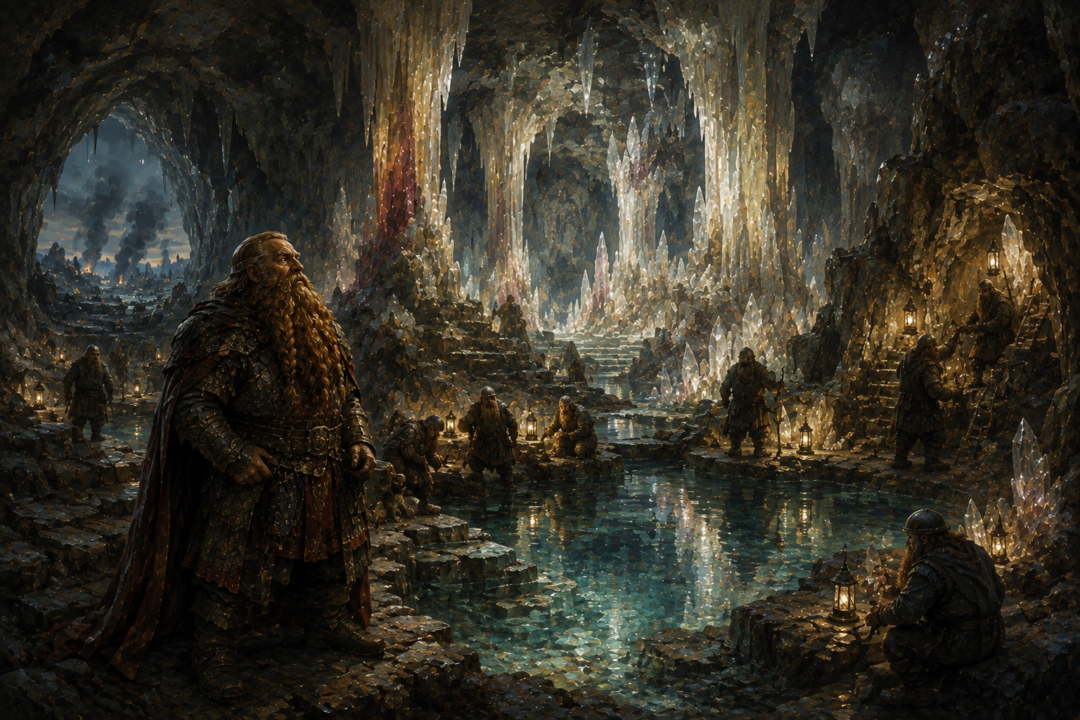
The Real Reason Gimli Fights in the Caves
Gimli fights in the caves because the Battle of Helm’s Deep goes badly.
The Deeping Wall is breached. The defenders are divided. Gimli remains with Éomer, Gamling, and the men fighting farther up the Deep, while Aragorn and Legolas withdraw toward the Hornburg.
There is no secret Dwarven strategy and no deliberate decision to exchange the wall for an underground battlefield.
He is simply cut off.
Yet that forced retreat becomes one of the most consequential accidents of Gimli’s journey.
He enters the caverns as a warrior trying to survive the night.
He emerges having discovered Aglarond.
Long after Saruman’s army is destroyed, the place into which Gimli was driven in defeat becomes the place he chooses to build in peace.
That may be the most fitting answer of all.
The enemy breaks the wall.
Gimli finds a kingdom behind it.
Sources & Notes
- Tolkien Gateway, “Battle of the Hornburg” — https://tolkiengateway.net/wiki/Battle_of_the_Hornburg
- Tolkien Gateway, “Deeping Wall” — https://tolkiengateway.net/wiki/Deeping_Wall
- Tolkien Gateway, “Glittering Caves” — https://tolkiengateway.net/wiki/Glittering_Caves
- Tolkien Gateway, “Gimli” — https://tolkiengateway.net/wiki/Gimli
- The Encyclopedia of Arda, “Helm’s Deep” — https://www.glyphweb.com/arda/h/helmsdeep.php
- The Encyclopedia of Arda, “Glittering Caves” — https://www.glyphweb.com/arda/g/glitteringcaves.php
References for the Deeping Wall’s breach, Gimli’s separation from Legolas and retreat with Éomer, and his later discovery and settlement of the Glittering Caves.