At first, the question seems devastatingly straightforward.
Gollum knew the words “Baggins” and “Shire.” He wanted the Ring more than anything else in Middle-earth. So why did he not simply go after it?
It sounds like one of those details that should collapse under its own weight. If the Ring was stolen from him by Bilbo Baggins, and Bilbo came from the Shire, then the path seems obvious. Find the Shire. Find Baggins. Find the Ring.
But the actual story is not that simple.
In fact, the deeper you look, the more this question reveals something essential about Gollum himself. He is not a mastermind following a clean trail. He is a broken creature with scraps of knowledge, dragged by obsession, fear, and powers beyond his control.
The texts do not show a failed detective story.
They show a ruined mind trying to recover the thing that has consumed it for centuries.
Gollum Did Pursue the Ring
The first thing to clear away is a common misunderstanding.
Gollum did pursue the Ring.
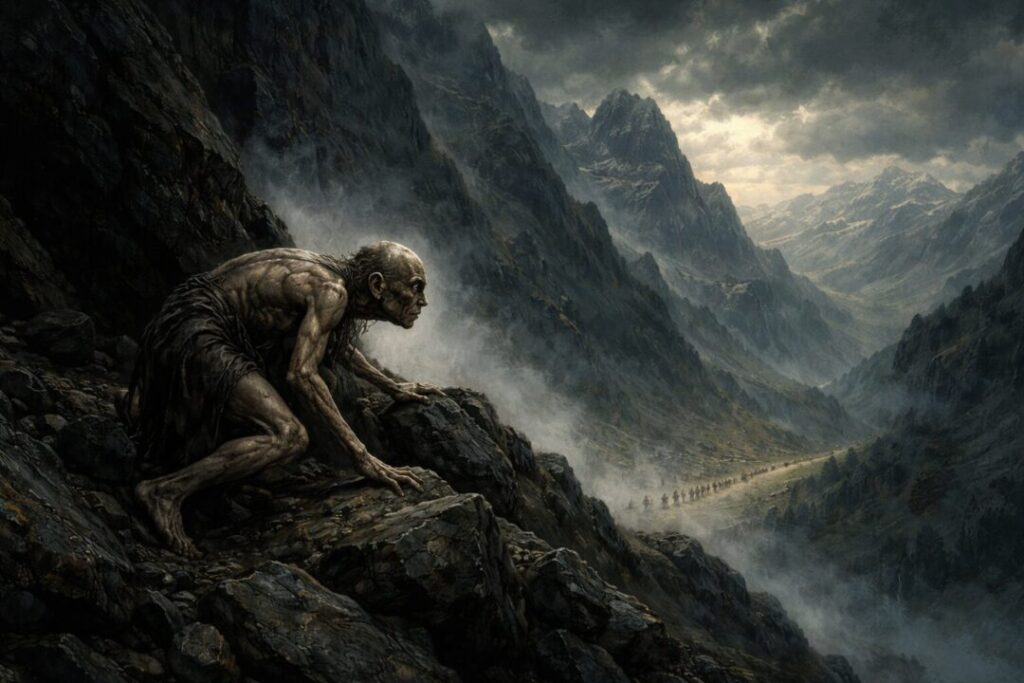
After Bilbo escaped the Misty Mountains, Gollum did not simply remain in his dark lake and forget what had happened. Gandalf recounts that Gollum’s obsession drew him out in pursuit of Bilbo, and that he followed the trail of Thorin’s Company as far as Erebor and then back again toward the Anduin.
That matters.
The story is not about a creature who strangely failed to care. It is about a creature who cared so completely that his whole life bent around the loss.
So the better question is not, “Why did Gollum never go after the Ring?”
He did.
The real question is why that pursuit never became a straight road to Hobbiton.
Knowing Two Words Was Not Enough
The answer begins with a simple limitation.
Gollum knew names. He did not know geography.
That distinction is easy to miss because readers know where the Shire is. We know it is a defined place in the northwest of Middle-earth. We know Bilbo is a famous hobbit from Hobbiton. But Gollum did not possess that broad map of the world.
He had lived for centuries in darkness beneath the mountains. His older life as Sméagol belonged to the banks of the Great River near the Gladden. He was not a traveler with clear knowledge of Eriador, its roads, or its settlements. Even when Sauron extracted “Baggins” and “Shire” from him, Gollum appears to have had only fragmentary information to offer. Later accounts explicitly say he both knew little and lied about what he knew.
This is one of the most important points in the whole question.
“Shire” was not a map coordinate.
For Gollum, it was more like a half-heard clue attached to a thief he hated.
That is enough to make him dangerous.
It is not enough to make him efficient.

Something Turned Him Aside
Then the story grows stranger.
Gandalf says that after Gollum followed Bilbo’s trail, “some unknown influence” caused him to change direction instead of continuing back toward the Shire.
That is a careful phrase, and it matters.
The text does not reduce this to accident. It does not say Gollum merely got lost. It suggests interference.
Exactly what that means is not stated with full precision. The safest reading is that the texts deliberately leave the mechanism undefined. But the broader tradition around the story connects Gollum’s wandering with a gradual draw toward Mordor. Reputable lore references summarize this as a southward pull linked to the Ring’s long corruption and to Sauron’s power over creatures already bent toward evil.
That should be phrased carefully.
The texts imply a dark attraction.
They do not spell out every step.
Still, the practical result is clear. Instead of turning his knowledge into a direct westward hunt for the Shire, Gollum drifts into a different current altogether.
And that current leads toward Mordor.
Mordor Changed Everything
Once Gollum reaches Mordor, the entire problem changes shape.
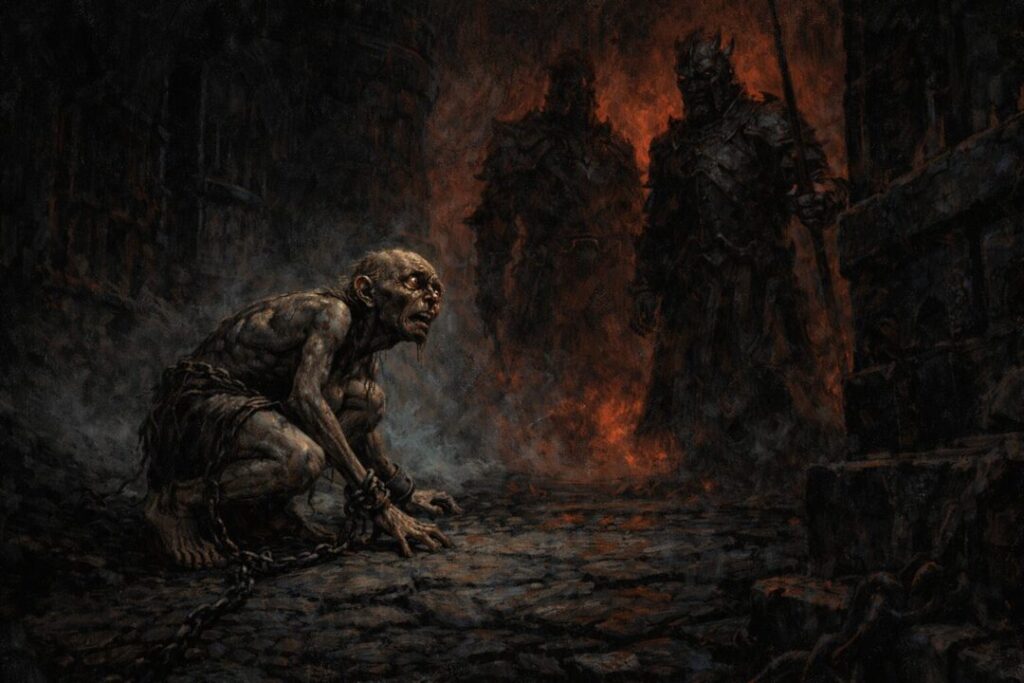
There he is captured and tortured. From him, Sauron learns the names “Baggins” and “Shire.” Gandalf reports this plainly at Rivendell, and the chronology in The Hunt for the Ring shows the consequences that follow from it.
But this does not mean Gollum had failed to value the clue.
It means he lost control of it.
That is the crucial distinction.
Before Mordor, Gollum is a hunter with broken information.
After Mordor, he is also prey.
He is caught between his obsession with the Ring and the will of the Dark Lord who wants it returned. From that point on, Gollum is no longer simply trying to reclaim his Precious. He is moving inside a far larger conflict in which he has almost no agency at all.
That is part of why the question feels deceptively easy. It imagines a straight line of intention. But Gollum’s life after losing the Ring is not a straight line. It is a series of distortions.
Gollum May Have Misled Sauron on Purpose
One of the most revealing details comes from The Hunt for the Ring.
There, Sauron’s search is hindered because Gollum was “not much help.” He both knew little and lied, saying that the land of the halflings was near his own former home by the Gladden Fields.
That detail matters for two reasons.
First, it confirms again that Gollum’s knowledge was incomplete. Even under torment, he could not hand over a neat route to Hobbiton.
Second, it suggests something darkly ironic about him. Gollum hated Sauron and feared him, but he did not want the Ring returned to Sauron either. He wanted it for himself. So even while broken under torture, he was not simply a willing informer.
This is not heroism.
It is possessiveness.
But it means Gollum’s knowledge never became the clean weapon people imagine.
The names were real.
The understanding behind them was not complete.
Aragorn Stopped the Hunt Before It Could Continue
Then comes another overlooked fact.
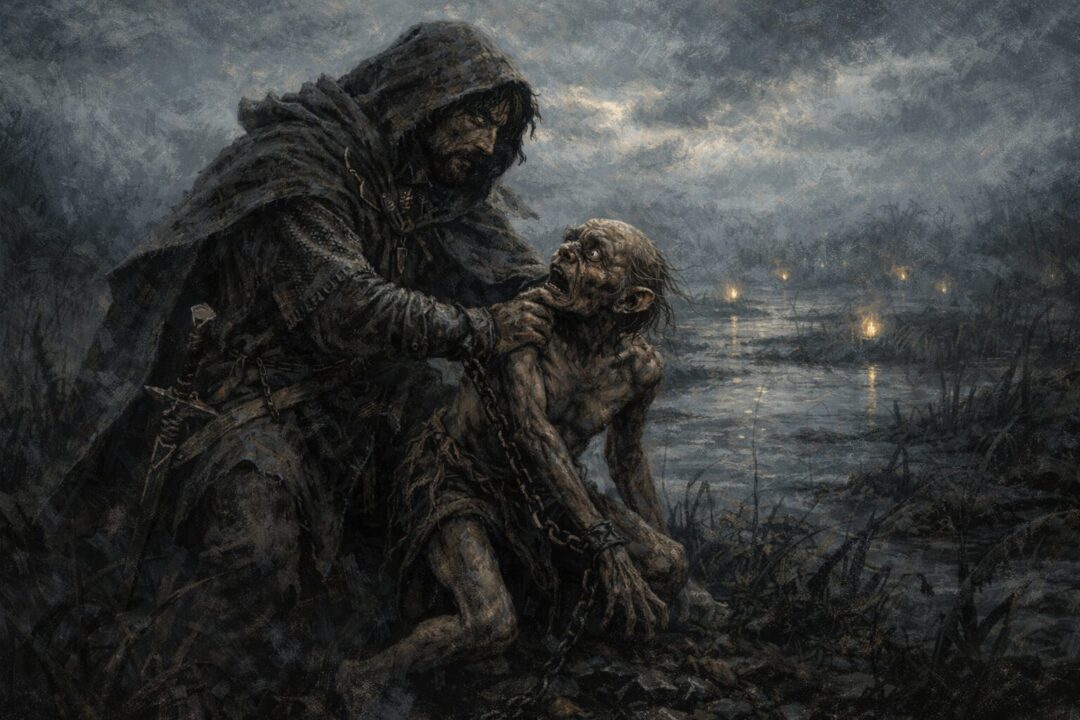
After Sauron releases Gollum, hoping perhaps to use him or at least to watch where he goes, Gollum does not get a free run westward. Aragorn captures him in the Dead Marshes on 1 February 3017 and brings him north to the Woodland Realm.
This effectively interrupts whatever pursuit Gollum might have resumed.
So even if we imagine that he might eventually have turned his steps toward the Shire, he does not get the chance. He is taken, questioned by Gandalf, and then held in Mirkwood. Only after his later escape does he move freely again, and by then the Ring is already on the road.
This is easy to underestimate because Gollum often feels like a solitary, slinking figure outside the main movements of the plot.
But he is not outside them.
He is repeatedly intercepted by them.
Why He Could Follow Frodo But Not Find Bilbo
This leads to the sharpest contrast of all.
Later, Gollum is able to follow the Fellowship and then Frodo with terrifying persistence. So why could he do that, but not find Bilbo earlier?
Because these are not the same kind of pursuit.
Earlier, he is chasing a memory, a thief, and two partial words.
Later, he is near the Ring itself.
That difference is enormous.
By the time he takes up Frodo’s trail, Gollum is not searching for an unknown land in the far West. He is moving through regions where the Ring-bearer has recently passed. He finds the Fellowship in Moria and follows them from there. Eventually Frodo himself becomes the living trail.
In other words, Gollum becomes effective when the hunt changes from abstraction to proximity.
He cannot reliably navigate from rumor to destination.
He can stalk what is already almost within reach.
That distinction fits his whole nature.
He is cunning, patient, and frighteningly persistent at close pursuit.
He is not a broad strategist.
The Deeper Meaning of the Question
So why did Gollum not simply pursue the Ring once he knew “Shire” and “Baggins”?
Because the story never gives him the clean certainty that question assumes.
He had names, but not a usable map.
He had obsession, but not freedom.
He had a goal, but he was pulled aside by darker forces.
Then he was captured, tortured, released, captured again, and confined before the search could become direct.
What looks at first like a gap in the plot is actually a very Tolkienian pattern.
Knowledge is partial.
Will is limited.
And desire does not guarantee the power to reach what it wants.
That pattern is especially fitting for Gollum.
He knows enough to be dangerous, but never enough to be secure.
He wants the Ring utterly, but his wanting does not master events.
Again and again, he is moved by larger powers while believing only in his own hunger.
That is why the question opens into something deeper than a travel problem.
It reveals the tragedy of Gollum himself.
He is always near the Ring in spirit.
He is often near it in body.
But he can almost never move toward it in a straight line.
And in Middle-earth, that is often how evil works.
It narrows the mind until obsession feels like certainty.
But certainty is not wisdom.
And hunger is not a road.
Sources & Notes
- J.R.R. Tolkien, The Hobbit, Chapter 5, “Riddles in the Dark” — shows Gollum learning the name Baggins, losing the Ring, and beginning the hatred that drives his later hunt.
- J.R.R. Tolkien, The Lord of the Rings, Book I, Chapter 2, “The Shadow of the Past” — Gandalf recounts Sméagol’s origins, Gollum leaving the mountains, and his pursuit of Bilbo’s trail.
- J.R.R. Tolkien, The Lord of the Rings, Book II, Chapter 2, “The Council of Elrond” — reports that Sauron learned “Shire” and “Baggins” from Gollum and shows how those scraps became dangerous without giving Gollum a clear road to Hobbiton.
- J.R.R. Tolkien, Unfinished Tales, “The Hunt for the Ring” — explains that Gollum knew little, lied under questioning, and misled Sauron toward the Gladden Fields rather than the true Shire.
- J.R.R. Tolkien, The Lord of the Rings, Appendix B, “The Tale of Years” — dates Aragorn’s capture of Gollum in the Dead Marshes in 3017, interrupting any renewed westward search before the Ring left the Shire.