When readers think of Gollum, they usually think first of the end result.
A pale thing under the mountains.
A voice split against itself.
A creature so bent by hunger, secrecy, and obsession that he seems to belong less to the world of Hobbits than to some darker corner of Middle-earth entirely.
That is why the question keeps returning:
Was Gollum always a Hobbit?
The lore-supported answer is more precise than many people expect.
Yes, Sméagol begins as one of a little people “of hobbit-kind,” closely tied to the Stoors, the river-loving branch of Hobbits. But the texts phrase this carefully, and that caution matters. They do not present Gollum as a separate race that later became hobbit-like. They present him as someone near enough to Hobbit-kind that the connection is essential to understanding what he became.
And that is what makes his story so disturbing.
If Gollum began far away from Hobbits, he would be easier to contain as a curiosity.
But he did not begin far away.
He began near enough to them that Frodo is forced to see the resemblance.
What the texts actually say about Sméagol’s origin
The most important passage comes when Gandalf explains Gollum’s past to Frodo in “The Shadow of the Past.”
He does not say that Sméagol was an Orc, a goblin, or some unknown being twisted into human shape. He traces him back to “a clever-handed and quiet-footed little people,” and says they were “of hobbit-kind,” akin to the ancestors of the Stoors. That is already enough to rule out the idea that Gollum belonged to some wholly separate race.
Other reference material makes the connection even plainer.
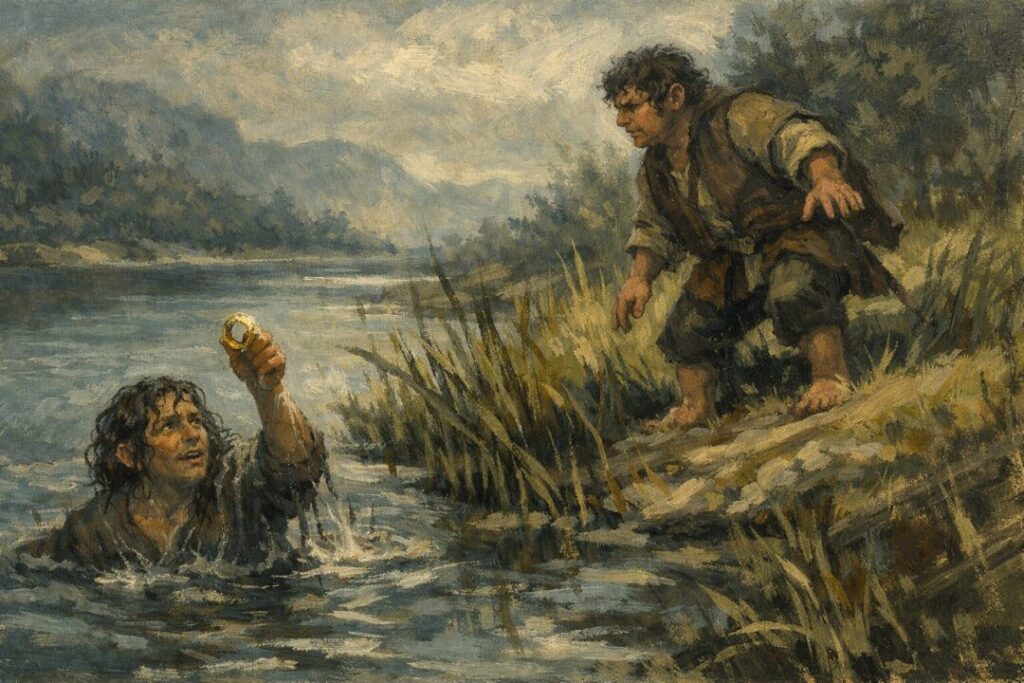
Tolkien Gateway’s summaries of the primary material identify Sméagol as a Stoorish Hobbit, and the chronology in Appendix B places Déagol explicitly as “the Stoor” who found the Ring and was murdered by Sméagol. The Stoors themselves are one of the three branches of Hobbit-kind, alongside Harfoots and Fallohides.
So in the internal history of Middle-earth, the broad answer is yes.
Sméagol begins as Hobbit-kind.
But the wording is still interestingly cautious.
Gandalf says “I guess they were of hobbit-kind,” not with the tone of someone reading from perfect records, but of someone reconstructing a half-lost branch of a small and obscure people. That is important because Sméagol’s folk lived long before the War of the Ring, outside the Shire, and beyond the tidy self-understanding of later Hobbits. The uncertainty is about exact classification and historical distance, not about whether Sméagol was secretly some other species.
Why the text does not make the answer feel simple
Part of the confusion comes from what readers meet first.
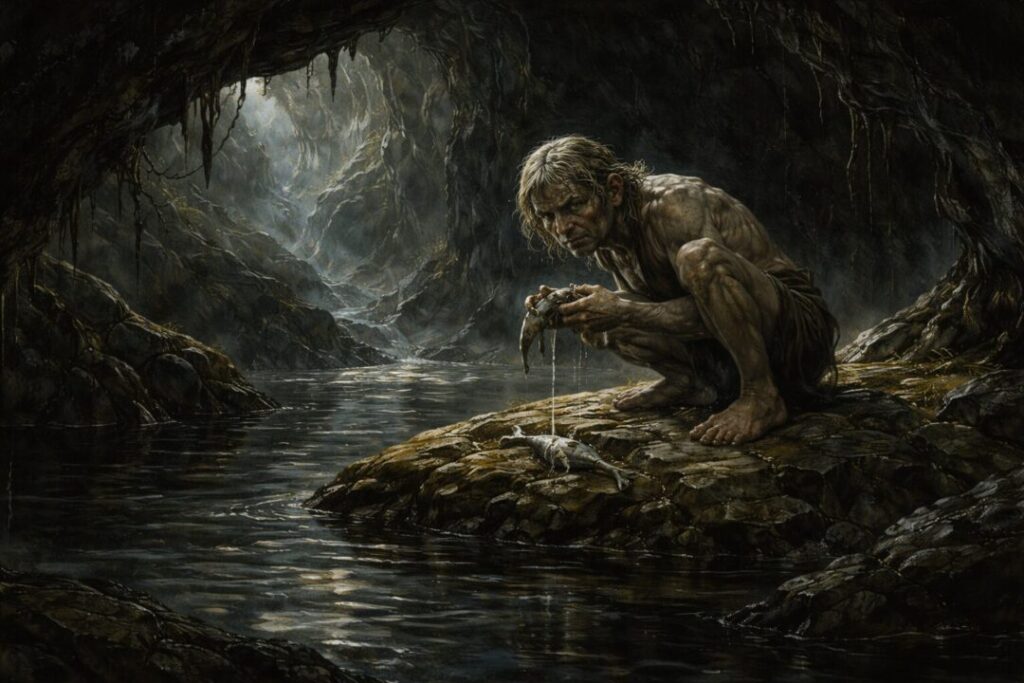
By the time Bilbo encounters Gollum beneath the Misty Mountains, he does not feel like a Hobbit at all. He is already centuries removed from ordinary life. He lives in darkness. He eats raw fish. He clings to the Ring with a possessiveness that has almost hollowed him out.
Everything about him encourages distance.
But the text insists on collapsing that distance.
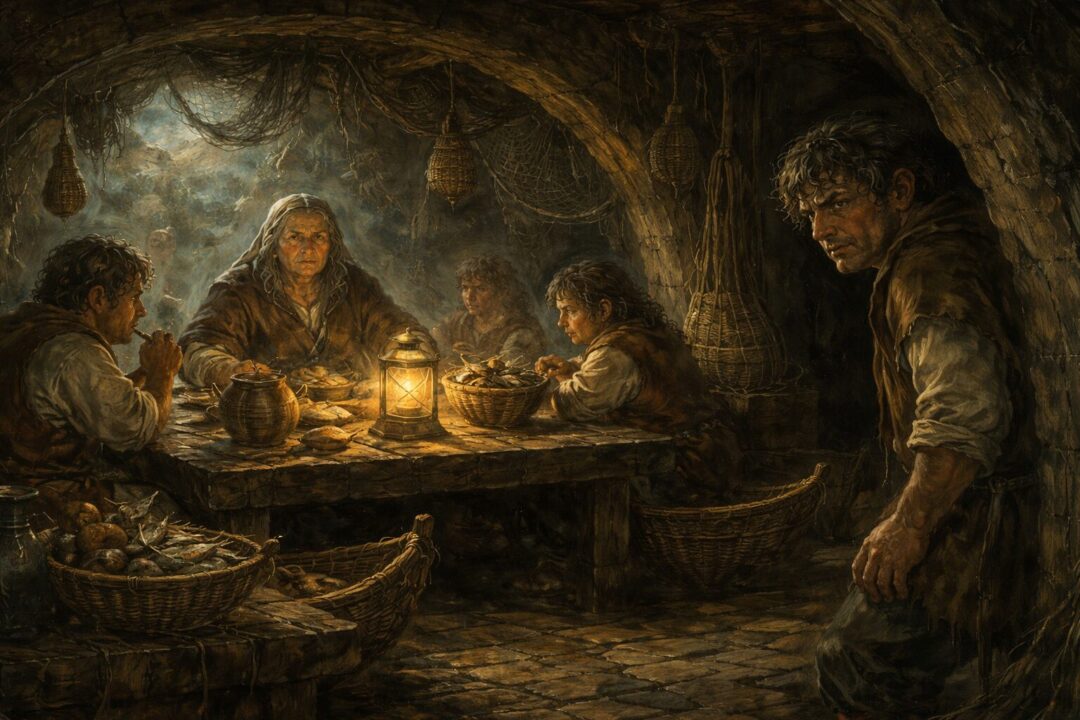
Sméagol had a family.
He had a grandmother.
He had birthday customs recognizable enough that the murder of Déagol is framed around the giving of a present.
He came from a settled little people by the river, not from some abyss outside history.
That is what gives the story its sting.
Gollum is not terrifying because he is alien.
He is terrifying because he is not alien enough.
The story wants readers, and Frodo most of all, to recognize that the Ring did not seize some already monstrous being. It seized someone small, local, petty, social, and morally limited in ways that belong very much to the ordinary world.
Sméagol and the Stoors
To understand why Sméagol feels both Hobbit and not quite Shire-Hobbit, the Stoors matter.
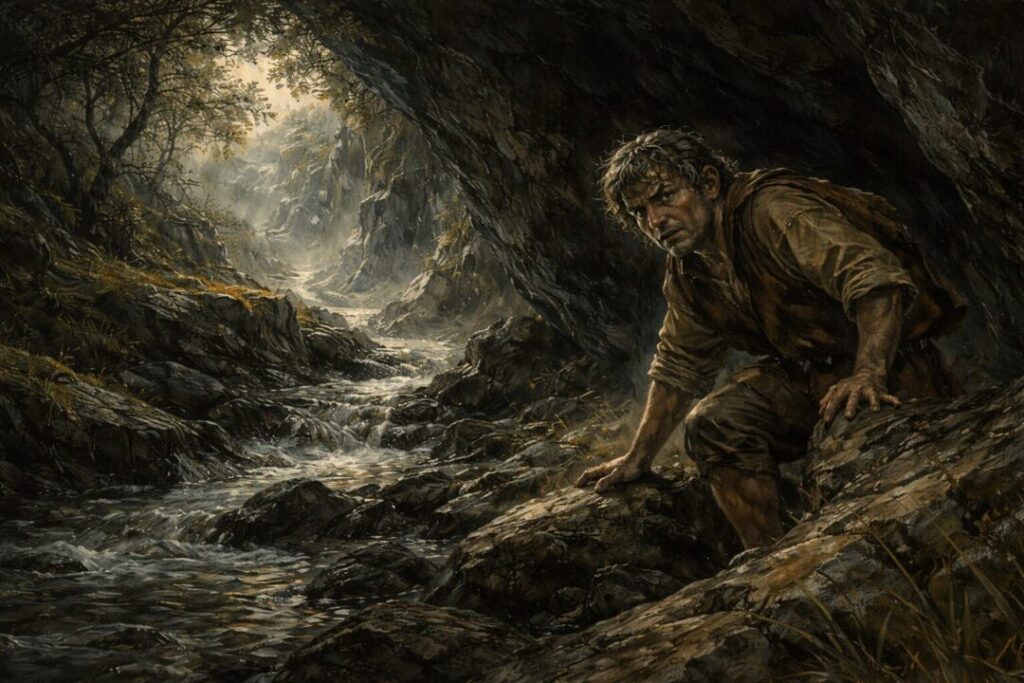
The Stoors were the broadest and heaviest branch of Hobbit-kind, more given to riversides and flat lands than the other kinds. They lived in the Vales of Anduin before many Hobbits moved westward, and later some crossed into Eriador. Their habits already help explain the details Gandalf notices in Sméagol’s people: boats of reeds, fondness for water, and a life shaped by the river.
That means Sméagol is not simply a Shire Hobbit with a strange accent or unusual habits.
He comes from an older and more remote offshoot of the same broader people.
This is one reason readers sometimes hesitate. When people hear “Hobbit,” they often imagine only the late Third Age Shire. But the Shire is not the whole of Hobbit history. Sméagol belongs to an older branch in a different land, with customs and circumstances that make him feel unfamiliar without placing him outside Hobbit-kind altogether.
That distance is cultural and historical.
It is not a sign that he was never a Hobbit at all.
Why Gollum seems less like a Hobbit than he really is
The answer, of course, is the Ring.
Sméagol’s transformation is not described as a change into another race. It is the long corruption of body and mind under the influence of the One Ring, sharpened by murder, secrecy, exile, and centuries of isolation under the mountains. Reference summaries based on the primary texts consistently describe the Ring as prolonging his life and twisting him physically and mentally, while cave-life deepened the change.
That distinction matters.
Gollum is not what he is because he was born other.
He is what he is because he has been worn down for nearly five centuries by possession of the Ring and by the life that followed from that first crime.
This is why the resemblance flashes back at certain moments.
Frodo can still feel pity for him.
Sam, though harsher, still recognizes something miserable rather than wholly bestial.
And in one of the most haunting moments in Ithilien, Gollum in sleep briefly appears “like an old starved pitiable thing,” with the shadow of Sméagol still somehow visible beneath the ruin. That moment only works because the story has never fully abandoned his original nature. The monster and the Hobbit are not two unrelated beings. One is the wreck of the other.
The wording problem: why “hobbit-kind” instead of simply “Hobbit”?
This is where the question becomes more interesting than a simple yes-or-no.
The texts often speak with just enough caution to leave readers wondering whether Sméagol was “really” a Hobbit. But that caution seems tied less to doubt about his nature than to the realities of history, language, and lost records.
A later note associated with “The Hunt for the Ring” says Gollum would not have used the word “Hobbit” himself because it was colloquial and not universal. That does not mean he belonged to another people. It suggests instead that names for small peoples were local, variable, and historically messy.
That detail helps explain a great deal.
“Sméagol was a Hobbit” is basically true in the broad sense readers mean.
But the legendarium is often more exact than that.
He was of hobbit-kind, tied to the Stoors, from a branch outside the later Shire-centered identity most readers picture first.
So the careful phrasing is not a contradiction.
It is the world feeling larger than the labels readers prefer to use.
Was he always Gollum in any moral sense?
This is the darker part of the question.
If Sméagol was Hobbit-kind, then readers are pushed toward a second question almost immediately: how much of Gollum was always there?
The texts do not support the idea that the Ring manufactured every element of his fall out of nothing. Sméagol commits murder almost at once. He shows envy, possessiveness, and a willingness to rationalize evil from the beginning. After taking the Ring, he quickly uses it for spying and malice.
But the texts also do not reduce him to a creature who was simply evil all along.
That would flatten the tragedy.
Sméagol had a home, kin, and social life before the Ring consumed him. He was capable of memory, fear, dependence, and even a fractured responsiveness to pity. Frodo’s treatment of him matters precisely because some part of him remains reachable, however unstable and damaged. The story never asks readers to call him innocent. It does ask them not to pretend he was born irredeemable.
So no, he was not always “Gollum” in the full sense the later name carries.
He was Sméagol first.
And that is more tragic than if he had begun as a cave-monster.
The answer the story seems to want us to keep in view
So was Gollum always a Hobbit?
In the internal history of Middle-earth, the answer is yes in substance: Sméagol comes from Hobbit-kind and is closely associated with the Stoor branch. The surviving lore does not present him as another race that merely resembled Hobbits.
But the question becomes more revealing when asked a little differently.
Not “Was he technically a Hobbit?”
But: why does the story work so hard to remind us that he was?
Because once that is admitted, Gollum is no longer just a grotesque from the dark.
He becomes a vision of what the Ring can do to someone uncomfortably close to Bilbo and Frodo themselves.
Smallness does not save him.
Ordinariness does not save him.
Even being of the same broad people as the heroes does not save him.
And that may be the real reason his origin matters so much.
Gollum is not the story’s alien shadow.
He is its near shadow.
Which is far more disturbing.
Sources & Notes
- J.R.R. Tolkien, The Lord of the Rings, Book I, Chapter 2, “The Shadow of the Past” — Gandalf traces Sméagol to a quiet, clever-handed little people “of hobbit-kind,” near the fathers of the Stoors, and recounts Déagol’s murder and the Ring’s early corruption.
- J.R.R. Tolkien, The Lord of the Rings, Prologue, “Concerning Hobbits” — the Stoors are one of the three Hobbit branches, associated with rivers, boats, and the lands near the Gladden Fields.
- J.R.R. Tolkien, The Lord of the Rings, Appendix B, “The Tale of Years” — the entry for 2463 names Déagol as “the Stoor” who found the One Ring and was murdered by Sméagol.
- J.R.R. Tolkien, The Hobbit, Chapter 5, “Riddles in the Dark” — Bilbo’s first encounter with Gollum shows the cave-dwelling, fish-eating figure centuries after the Ring has separated him from ordinary hobbit-like life.
- J.R.R. Tolkien, The Lord of the Rings, Book IV, Chapter 8, “The Stairs of Cirith Ungol” — Sam’s glimpse of sleeping Gollum as an old, starved, pitiable creature supports the article’s point that Sméagol remains visible beneath Gollum’s ruin.
- J.R.R. Tolkien, Unfinished Tales, “The Hunt for the Ring” — Tolkien’s notes on Gollum and the Ringwraiths help explain the historical and linguistic caution around “Hobbit” as a label rather than making Sméagol a different kind of being.