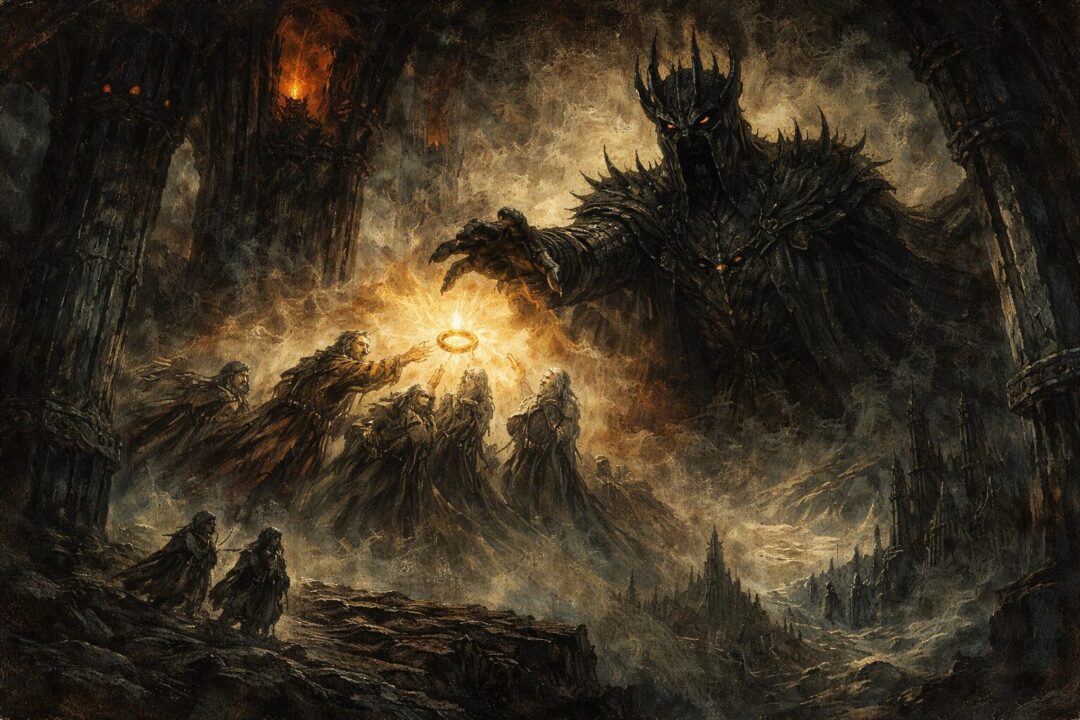
One of the most revealing things about Sauron is that he does not merely fail to stop the destruction of the Ring.
He fails to imagine the central intention behind it.
He understands that his enemies may hide the Ring.
He understands that they may seek to keep it from him.
He understands, above all, that someone mighty may try to claim it and use it against him.
But he does not seriously account for the possibility that anyone in possession of the One Ring would choose its unmaking over its power.
At first glance, this looks like simple arrogance.
It is that.
But it is also something more precise. Sauron’s error is not just pride in his own strength. It is a failure to understand renunciation. The Ring was made as an instrument of domination, and Sauron assumes that all serious minds will ultimately respond to it in the same way: by desiring mastery.
That assumption drives much of the final movement of The Lord of the Rings.
And disturbingly, the story suggests that it was not wholly irrational.
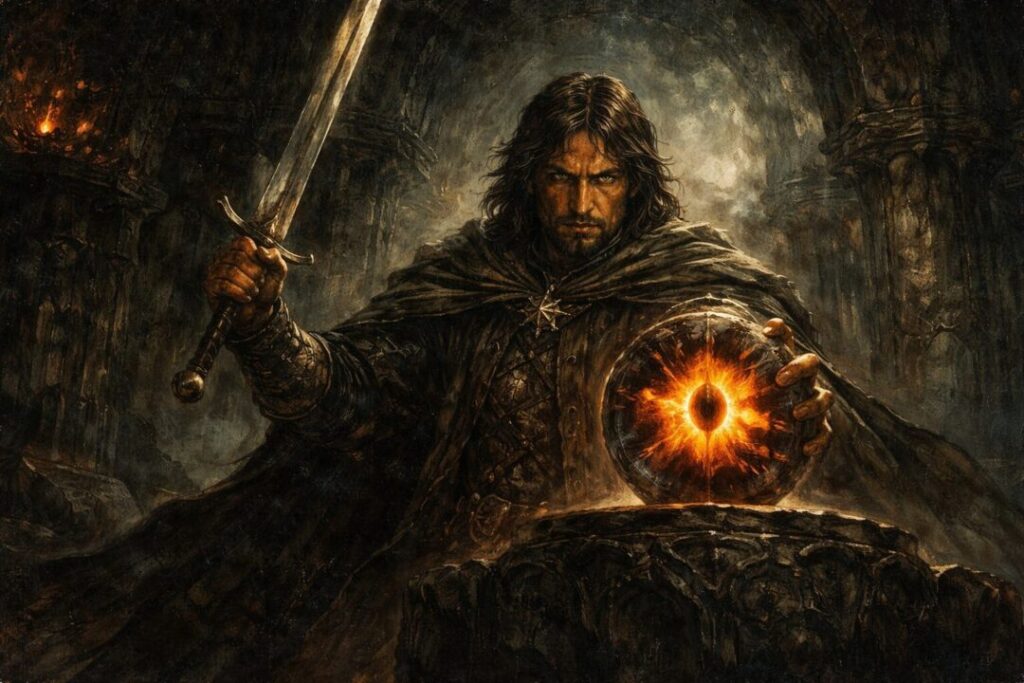
The Ring Was Made to Be Desired
The One Ring is not a neutral object that merely happens to be dangerous.
It was made by Sauron for a purpose. It is bound up with his own native power and designed to rule the other Rings and dominate the wills of others. From the beginning, it is an instrument of command.
That matters, because Sauron’s entire political imagination is built around power seeking power.
He seduces the Elven-smiths through instruction and hidden control.
He corrupts Númenor through ambition and fear.
He ensnares Saruman through pride and the desire to direct events rather than submit to limits.
He rules the Nazgûl through Rings that turn greatness into slavery.
In other words, Sauron does not live in a moral universe where power is refused.
He lives in one where power is contested.
So when the Ring is lost and later found again, his instinct is not to ask, “Who would destroy it?”
His instinct is to ask, “Who will wield it first?”
That is why Gandalf and Elrond treat the idea of using the Ring as ruinous even before the plan of destruction is agreed upon. The Ring can be used only by someone already great in power, but for such people the danger is even worse: the desire for it corrupts the heart.
Sauron counts on that.
And the history of Middle-earth gives him reason to.
His Enemies Keep Proving His Point
The great irony is that nearly everyone important in the story confirms Sauron’s view of the Ring’s appeal.
Boromir sees it as a weapon.
Saruman imagines power can be managed and redirected.
Denethor, in his own way, cannot accept that destruction is the only true answer.
Even the wise must actively refuse it rather than casually ignore it. Gandalf recoils from the suggestion that he should take it. Galadriel imagines herself made terrible and beautiful with it before she rejects that road.
This is crucial.
Sauron is not dealing with an object that people naturally want to discard. He is dealing with the one thing in Middle-earth most calculated to awaken the desire to save, rule, order, avenge, protect, and dominate all at once.
That is why a direct military victory over Sauron by means of the Ring is repeatedly treated as conceivable in principle, even though it would end in another tyranny. In the second-edition foreword, the alternative outcome is described plainly: if the story had followed that sort of pattern, the Ring would have been seized and used against Sauron, who would not have been destroyed but enslaved.
That line is remarkably revealing.
It tells us that Sauron’s expectation was not some random delusion. It fits the logic of the Ring itself.
The normal outcome of finding such a weapon is not self-denial.
It is seizure.
Why Sauron Misread the Quest
And yet the Quest of the Ring is real.
Elrond’s Council does choose destruction.
Frodo accepts the burden.
Sam helps carry it through.
Aragorn, Gandalf, and the Captains of the West build their final strategy around preserving that chance.
So why does Sauron still fail to see it?
Because he understands the Ring better than he understands humility.
He knows what the Ring does to ambition.
He does not understand a moral choice grounded in pity, self-limitation, and refusal of domination.
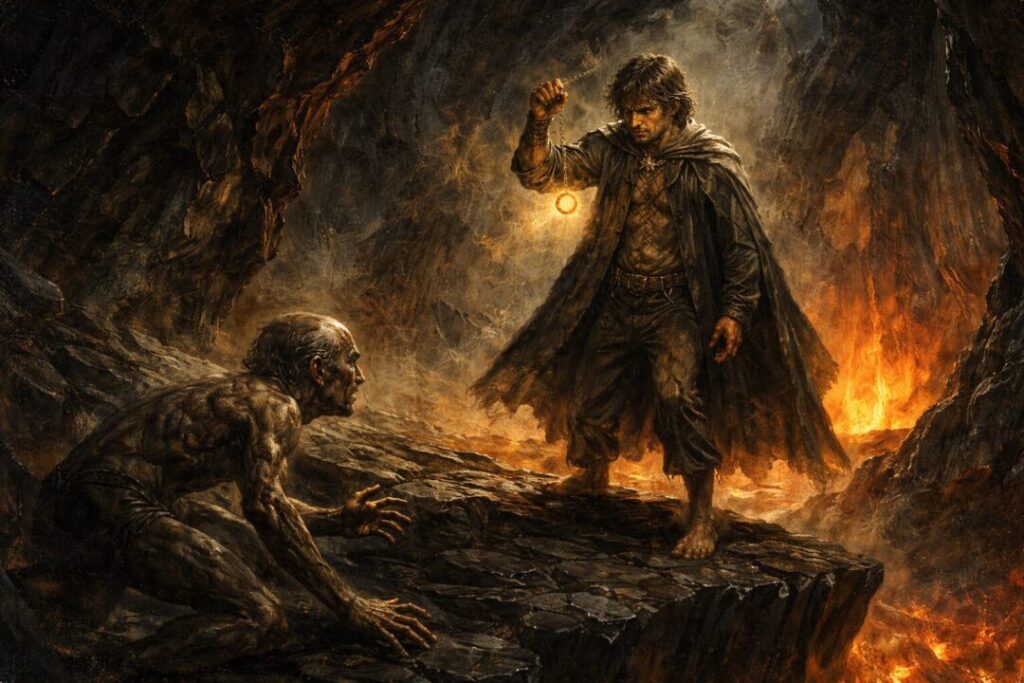
This becomes especially important after the encounters with the palantír.
First Pippin appears in the Orthanc-stone, and Sauron concludes that the Ring-bearer or one closely connected to the Ring is in Saruman’s sphere.
Then Aragorn reveals himself, shows the sword of Elendil reforged, and openly challenges him. Sauron interprets this through the only framework that makes sense to him: a bold claimant has taken the Ring and is moving too soon out of pride.
This is why the march on the Black Gate works as a feint.
The Captains do not truly threaten Sauron by force of arms.
They threaten him by appearing to confirm his deepest assumption.
Someone has the Ring.
Someone intends to use it.
That is the possibility he fears.
Not its destruction.
The Disturbing Part: Sauron Was Half Right
There is, however, a darker twist.
Sauron is wrong about what his enemies are trying to do.
But he is not entirely wrong about what the Ring does to its bearer.
A late letter explains with unusual bluntness that Frodo, at the Cracks of Doom, could not voluntarily destroy the Ring. After long possession, progressive torment, exhaustion, and the Ring’s power reaching its maximum at the place of its making, the final renunciation was beyond him. Frodo had done what he could, but the last act was no longer possible by sheer will.
This means Sauron’s confidence was not mere vanity.
He had correctly judged one terrible thing: possession of the Ring tends not toward destruction, but toward possession.
Even Frodo does not cast it away in the end.
He claims it.
That does not make Frodo corrupt in the simple sense, nor does it undo the heroism of the journey. The same letter insists that this is not a moral failure. It is the point at which the burden has become more than any creature could bear by ordinary strength.
So when we ask why Sauron thought no one would want to destroy the Ring, the answer has to be sharpened.
He was wrong to assume no one would attempt the quest.
But he was chillingly close to the truth in believing that no one who actually reached the end with the Ring in hand could simply choose its destruction unaided.
What Sauron Could Never See
And this is where his blindness becomes final.
Sauron can understand force.
He can understand fear.
He can understand calculated boldness, rival claimants, prideful kings, and corrupted wisdom.
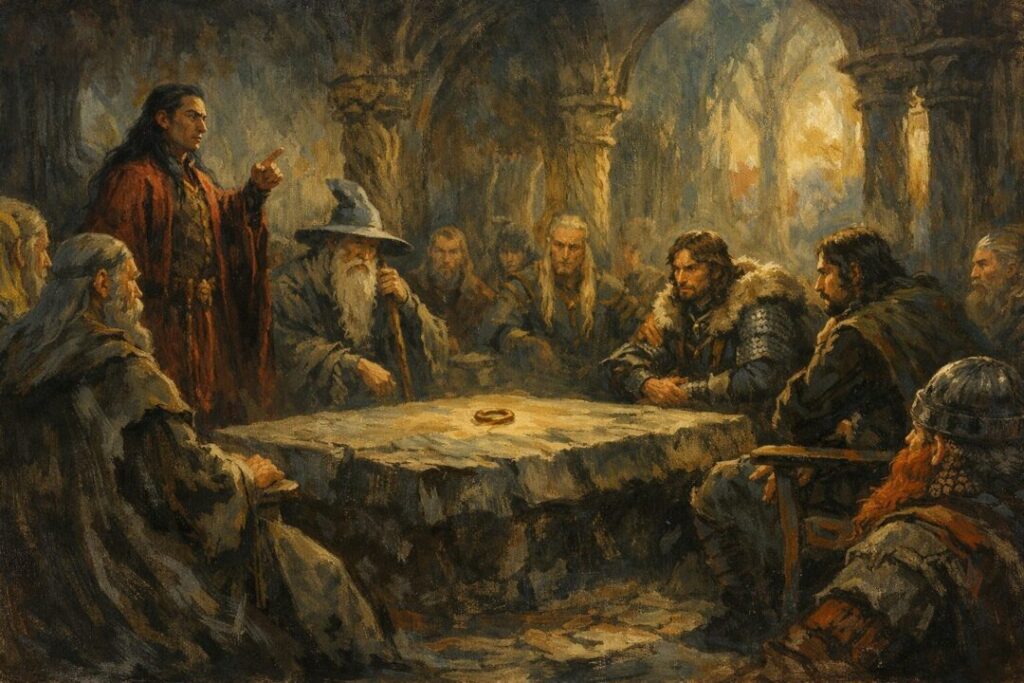
He cannot understand the chain of mercy that has followed the Ring from the beginning.
Bilbo spares Gollum.
Frodo spares Gollum.
Sam, for a brief moment, is moved by pity as well.
Those acts do not look strategic.
They do not look powerful.
They do not look like the kind of things that overthrow Dark Lords.
And yet the destruction of the Ring finally comes through that very pattern.
Not through conquest.
Not through mastery.
Not through a stronger will outmatching the Ring at the brink of the fire.
It comes through the long consequences of pity, endurance, and a providential turn that Sauron’s mind is incapable of forecasting. Frodo brings the Ring to the only place where it can be unmade, but Gollum’s seizure of it and fall complete what the bearer himself can no longer do.
This is the deepest reason Sauron loses.
He knows how evil behaves.
He knows how ambition behaves.
He even knows, in a grim sense, how weakness behaves under the pressure of the Ring.
But he does not know how mercy works.
Why This Matters
Sauron’s failure is often described as arrogance, and that is true.
But arrogance alone is too simple.
His real blindness is moral and imaginative. He assumes that all serious actors are ultimately versions of himself: that given enough power, they will seek domination; that given the Ring, they will use it; that no one would embrace diminishment where command is available.
The story answers him in a subtle way.
It does not claim that destroying the Ring is easy.
It does not even claim that a Ring-bearer can finally do it by unaided will.
Instead, it shows that the road to the Ring’s end is built out of refusals Sauron never respected: the refusal to seize, the refusal to rule, the refusal to answer evil on its own terms.
That is why he watches kings and captains and misses the true danger.
He understands the hand that would close around the Ring.
He never really understands the heart that would carry it toward fire knowing it should not be kept.
And in the end, that failure of vision is more fatal than any army at his gate.
Sources & Notes
- J.R.R. Tolkien, The Silmarillion, “Of the Rings of Power and the Third Age” — Sauron forges the One Ring to rule the other Rings and dominate their bearers.
- J.R.R. Tolkien, The Lord of the Rings, Book II, Chapter 2, “The Council of Elrond” — the Wise reject using the Ring and settle on its destruction as the only answer.
- J.R.R. Tolkien, The Lord of the Rings, Book V, Chapter 10, “The Black Gate Opens” — the Captains’ feint works because Sauron expects a rival claimant, not renunciation.
- J.R.R. Tolkien, The Lord of the Rings, Book VI, Chapter 3, “Mount Doom” — Frodo claims the Ring at the brink, and Gollum’s fall brings about its destruction.
- J.R.R. Tolkien, The Letters of J.R.R. Tolkien, Letter 131 — Tolkien frames Sauron’s evil around order, control, and domination, matching the Ring’s purpose.
- J.R.R. Tolkien, The Letters of J.R.R. Tolkien, Letter 246 — Tolkien explains why Frodo could not voluntarily destroy the Ring at the final moment and treats this with moral nuance.